

TL;DR:
- Outdated online listings cause lost trust, revenue, and lower search rankings for local businesses.
- Accurate, consistent NAP data enhances visibility, customer confidence, and online reputation.
- Implementing a proactive, automated listing management system ensures ongoing accuracy and holds competitive advantage.
Over 70% of consumers will lose trust in a business with outdated or incorrect online information. That single statistic should stop any small business owner in their tracks. Wrong hours, a disconnected phone number, or an old address are not minor oversights. They are active barriers between you and paying customers. In this article, we break down exactly how stale listings cost you real revenue, what accurate listings do for your search visibility, and how to build a simple system that keeps your business information current across every platform that matters.
Table of Contents
- The true cost of outdated business listings
- How up-to-date listings supercharge your SEO and discoverability
- Boosting credibility and trust with every update
- Building a simple, repeatable process for updating your listings
- When to update: Recognizing the moments that matter most
- Beyond basics: Why businesses can't afford 'set it and forget it'
- How our solutions make business listing updates effortless
- Frequently asked questions
Key Takeaways
| Point | Details |
|---|---|
| Builds trust | Accurate listings make customers more likely to choose your business and leave positive reviews. |
| Boosts search ranking | Updating your details regularly keeps you at the top of local, AI, and voice searches. |
| Prevents lost sales | Correct hours and contacts ensure new clients find you when they need you. |
| Easy to automate | AI tools and digital dashboards streamline listing management for small businesses. |
The true cost of outdated business listings
Think about the last time you searched for a local business, drove to the address, and found it closed or relocated. That frustration is exactly what your potential customers feel when your listings are wrong. And unlike a one-time bad experience, that frustration turns into a permanent lost customer.
The financial damage is real. When someone calls a disconnected number or shows up at the wrong location, they do not give you a second chance. They go to your competitor. Multiply that across dozens of monthly searches and you start to see how quickly inaccurate data erodes your revenue.
Search engines feel the same way. Businesses with inaccurate listings appear less frequently in search results, which means fewer impressions, fewer clicks, and fewer calls. Google and other search engines cross-reference your business data across multiple sources. When the data conflicts, your ranking drops.
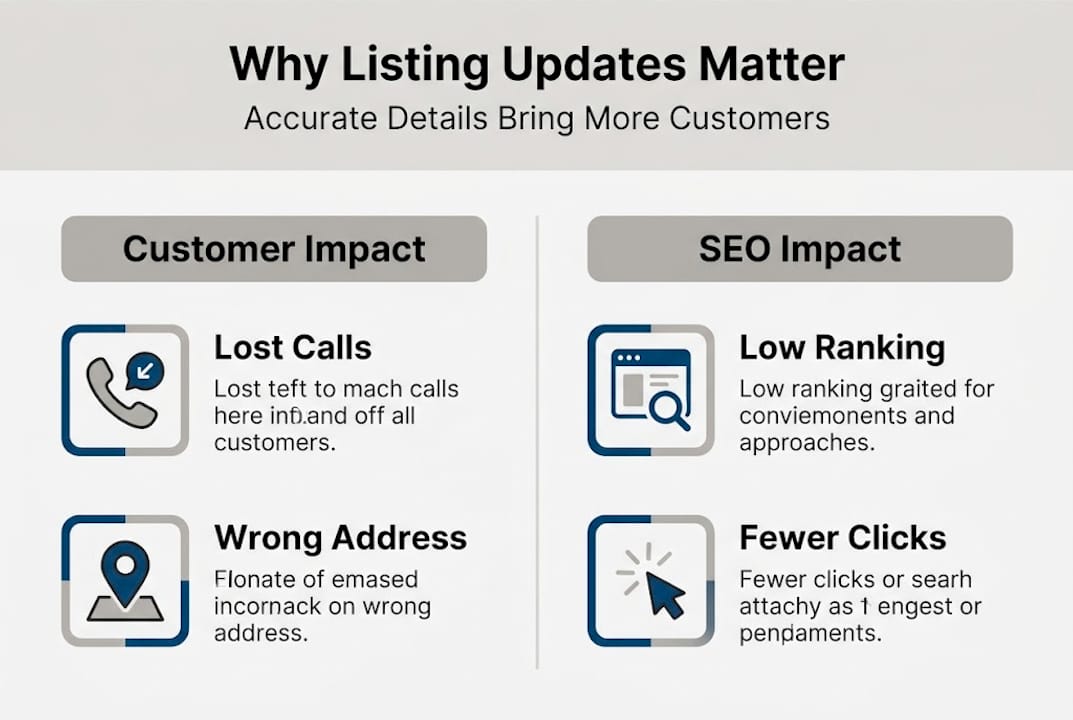
Here is a quick look at how listing errors affect your business:
| Listing Error | Customer Impact | SEO Impact |
|---|---|---|
| Wrong phone number | Lost calls, zero contact | Reduced trust signals |
| Outdated address | Wasted trips, angry reviews | Lower map pack ranking |
| Incorrect hours | Frustrated walk-ins | Negative engagement signals |
| Missing categories | Invisible to relevant searches | Lost keyword relevance |
The ripple effects go beyond just one bad interaction. Customers who feel misled often leave negative reviews, which compounds the damage. The benefits of accurate local numbers extend well beyond simple contact. A local, working phone number signals legitimacy and builds confidence before a customer even walks through your door.
Key warning signs your listings need immediate attention:
- Multiple versions of your business name across directories
- Phone numbers that ring to voicemail without a callback option
- Hours that do not reflect holidays or seasonal changes
- No photos or severely outdated images
- Missing or inconsistent website URLs
Inconsistent business data is one of the top reasons local businesses lose ranking position. Every conflicting detail is a signal to search engines that your information cannot be trusted.
The good news is that fixing these issues creates a direct path to increasing business views and reclaiming lost traffic. With the risks clear, it is critical to see how updating listings can flip those negatives into business gains.
How up-to-date listings supercharge your SEO and discoverability
Search engines are built on trust. They want to send users to businesses that are reliable, reachable, and relevant. Accurate listings are your way of proving all three at once.
The foundation of local SEO is NAP consistency. NAP stands for Name, Address, and Phone number. When these three details match exactly across Google, Yelp, Facebook, and every directory you are listed in, search engines treat your business as a verified, trustworthy source. When they do not match, even small differences like "St." versus "Street" create confusion in the algorithm.
Local directories with current information lead to top search positions and more incoming calls. This is especially true for voice search and AI-powered assistants like Siri, Alexa, and Google Assistant. These tools pull from structured data sources. If your listing is incomplete or outdated, you simply will not be recommended.

Here is a comparison of what accurate versus inaccurate listings deliver:
| Factor | Accurate Listings | Inaccurate Listings |
|---|---|---|
| Local pack ranking | High | Low or absent |
| Voice search visibility | Strong | Minimal |
| Customer confidence | High | Low |
| Review quality | Better average ratings | More complaints |
Follow these steps to strengthen your search presence through listing updates:
- Claim and verify your Google Business Profile if you have not already done so.
- Audit your NAP data across all directories for exact consistency.
- Add complete business categories, hours, and a keyword-rich description.
- Upload recent, high-quality photos of your location and products.
- Enable messaging and Q&A features to increase engagement signals.
For businesses ready to go further, exploring AI-driven local SEO tips gives you an edge as AI search becomes the dominant discovery method. Pairing that with ranking higher on Google Maps puts your business in front of customers who are ready to act.
Pro Tip: Add structured data markup (schema.org) to your website so search engines can verify your business details directly from your site. This reinforces your listing data and improves your chances of appearing in rich results.
Strategically using local phone numbers for SEO also signals geographic relevance, which matters for location-based searches. With the SEO benefits established, let us explore how frequent updates build lasting trust and boost reputation.
Boosting credibility and trust with every update
Accurate business information does more than help search engines find you. It tells customers that you are organized, professional, and worth their time. Trust is built in small moments, and a correct listing is one of them.
When a customer searches for your business and finds consistent, current details across every platform, it reinforces confidence before they ever interact with you. Conversely, finding conflicting information creates doubt. And doubt kills conversions.
Listing errors are one of the most common triggers for negative reviews. A customer who drove 20 minutes to find your business closed will leave a one-star review. That review then discourages future customers. Consistently updated listings result in fewer complaints and higher ratings, which creates a self-reinforcing cycle of trust and visibility.
Here is what accurate listings protect you from:
- Angry reviews citing wrong hours or location
- Lost leads from disconnected or wrong phone numbers
- Confusion from duplicate or conflicting listings
- Damaged reputation from unmonitored outdated content
- Missed opportunities from incomplete service descriptions
A strong review management strategy works hand in hand with listing accuracy. When your information is correct, customers have fewer reasons to complain and more reasons to praise. That positive feedback loop builds your online reputation steadily over time.
Statistic to note: Businesses that actively manage their listings and reviews see measurably higher customer engagement and repeat visits compared to those that do not.
For a broader look at how all of this connects, the ultimate guide to improving online presence walks through the full picture of local visibility. Additionally, using phone numbers to build trust is a practical detail that many businesses overlook but that customers notice immediately.
Pro Tip: Set a quarterly calendar reminder to audit your listings on Google, Yelp, Facebook, Apple Maps, and Bing Places. A 30-minute check four times a year can prevent months of lost business. Trust gains are powerful, but updates are only effective with a consistent system.
Building a simple, repeatable process for updating your listings
Knowing you need to update your listings is one thing. Having a system that makes it happen reliably is another. Most small business owners update listings reactively, only after something goes wrong. A proactive process changes that entirely.
Start with a master document. List every platform where your business appears along with your login credentials, current NAP data, and the date of your last update. This single document saves hours of confusion when changes need to happen fast.
Next, follow this step-by-step listing update plan:
- Identify all platforms where your business is listed, including Google, Yelp, Facebook, Apple Maps, Bing, and any industry-specific directories.
- Verify that your NAP data matches exactly across all of them.
- Update your hours, services, photos, and descriptions to reflect current reality.
- Set up Google Business Profile alerts to monitor new reviews and questions.
- Use a listing management tool or AI-powered dashboard to automate future checks.
- Assign one team member as the listings owner so updates never fall through the cracks.
Routine listing management can be streamlined with digital dashboards and AI tools that push updates to multiple directories simultaneously. This eliminates the manual work and reduces the risk of missing a platform.
For businesses focused on local dominance, optimizing your Google Business Profile is the highest-leverage action you can take. Google remains the primary discovery channel for local searches, and a fully optimized profile directly impacts your map pack ranking.
Pro Tip: Document your update policy in writing. Include which team member is responsible, how often audits happen, and what triggers an immediate update. A written policy turns a good intention into a reliable habit.
When to update: Recognizing the moments that matter most
Not every listing update is routine. Some business changes require you to act within hours, not weeks. Knowing the difference protects your reputation and keeps customers from getting the wrong information.
Major changes in business details require prompt updates to all listings to avoid confusion and lost leads. The longer inaccurate information stays live, the more damage it does.
Here are the business events that should trigger an immediate update:
- Change of address or phone number
- New or modified business hours, including holiday schedules
- Addition or removal of services or products
- Temporary closures or emergency alerts
- Ownership or branding changes
| Change Type | Update Priority | Platforms to Update First |
|---|---|---|
| Address change | Immediate | Google, Yelp, Facebook |
| Phone number change | Immediate | All directories |
| Holiday hours | 1 week in advance | Google, Apple Maps |
| New service added | Within 3 days | Google, website, Yelp |
| Temporary closure | Same day | Google, Facebook |
Staying ahead of these moments also gives you a competitive edge. When a competitor is slow to update and you are not, customers find you first. Pair this awareness with owning the search box and you position your business to capture demand the moment it appears. Use tools that monitor your listings for discrepancies and alert you when something looks off, so you can act before customers notice. For deeper insight into maintaining business identity online, consistent contact details are a cornerstone of that effort.
Beyond basics: Why businesses can't afford 'set it and forget it'
Here is an uncomfortable truth we see repeatedly with new clients: most businesses set up their listings once and never revisit them. They treat it as a one-time task rather than an ongoing responsibility. That mindset is costly.
AI search is evolving fast. Platforms like Google, ChatGPT, and voice assistants are now pulling real-time data to answer local queries. If your listing has not been touched in two years, you are invisible to these systems. Worse, your competitors who do maintain their listings are getting recommended in your place.
The businesses that win in local search treat their listings as a living asset. They update regularly, respond to reviews, and monitor for errors. That continuous attention compounds over time. It is not glamorous work, but it is the kind of disciplined effort that separates visible businesses from forgotten ones. Integrating AI integration strategies into your listing management process is no longer optional. It is how you stay competitive as search behavior continues to shift.
How our solutions make business listing updates effortless
Keeping every listing accurate across dozens of platforms is a real challenge for busy business owners. That is exactly where we come in.

At Digital Marketing All, our managed listing and review management platform handles the heavy lifting for you. Our AI-powered tools push updates across directories instantly, monitor for errors, and alert you when something needs attention. Whether you need help with Google, or are focused on managing your Yelp presence, our expert team ensures your business information is always accurate, complete, and working in your favor. Ready to stop losing customers to outdated listings? Connect with our team today and take the first step toward consistent, effortless visibility.
Frequently asked questions
How often should business listings be updated?
Update your listings whenever you change hours, location, or services, and audit all details at least every quarter. Routine listing management can be streamlined with digital dashboards and AI tools to make this process easier.
What platforms matter most for business listings?
Focus on Google, Yelp, Facebook, and top local directories for maximum customer visibility. Major changes in business details should be reflected on these platforms first to avoid confusion and lost leads.
How do updated listings improve search engine ranking?
Accurate, current listings help you appear higher in local search results and on AI-driven platforms like voice assistants. Businesses with inaccurate listings appear less frequently in search results, directly hurting your visibility and call volume.
Can AI tools automate business listing management?
Yes, AI-powered tools can update your details across directories and send alerts for changes or errors. Routine listing management is far more efficient when supported by automated dashboards that monitor all your platforms simultaneously.