

TL;DR:
- Prioritizing quality traffic improves conversion rates and enhances search engine rankings by attracting visitors with genuine intent.
- Focusing on behavioral and commercial engagement metrics helps identify and target high-value audiences effectively.
Quality traffic is defined as website visitors who match your target audience, arrive with genuine intent, and are likely to engage or convert. Chasing raw visitor numbers is one of the most common and costly mistakes in digital marketing. A site with 10,000 monthly visitors who bounce immediately delivers less business value than one with 2,000 visitors who read, click, and buy. Understanding why prioritize quality traffic matters is the foundation of any marketing strategy that actually produces revenue. Digitalmarketingall works with business owners and marketers every day who have learned this lesson the hard way, and the data consistently points in one direction: quality wins.
Why prioritize quality traffic over raw visitor numbers?
Quality traffic is the single strongest predictor of conversion rate performance. Visitor volume tells you how many people showed up. Engagement metrics tell you whether they cared. Those are two very different things, and confusing them is where most marketing budgets go wrong.
The importance of quality traffic becomes clear when you look at what actually drives revenue. A visitor who spends four minutes reading your service page, clicks to your pricing section, and fills out a contact form is worth more than 50 visitors who land and leave in under ten seconds. Search engines have recognized this reality too. User engagement signals are now critical ranking factors, meaning quality traffic improves your SEO standing at the same time it improves your sales pipeline.
Marketers who focus on volume metrics alone often report a frustrating pattern: traffic goes up, but leads and revenue stay flat. That gap is the cost of low-quality visitors. Shifting focus to audience alignment and intent closes that gap faster than any traffic volume campaign.
What metrics best measure quality traffic beyond raw volume?
Measuring traffic quality requires moving past total unique visitors and into behavioral data. The metrics that matter are the ones that reveal whether a visitor found your content relevant and took a meaningful next step.
Effective traffic quality monitoring centers on four core engagement signals: time-to-first-action, pages per session, scroll depth, and return visits. Each one reveals a different dimension of audience fit. Time-to-first-action shows how quickly a visitor engages with your content after landing. Pages per session indicates whether they explored beyond the entry point. Scroll depth confirms they actually read what you published. Return visits prove they found enough value to come back.
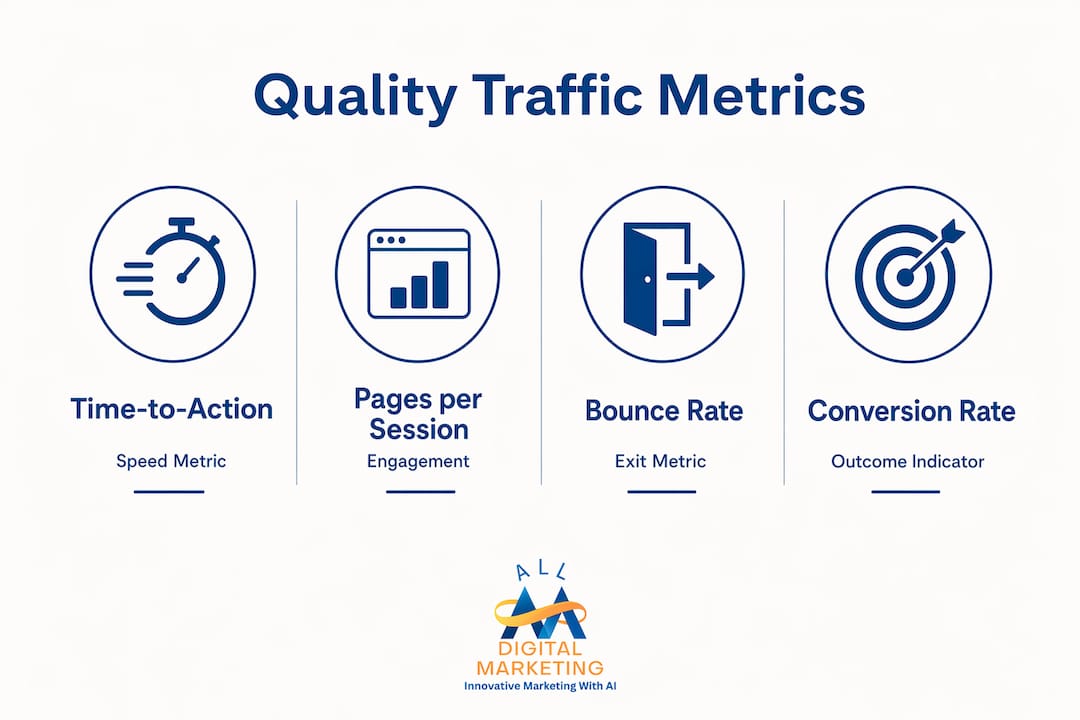
A comprehensive quality framework also blends behavioral signals with commercial and attribution data. Evaluating form starts, geography, device type, and return behavior gives you a full picture of whether a visitor segment is worth pursuing. Geography matters because a local service business has no use for visitors from the wrong city. Device type matters because mobile and desktop users often have different intent levels depending on your industry.
| Metric | What it measures | Quality indicator |
|---|---|---|
| Time-to-first-action | Speed of initial engagement after landing | Fast action signals strong intent |
| Pages per session | Depth of site exploration | Higher pages show genuine interest |
| Scroll depth | How far visitors read on a page | Deep scrolling confirms content relevance |
| Return visits | Repeat engagement over time | Returns signal trust and brand alignment |
| Form starts | Early conversion behavior | Indicates commercial intent |
Pro Tip: Set up a custom segment in Google Analytics 4 that filters for visitors with two or more pages per session and a session duration above 90 seconds. That segment is your quality traffic baseline, and it will tell you which channels actually deliver value.
Why does intent-driven traffic outperform high-volume, low-intent traffic?
Intent traffic and awareness traffic are not the same thing, and treating them as equal is a budget drain. Awareness traffic comes from broad keywords or general interest. Intent traffic comes from visitors who are actively evaluating a solution and are close to a decision.

High-intent visitors convert faster and need less nurturing than broad, low-intent traffic. That means shorter sales cycles, lower cost per acquisition, and better use of your sales team's time. A visitor searching "best local SEO agency for plumbers" is far closer to buying than one searching "what is SEO." Both are traffic. Only one is quality traffic.
Broad, low-intent keywords inflate traffic numbers but do not produce qualified leads or healthy conversion rates. Stopping budget on broad terms and redirecting it toward high-intent keywords improves traffic quality without requiring more total spend. That is a direct improvement in marketing ROI with no increase in cost.
The benefits of attracting intent-driven visitors compound over time:
- Faster conversion cycles with less follow-up required
- Lower cost per lead because fewer unqualified visitors consume resources
- Higher average order value because intent visitors often know what they want
- Better data accuracy for SEO and ad targeting because your analytics reflect real buyers
- Stronger brand authority as satisfied, aligned customers share and return
Quality traffic creates a compounding effect through repeat visits, referrals, and brand equity that raises organic rankings over time. This is the flywheel that separates businesses with sustainable growth from those constantly chasing the next traffic spike.
Pro Tip: Review your top five traffic sources and calculate a simple quality score for each: divide the number of leads generated by total sessions from that source. The source with the highest score deserves more budget, regardless of raw volume.
Personalized marketing tactics accelerate this process. When you match your messaging to the specific intent of your visitor segment, conversion funnel performance improves measurably. Generic messaging loses intent visitors because it fails to confirm relevance fast enough.
How to attract quality traffic using modern marketing strategies
Attracting quality visitors requires a deliberate approach to both paid and organic channels. The goal is not to reach more people. The goal is to reach the right people at the right moment in their decision process.
For paid search, testing 5–10 single keyword ad groups (SKAGs) is the most reliable method for isolating high-intent keywords. SKAGs give you precise control over which search queries trigger your ads. That precision eliminates wasted spend on irrelevant clicks and reveals which exact phrases drive conversions. Once you identify the top performers, you scale those and cut the rest.
For organic search, the same principle applies. Searcher intent optimization means building content around keywords that signal evaluation or purchase intent, even when those keywords have lower search volume. A keyword with 200 monthly searches and strong commercial intent will outperform a keyword with 20,000 searches and pure informational intent every time, measured by leads generated.
The comparison below shows how a volume-focused approach differs from a quality-focused one across key acquisition decisions:
| Decision point | Volume-focused approach | Quality-focused approach |
|---|---|---|
| Keyword selection | Broad, high-volume terms | Specific, intent-rich phrases |
| Ad targeting | Wide demographic reach | Detailed audience and behavioral filters |
| Content strategy | High-frequency, general topics | Fewer pieces targeting evaluation-stage queries |
| Success metric | Total sessions and impressions | Leads, conversions, and cost per acquisition |
| Budget allocation | Spread across many channels | Concentrated on proven high-intent sources |
Practical steps to shift toward quality-focused acquisition:
- Audit your current keyword list and tag each term by intent level (informational, navigational, or commercial)
- Pause broad match keywords in paid campaigns and test exact and phrase match instead
- Build landing pages that speak directly to the specific problem your best customers are trying to solve
- Use lead funnel automation to qualify visitors faster and route high-intent leads to immediate follow-up
- Track cost per qualified lead, not cost per click, as your primary paid channel metric
Organic traffic built on quality principles compounds in ways paid traffic cannot. Every well-ranked piece of intent-focused content continues to deliver qualified visitors without additional spend.
What role does quality traffic play in SEO and organic search success?
Quality traffic and SEO success reinforce each other directly. Search engines measure how users interact with your site after clicking a result. Strong engagement signals tell the algorithm your content delivered on its promise. Weak engagement signals do the opposite.
Quality traffic positively signals search engines through longer dwell times, deeper scrolling, and internal link clicks. These behaviors confirm content utility. The result is a feedback loop: better-aligned visitors engage more, engagement improves rankings, better rankings attract more aligned visitors. Breaking into that loop requires starting with the right audience, not just more audience.
The March 2026 Google core update confirmed that user engagement signals outweigh generic traffic volume as a ranking factor. Sites with higher engagement maintained their rankings through the update. Sites relying on volume from generic or AI-generated content saw significant drops. The lesson is direct: search engines now reward audience alignment, not audience size.
Quality traffic also improves the accuracy of your SEO data. When your analytics are filled with unqualified visitors who bounce immediately, your performance data becomes misleading. You cannot tell which content actually resonates or which keywords drive real interest. Clean, aligned traffic produces clean data, and clean data produces better decisions.
Key SEO benefits of prioritizing quality visitors:
- Lower bounce rates that signal content relevance to search algorithms
- Higher dwell time that confirms page quality and depth
- More internal link clicks that distribute authority across your site
- Accurate keyword performance data for ongoing content decisions
- Stronger brand trust signals as satisfied visitors return and share
Website conversion optimization works best when the traffic arriving at your pages already has intent. No amount of landing page testing will fix a traffic quality problem.
Key Takeaways
Prioritizing quality traffic is the most direct path to higher conversion rates, stronger SEO performance, and sustainable business growth.
| Point | Details |
|---|---|
| Define quality by intent | Quality traffic means visitors who match your audience and arrive ready to engage or convert. |
| Measure engagement, not volume | Track time-to-first-action, pages per session, scroll depth, and return visits to assess traffic quality. |
| Intent traffic converts faster | High-intent visitors need less nurturing and produce shorter sales cycles than broad, low-intent traffic. |
| SKAGs isolate high-intent keywords | Testing 5–10 single keyword ad groups in paid search reveals which exact phrases drive real conversions. |
| Engagement signals drive SEO | Longer dwell times and deeper scrolling tell search engines your content is relevant, improving rankings. |
The metric most marketers ignore until it's too late
After working in digital marketing for years, the pattern I see most often is this: a business celebrates a traffic milestone, then wonders why revenue did not follow. The milestone was real. The traffic was not.
Volume metrics are easy to report and easy to sell internally. Quality metrics require more explanation and more patience. That is exactly why so many marketing teams default to impressions, clicks, and sessions as their primary success measures. Those numbers go up quickly. They feel like progress.
The shift I encourage every marketer to make is simple: stop asking "how much traffic did we get?" and start asking "how much of that traffic was worth getting?" Those are different questions, and they produce very different strategies. The first question leads to broad keywords, wide targeting, and inflated reports. The second leads to SKAGs, intent-focused content, and real leads.
The marketers who resist this shift usually cite one concern: "We'll lose volume." That is true. You will lose volume. You will also gain clarity, better data, and a conversion rate that actually reflects your marketing effort. That trade is worth making every time. The businesses I have seen grow consistently are not the ones with the most traffic. They are the ones who know exactly who is visiting and why.
— Diane
How Digitalmarketingall helps you attract the right visitors
Digitalmarketingall specializes in driving quality traffic for local and national businesses through SEO, search box optimization, PPC, and content marketing built around high-intent keywords. The agency's AI-powered approach targets visitors who are actively searching for what you offer, not just browsing. If your current traffic is not converting at the rate your business needs, the issue is almost always audience alignment, not volume. Digitalmarketingall's team can audit your current traffic sources, identify where quality is leaking, and build a targeted strategy to fix it. Reach out to Digitalmarketingall to get a clear picture of where your traffic quality stands and what it takes to improve it.
FAQ
What is quality traffic in digital marketing?
Quality traffic refers to website visitors who match your target audience, arrive with genuine intent, and are likely to take a meaningful action such as making a purchase or submitting a lead form.
How does quality traffic affect conversion rates?
Targeted visitors convert significantly better than random traffic because their intent aligns with your offer. PPC top performers regularly achieve conversion rates above 11% when targeting is precise.
What is the difference between quality traffic and quantity traffic?
Quality traffic prioritizes audience fit and intent over raw visitor numbers. Quantity-focused strategies inflate session counts but produce low conversion rates and unreliable analytics data.
How do I start attracting higher-quality visitors?
Shift your keyword strategy toward specific, intent-rich phrases and test single keyword ad groups in paid search. Pair that with content built for evaluation-stage queries to attract visitors who are ready to act.
Does traffic quality affect SEO rankings?
Yes. Search engines measure engagement signals like dwell time, scroll depth, and internal clicks. Sites with higher-quality, more engaged traffic maintain stronger rankings, as confirmed by data from the March 2026 Google core update.