

TL;DR:
- Growing your presence across multiple formats and positions on a search engine results page increases visibility and protects traffic.
- Focusing on share of SERP rather than a single rank offers a more accurate measure of total search real estate owned.
SERP domination is defined as the practice of controlling multiple positions, formats, and features on a single search engine results page to capture the maximum share of traffic and authority for a target keyword. The industry term for this approach is "search engine results page domination," and it goes far beyond ranking one page at number one. Digitalmarketingall works with businesses every day that treat the SERP as a single slot to win. The ones who grow fastest treat it as real estate to own across multiple formats, domains, and features. This guide explains exactly how that works and how you can apply it.
What is SERP domination and why does it matter?
SERP domination is the strategy of occupying multiple visible positions on a search engine results page for a given keyword, using different content formats, domains, and SERP features simultaneously. A brand that dominates the SERP does not just rank first. It appears in the Featured Snippet, the People Also Ask box, the video carousel, and the organic listings, all for the same search query.

The practical effect is significant. When your brand fills more of the visible page, competitors get pushed further down or off the first page entirely. Users see your name repeatedly before they click anything, which builds recognition and trust before a single visit occurs.
This approach also protects your traffic. If one listing drops in rank, others remain visible. A diversified SERP presence acts as a buffer against algorithm updates that would otherwise wipe out a single-page strategy overnight.
How does occupying multiple SERP positions increase traffic and authority?
The traffic math behind multi-position SERP strategies is compelling. Three positions in the top ten for a single keyword can capture roughly 43% of total search traffic for that query. Position one earns approximately 30% of clicks, position three earns about 10%, and position seven earns about 3%. That means a brand holding all three spots collects nearly half the available traffic while competitors split the remainder.
The multi-domain approach makes this possible without violating Google's rules. Google's diversity filters prevent the same domain from appearing more than twice in the top ten organic results. Separate authoritative domains, however, can each rank independently, allowing a brand to legally occupy several top positions at once.
Content format diversification is the engine that makes this work. The most effective multi-position strategies combine:
- Long-form text articles on your primary domain targeting informational intent
- Video content on platforms like YouTube, which can appear in video carousels and push text results below the fold
- Tools and calculators hosted on separate domains targeting transactional or comparison intent
- Marketplace listings or third-party review profiles that rank independently for branded and category keywords
Video results can push organic text listings below the fold entirely, shifting traffic distribution in favor of whoever owns the video carousel. That is a position most businesses leave completely uncontested.
Pro Tip: Coordinate content across platforms by assigning each piece a distinct angle or format. A YouTube video, a written guide, and a tool page can all target the same keyword without duplicating each other, which keeps Google's quality filters satisfied and your SERP footprint wide.
What is "Share of SERP" and why is it a better visibility metric?
Share of SERP is defined as the percentage of total visible search real estate a brand occupies for a given keyword, measured across all SERP features rather than a single organic position. Traditional rank tracking tells you where one page sits. Share of SERP tells you how much of the page you actually own.
The difference matters because SERP layouts vary dramatically. A keyword with a Featured Snippet, three People Also Ask boxes, a local pack, and a video carousel leaves very little room for standard organic results. A brand ranking third organically on that page may receive far less traffic than a brand ranking fifth on a clean, text-only SERP.
Moving from position four to position two on a SERP without heavy ads or snippets can increase traffic by 200%–300%. That same move on a feature-heavy SERP might produce almost no traffic gain at all. The SERP layout determines the value of any given rank, which is why Share of SERP is the more honest metric.
The SERP features that most directly affect your Share of SERP include:
- Featured Snippets: The answer box at the top of the page, which often earns clicks even from users who would otherwise click position one
- People Also Ask (PAA) boxes: Expandable questions that appear mid-page and can be won by any domain, regardless of organic rank
- Local packs: The map-based results that dominate local searches and operate on entirely separate ranking signals
- Video carousels: Rows of video thumbnails that appear above or within organic results
- Paid ads: Google Ads placements that consume the top of the page and reduce organic visibility
Optimizing for SERP features through tactics like FAQ schema markup and restructured introduction paragraphs is often faster and more effective than climbing organic rankings. You can win a Featured Snippet from position five without ever reaching position one.
Pro Tip: Audit your target keywords monthly using a SERP feature tracker. Identify which features appear for each keyword, then build content specifically structured to win those features. A keyword with a PAA box is an invitation to write a concise, direct answer that Google will pull.
How do you tell the difference between keyword cannibalization and healthy diversification?
Keyword cannibalization is defined as the condition where two or more pages on the same site compete for the same keyword by serving the same user intent with similar content, causing both pages to rank lower than either would alone. Cannibalization reduces overall traffic because the pages trade rankings unpredictably and dilute click-through rates between them.
Keyword diversification is the opposite condition. Multiple pages rank for the same keyword by serving distinct intents or formats, so they complement rather than compete with each other. One page answers the informational question. Another delivers a transactional tool. A third provides a comparison. All three can rank simultaneously because Google recognizes they serve different needs.
The table below shows how to distinguish between the two scenarios and what to do in each case.
| Signal | Keyword cannibalization | Healthy diversification |
|---|---|---|
| User intent served | Same intent, similar content | Distinct intents or formats |
| Ranking behavior | Pages trade positions, volatile | Stable parallel rankings |
| Traffic effect | Both pages underperform | Both pages earn consistent traffic |
| Google's response | Confusion, suppressed rankings | Recognition of multi-faceted intent |
| Recommended action | Merge or rewrite one page | Maintain and expand the strategy |
The clearest signal of cannibalization is ranking volatility. If two pages swap positions week to week for the same keyword, they are competing with each other. Stable parallel rankings of distinct content types signal healthy diversification and indicate Google's recognition that both pages serve real needs.
To convert cannibalization into diversification, rewrite one page to serve a different intent or format. If two blog posts both answer the same informational question, merge them into one authoritative page and redirect the weaker URL. Then create a new page targeting a transactional or comparison angle for the same keyword cluster.
Pro Tip: Run a cannibalization check before publishing any new page. Search your target keyword in Google and filter results to your domain using the "site:" operator. If an existing page already ranks, decide whether the new page serves a genuinely different intent before publishing.
How to achieve SERP domination: practical steps for your business
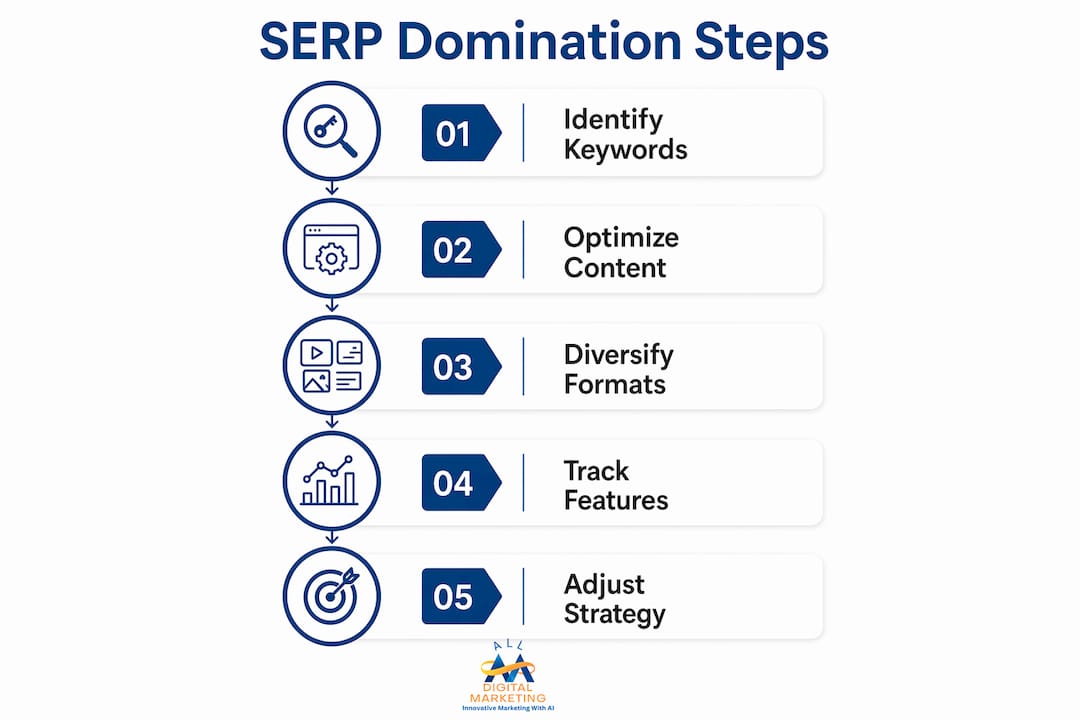
A structured workflow separates businesses that accidentally hold one ranking from those that deliberately control a keyword's entire SERP. The steps below build that structure.
-
Map the SERP for each target keyword. Search the keyword manually and record every feature present: Featured Snippet, PAA boxes, local pack, video carousel, image pack, and organic results. This map becomes your content plan.
-
Audit your current Share of SERP. Identify which features you already appear in and which are held by other brands. Competitor gap analysis reveals where rivals rank in snippets or video carousels that you do not, giving you specific targets for growth.
-
Build distinct content for each SERP feature. Write a long-form article for organic rankings. Create a short, direct FAQ page structured to win the Featured Snippet. Produce a video for the carousel. Each piece targets the same keyword from a different angle and format.
-
Apply structured data markup. Add FAQ schema to pages targeting PAA boxes. Add HowTo schema to tutorial content. Add VideoObject schema to video pages. Schema markup signals to Google exactly what type of content each page contains, increasing the chance of feature inclusion.
-
Distribute content across authoritative platforms. Publish video on YouTube. Publish tools or calculators on a separate subdomain or partner domain. Publish guest articles on high-authority third-party sites. Each platform can rank independently, expanding your search visibility without triggering Google's same-domain diversity filter.
-
Coordinate publishing schedules. Stagger content releases across platforms over two to four weeks. Simultaneous publishing can dilute crawl budget and slow indexing. A staggered schedule gives each piece time to index and begin ranking before the next piece enters the SERP.
-
Monitor Share of SERP monthly and adjust. Track which features you hold, which you lose, and which competitors gain. Shift content investment toward the features that drive the most traffic for your specific keyword set.
Pro Tip: Use searcher intent optimization as the organizing principle for your content plan. Every piece you create should map to a specific intent type: informational, navigational, commercial, or transactional. That mapping prevents cannibalization and ensures each piece earns its own SERP position.
Key Takeaways
SERP domination requires owning multiple positions and formats on the search results page, not just ranking one page at number one.
| Point | Details |
|---|---|
| Multi-position traffic math | Three top-ten positions for one keyword can capture roughly 43% of total search traffic. |
| Multi-domain strategy | Separate authoritative domains bypass Google's diversity filter and expand your SERP footprint legally. |
| Share of SERP over rank | Measure total visible real estate across all SERP features, not just a single organic position number. |
| Diversification beats cannibalization | Pages serving distinct intents rank stably together; pages serving the same intent compete and underperform. |
| Structured workflow wins | Map the SERP, audit gaps, build format-specific content, apply schema, and monitor monthly. |
What I've learned after years of watching brands fight over one ranking
The most common mistake I see from business owners is treating SEO as a race to position one. They spend months chasing that single spot, and when they finally get it, they discover that a Featured Snippet, a video carousel, and three PAA boxes have already consumed most of the page above them. Their position one listing sits below the fold on mobile, and the traffic they expected never arrives.
The shift I encourage every client to make is from rank thinking to real estate thinking. Your goal is not to rank first. Your goal is to appear as many times as possible on the same page, in as many formats as possible, for the same keyword. That mindset change alone produces better content decisions, better platform choices, and better long-term results.
The brands I have watched build the most durable traffic are the ones that invest in video alongside text, that publish on third-party platforms with genuine authority, and that structure every piece of content to win a specific SERP feature. They do not get there fast. But when they arrive, they are very hard to displace because displacing them requires winning multiple formats simultaneously.
The risk of ignoring SERP feature optimization is real and growing. Google continues to add features that push organic results further down the page. A brand that only optimizes for organic rank is ceding more and more visible space to competitors who understand the full SERP. The Google SERP landscape in 2025 and 2026 rewards breadth, not just depth.
My honest advice: build your content portfolio with patience and purpose. Map the SERP first. Create for features second. Rank third. That sequence produces results that compound over time rather than spike and fade.
— Diane
How Digitalmarketingall helps you build a SERP-ready presence
Executing a full SERP domination strategy requires a website built to support it. Digitalmarketingall offers professional website solutions designed specifically for businesses that want to rank across multiple formats and features. The sites are structured for schema markup, fast load times, and content organization that Google's crawlers reward. For businesses that want a turnkey option, the zero-maintenance website rental program removes the technical burden entirely, so your team can focus on content and strategy rather than server management. Digitalmarketingall's SEO team also handles the SERP feature audits, gap analysis, and content coordination that multi-position strategies require.
FAQ
What does SERP domination mean in simple terms?
SERP domination means your brand appears in multiple positions and formats on a single search results page for a target keyword. The goal is to own as much visible space as possible, including organic listings, Featured Snippets, video carousels, and People Also Ask boxes.
How many SERP positions do I need to dominate a keyword?
Holding three positions in the top ten for one keyword can capture roughly 43% of total search traffic for that query. The exact number depends on which positions you hold and which SERP features are present on that page.
What is the difference between Share of SERP and traditional rank?
Traditional rank measures where one page sits in organic results. Share of SERP measures the total percentage of visible search real estate your brand occupies across all features, including snippets, local packs, and video carousels, for a given keyword.
Does SERP domination require multiple websites?
Multiple domains expand your SERP footprint because Google's diversity filter limits the same domain to roughly two listings in the top ten organic results. Separate authoritative domains, including YouTube, third-party review sites, and partner platforms, can each rank independently for the same keyword.
How is keyword diversification different from keyword cannibalization?
Keyword cannibalization occurs when two pages serve the same intent and compete against each other, causing volatile rankings and lower traffic for both. Keyword diversification occurs when multiple pages serve distinct intents or formats for the same keyword, producing stable parallel rankings and combined traffic gains.