

TL;DR:
- Search habits are transforming as AI Overviews appear on over 60% of US Google searches, increasing zero-click rates to 69%. To stay competitive in 2026, marketers must optimize for both traditional rankings and AI citations while emphasizing expertise, topical depth, and authoritative brand signals. Regular audits, structured topic clusters, author credibility, and AI content optimization are essential for mastering evolving SEO challenges and tracking success effectively.
The way people search is shifting under your feet. AI Overviews now appear on over 60% of US Google searches, and the zero-click search rate has climbed to 69%, meaning more users get answers without ever visiting your site. Following the SEO trends in 2026 step by step is no longer optional for digital marketers and business owners who want to stay competitive. Traditional tactics still matter, but they are no longer enough on their own. This guide walks you through exactly what is changing, what to do first, and how to measure whether your updated approach is actually working.
Table of Contents
- Key Takeaways
- SEO trends in 2026 step by step: the groundwork
- Executing your 2026 SEO strategy
- Common challenges when adopting 2026 SEO trends
- How to verify your 2026 SEO results
- My honest take on mastering SEO in 2026
- Ready to put these strategies into action?
- FAQ
Key Takeaways
| Point | Details |
|---|---|
| Dual-track strategy required | Optimize simultaneously for traditional organic rankings and AI search citations to maximize visibility. |
| E-E-A-T is the new baseline | Content must demonstrate verified expertise and original insight to satisfy Google's 2026 ranking signals. |
| Zero-click is not the enemy | Adapt by targeting AI Overviews and featured snippets to build brand recognition even without clicks. |
| Topic clusters beat thin pages | Structured pillar pages with clear intent separation drive topical authority and reduce cannibalization risk. |
| Measure recognition, not just rankings | Track AI citation frequency, brand mentions, and topical authority signals alongside traditional ranking metrics. |
SEO trends in 2026 step by step: the groundwork
Before you restructure a single page, you need a clear picture of where your site stands today. Skipping this step is the single fastest way to waste months of effort on tactics that do not fit your current situation.
What Google's 2026 ranking signals actually require
Google's March 2026 core update formalized what many SEOs suspected was coming: content must add genuine new knowledge, not just repackage what already ranks. Google calls this "Information Gain." If your article covers exactly the same points as the top three results with no original data, no proprietary insight, and no verifiable author expertise, you are not competitive under the new system. E-E-A-T (Experience, Expertise, Authoritativeness, Trustworthiness) now governs how AI models select citations just as much as how Google ranks pages.
Domain-level topical coherence compounds this effect. A site that covers ten loosely related topics at surface level will consistently lose ground to a site that owns three topics with depth. Start your preparation by mapping your existing content against your core topic areas. Flag any page that does not clearly belong to a defined cluster.
Tools and resources you need in place
The table below outlines the resources you should have ready before moving into execution. This is not an exhaustive technology list. It is the minimum functional toolkit for 2026 SEO.
| Resource | Purpose | Priority |
|---|---|---|
| Google Search Console | Track organic impressions, AI feature appearances, and click-through rates | Critical |
| Content audit spreadsheet | Catalog all existing URLs with topic cluster, author, and freshness date | Critical |
| Author profile pages | Establish verifiable credentials for all content contributors | High |
| Topical map document | Visualize pillar topics, subtopics, and content gaps | High |
| AI writing assistant | Draft acceleration and coverage gap identification | Medium |
| Third-party citation tracker | Monitor brand mentions across AI platforms and external sites | Medium |
Pro Tip: Run your domain through a topical coherence check by listing every published URL and tagging it with one primary topic. If more than 30% of your URLs do not fit cleanly into three to five core topic areas, consolidation and redirection work should happen before you produce any new content.
Executing your 2026 SEO strategy
With the groundwork complete, you can move into the specific steps that define modern SEO success. The key shift here is recognizing that only 12% of AI search citations overlap with traditional organic SERP results. That single statistic reframes your entire workflow. You are not optimizing for one channel. You are optimizing for two that mostly do not overlap.

Step-by-step execution workflow
Follow these steps in sequence. Each one builds on the previous, and skipping ahead creates gaps that undermine the whole structure.
-
Audit existing content for originality and expertise. Pull your top 20 traffic pages and evaluate each one honestly. Does it contain data your organization collected? Does it include a named author with a linked bio and verifiable credentials? If the answer to both is no, that page needs a revision pass before you build anything new around it.
-
Build or refine your topic cluster architecture. Choose three to five core pillar topics that align with your business model and audience needs. Each pillar page should be a thorough, long-form resource. Supporting cluster pages drill into specific subtopics with clear intent separation. SERP-based clustering aligned with search intent is more reliable than NLP similarity grouping, which often creates cannibalization problems.
-
Establish author authority signals. Create dedicated author profile pages with professional bios, publication history, and links to external credentials. Google rewards content with verified human accountability, and AI models use these signals when deciding which sources to cite. Every piece of content on your site should connect to a real person's expertise.
-
Optimize content for AI Overview inclusion. Structure each article with a clear, direct answer in the first two paragraphs. Use concise definitions, entity-clear language, and schema markup. Understanding how AI Overviews select content helps you write in a format that AI systems can parse and cite. Think of each key section as a standalone answer to a specific question.
-
Build brand authority beyond your own site. SEO in 2026 shifts from rankings to recognition, which means third-party mentions, guest contributions, podcast appearances, and social proof all count. Publish proprietary research and data studies that earn organic citations from other sites. This is how you build the external authoritativeness that AI models trust.
-
Maintain traditional on-page and technical SEO. Core web vitals, mobile optimization, clean site architecture, and internal linking still matter. Traditional ranking signals have not disappeared. They have become the floor, not the ceiling. A technically strong site earns the right to compete on content quality.
-
Integrate AI as a structural auditor. Using AI for topical mapping and coverage gap analysis improves citation trust from AI models. Run AI tools against your content to identify missing subtopics, weak transitions, and structural inconsistencies. Then apply human expertise to fill those gaps with original perspective.
Pro Tip: When using AI writing tools, treat the AI output as a first draft that needs substantial editing by a named expert. AI-assisted content performs well when a qualified human rewrites and adds original insight. Publishing AI drafts without this step is the fastest path to a quality penalty.
Common challenges when adopting 2026 SEO trends
Every major SEO shift creates transition problems. The 2026 changes are no exception. Knowing what the common failure points look like before you hit them saves significant recovery time.
Problems you are likely to encounter
-
Content cannibalization from clustering. When you restructure existing content into clusters, similar pages can compete with each other for the same queries. Strategic keyword clustering with clear intent separation solves this, but it requires deliberate planning. Map each URL to a unique intent before publishing or consolidating.
-
Scaled content abuse flags. If you produce large volumes of AI-generated content without adequate human review, Google's spam systems will catch it. Google's spam policies specifically target thin, templated, or unverified content at scale. Establish a quality review process with a named editor responsible for each content batch.
-
Measuring success in a zero-click world. Organic clicks will be lower than they were in 2023 or 2024 for many query types. This does not mean your SEO is failing. Track brand impression volume, AI citation appearances, direct traffic trends, and branded search volume alongside click data. These signals tell a more complete story of your visibility in zero-click searches.
-
Author profile decay. Profiles that are created once and never updated lose credibility signals over time. Set a calendar reminder to update each author bio quarterly with new credentials, publications, or speaking appearances.
The table below compares traditional SEO challenges with their 2026 equivalents, along with practical solutions for each.
| Traditional challenge | 2026 equivalent | Solution |
|---|---|---|
| Keyword stuffing penalties | AI content spam flags | Human editorial review on all AI-assisted content |
| Thin content rankings | Information gain deficits | Add original data, case studies, and proprietary insight |
| Link building manipulation | Low entity clarity in AI models | Build third-party citations and brand mentions organically |
| Page speed issues | AI citation exclusion | Structured formatting and entity-clear language in content |
| Duplicate content | Cluster cannibalization | Intent-based URL mapping before publication |
Google does not penalize AI content as a category. The target is content that lacks human accountability and original value. Keep that distinction clear as you build your quality control process.
How to verify your 2026 SEO results
Running updated 2026 SEO strategies without a clear measurement framework is guesswork. You need specific metrics tied to the outcomes that actually matter in the current search environment.
Key performance indicators for 2026 SEO
-
AI citation frequency. Track how often your brand and content appear in AI-generated answers across Google, Bing Copilot, and other AI search platforms. This requires manual spot checks and specialized tracking tools since no universal citation dashboard exists yet.
-
Topical authority score. Tools like Google Search Console can show you query impressions across a topic cluster. If your pillar page and cluster pages are collectively gaining impression share on a defined topic, your authority is growing.
-
Branded search volume. An increase in direct brand searches indicates that your recognition strategy is working. People search for you by name when they have seen you cited or mentioned elsewhere.
-
Organic click-through rate by query type. Monitor CTR separately for informational queries versus commercial queries. AI Overviews on commercial queries now trigger 42.9% of the time, which directly suppresses clicks. Expect lower CTR on informational content and compensate with brand impression volume.
-
Content freshness and author update frequency. Set a review cycle of 90 days for high-priority content. Google rewards updated, expert-authored pages, especially in fast-moving topic areas.
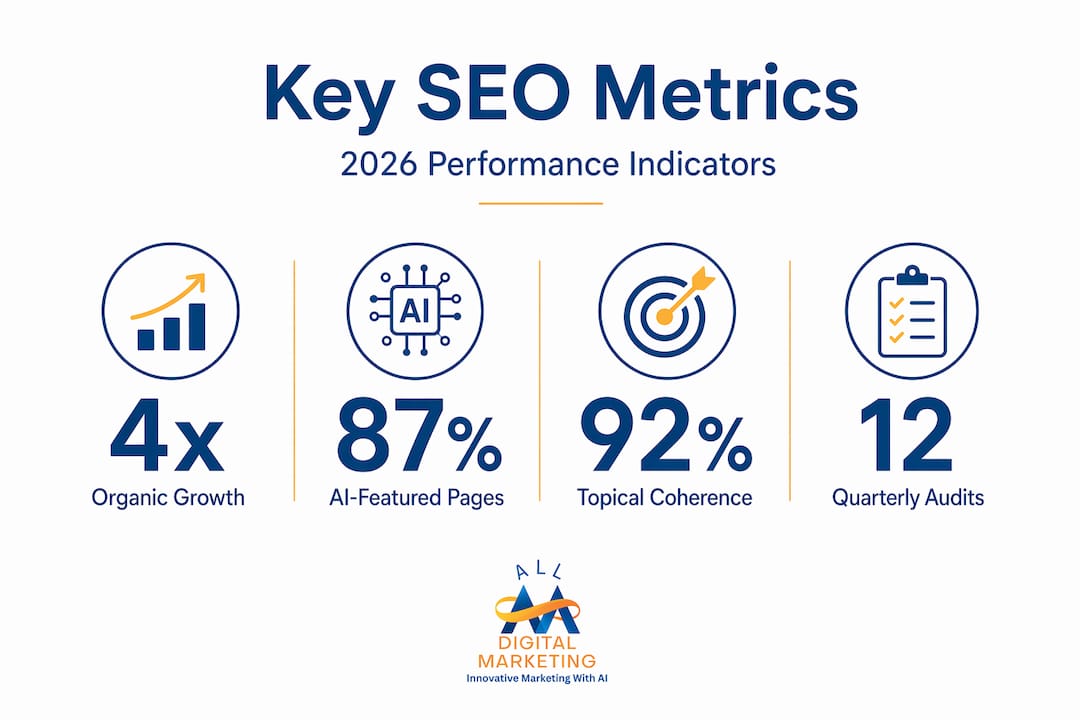
Conduct a full content audit every quarter. Review each pillar page and cluster article against three criteria: Is the information still accurate? Does it reflect the author's current expertise? Does it add something no competing page currently offers? Use your AI tools to find content gaps that competitors have addressed and you have not.
My honest take on mastering SEO in 2026
I have spent years watching marketers chase ranking positions like they are the final destination. What I have seen consistently is that rankings are a signal, not the goal. In 2026, that distinction matters more than ever. The businesses winning right now are the ones that built genuine authority in their niche and are now getting cited by AI systems without even trying to game them.
The biggest mistake I see marketers making is treating AI tools as a shortcut to volume. Publishing 50 AI-generated articles a week with light editing feels productive. It is not. It dilutes your topical authority and triggers quality flags that set you back months.
What I have found actually works is combining human expertise with AI assistance in the right order. Use AI to audit coverage gaps and draft structure. Then bring in your best subject matter expert to rewrite, add original data, and connect the content to real-world experience. That combination satisfies both Google's E-E-A-T requirements and the entity clarity signals that AI models use when selecting citations.
The brands that embrace building authority in AI-driven search early will compound that advantage over the next two to three years. The ones that wait will find the gap harder to close. My encouragement is simple: start with your content audit this week, not next quarter.
— Diane
Ready to put these strategies into action?
At Digitalmarketingall, we work with local and national businesses every day to implement exactly the kind of dual-track SEO approach this article describes. We combine AI-powered search visibility strategies with proven on-page and authority-building techniques to help your brand get found where it matters most, including inside AI-generated answers.
If you want expert support applying these 2026 digital marketing trends to your specific business, our team is ready to help. Whether you need a full content architecture review, author authority development, or a complete SEO overhaul built for the AI era, Digitalmarketingall has the tools and experience to move you forward. Visit digitalmarketingall.org to explore our services and take the next step toward stronger, more future-ready search visibility.
FAQ
What are the most important SEO ranking factors in 2026?
Google's 2026 ranking signals prioritize original content with verifiable author expertise, topical depth, and E-E-A-T compliance. Technical fundamentals like site speed and mobile optimization remain necessary but are no longer sufficient on their own.
How do I optimize for AI Overviews and zero-click searches?
Structure your content with direct, concise answers near the top of each page, use entity-clear language, and apply schema markup. Optimizing for AI citations requires the same signals that earn traditional featured snippets, combined with strong brand authority across the web.
Does Google penalize AI-generated content in 2026?
Google does not target content based on its origin. It targets content that lacks human oversight, original insight, and verifiable expertise. AI-assisted content that is substantially edited by named experts with clear credentials performs well under Google's quality guidelines.
What is the difference between traditional SEO and 2026 SEO strategies?
Traditional SEO focuses primarily on keyword targeting and backlink acquisition to earn organic rankings. The 2026 approach adds AI citation optimization, entity clarity, topical authority building, and brand recognition signals, because only 12% of AI citations overlap with standard organic results.
How often should I audit my content under 2026 SEO best practices?
A quarterly audit cycle is the recommended minimum for high-priority content. Each audit should evaluate factual accuracy, author credential freshness, and whether the page still adds unique value that competing pages do not provide.