

TL;DR:
- Most businesses still focus on ranking number one on Google, but AI-powered snippets now surpass traditional links in visibility. To succeed, small businesses must optimize content structure, add schema markup, and ensure consistent citation data to become trusted AI sources. This shift requires thinking about being cited rather than solely ranking in organic search results.
Most business owners still think the goal is to rank at the top of Google search results. That instinct made perfect sense five years ago. Today, the landscape has shifted in a way that changes everything about how customers find and choose local businesses. AI-powered search surfaces, featured snippets, and answer boxes now sit above traditional blue links, capturing attention and clicks before users ever scroll down. If your business content is not structured for extraction and citation by AI systems, you are already losing visibility to competitors who understand this new reality.
Table of Contents
- How search snippets changed the game for small businesses
- What makes a snippet eligible: Extraction, structure, and schema
- AI, local SEO, and citation presence: The new local battleground
- Practical steps to make your business the answer: Action frameworks
- The real opportunity: Shifting your mindset beyond blue links
- How Digital Marketing All can help you dominate search snippets
- Frequently asked questions
Key Takeaways
| Point | Details |
|---|---|
| Snippets drive visibility | Being the answer in AI or featured snippets brings more customers than a high search position alone. |
| Structure enables extraction | Answers in lists and tables with clear headings make your business more 'snippable' for AI. |
| Local SEO means citations | Consistent business data and citation presence are critical for showing up in location-based AI results. |
| Ranking isn’t everything | AI often chooses sources outside the organic top 100, focusing on clarity and authority signals instead. |
How search snippets changed the game for small businesses
Search snippets are no longer a bonus feature for big brands with dedicated SEO teams. They are now the primary entry point for discovery, especially as Google's AI Overviews expand across more searches. When someone types "best plumber near me" or "how much does lawn care cost," they often get an AI-generated answer at the top of the page before seeing any classic listings. That answer comes from somewhere. Your job is to make it come from your business.
The shift is significant. Classic "rank number one" strategies focused on earning a top blue link. You built backlinks, optimized your title tags, and pushed your domain authority. Those tactics still matter, but they no longer guarantee visibility the way they once did. When AI Overviews appear, they can absorb the majority of user attention and clicks before a single traditional result gets noticed.
"When SERPs include AI Overviews or answer boxes, classic 'rank #1' strategies may yield diminishing returns because the snippet or AI answer can absorb the click. Businesses need to optimize for being the selected extractable source, not just for blue-link ranking."
This changes the game entirely for small business owners. You are not just competing for a position on a list. You are competing to be the authoritative source that AI systems choose to cite in their generated answers. That requires a completely different approach to how you build and format content online.
Here is what that transition looks like in practice:
- Stop writing for rankings alone. Shift your focus toward writing content that directly answers specific questions customers ask.
- Structure each page around extractable answers. Every section should be able to stand alone as a response to a clear, defined question.
- Think about intent, not just keywords. AI systems are designed to match user intent with the best available answer, not just the page with the most matching keywords.
- Format content for machines and humans equally. Use headings, lists, and tables that help both AI systems and real visitors quickly get the information they need.
- Update content regularly. AI systems favor current, accurate information, especially for local and time-sensitive queries.
The businesses that thrive in this environment are not necessarily those with the biggest SEO budgets. They are the ones who understand that snippet optimization now extends beyond classic featured snippets to answer engines and AI surfaces, where structuring content into extractable, answer-first sections increases eligibility to be selected for AI-driven summaries and citations.
What makes a snippet eligible: Extraction, structure, and schema
Eligibility for snippet selection comes down to one principle: can AI easily extract a clean, useful answer from your content? Generic paragraphs full of filler phrases and loosely related sentences will not be pulled into a snippet or an AI overview. AI systems look for specific signals that tell them your content is organized, authoritative, and directly relevant to the question being asked.
The core approach is answer-engine extractability engineering. That means using self-contained sections that match the intent of specific headings, combining H2 and H3 structures with list and table formats, so both Google's snippet selection algorithms and large language models can cleanly reuse your text in their summaries.
Here is a comparison of content approaches and how they affect snippet eligibility:
| Content approach | Snippet eligibility | AI citation potential | Reader clarity |
|---|---|---|---|
| Long, generic paragraphs | Low | Very low | Moderate |
| Keyword-stuffed blocks | Very low | None | Poor |
| Clear H2/H3 with lists | High | High | Excellent |
| FAQ format with direct answers | Very high | Very high | Excellent |
| Tables with structured data | High | High | Excellent |
| Schema-marked local data | Very high | Very high | Good |
Schema markup is one of the most underused tools available to small business owners. It tells search engines exactly what your content means, not just what it says. For a local business, schema can signal your name, address, phone number, service categories, business hours, and customer reviews in a structured format that AI systems can read and reference directly. Adding schema to your website pages is one of the fastest ways to boost your eligibility for local and service-based snippets.

Pro Tip: Make each answer on your page "blockable" in both meaning and length. That means each answer should be fully understandable on its own, without needing surrounding context, and should be between 40 and 60 words. This is the sweet spot for AI extraction and featured snippet selection.
Key elements that increase snippet eligibility include:
- Clear, question-matching H2 and H3 headings that mirror the exact phrasing of common customer questions
- Bulleted and numbered lists for processes, comparisons, and grouped facts
- Data tables for pricing, comparisons, service areas, or any structured information
- Q&A formatted sections that directly anticipate and answer customer queries
- Schema markup for local business, FAQPage, HowTo, and Product content types
- Short introductory sentences at the start of each section that state the main point immediately
When you apply this structure consistently across your website, you make it easier for AI search to recognize and cite your content. You also avoid the problem of duplicate content signals that can confuse AI systems about which version of your information is most authoritative.
The best part? This approach improves the experience for real human visitors at the same time. Clear structure, direct answers, and organized data make your website easier to use and more convincing to potential customers who are evaluating their options.
AI, local SEO, and citation presence: The new local battleground
If you run a local business, the shift to AI-driven search snippets affects you more directly than almost any other type of business owner. When someone searches for a service "near me" or asks their phone for a recommendation in your city, AI systems generate an answer based on a combination of citation data, entity signals, and content structure. Traditional local ranking signals alone are not enough to guarantee you appear in those answers.
Here is the finding that surprises most local business owners: 80% of AI-cited sources do not appear in Google's top 100 organic results. That number reframes the entire conversation about local SEO. You do not need to dominate the organic results page to get cited by AI. But you do need to have strong, consistent citation presence across the web.
Citation presence means your business information appears accurately and consistently across directories, review platforms, local data aggregators, and your own website. AI systems use these signals to confirm that your business is a real, trusted entity with a clear identity. When those signals are consistent, you become a reliable source for AI to reference in location-based answers.
Here is a look at how traditional local SEO compares to AI-focused local citation optimization:
| Local SEO factor | Traditional impact | AI citation impact |
|---|---|---|
| Organic keyword ranking | High | Low to moderate |
| Google Business Profile accuracy | High | Very high |
| NAP consistency across platforms | Moderate | Very high |
| Review volume and recency | High | High |
| Schema markup on website | Moderate | Very high |
| Local directory listings | Moderate | High |
| Entity recognition signals | Low (traditionally) | Very high |
Optimizing entities and data sources that AI systems use for location-based recommendations, including correct business identity signals, is now a core requirement for local visibility. This goes beyond just claiming your Google Business Profile. It means auditing every place your business appears online and ensuring that name, address, phone number, category, and service descriptions are accurate and consistent everywhere.
Pro Tip: NAP consistency is non-negotiable for AI citation inclusion. Your business name, address, and phone number must be identical across your website, Google Business Profile, Yelp, Facebook, industry directories, and every other platform. Even small discrepancies, like "St." versus "Street," can weaken your entity signals and reduce your citation eligibility.
The local search ranking environment in 2026 demands that you think of your business as a data entity, not just a website. AI systems are essentially looking for the best data available to answer a user's question. If your entity data is clean, consistent, and well-distributed, you become the most logical choice for citation.
Practical actions for local citation optimization include:
- Audit your existing citations using a citation tracking tool to find inconsistencies or missing listings
- Update your Google Business Profile with accurate hours, services, photos, and categories
- Build listings on high-authority directories in your specific industry and geographic area
- Encourage and respond to customer reviews since review signals factor into AI recommendation algorithms
- Add LocalBusiness schema to your website with complete, accurate business data
- Monitor for outdated information after any business changes like address updates or new service offerings
For a deeper look at how AI is reshaping local SEO strategy, the connection between entity data and AI visibility is one of the most actionable areas for local businesses to invest in right now. Pair that with proven search optimization tactics built for local markets, and you have a strong foundation for AI-driven discovery.
Practical steps to make your business the answer: Action frameworks
Knowing why snippet optimization matters is only useful if you know exactly what to do next. This section gives you a clear, step-by-step framework to start making your business the preferred source for AI and featured snippet citations. These are practical actions you can begin taking this week, regardless of your website platform or technical background.
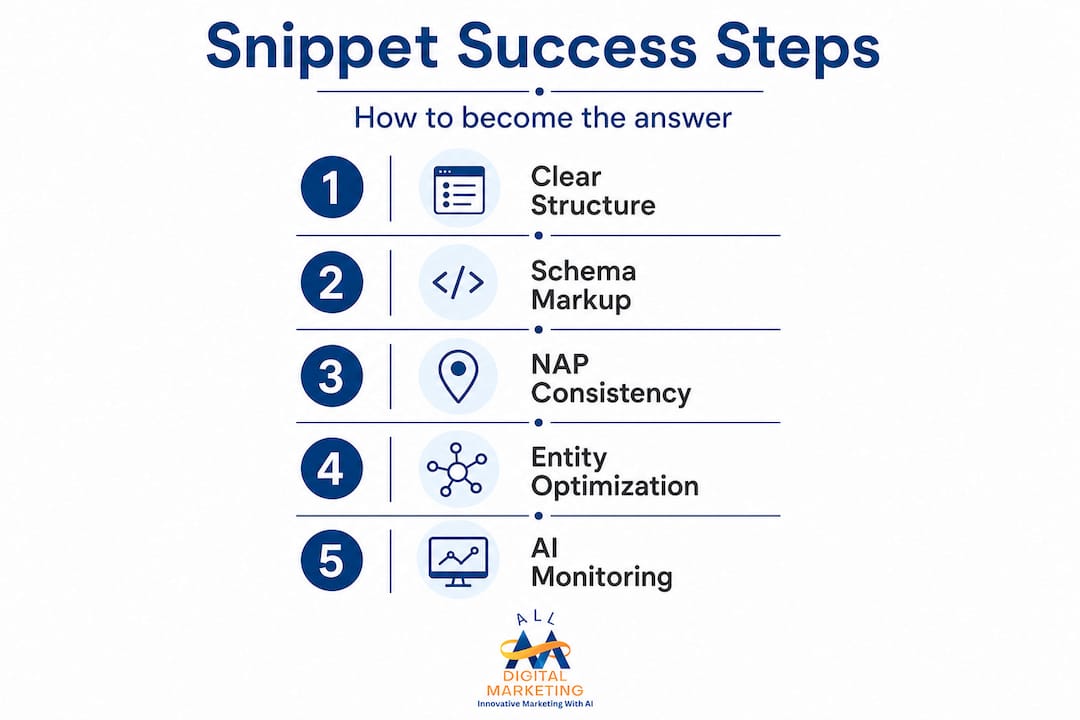
Structuring content into extractable, answer-first sections is the single most impactful change most small business websites need. Most local business websites are built to look good, not to be cited. That means content is often buried in design elements, written in vague marketing language, or organized in a way that makes no sense to an AI system trying to extract a clean answer.
Here is a step-by-step action framework for snippet and AI citation readiness:
- Conduct a content audit. Review every page on your website. Identify which pages answer specific customer questions and which ones are just general descriptions of your services. Flag the pages that need restructuring.
- Rewrite service pages with answer-first sections. Each major service or topic should have its own clearly labeled section. Start each section with a direct, one-sentence answer to the most common question about that topic.
- Add a FAQ section to every key page. Build a dedicated FAQ block on service pages, your homepage, and your about page. Write each question the way a real customer would type it into a search engine.
- Implement schema markup. Add LocalBusiness, FAQPage, and HowTo schema to your most important pages. Use a structured data plugin or ask your web developer to add JSON-LD schema directly to your pages.
- Claim and complete every major directory listing. Focus on Google Business Profile first, then expand to industry-specific directories, Yelp, Bing Places, and Apple Maps. Verify that all information matches exactly.
- Run a NAP consistency check. Search your business name online and review every listing that appears. Correct any discrepancies in your name, address, or phone number.
- Schedule quarterly content reviews. AI systems favor current, accurate information. Set a recurring calendar reminder to review and update your key pages every three months.
- Track your snippet appearances. Use Google Search Console to monitor whether your pages are appearing in featured snippet positions. Look for which queries trigger these appearances and optimize those pages further.
Pro Tip: Always review your Google Business Profile for accuracy and completeness. AI draws heavily from Google Business Profile data when generating local recommendations. Incomplete profiles, outdated hours, or missing service categories will directly reduce your chances of being cited in AI-generated local answers.
Your AI SEO strategy needs to treat your Google Business Profile as a living document, not a one-time setup task. The same applies to your website content. Every time you add a new service, change your hours, or open a new location, that information needs to be updated everywhere simultaneously.
Understanding the role of AI in local SEO helps you prioritize these actions. AI systems do not just look at your website. They pull from a wide network of data sources to build a complete picture of your business. The more complete and consistent that picture is, the more confidently AI will cite you as a trusted local source.
The real opportunity: Shifting your mindset beyond blue links
Here is something most digital marketing content will not tell you directly: a lot of businesses are now measuring the wrong thing. They track keyword rankings obsessively, celebrate when they move from position four to position two, and feel frustrated when traffic does not follow. The uncomfortable reality is that in a world where AI Overviews and answer boxes dominate the top of the page, a number two ranking can actually mean fewer clicks than a well-placed citation in an AI summary that never shows a traditional ranking at all.
This is the mindset shift that separates businesses building for the future from those still optimizing for a search environment that is rapidly changing. The goal is not to be ranked. The goal is to be cited. Those are two fundamentally different objectives, and they require different strategies.
Thinking like an information provider means asking a different question. Instead of "how do I rank for this keyword," ask "what is the most direct, complete answer I can give to this question, and how can I structure it so that any AI system would be confident citing it." That shift in thinking changes how you write content, how you organize your website, and how you build your online presence.
The businesses winning the AI visibility game right now are often not the largest or the most well-funded. They are the ones who have invested in owning the search box by building content that is clear, structured, and answer-ready. They have audited their citations, cleaned up their NAP data, and written FAQ sections that mirror real customer questions. These are not expensive tactics. They require time, consistency, and a willingness to think about your online presence differently.
The opportunity right now is real. Many local businesses are still running on old SEO assumptions, which means the field is less competitive for those who adapt early. The businesses that invest in extractable content structure and citation presence in 2026 will have a meaningful advantage as AI-driven search continues to grow.
How Digital Marketing All can help you dominate search snippets
The strategies covered in this article, from restructuring your content for AI extraction to auditing your local citations and optimizing your Google Business Profile, are highly effective. They are also time-consuming and technically detailed for business owners who are already managing everything else. That is where Digital Marketing All steps in.
We specialize in helping small and medium-sized businesses win visibility in AI-driven search results, featured snippets, and local answer boxes. Our team handles local SEO and citation management, content restructuring for answer-engine eligibility, schema markup implementation, Google Business Profile optimization, and reputation management. We combine these tactics with our proven search optimization approach to make your business the answer customers find first. Visit digitalmarketingall.org to learn more and get started with a strategy tailored to your market.
Frequently asked questions
What is a search snippet and why does it matter for my business?
A search snippet is the short answer box or summary AI pulls from websites to answer questions in search results, often above classic listings, making it your best opportunity for high visibility. According to snippet optimization research, structuring content into extractable, answer-first sections increases your eligibility to be selected for these AI-driven summaries.
How can I improve my small business's chances of being featured in AI-driven search snippets?
Structure your pages with clear headings, lists, and concise answers that AI can easily extract, and ensure your business info is consistent across all online sources. Treat snippet optimization as answer-engine extractability engineering, using self-contained sections and list or table formats that both Google and AI language models can reuse.
Is it possible for my business to appear in AI answers even if I don't rank in the top results?
Yes, 80% of AI-cited sources do not appear in Google's top 100 organic results, which means citation presence and clear business signals matter more than traditional ranking for AI inclusion.
What's the role of schema markup in snippet optimization?
Schema markup provides search engines and AI systems with clear, structured signals about your business and website content, directly boosting your eligibility for snippet selection and AI-driven citations.