
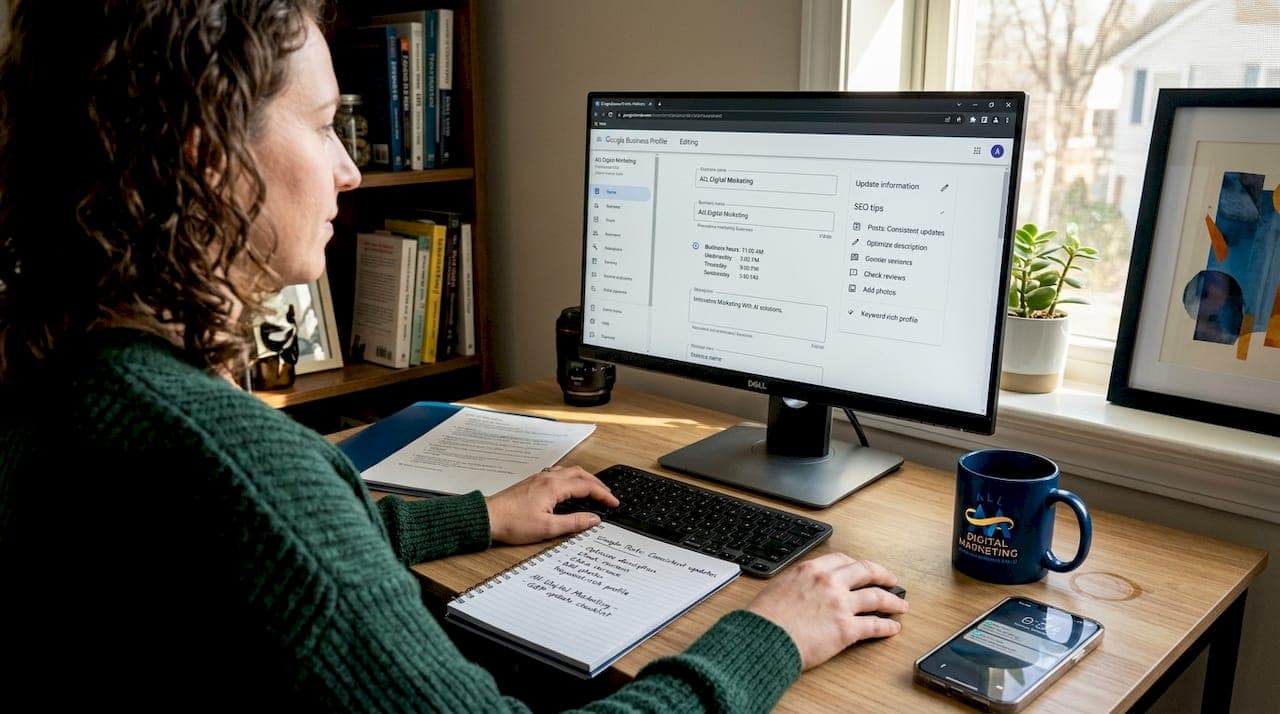
TL;DR:
- AI tools optimize local search performance by analyzing user behavior and monitoring traffic in real time.
- Consistent updates to Google Business Profile and managing reviews remain crucial for high local rankings.
- A structured 90-day plan focusing on self-audits, content, reviews, and AI monitoring drives effective local SEO results.
Local search has never moved this fast. Google's algorithm updates in early 2026 have reshuffled rankings for businesses across every category, and AI is no longer a future consideration—it's actively changing how customers find you right now. If you're running a local business, you've probably noticed that what worked even 18 months ago isn't delivering the same results. The good news is that visibility is still very achievable, but it requires knowing which trends actually drive results and which ones are noise. This guide gives you exactly that: a clear, practical breakdown of the top local SEO trends in 2026 and how to act on them.
Table of Contents
- Key criteria for evaluating local SEO trends in 2026
- Top 5 local SEO trends businesses can't ignore in 2026
- Trend comparison: What delivers the best ROI?
- 90-day action plan to win at local SEO in 2026
- Our take: The uncomfortable truth about local SEO in 2026
- Ready to transform your local SEO results?
- Frequently asked questions
Key Takeaways
| Point | Details |
|---|---|
| Prioritize GBP and reviews | Focus on Google Business Profile and customer reviews for top local rankings. |
| Leverage AI tracking | Integrate AI-driven traffic monitoring to capitalize on emerging search behaviors. |
| Mix paid and organic | Use both organic SEO and paid ads for the best local search visibility in 2026. |
| Follow a 90-day roadmap | Implement short, focused action plans to see measurable ranking gains fast. |
| Focus on behavioral signals | Monitor site engagement, reviews, and GBP actions to influence search rankings. |
Key criteria for evaluating local SEO trends in 2026
Not every trend deserves your time and budget. Before we explore what's working right now, it helps to have a clear filter for separating meaningful shifts from passing fads. This is especially important for small and medium-sized businesses that have limited resources and need every marketing dollar to count.
When evaluating any local SEO trend, focus on these core criteria:
- Proven ranking impact: Does it directly affect how Google ranks your business in local results? Trends tied to search ranking factors with documented, measurable impact deserve priority.
- ROI potential: Will the effort translate into actual leads, calls, or foot traffic? Tactics that look impressive but don't convert aren't worth chasing.
- Adaptability: Can this strategy evolve as Google continues updating its algorithm? Sustainable tactics have built-in flexibility.
- AI compatibility: Is this trend aligned with how AI-driven search tools surface local results? The rise of AI-driven local search signals means that what satisfies AI recommendations matters as much as what satisfies traditional crawlers.
- Integration with fundamentals: Does it build on your existing Google Business Profile (GBP), reviews, and local content, or does it require you to abandon proven methods?
One of the biggest lessons from 2026's search landscape is that organic alone is insufficient as Google continues its pay-to-play shift. At the same time, the fundamentals like GBP and reviews still drive the vast majority of local ranking success. The winning strategy blends both organic discipline and targeted paid visibility.
Pro Tip: When a new trend surfaces, run it through this checklist before investing time or money. If it doesn't score well on at least three of the five criteria above, it's probably not worth prioritizing right now.
Top 5 local SEO trends businesses can't ignore in 2026
With these evaluation criteria in mind, here are the five trends every local business must focus on in 2026. Each one has been vetted against real-world performance data, and each comes with a clear action step you can start on immediately.
-
AI-powered traffic monitoring and optimization. Artificial intelligence tools are no longer just for large enterprises. AI platforms now analyze local search data, monitor how users interact with your listings, and identify patterns that predict which ranking actions will have the most impact. Understanding AI in local SEO is essential because AI tools help you prioritize your optimization efforts and avoid wasted work. You should be using AI to track which keywords drive profile visits, which search queries lead to calls, and how users behave after they land on your site.
-
Ongoing Google Business Profile (GBP) updates. Your GBP is still the single most powerful local ranking tool you have, and it rewards consistency. Businesses that post updates weekly, add fresh photos, update hours accurately, and use the Q&A feature are outperforming those that set it and forget it. Your GBP optimization guide should be treated as a living document, not a one-time checklist. Google signals that active, well-maintained profiles get more placement in the local pack results.
-
Reviews and reputation management. Reviews have always mattered, but in 2026, their role in ranking and customer conversion has intensified. Quantity, recency, response rate, and keyword richness inside reviews all influence your standing. Businesses that respond to every review, good or bad, signal trustworthiness to both Google and potential customers. This isn't just a soft branding exercise; it's a direct ranking input.
-
Integrated service pages and local content. Thin websites with generic content are losing ground. Google rewards location-specific service pages that answer real customer questions with depth and accuracy. If you serve five neighborhoods or five service categories, each deserves its own optimized page. This approach also feeds AI-powered search tools, which pull structured, specific content when generating recommendations.
-
Adaptive organic and paid strategy. Running Google Ads alongside your organic local SEO isn't optional anymore—it's strategic. The local search results page now includes ads, the local pack, organic listings, and AI-generated summaries. Covering multiple positions increases your visibility and your chances of being chosen. Businesses that treat paid and organic as complementary rather than competing channels are seeing stronger overall performance.
"Behavioral signals are a rising ranking factor for local search. Clicks, dwell time, and engagement with your profile all send signals to Google about your relevance and authority."
The way people interact with your listing matters. User engagement metrics like click-to-call rates, direction requests, and time spent on your website are being weighted more heavily in 2026's ranking signals. Businesses that actively encourage clicks and engagement are seeing measurable ranking improvements.

Pro Tip: Don't wait for customers to take action on their own. Include clear calls to action on your GBP posts, website, and in every review response. Small prompts like "call us today" or "get directions here" can measurably lift your behavioral signals.
Trend comparison: What delivers the best ROI?
Understanding the trends is crucial, but how do they stack up against each other in terms of practical results? Here is a side-by-side comparison to help you allocate your time and budget effectively.
| Trend | Time investment | Cost level | Speed to results | Long-term impact |
|---|---|---|---|---|
| AI-powered traffic monitoring | Medium | Low to medium | Fast (30-60 days) | Very high |
| GBP ongoing updates | Low (weekly) | Low | Fast (30-45 days) | Very high |
| Reviews and reputation | Low to medium | Low | Medium (60-90 days) | Very high |
| Service pages and local content | High | Medium | Slow (90+ days) | High |
| Paid and organic integration | Medium | Medium to high | Fast (immediate) | Medium to high |
AI-powered traffic monitoring stands out because it has the fastest feedback loop. You can see which changes move the needle in real time and adjust your strategy without waiting months for data. This is a significant advantage over traditional SEO approaches where you often had to wait 3-6 months to evaluate results.
Key stat: AI traffic monitoring now accounts for 2-22% of all search-driven website visits for small and medium businesses, a range that reflects how quickly different industries are seeing AI-generated search traffic arrive. If your business isn't optimized for AI recommendations, you're missing a growing slice of your potential audience.
GBP updates and reviews offer the best combination of low cost and high impact. These are the two areas where most local businesses can outperform their competitors without spending heavily. If you execute consistently here, you build a compounding advantage that is very difficult for competitors to close quickly.
Service pages and local content take more upfront investment but create durable ranking assets. A well-built service area page continues to generate organic traffic and leads for years. Think of it as building a long-term asset rather than a short-term tactic. Pairing this with the advanced SEO tactics that actually work in 2026 can significantly accelerate your results.
For businesses ready to accelerate growth, following a structured 90-day SEO plan gives you a clear framework to layer these strategies in the right order without overwhelming your team or budget.
90-day action plan to win at local SEO in 2026
Comparing ROI gives you the big picture. Now here's how to take real action, starting today.
A structured 90-day approach is the most effective way to build local SEO momentum without burning out. Research confirms that 90-day SEO sprints focused on GBP audits, service page builds, review cadence, and citation cleanup are generating measurable ranking improvements for service businesses in competitive markets.
Here is how to break it down:
-
Days 1-30: Foundation and audit. Start with a full GBP audit. Verify all business information is accurate and consistent across your profile. Add or update your service categories, upload fresh photos, and write a new business description that includes your primary service keywords. Check that your name, address, and phone number match exactly across every online directory. Inconsistencies here are one of the most common and easiest-to-fix ranking killers.
-
Days 31-60: Content and reviews. Build or improve at least two location-specific service pages on your website. Each page should address a specific service for a specific area and answer the questions your customers actually ask. Simultaneously, launch a review request campaign. Reach out to past customers via email or text and ask for honest feedback on Google. Aim for a minimum of five new reviews per month. The steps for ranking on Google Maps are deeply tied to this review and content work.
-
Days 61-90: Optimization and integration. Begin using AI tools to monitor your traffic and ranking changes from the first two months. Identify which keywords or pages are gaining traction and double down there. Start integrating paid ads to cover your highest-value search terms where your organic ranking isn't yet in the top three positions. Focus on improving your GBP reputation by responding to all new reviews and adding weekly posts with offers, updates, or events.
| Phase | Key actions | Primary goal |
|---|---|---|
| Days 1-30 | GBP audit, citations, photos | Fix foundation |
| Days 31-60 | Service pages, review campaign | Build authority |
| Days 61-90 | AI monitoring, paid integration | Scale results |
Pro Tip: Set a monthly review day in your calendar. Once a month, spend 30 minutes reviewing your GBP insights, tracking your keyword positions, and identifying your top-performing service page. This habit keeps your strategy current and lets you spot problems before they cost you rankings.
Our take: The uncomfortable truth about local SEO in 2026
After working with local businesses across dozens of industries, we've seen a pattern that most SEO articles won't tell you. Business owners often get so excited about new tools and trends that they skip the boring stuff. And the boring stuff is exactly what wins.
The businesses that rank consistently in 2026 are not necessarily the ones using the most sophisticated AI tools or running the biggest ad budgets. They are the ones who update their GBP every single week. They respond to every review within 24 hours. They build location pages that actually help customers find and choose them. These are not exciting activities, but they compound over time in a way that no shortcut can replicate.
AI is genuinely powerful in 2026, and we encourage every client to adopt AI tools for traffic monitoring and content assistance. But AI is a force multiplier for good fundamentals, not a replacement for them. If your GBP is incomplete, your reviews are nonexistent, and your website has no local content, AI tools will not save your rankings. They will just help you see the problem faster.
The other uncomfortable reality is that chasing every new trend actively hurts your results. Every hour spent testing an unproven tactic is an hour not spent on the proven actions that move the needle. We've watched businesses cycle through tool after tool while their core metrics stagnated. The antidote is discipline. Do the fundamentals better than your competitors, layer in AI to optimize, and then and only then add paid strategies to amplify what's already working.
One resource we consistently point clients to is the driving local customers framework, which captures this philosophy well. Start with what's proven. Build from strength. Use new tools to go further, not to replace what works.
Ready to transform your local SEO results?
You now have a clear picture of the trends, the ROI comparisons, and a 90-day roadmap to act on them. The next step is execution, and that's where having the right partner makes a real difference.
At Digital Marketing All, we specialize in helping local businesses like yours translate strategy into rankings, traffic, and leads. Whether you need a full local SEO strategy, a Google Business Profile overhaul, or AI-powered optimization tools, we have the experience to move your business forward in 2026. Our team works with small and medium-sized businesses every day to build the kind of consistent, disciplined local search presence that compounds over time. Reach out today and let's build your 90-day growth plan together.
Frequently asked questions
What is the most important local SEO ranking factor in 2026?
Google Business Profile and reviews remain the top ranking factors impacting local search visibility in 2026, outperforming most other signals when maintained consistently.
How much does AI impact local SEO now?
AI-driven traffic now accounts for 2-22% of search-driven website visits for small businesses, and that number is rising as more users rely on AI-generated search summaries.
How quickly can I improve my local search rankings?
You can see measurable local SEO results within 90 days by prioritizing GBP optimization and building local content, as 90-day SEO sprints have proven effective for service businesses in 2026.
Do paid ads replace organic local SEO in 2026?
No. Both organic and paid strategies are necessary, because organic alone is insufficient to maintain consistent visibility across all the positions Google now shows in local results.
How do I track behavioral signals for my business?
Monitor reviews, website engagement rates, and Google Business Profile actions like calls and direction requests, as behavioral signals are a growing ranking factor in 2026's local search algorithm.