
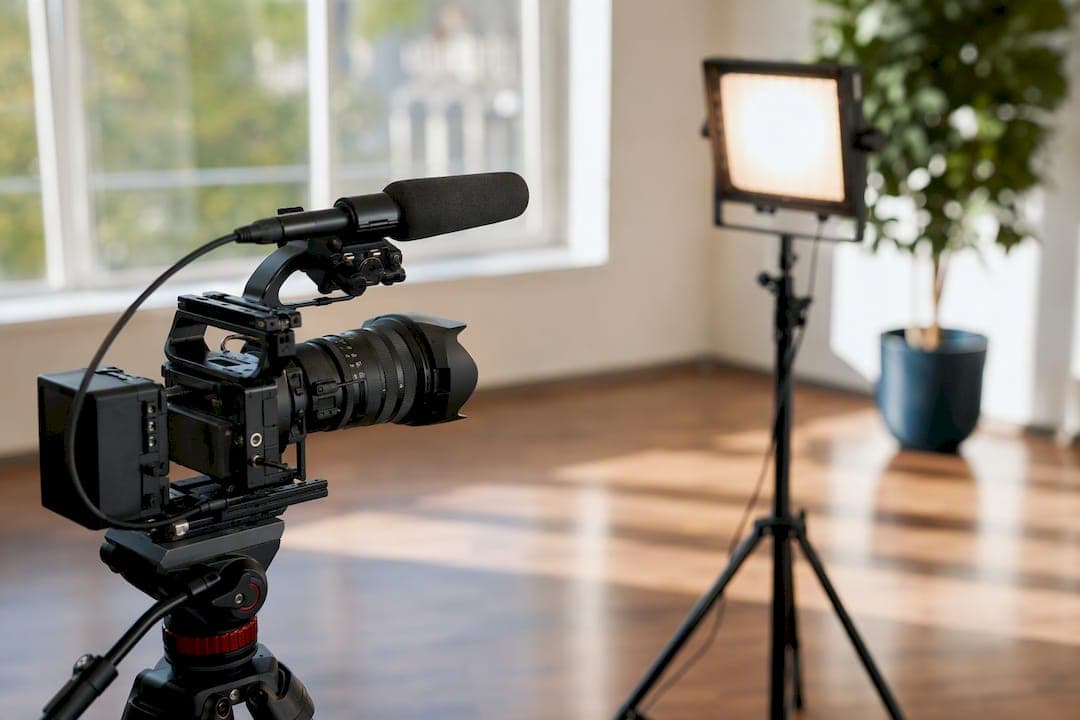
The most effective testimonial videos use a short, specific story that proves a measurable outcome, then get placed where buyers decide. Follow testimonial video best practices that matter: pick a customer who mirrors your ideal buyer, structure the story as problem to decision to outcome, keep it between 30 and 90 seconds, capture clean audio with captions, and embed it directly at your pricing or checkout page.
TL;DR:
- Testimonials should focus on a specific, measurable outcome and be placed where buyers hesitate, like pricing pages or checkout flows.
- A strong story follows the problem, decision trigger, result with a number, and recommendation, ideally within 30 to 90 seconds.
- Choosing customers who reflect your target buyer and preparing open questions increases authenticity and relevance in videos.
- Use natural lighting, clear audio, stable framing, and vertical orientation for social, while keeping videos short and captioned for accessibility.
- Continuous collection and testing over 90 days, with permission workflows and honest, imperfect footage, maximize ROI and authenticity.
Table of Contents
- Why Testimonial Videos Influence Conversions and Trust
- The Testimonial Narrative Arc: Short-Form and Case-Study Versions
- How to Choose and Prepare Testimonial Participants
- Production Checklist: Lighting, Audio, Framing, and Format
- Editing Rules: Length, Captions, and Repurposing
- Where to Place Testimonial Videos for Maximum Impact
- Measuring ROI: KPIs, Testing, and Realistic Timelines
- Ready-to-Use Prompts, Questions, and a Simple Shot List
- A 90-Day Testimonial Program You Can Run Starting Monday
- How to Handle Negative or Neutral Testimonials
- Getting Authentic, Compelling Answers on Camera
- Why Imperfection Beats Polish
- How Digital Marketing All Builds Your Testimonial Program
- Sources
- FAQ
Why Testimonial Videos Influence Conversions and Trust
Video transfers trust faster than text because it shows a real person's tone, hesitation, and body language. Written reviews can be skimmed and dismissed; a face on camera saying "this fixed my actual problem" is harder to fake and harder to ignore.
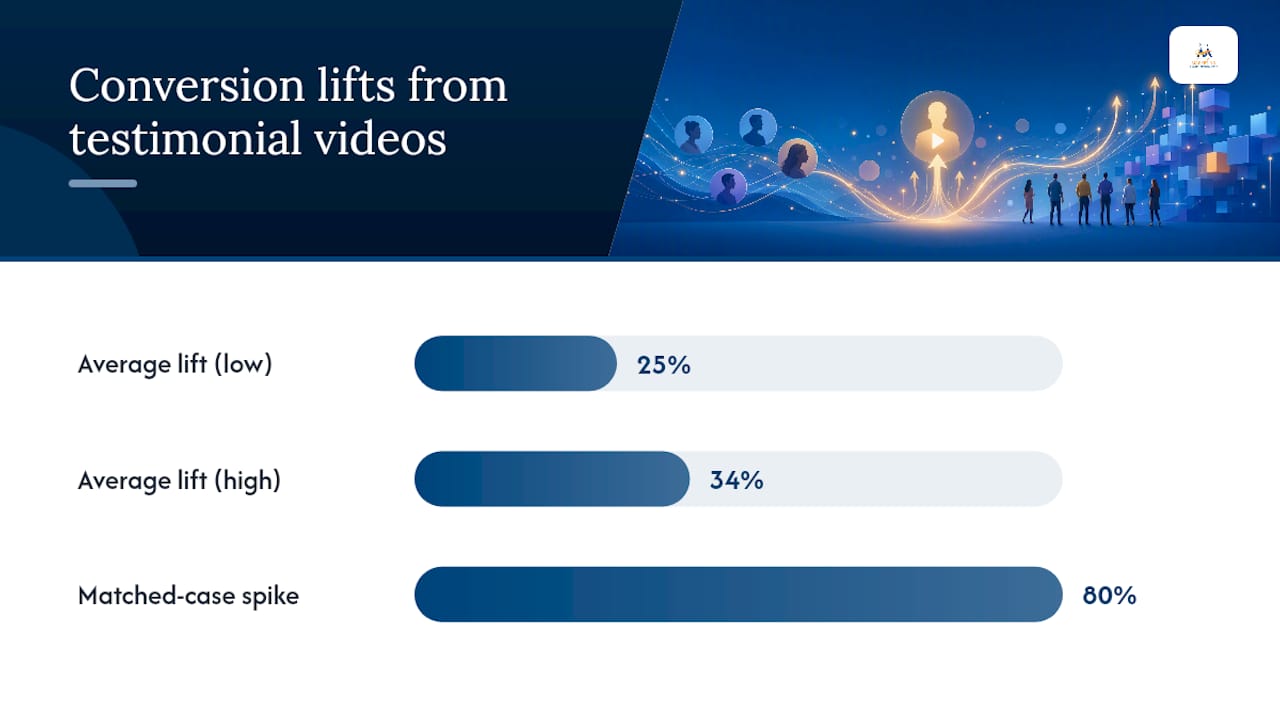
The numbers back this up. Testimonial video statistics from 2026 point to average conversion lifts of 25 to 34%, with some campaigns seeing spikes as high as 80% when the testimonial matches the visitor's specific use case. Testimonials matter most at moments of hesitation, not moments of discovery. That means pricing pages, cart abandonment emails, and proposal follow-ups, not just your homepage.
Pro Tip: Don't save your best testimonial for the homepage. Put it where people are already reaching for their wallet and pausing.
The Testimonial Narrative Arc: Short-Form and Case-Study Versions
Every strong testimonial follows a four-beat arc, whether it runs 45 seconds or five minutes. GetPureProof's guide to video testimonials calls this the Before, Trigger, Outcome, Recommendation structure, and it holds up because it mirrors how buyers actually make decisions.
- Before/problem: what was broken, slow, or costing money before your product entered the picture
- Trigger/decision: the specific moment or reason they chose to act, not a vague "we needed help"
- Outcome: a concrete result, ideally with a number attached
- Recommendation: who this is for and why they'd tell a peer to try it
Longer case-study cuts add three more layers: implementation detail (how long onboarding took, who was involved), friction points they overcame, and role-specific proof for different buyers on a committee. One well-run 20-minute interview can yield a 30-second social clip, a 90-second site clip, and a 4-minute case study, all from the same footage.
How to Choose and Prepare Testimonial Participants
Picking the right customer matters more than picking the most enthusiastic one. CaseLeap's B2B testimonial playbook recommends choosing customers who mirror your ideal customer profile, meaning similar company size, industry, or use case to the prospects you're trying to convert. A glowing review from an outlier customer won't resonate with the buyer scrolling your pricing page.
- Shortlist 3 to 5 customers whose situation matches a specific buyer persona or use case gap
- Run a 15 minute discovery call before the shoot to surface their real story, not just their opinion
- Send a signed release form covering usage rights, distribution channels, and duration before recording anything
- For enterprise clients, build in extra lead time. Legal and marketing approval can take two to four weeks
- Offer an asynchronous, browser-based recording option so customers can film on their own schedule
G2 reviews of testimonial collection tools consistently show buyers favor platforms with built-in permission workflows and low-friction recording, because it removes the scheduling back-and-forth that kills momentum.
Pro Tip: Send participants three to four sample questions in advance, but never a full script. You want prepared thoughts, not memorized lines.
Production Checklist: Lighting, Audio, Framing, and Format
You don't need a studio, but you do need to control three variables: light, sound, and stability. A customer sitting near a window with soft, indirect daylight will look more natural than one under harsh overhead office lighting.
- Audio first: a $50 lavalier mic beats a $2,000 camera with built-in audio every time; bad sound kills credibility faster than bad video
- Lighting: one soft light source at a 45 degree angle, or natural window light, avoids harsh shadows
- Framing: shoot at eye level, keep the subject slightly off-center using the rule of thirds, and leave headroom without excessive empty space above them
- Stabilization: a basic tripod or phone mount removes shake that reads as amateur in a distracting way
- Orientation: shoot vertical (9:16) for social and mobile-first placements, and horizontal for site embeds and sales decks, since vertical formats consistently outperform on mobile and social platforms
- Background: a clean, uncluttered space (a home office, a real workspace) builds more trust than a stock studio backdrop
Comfortable subjects give better answers. Let them adjust their seat, offer water, and do a 30-second warm-up question before you start recording the take you'll actually use.
Editing Rules: Length, Captions, and Repurposing
Length depends entirely on where the clip lives. Social clips should run under one minute, site-embedded testimonials are often around one to one and a half minutes, and full case-study videos can be longer for more detailed buyer engagement.
- Cut for pace, but never edit a quote to change its meaning or context. That's an ethical line, not a style preference
- Add captions and a full transcript to every video. This helps accessibility and lets Google index the content
- Keep small imperfections. Research on video testimonials shows over-polished clips can actually reduce perceived authenticity compared to slightly rougher, real footage
- Design thumbnails around the customer's face mid-expression, not a static frame, to boost click-through
- Build a repurposing plan before you shoot: one interview should become a library of 20 to 45 second clips, each mapped to a different buyer objection
Pro Tip: Cut one role-specific version for each stakeholder in a typical buying committee, IT, finance, and the executive sponsor each want to hear different proof; for expert advice on editing and visual storytelling techniques, see visual storytelling tips.
For teams building this into an ongoing content system, DigitalMarketingAll's guide to video-first marketing covers how testimonial clips fit into a broader content calendar.
Where to Place Testimonial Videos for Maximum Impact
Placement determines whether a great testimonial ever gets seen by the right person at the right time.
- Pricing and product pages: embed a 60 to 90 second clip directly next to the CTA, not buried below the fold
- Checkout and cart abandonment flows: a short clip addressing common hesitation ("was it worth the switch?") reduces drop-off
- Proposal follow-ups and sales decks: a role-specific clip closes gaps a generic case study can't
- Social and paid ads: vertical, sub-60-second cuts drive top-of-funnel awareness and retargeting
Technically, embed with async loading so the video doesn't slow initial page render, use a compressed thumbnail instead of autoplay, and serve through a CDN with adaptive bitrate so mobile viewers aren't stuck buffering. Video testimonial ROI data shows landing-page conversion lift is the clearest metric to track, so tag every placement with its own UTM parameter to isolate which clip and which page combination actually moves the needle.
Measuring ROI: KPIs, Testing, and Realistic Timelines
Track four numbers: conversion lift on the page hosting the video, pipeline influenced by testimonial-viewing accounts, deal velocity for prospects who watched a clip versus those who didn't, and average watch time as a proxy for relevance.
- Run A/B tests with the video against a static image or no media at all, and don't call a winner until you've got a meaningful sample size on both variants
- Expect early signal within 90 days on high-traffic pages; enterprise sales-cycle impact on deal velocity often takes 6 months to show clearly
- Combine analytics data with sales team feedback. Reps often notice a testimonial closing objections weeks before the dashboard shows it
- Cost ranges widely, from near $0 for self-recorded async clips to several thousand dollars for a studio production, so weigh testimonial video cost against the specific placement's expected lift before over-investing in polish
Ready-to-Use Prompts, Questions, and a Simple Shot List
You don't need a creative brief to start collecting testimonial video examples. You need four prompt templates and a short list of questions mapped to the narrative arc.
- Social clip prompt: "In 30 seconds, tell us the one problem we solved and the result you got."
- Site testimonial prompt: "Walk us through what changed before and after, plus one number that proves it."
- Case study prompt: "Describe the decision process, what almost stopped you, and what you'd tell a peer considering the same move."
- Executive soundbite prompt: "What would you tell another decision-maker at your level who's on the fence?"
Sample interview questions that map to each beat: What was frustrating enough to make you look for a solution? What almost made you say no? What surprised you after switching? What would you measure to prove this worked to your boss? A minimal shot list needs three shots: a medium shot for the main talking-head answer, a close-up for the emotional beat, and one b-roll shot of the product or workspace in use, plus a thumbnail captured mid-sentence for authenticity.
A 90-Day Testimonial Program You Can Run Starting Monday
Running testimonial collection as a one-off shoot wastes the infrastructure you just built. Treat it as a recurring program instead.
- Days 1 to 30: identify 8 to 10 ICP-matching customers, send release forms, and collect 4 to 6 async or scheduled interviews
- Days 31 to 60: edit clips into short, mid, and long formats; embed the strongest three on pricing and product pages
- Days 61 to 90: measure conversion lift and pipeline influence, then retire underperforming clips older than 12 to 18 months to keep proof current
Assign one owner for outreach and consent, one editor for cuts and captions, and one analyst to close the loop on measurement. DigitalMarketingAll's team playbook for video content workflows is a useful template for assigning these roles without creating bottlenecks at approval stages.
How to Handle Negative or Neutral Testimonials
Not every customer interview produces a glowing review, and that's not a failure. It's often more useful than you'd expect. A mixed or neutral testimonial, one that mentions a rough onboarding period or a feature gap alongside a genuine result, reads as more credible than a uniformly perfect one, because real buyers know no product is flawless.
The key is context, not suppression. If a customer says implementation took longer than expected but the result justified it, keep that friction in the cut. It answers the objection a skeptical prospect is already forming in their head. Cutting it out to make the story sound cleaner actually makes it less persuasive, not more.
When an interview turns out neutral rather than negative, meaning the customer likes the product but doesn't have a dramatic before-and-after story, look for a narrower angle. Maybe they can't speak to ROI, but they can speak credibly to ease of use, support responsiveness, or how it compares to a previous vendor. Reframe the ask around what they can honestly praise instead of forcing a testimonial that doesn't fit their experience.
If an interview turns genuinely negative during recording, don't publish it, but don't ignore it either. Treat it as product or service feedback and route it to the right team. Never edit a hesitant or critical comment to sound more positive than it was; that crosses from editing into misrepresentation, and customers who discover their words were twisted rarely stay customers. The goal isn't a perfect record. It's an honest one that still does its job.
Getting Authentic, Compelling Answers on Camera
The biggest reason testimonials sound like hostage statements, stiff, generic, over-rehearsed, is that interviewers ask closed questions that invite a one-word answer. "Did you like working with us?" gets you "yes." That's not usable footage.
Ask open, specific questions instead: "Walk me through the day you realized the old process wasn't working anymore." Specificity invites detail, and detail is what makes a testimonial believable. Structured discovery questions around stakes, decision criteria, and friction consistently produce decision-oriented footage instead of generic praise.
Let silence do some work. After someone answers, pause for two full seconds before your next question. People often add the most honest, specific detail in that gap, once they think the "official" answer is done. Don't rush to fill dead air.
Avoid feeding them your own language. If you ask "would you say our platform is intuitive?" they'll parrot "intuitive" back at you, and it'll sound scripted because it is. Ask them to describe the experience in their own words and let their vocabulary carry the story.
Finally, film more than you need. Ask the same question two different ways if the first answer feels flat, and give them permission to restart an answer if they stumble. The best line in a testimonial video often comes on the second or third attempt, once the subject relaxes into talking like a person instead of performing like a spokesperson.
Why Imperfection Beats Polish
The instinct to over-produce testimonials comes from a good place, but it backfires. A slightly shaky handheld clip of a real customer describing a real frustration will outperform a glossy, scripted-sounding version nine times out of ten, because buyers have gotten very good at smelling a script. Preserve the imperfection. That's the whole trick.
— Diane O'Brien
How Digital Marketing All Builds Your Testimonial Program
Collecting testimonials is only half the job. Getting permission, editing them well, and embedding them where they actually convert is the other half, and it's where most in-house teams stall out. Digital Marketing All's review generation and management service handles the outreach, consent tracking, and collection workflow so you're not chasing customers for a signed release form three weeks after the interview.
Once you have footage, placement matters as much as production quality. If your current site can't embed video without slowing page load, that's a conversion leak worth fixing before you invest in more shoots. Digital Marketing All's website design services build pricing and product pages around fast, adaptive video embedding from day one. Ready to turn customer stories into a measurable growth channel? Start with a review generation consultation and get your first testimonial workflow running this month.
Sources
- Video testimonials: the ultimate guide for 2026 (with examples, scripts, embed tips) | Get Pure Proof
- Video Testimonial Statistics 2026: 48% Conversion Lifts in the AI-Personalization Era
- The ROI of Video Testimonials: What the Data Says in 2026 | VideoTestimonials Blog
- B2B Testimonial Video Best Practices That Drive Pipeline
FAQ
How Can I Create an Effective Testimonial Video?
Pick a customer who mirrors your target buyer, structure their story as problem, decision, and outcome, then keep the final cut between 30 and 90 seconds with clean audio and captions.
How Long Should a Testimonial Video Be?
Social clips work best under 60 seconds, site-embedded testimonials perform well at 60 to 90 seconds, and full case studies for enterprise buyers can run 3 to 5 minutes.
What Is the Best Format for a Testimonial Video?
Vertical (9:16) format performs best for social and mobile placements, while horizontal video suits website embeds and sales presentations, since vertical clips consistently see stronger mobile engagement.
Can You Give an Example of a Strong Testimonial Video Structure?
A strong example follows the four-beat arc: a customer describes their problem, the trigger that pushed them to act, a specific measurable outcome, and a direct recommendation, all in under 90 seconds.
How Much Does a Testimonial Video Cost to Produce?
Testimonial video cost ranges from close to $0 for self-recorded, browser-based clips to several thousand dollars for a full studio production, depending on crew, editing, and the number of deliverables.