

TL;DR:
- In 2026, the fastest growth comes from implementing a video-first program that leverages short-form content, AI-assisted production, and strict brand quality controls. Most teams now adopt AI tools for video creation and editing, combining speed with human oversight to maintain quality. Successful teams map videos to buyer personas and funnel stages, measure impact through CRM integration, and refresh creative variants regularly to prevent fatigue.
The fastest path to measurable growth in 2026 is a video-first program that pairs short-form formats, AI-assisted production at scale, and strict on-brand quality controls. This video marketing guide for 2026 gives you the complete playbook: trends, strategy, production workflows, measurement, and a copyable 90-day plan you can run starting this week.
Your 2026 TL;DR checklist:
- Prioritize short-form series and repurposing pipelines across your top one or two platforms
- Map every video asset to a specific buyer persona and funnel stage before production starts
- Adopt modular production: capture once, then version many using AI-assisted tools with human QC at every gate
- Invest in paid amplification and run incrementality tests to separate real video lift from organic noise
- Wire video analytics to your CRM so you can show video-influenced pipeline to leadership
According to Wyzowl, 63% of video marketers used AI tools to help create or edit marketing videos in 2026. That majority threshold signals a structural shift: AI-assisted production is now the baseline, not the experiment. The teams pulling ahead are the ones combining that speed with human judgment to protect brand quality.
Table of Contents
- What are the top video marketing trends in 2026?
- How to build a video-first strategy that sales will actually use
- Which video types should you use and when?
- How do you scale video production without losing brand quality?
- How should you distribute and amplify video content in 2026?
- What KPIs should you track to prove video's impact on revenue?
- What does video marketing actually cost, and how do you staff it?
- A copyable 90-day video plan from an agency playbook
- Key Takeaways
- What winning teams do differently in 2026
- How Digital Marketing All can help you build this program
- Curated further reading and data sources for 2026
- FAQ
What are the top video marketing trends in 2026?
Short-form dominance is real, and the numbers back it up
Most marketers consider short-form the most effective social media video format, and many rate the 30-second to 2-minute window as the most effective overall. Platform sweet spots still cluster around 15–60 seconds for awareness-stage content, with 60–90 seconds performing well for consideration hooks. The practical implication: build series, not one-offs. A single shoot can yield 6–10 short-form clips when you plan for repurposing from the start.
AI-assisted production has crossed the majority threshold
With a majority adoption among video marketers, AI tools are now a production standard. The economics are compelling: AI video platforms can reduce per-video production cost significantly and cut timelines substantially versus traditional workflows. The risk is real, too. ROI satisfaction with video has decreased compared to the previous year, a drop that tracks directly with volume-driven quality issues. What to do: use AI for iteration and first drafts, then require human QC before anything goes live.

Creator and UGC formats have set the authenticity baseline
Audiences now judge brand video against creator content, not broadcast ads. That shift means polished-but-stiff corporate video underperforms against authentic, presenter-led formats even when the production budget is lower. Creator briefs and UGC briefs are no longer optional extras; they are the starting point for any social-first video program. What to do: write a creator brief template that defines your brand guardrails, key message, and call-to-action, then give creators room to perform in their own voice.
Personalization and localization scale with AI dubbing
Platforms in 2026 support presenter-led localization and dubbing across many languages, removing the need to reshoot for each market. Localization is now a revenue-prioritization decision, not a production-capacity decision. What to do: rank your target markets by revenue potential, then build a localization queue that works through them systematically, starting with your highest-value segments.
CTV growth is reshaping upper-funnel video strategy
Connected TV has moved from a test budget to a core upper-funnel channel for brands with national reach. CTV pairs well with short-form social: use short-form for discovery and retargeting, then use CTV for brand reach and sequential messaging to warm audiences. Frequency management matters here. CTV audiences are easy to oversaturate, so cap frequency and rotate creative every two to three weeks.

Accessibility and privacy are now table stakes
Captions are no longer a nice-to-have. Search engines index caption text, accessibility regulations are tightening across U.S. markets, and a significant share of viewers watch video without sound. Audio descriptions for visual-only content are increasingly expected. On the privacy side, personalization tactics must account for consent flows that comply with state-level privacy laws like the California Consumer Privacy Act (CCPA) and its 2023 amendments. What to do: standardize captions on every published video and build a consent-documentation step into your production checklist.
How to build a video-first strategy that sales will actually use
A video strategy that marketing loves but sales ignores is a wasted investment. The goal is a shared content map that both teams treat as a pipeline asset.
Start with goals, personas, and a content map
Before you produce a single frame, answer these four questions: What business outcome does this video program need to move? Who are the buyer personas and buying-committee roles you are targeting? What stage of the funnel does each persona need content for? How will you measure video's contribution to pipeline?
B2B decision-makers now consume an average of 13 pieces of content before engaging sales, which means your video program needs depth across stages, not just top-of-funnel awareness clips. Map content to persona × stage, and you will immediately see the gaps.
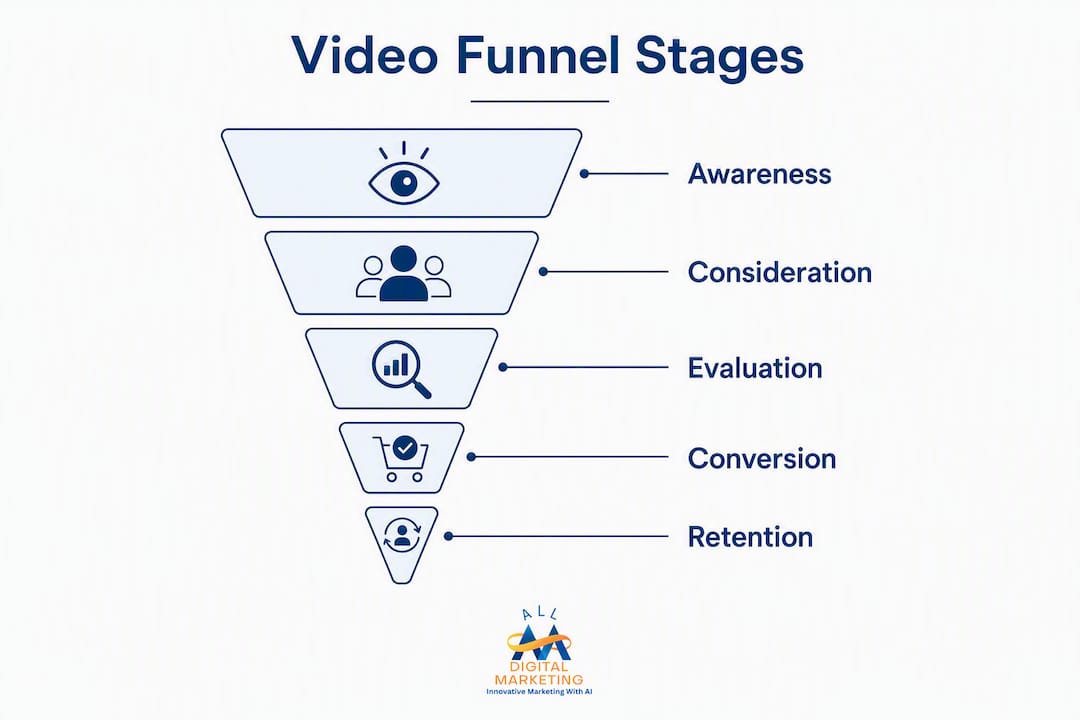
Content-to-funnel mapping table
| Funnel Stage | Content Type | Primary Goal | Recommended Cadence | Priority |
|---|---|---|---|---|
| Awareness | Short-form social, brand story | Reach and recall | 3–5 per week | High |
| Consideration | Explainer, webinar, series | Education and engagement | 1–2 per week | High |
| Evaluation | Product demo, walkthrough, comparison | Purchase intent | As needed per SKU/segment | Medium |
| Trust/Close | Testimonial, case study | Confidence and conversion | Quarterly refresh | High |
| Retention/Advocacy | How-to, onboarding, community | Loyalty and expansion | Monthly | Medium |
Operational questions to answer before you build
Your strategy needs owners, not just ideas. Assign a person to each of these before production starts:
- Who writes and approves briefs?
- Who owns distribution for each channel?
- How are analytics wired to your CRM?
- What is the split between in-house production and agency partners?
- What is the approval SLA for each asset type?
Wistia reports that video demand is up while fewer teams plan to increase budgets, which means operational efficiency is the competitive edge. Teams that answer these questions up front produce more usable content per dollar than teams that improvise.
Governance rules that keep programs on track
Keep briefs to a single template with five fields: objective, persona, funnel stage, key message, and call-to-action. Set a 48-hour approval SLA for short-form assets and a five-day SLA for long-form. Store all approved assets and variants in one shared library so sales can find and use them without asking marketing.
Which video types should you use and when?
Short-form for awareness and social
Short-form video under 90 seconds is your highest-frequency, highest-reach format. On TikTok and Instagram Reels, clips around 15–30 seconds perform best for cold audiences. YouTube Shorts extends effectively up to 60 seconds. The repurposing rule: every short-form clip should be designed to work as a standalone piece and as part of a series. Explore short-form tactics that convert awareness into leads.
Long-form and webinars for consideration and education
Webinars and long-form videos are underused as evergreen assets. When repurposed, they can continue driving plays for 3–12 months. A 45-minute webinar yields 8–12 short clips, a blog post, a LinkedIn carousel, and a sales follow-up sequence. Plan the repurposing map before the webinar goes live, not after.
Product demos and walkthroughs for evaluation
Demos are the most direct sales-enablement tool in your video library. Personalize them by industry vertical or use case rather than producing one generic version. A 90-second demo tailored to a specific pain point outperforms a 5-minute comprehensive walkthrough for most evaluation-stage buyers.
Testimonials and case studies for trust and close
Keep testimonials under 2 minutes. The most effective format is a problem-solution-result structure: what was the challenge, what changed, and what was the measurable outcome. Place these on product pages, in sales sequences, and in retargeting campaigns targeting bottom-of-funnel audiences.
UGC and creator-led formats for authenticity
UGC works because it signals real-world use, not marketing intent. Your brief for UGC creators should specify the key message and the call-to-action, then leave the delivery entirely to the creator. Include a legal consent checklist: usage rights, exclusivity terms, platform permissions, and disclosure requirements under FTC guidelines.
CTV and programmatic video for upper-funnel reach
CTV creative needs to work at 15 and 30 seconds, with a clear brand identifier in the first three seconds. Unlike social video, CTV viewers cannot skip, so the creative must earn attention without relying on a hook-and-scroll dynamic. Use CTV for brand reach campaigns, then retarget CTV-exposed audiences with short-form social for conversion.
How do you scale video production without losing brand quality?
The production model that works in 2026 is modular: capture once, then version many. Here is how the workflow runs end to end.
Briefing. Every asset starts with a brief that specifies objective, persona, stage, key message, and call-to-action. No brief, no production. This is the single rule that prevents wasted shoots.
Capture. Shoot with variants in mind. If you are filming a spokesperson, capture three versions of the opening hook and two versions of the CTA. That raw material feeds the versioning pipeline downstream.
Transcript and asset ingestion. After capture, transcribe immediately. The transcript becomes the source for captions, blog posts, social copy, and AI-assisted editing. URL-to-video tools can generate studio-quality outputs from product pages and structured inputs, removing the biggest paid-social bottleneck by enabling systematic A/B testing at scale.
AI-first iteration. Use AI tools for first-cut edits, caption generation, avatar dubbing for localization, and variant packaging. The goal is to generate multiple testable versions quickly, not to produce a finished hero asset.
Human edit and QC. A human reviewer checks every output before distribution. The QC checklist covers visual brand standards, lip-sync accuracy for dubbed versions, caption accuracy (aim for 99%+ accuracy), and consent documentation for any third-party talent or UGC.
Variant packaging and distribution handoff. Package variants by platform spec (aspect ratio, length, caption format) and hand off to the distribution owner with a brief that specifies placement, targeting, and test parameters.
Pro Tip: Direct AI tools like a producer, not a user. Include camera direction ("medium close-up, presenter facing camera"), start and end frame descriptions, and pacing notes ("pause after the key stat, then cut to product"). Prompts that include this level of direction produce outputs that stay on-brand and require fewer revision cycles.
High-performing teams in 2026 are hiring hybrid specialists who act as creative director, prompt engineer, and editor in one role. This keeps brand standards intact while enabling the volume that AI makes possible. AI tools for business now span the full production stack, from script generation to auto-captioning to browser-based editing.
How should you distribute and amplify video content in 2026?
Channel selection: match content type to platform
LinkedIn is now B2B's top video channel, making it the default starting point for B2B teams. YouTube remains the search-driven long-form home and the second-largest search engine. For B2C and D2C brands, short-form social platforms are the primary discovery channels, with platform-specific creative requirements for each.
A practical channel-selection rule: go deep on one or two platforms before spreading thin across five. Pick the platform where your audience is most active and where your content type performs best, then add channels once you have a repeatable production rhythm.
Paid amplification: the math that protects ROI
Organic reach on most platforms has declined. Paid amplification is not optional for teams that need predictable reach. A reasonable starting ratio for testing is to put paid spend behind your top 20% of organic performers. This lets you test variants at scale without committing budget to unproven creative.
For creative testing, design your variants around one variable at a time: hook (first 3 seconds), thumbnail, or CTA. Test hook first because it has the highest impact on view-through rate. Run each variant for at least 7 days before drawing conclusions, and rotate creative every 2–3 weeks to manage fatigue.
Cross-screen sequencing
Short-form social drives discovery. Long-form content and landing page video deepen engagement. CTV extends reach to audiences who are not active on social. The sequence that works: short-form ad → retargeting with a longer explainer or testimonial → CTV for brand reinforcement among warm audiences.
Amplification tactics that work in 2026
- Lookalike seeding: upload your best-performing customer list and build lookalike audiences for video campaigns
- Creator partnerships: co-create with niche creators whose audiences match your buyer personas; give them the brief and let them own the delivery
- Sequential retargeting: serve different creative to users based on how much of your previous video they watched (25%, 50%, 75%, 100% view-through segments)
- Smart-bid video campaigns: use platform-native smart bidding for video views or conversions, then layer in audience signals from your CRM
Social media trends in 2026 show that social search is growing fast, which means optimizing video titles, descriptions, and captions for search terms is now part of distribution, not just SEO.
What KPIs should you track to prove video's impact on revenue?
KPI tiers by funnel stage
Tracking everything is the same as tracking nothing. Assign KPIs by stage so each metric has a clear owner and a clear decision attached to it.
Awareness: reach, ad recall lift, video view-through rate (VTR), and cost per thousand views (CPM). These tell you whether your creative is breaking through.
Consideration: engagement rate, average watch rate (aim for 50%+ on short-form), time to first action, and click-through rate (CTR). Watch rate is the most honest signal of content quality.
Conversion: video-assisted conversions, influenced opportunities in CRM, and cost per video-influenced lead. These connect your video program to pipeline.
Revenue attribution: multi-touch attribution showing video's contribution to closed deals, video-influenced pipeline value, and return on video investment (ROVI). This is the number that gets budget approved.
2026 video marketing benchmarks
| Metric | 2026 Benchmark | Source |
|---|---|---|
| AI adoption among video marketers | 63% | Wyzowl via Adwave |
| Marketers rating short-form most effective | 85% | Wyzowl via Adwave |
| ROI satisfaction with video (2026) | — | Wyzowl via Adwave |
| AI production cost reduction vs. traditional | 70–90% | Wyzowl via Adwave |
| Content pieces consumed before sales contact (B2B) | 13 avg. | KEO Marketing |
| Webinar/long-form repurposing lifespan | 3–12 months | HubSpot/Wistia |
Incrementality and lift testing
An incrementality test holds out a portion of your audience from video exposure, then measures the difference in conversion rate between the exposed and holdout groups. Minimum test duration is two weeks for most B2C campaigns and four weeks for B2B. You need at least 10,000 impressions per cell to get statistically meaningful results.
Reporting cadence and dashboard wiring
Wire video engagement data to your CRM at the contact level so sales can see which prospects watched a demo or a testimonial before a call. Report weekly on creative performance (VTR, CTR, watch rate) and monthly on pipeline influence. The monthly pipeline report is the one that justifies budget.
What does video marketing actually cost, and how do you staff it?
Typical cost shapes by asset type
Short-form social clips produced with AI-assisted workflows run significantly lower than traditional production. A single short-form clip with AI editing and auto-captioning can cost a fraction of a traditionally produced spot. Long-form content like webinars or explainer videos sits in a mid-range, while premium brand films with professional crews and post-production remain the highest-cost format. Video marketing tips for small businesses show that small teams can build effective programs by focusing on short-form and repurposing rather than premium production.
Time estimates matter as much as dollar costs. A short-form clip with AI tools takes 2–4 hours from brief to published. A webinar takes 1–2 days of prep and 1 day of repurposing. A premium brand film takes 4–8 weeks from brief to delivery.
Staffing matrix
| Role | Responsibility | Small Team | Enterprise |
|---|---|---|---|
| Creative Director / Prompt Lead | Briefs, brand standards, AI direction | 1 hybrid FTE | 1–2 FTE |
| Editor / QA | Human review, caption QC, variant packaging | 1 FTE or contractor | 2–3 FTE |
| Social Producer | Scheduling, platform optimization, community | — | 1–2 FTE |
| Paid Media Lead | Campaign setup, testing, bidding | Contractor or agency | 1 FTE |
| Measurement Owner | Analytics wiring, CRM integration, reporting | Shared with broader team | 1 dedicated FTE |
The hybrid specialist role is the most important hire in 2026: someone who can write a creative brief, prompt an AI tool with producer-level direction, and QC the output against brand standards. This single role replaces what used to require a producer, an editor, and a prompt engineer working separately.
In-house vs. agency: when to split the work
The optimal model for most B2B programs is hybrid. Use agency partners for brand launches, complex storytelling, and campaigns that require specialized production. Keep rapid-response clips, sales enablement videos, and social-first content in-house where speed matters more than polish.
Avoid all-or-nothing resourcing. An all-agency model is too slow and expensive for the volume that 2026 programs require. An all-in-house model often lacks the strategic depth for brand-defining work. The split that works: in-house for volume and speed, agency for brand and complexity.
Resourcing pitfalls to avoid:
- Under-investing in distribution (producing great content no one sees)
- Missing measurement wiring (no CRM connection means no pipeline proof)
- Failing to plan variant refresh cadences (creative fatigue kills ROI faster than any other single factor)
- Treating QC as optional when using AI at scale
A copyable 90-day video plan from an agency playbook
This plan is structured as three 30-day sprints. Assign an owner to each task before Day 1.
Sprint 1 (Days 1–30): Discovery and brief
- Audit existing video assets: catalog what you have, map each asset to a funnel stage, and identify gaps
- Define two to three primary buyer personas and their content needs at each stage
- Write a brief template and get it approved by marketing and sales leadership
- Select your primary platform (one or two maximum) based on audience data
- Set up video analytics in your CRM: connect platform data to contact records
- Produce and publish three to five short-form test clips using different hooks
- Establish your QC checklist: brand standards, caption accuracy, consent documentation
- Sprint 1 KPIs: brief template approved, analytics wired, first clips published, baseline VTR and CTR recorded
Sprint 2 (Days 31–60): Build and test
- Launch a 30-day content calendar with at least two short-form clips per week
- Run your first creator or UGC brief: recruit one to two creators and brief them
- Produce one long-form asset (webinar or explainer) and build a repurposing map for it
- Start paid amplification on your top organic performer; test two hook variants
- Run a localization test if you have a second-priority market: use AI dubbing for one asset
- Review QC outputs weekly and document any brand-standard failures for process improvement
- Sprint 2 KPIs: 8–12 short-form clips published, one long-form asset live, first paid test running, creator brief delivered, watch rate and CTR trending vs. baseline
Sprint 3 (Days 61–90): Scale and measure
- Expand to a second platform if Sprint 2 data supports it
- Build a sequential retargeting sequence using view-through audience segments
- Produce two to three testimonials or case studies for evaluation and close stages
- Run an incrementality test: hold out 10–20% of your audience and measure lift
- Deliver a pipeline influence report to leadership: video-influenced opportunities, cost per influenced lead, and ROVI
- Refresh creative variants on any ad set running longer than three weeks
- Write the next 90-day brief based on what Sprint 1–3 data showed
- Sprint 3 KPIs: sequential retargeting live, incrementality test complete, pipeline report delivered, creative refresh cadence established
B2B teams that treat video as a pipeline input and map content to personas and stages consistently outperform peers on pipeline velocity and deal size. This 90-day plan is designed to get you to that operating model by Day 90.
Key Takeaways
Video marketing success in 2026 requires a video-first program built on short-form series, AI-assisted production with human QC, funnel-mapped assets, and measurement wired directly to pipeline.
| Point | Details |
|---|---|
| AI adoption is the new baseline | 63% of video marketers used AI tools in 2026; pair AI speed with human QC to protect brand quality. |
| Short-form leads every program | 85% of marketers rate short-form as the most effective format; build series and repurposing pipelines from every shoot. |
| Map video to pipeline, not just views | B2B buyers consume 13 pieces of content before engaging sales; map every asset to a persona and funnel stage. |
| Measure what moves revenue | Track video-influenced pipeline and ROVI monthly; wire video analytics to your CRM from Day 1. |
| Digital Marketing All accelerates execution | Digital Marketing All's AI-enabled video strategy, production workflows, and measurement integrations help you build and run this program faster. |
What winning teams do differently in 2026
The teams pulling ahead in 2026 share one operating belief: video is a repeatable pipeline input, not a one-off creative project. They plan shoots the way a publisher plans an editorial calendar, with assigned personas, stages, and KPIs attached to every asset before production starts. That discipline is what separates programs that generate measurable revenue from programs that generate views.
What typically derails programs is not a lack of creative talent. Creative fatigue is the most common killer: teams produce a strong hero asset, run it until performance drops, then scramble to replace it. The fix is a refresh cadence built into the production calendar from the start, not bolted on after the first sign of fatigue. Winning teams generate, test, and refresh variants rapidly to prevent audience fatigue, and the KPI shifts from cost per asset to cost per iteration.
Poor measurement wiring is the second most common failure. When video analytics are not connected to CRM, the program cannot prove pipeline influence, and budget gets cut at the first sign of pressure. Wiring analytics to CRM is a Day 1 task, not a Q4 cleanup project.
Inconsistent QC is the third. AI-assisted production at scale creates a real risk of off-brand outputs slipping through. The teams that avoid this problem are the ones who treat QC as a production step, not an afterthought. A 15-minute human review on every asset before it publishes is a small cost relative to the brand risk of a poorly dubbed video or an inaccurate caption going live.
The practical takeaway: build the governance before you build the volume. A brief template, a QC checklist, and a measurement dashboard are the three tools that make everything else in this playbook work.
How Digital Marketing All can help you build this program
If you have read this far, you know what a video-first program requires: a clear strategy, modular production, paid amplification, and measurement wired to pipeline. The challenge most teams face is not knowing what to do. It is having the bandwidth and expertise to execute all of it at once.
Digital Marketing All builds and runs these programs for small and medium-sized businesses across the United States. The agency combines AI-enabled production workflows, distribution strategy, and CRM-connected measurement into a single managed service, so your team gets the output of a full video operation without hiring five specialists.
Three ways Digital Marketing All typically helps:
- 90-day video programs: strategy, brief templates, production oversight, and paid amplification from Day 1
- Measurement integrations: CRM wiring, pipeline reporting, and incrementality test design so you can prove ROI to leadership
- Ongoing content operations: monthly content calendars, variant refresh cycles, and creator brief management to keep programs running at scale
Contact Digital Marketing All to get a program scoped for your audience, your platforms, and your pipeline goals.
Curated further reading and data sources for 2026
These are the primary reports and playbooks behind the claims in this article. Use them as benchmarking inputs when building your own program.
- State of Video Report 2026 — (Wistia): Budget and demand data, plus LinkedIn's position as the leading B2B video channel. Use for strategy and distribution planning.
FAQ
What is the most effective video format in 2026?
Short-form video under 90 seconds is the most effective format, with 85% of marketers rating it as the top social media video type and 71% rating the 30-second to 2-minute range as most effective overall.
How much does AI reduce video production costs?
AI video platforms can reduce per-video production cost by roughly 70–90% and cut production timelines by approximately 80% compared to traditional workflows, according to Wyzowl's 2026 data.
Which platform is best for B2B video marketing?
LinkedIn is now the leading B2B video channel, according to Wistia's 2026 State of Video report. YouTube remains the primary platform for search-driven long-form content and educational series.
How do you measure video's impact on revenue?
Wire video analytics to your CRM at the contact level, then track video-influenced pipeline opportunities and return on video investment (ROVI) monthly. Incrementality testing with holdout groups gives the cleanest read on true video lift.
How do you prevent creative fatigue in a high-volume video program?
Build a variant refresh cadence into your production calendar from the start, targeting a creative rotation every 2–3 weeks for active ad sets. The KPI to watch is cost per iteration, not cost per finished asset, which keeps the focus on testing velocity rather than production volume.