

Yes, respond to positive reviews, and do it fast. Reply within 24 to 48 hours, keep it short, and personalize at least one detail from the customer's comment. Use a simple thank, mirror, reinforce, invite, sign pattern. When volume is heavy, prioritize the detailed and 4 to 5 star reviews first with edited templates rather than generic copy.
TL;DR:
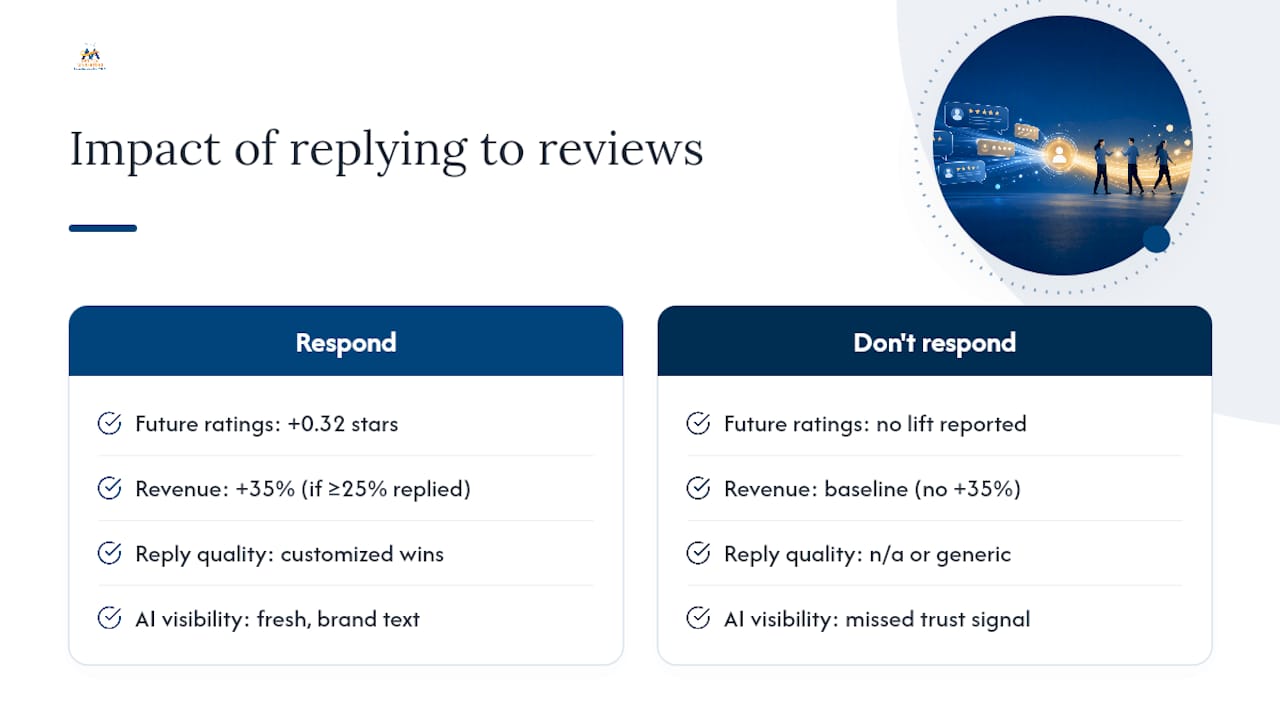
- Responding to positive reviews within 24 to 48 hours increases future review ratings by 0.32 stars and boosts revenue by at least 35 percent for businesses replying to a quarter or more of reviews.
- Personalizing replies with specific details from reviews, such as mentioning staff or products, significantly enhances trust signals and improves search engine visibility through AI platforms.
- Prioritize detailed reviews and mentions of staff or product issues first, especially those with friction or specific references, to maximize operational insights and customer loyalty.
- Use a structured five-step reply format — thank, mirror, reinforce, invite, sign — to ensure responses are genuine, engaging, and human-like, with length kept between 40 and 75 words.
- Automating replies using templates or AI tools requires human oversight to maintain authenticity, and responses should avoid sharing private information or offering incentives to comply with platform policies.
Table of Contents
- Why Reply to Positive Reviews: The Business Case and Research
- When and How Fast Should You Reply to Reviews?
- The Five-Step Framework Behind Every Great Reply
- Copy These Review Response Templates by Scenario
- Getting the Tone Right: Personalization Without Sounding Robotic
- Scaling Review Replies Without Losing the Human Touch
- Templates and Tools Already Working for Digital Marketing All Clients
- How to Respond to a Negative Review the Right Way
- What to Do About Fake or Unfair Reviews
- Handling Mixed and Neutral Reviews (3-Star Territory)
- Legal and Ethical Lines You Shouldn't Cross
- Authenticity vs. Scale: Where to Spend Your Effort
- Let Digital Marketing All Handle Your Review Responses
- Sources
- FAQ
Why Reply to Positive Reviews: The Business Case and Research
Every positive review you leave unanswered is a missed marketing opportunity, not a neutral outcome. Responding to reviews changes the trajectory of your ratings and your revenue, and the data on this is more specific than most business owners realize.
Businesses that respond to positive reviews see a measurable lift in future ratings. Research tracking review responses found a 0.32-star increase in future review ratings tied to manager responses, and companies that respond to at least a quarter of their reviews earned 35% more revenue than those that stayed silent. That's not a marginal bump. It's the difference between a review section that quietly accumulates and one that actively works as a sales asset.
The mechanism behind this makes sense once you think about it. A reply signals to the next reader, and to the platform's algorithm, that a real person is running the business and paying attention. Research from HKU Business School backs this up further: managerial responses to positive reviews improve both subsequent ratings and financial performance, and customized responses outperform generic, copy-paste ones. Standardized replies work fine for damage control on negative reviews, but on positive reviews, the personal touch is what moves the needle.
Statistic Callout: Responding to positive reviews correlates with a 0.32-star increase in future ratings, and businesses answering at least 25% of their reviews report 35% more revenue than those that don't reply at all.
There's a second reason to reply that has nothing to do with the reviewer at all: AI search visibility. AI-driven platforms increasingly treat review responses as fresh, contextual content when deciding which businesses to recommend. According to Yext's research on AI trust and consumer decision-making, a business's own words in its review replies function as trust signals that AI engines weigh alongside the review itself. A reply that mentions your location, a specific product, or a staff member gives AI systems more concrete material to work with when someone asks an AI assistant "who's the best [service] near me."
This is the part most small business owners miss. You're not just thanking a customer. You're feeding search engines and AI platforms fresh, brand-specific text that reinforces what you do and where you do it. Skipping replies means leaving that signal on the table entirely.
When and How Fast Should You Reply to Reviews?
Reply within 24 to 48 hours. That window isn't arbitrary. It's close enough to the original experience that the customer still remembers writing it, and it's fast enough that new visitors reading your review section see an active, responsive business rather than an abandoned storefront.
Speed matters more than most owners assume. A review that sits unanswered for two weeks looks the same to a browsing customer as one that will never get a reply. Prompt responses paired with mirrored details are what separate businesses that use reviews as active marketing from businesses that just collect them.
The real challenge isn't timing. It's volume. A single-location shop with ten reviews a month can reply to everything. A multi-location retailer or a busy restaurant generating fifty reviews a week cannot, at least not with the same care for each one. That's where prioritization rules save you.
When you can't respond to everything immediately, work through reviews in this order:
- Detailed text reviews first. A three-paragraph review carries more weight with future readers than a bare five-star rating, so it deserves a real reply.
- Reviews mentioning a specific staff member or product. These are opportunities to reinforce something concrete, and they matter to the employee or product line named.
- 4-star reviews with any hint of friction. These often contain a small complaint buried in an otherwise positive review, and practitioner guidance consistently flags these as worth extra attention since they can reveal a fixable pattern before it becomes a bigger problem.
- 5-star reviews with no comment. These matter least individually, but a short, warm reply still adds up over time.
If you genuinely can't cover every review, respond to a representative sample rather than skipping entire categories. Answering every detailed review and half of the one-line five-star ratings looks far more active than answering every short review and ignoring the long, specific ones that actually move opinion.
The Five-Step Framework Behind Every Great Reply
Every strong reply follows roughly the same shape: thank, mirror, reinforce, invite, sign. This pattern works because it forces you to acknowledge the customer specifically instead of defaulting to a generic "thanks for your feedback" that could apply to any business on the planet.
Here's what each step does and what it sounds like in practice.
- Thank. Open with genuine appreciation, not a rote greeting. "Thank you so much for taking the time to write this."
- Mirror. Repeat back a specific detail from their review, word choice included where possible. "We're glad the quick turnaround on your custom order stood out."
- Reinforce. Connect their experience to something your business stands for. "Fast, careful work is exactly what we aim for on every order."
- Invite. Give them a reason to come back or take another action. "We'd love to see you again next time you're in the neighborhood."
- Sign. Close with a name or role, which adds a human signature to the reply. "Warmly, Maria, Owner."
Strung together, that's a complete reply in five sentences. Keep the whole thing between 40 and 75 words when possible. Anything shorter risks sounding dismissive, and anything longer starts to compete with the review itself for the reader's attention. A five-star review with no written comment deserves a shorter reply, maybe two sentences, while a detailed paragraph praising a specific service earns the full five-step treatment.
Pro Tip: Write your mirror line first, before the thank-you. If you can't find one specific detail to repeat back, you're about to write a generic reply, and the customer will be able to tell.
Copy These Review Response Templates by Scenario
Here's a working library of review response templates organized by the situations you'll actually run into. Swap in the bracketed tokens like [Name], [Product], [Location], and [Staff] with real details every time. Never leave a bracket unfilled in a published reply.
5-star reviews with no written comment
These need brevity. The customer didn't write much, so match their effort with a short, warm reply rather than an essay.
- "Thank you so much, [Name]! We're thrilled you had a great experience at [Location]. Hope to see you again soon."
- "We really appreciate the five stars, [Name]! Thanks for choosing us, and we hope to serve you again."
- "Thank you for the kind rating, [Name]. It means a lot to our whole team at [Location]."
5-star reviews with detail
Full framework applies here. These reviews contain the most useful specifics to mirror back.
Usage note: Pull the exact phrase or product name the customer used, not your own paraphrase, since matching their language reads as more genuine.
"Thank you for such a thoughtful review, [Name]! We're so glad our [Staff] took the time to walk you through [Product] step by step, exactly what we aim for with every customer. That kind of patience is something we train our whole team on. We'd love to help you again whenever you need us, just ask for [Staff] by name next time. Thanks again for sharing your experience!"
4-star reviews
Treat these as a near-win. Thank them fully, but don't over-apologize for a star they didn't explicitly complain about.
"Thank you for the great review, [Name]! We're happy to hear you enjoyed [Product] at [Location]. If there's anything we could have done to make it a five-star experience, we'd genuinely love to hear it, feel free to reach out directly. Hope to see you again soon."
Staff shoutout reviews
Usage note: Always name the specific employee in your reply, and consider letting that team member see the review. It boosts morale and reinforces the behavior publicly.
- "What a wonderful shoutout for [Staff]! We'll be sure to share this with them, they'll be so glad to know their help with [Product/Service] made your visit at [Location] memorable. Thank you for taking the time to mention them by name."
- "[Staff] is going to love reading this, thank you, [Name]! Going above and beyond is exactly the standard we hold at [Location], and it's great to see it recognized."
Product or feature praise
Reinforce the specific feature they mentioned rather than your business generally, since that's what future customers searching for that exact feature will read.
"Thanks for the detailed feedback on [Product], [Name]! We put a lot of thought into [specific feature mentioned], so it's great to hear it made a real difference for you. We hope you get plenty of use out of it, and don't hesitate to reach out if you ever have questions."
First-time customer reviews
New customers deserve a slightly stronger invite step, since the goal is converting a single visit into a habit.
"Welcome, [Name], and thank you for the wonderful first review! We're so glad your first visit to [Location] went well. We'd love to have you back, next time ask for [Staff] and mention this review for a warm welcome."
Loyal or repeat customer reviews
Usage note: If your review platform or CRM flags repeat customers, always acknowledge that history. It's the single easiest personalization win available.
"[Name], thank you for another glowing review! Customers like you are the reason we love what we do at [Location]. We really appreciate your continued trust, year after year, and we're not taking it for granted."
Reviews with photos included
Mention the photo specifically. It shows you actually looked at the review rather than skimming the star rating.
"Thank you for the review and the great photos, [Name]! [Product] looks fantastic in your space. We love seeing how customers use what they buy from [Location], feel free to tag us anytime."
Special occasion reviews (weddings, birthdays, anniversaries)
These carry emotional weight, so match the tone rather than defaulting to a business-as-usual reply.
"Congratulations, [Name], and thank you for letting us be part of your special day! We're honored that [Product/Service] played a role in celebrating your [occasion] at [Location]. Wishing you all the best, and thank you again for trusting us with such an important moment."
B2B and professional services praise
Business clients respond well to a slightly more formal register that still acknowledges specifics.
"Thank you for the kind words, [Name]. We're glad our team could support [Company] with [specific service or deliverable]. Partnerships like this are exactly why we do what we do, and we look forward to continuing to work together."
Short, mobile-friendly replies
When you're triaging a large batch from a phone, these compact versions still hit thank, mirror, and sign without demanding much typing.
- "Thanks, [Name]! Glad you loved [Product]. See you soon!"
- "Appreciate this, [Name]! Thanks for the kind words about [Location]."
- "So glad to hear it, [Name]! Thanks for the review."
Industry variants worth adapting
A retail shop, a hotel, and a law firm all need the same framework dressed differently.
- Retail: Mention the specific item and invite a return visit tied to new inventory. "Thanks for the review, [Name]! We just got new stock in that pairs well with [Product], come check it out."
- Hospitality: Reference the specific amenity or staff interaction and invite a rebooking. "Thank you for staying with us, [Name]! We're glad your room and the breakfast service exceeded expectations, we'd love to host you again."
- Professional services: Keep it formal, reference the outcome delivered, and avoid overly casual language. "Thank you for trusting our team with [service], [Name]. We're pleased the results met your expectations and look forward to supporting [Company] again."
Getting the Tone Right: Personalization Without Sounding Robotic
Mirroring specifics from the review isn't optional flavor text, it's the mechanism that makes a reply feel human instead of automated. When you repeat a customer's exact phrase, product name, or the employee they mentioned, you prove you actually read what they wrote. Skip that step and even a well-structured reply reads like a form letter.
Academic research on manager responses adds a nuance worth knowing: downplaying excessive praise, using moderate language or crediting your team instead of accepting all the credit yourself, actually increases how genuine a reply feels to future readers. A study on how managers should respond to compliments found that humility signals read as more trustworthy than full-throated self-congratulation. If a customer calls your service "the best in the city," a reply crediting your team's training rather than simply agreeing tends to land better.
Tone dos and don'ts:
- Do use the customer's own words when they're specific and positive.
- Do vary your sentence structure across replies so ten consecutive responses don't read like a form.
- Don't copy the exact same reply text across multiple reviews, since research on response similarity found that near-identical replies actually weaken the benefit of responding at all.
- Don't over-explain or apologize in a five-star reply. There's nothing to apologize for.
- Don't use exclamation points on every sentence. One is enthusiastic, four is exhausting.
On signing, decide once whether your business replies as a team ("The [Location] Team") or as a named individual ("Maria, Owner") and stick with it. A named signature builds more personal trust for a small, owner-run business. A team signature works better for larger operations where the manager rotates.
Pro Tip: Keep a running list of banned filler phrases, "we value your feedback," "thank you for your business," and similar boilerplate, and physically block your team from using them. Forcing a specific detail into every reply is the single fastest way to kill robotic language.
Scaling Review Replies Without Losing the Human Touch
AI-suggested replies can speed up your workflow, but they need a mandatory human edit step before publishing. Use AI or templates to draft the skeleton of a reply, especially for high-volume locations, but never publish a draft without a person confirming it mirrors something real from that specific review. Skipping that check is how businesses end up with the exact kind of repetitive, near-identical replies that research shows actually erode the benefit of responding at all.
Build a short governance checklist before you scale:
- Maintain a list of approved personalization tokens ([Name], [Product], [Location], [Staff]) and require at least one filled in before publishing.
- Keep a list of forbidden generic phrases your team can't fall back on, things like "we appreciate your business" with nothing else attached.
- Set an escalation rule for anything ambiguous, a 3-star review that reads mixed, or a review mentioning a legal or safety issue, so it routes to a manager instead of an auto-reply.
- Sample-check a percentage of published replies weekly for tone drift and repeated phrasing.
- Sync review replies with your CRM so repeat customers and known complaint histories are visible to whoever is writing the response.
The goal isn't to automate personalization out of existence. It's to remove the blank-page problem so your team can focus their time on the mirroring and reinforcing that actually make a reply land, rather than staring at a cursor trying to think of an opening line.
Templates and Tools Already Working for Digital Marketing All Clients
Beyond the scenario templates above, Resources go deeper into the mechanics that support strong review replies. If review volume is your bottleneck, the review request email templates built to convert and comply with platform rules address the front half of the problem: generating more reviews worth responding to in the first place.
For businesses running review programs across multiple locations, guidance on deciding which reviews to answer and maintaining brand consistency walks through the operational side of keeping tone uniform across a growing team. And if you're trying to justify the time investment to a skeptical partner or manager, the measurable outcomes tied to organized reputation management lay out the business case in more detail than a single statistic can carry.
One practical adaptation worth borrowing: pair every published five-star reply with a Google Business Profile post referencing the same theme. If a review praises your weekend hours, a short profile post confirming those hours reinforces the same message to browsing customers who never read the review section at all.
How to Respond to a Negative Review the Right Way
A negative review response needs a different structure than a positive one: acknowledge, apologize for the specific issue (not generically), offer to fix it offline, and keep the tone calm. Research on managerial responses found that standardized, consistent language actually works better for negative reviews than the customization that helps positive ones, since an even, professional tone reduces the appearance of defensiveness.
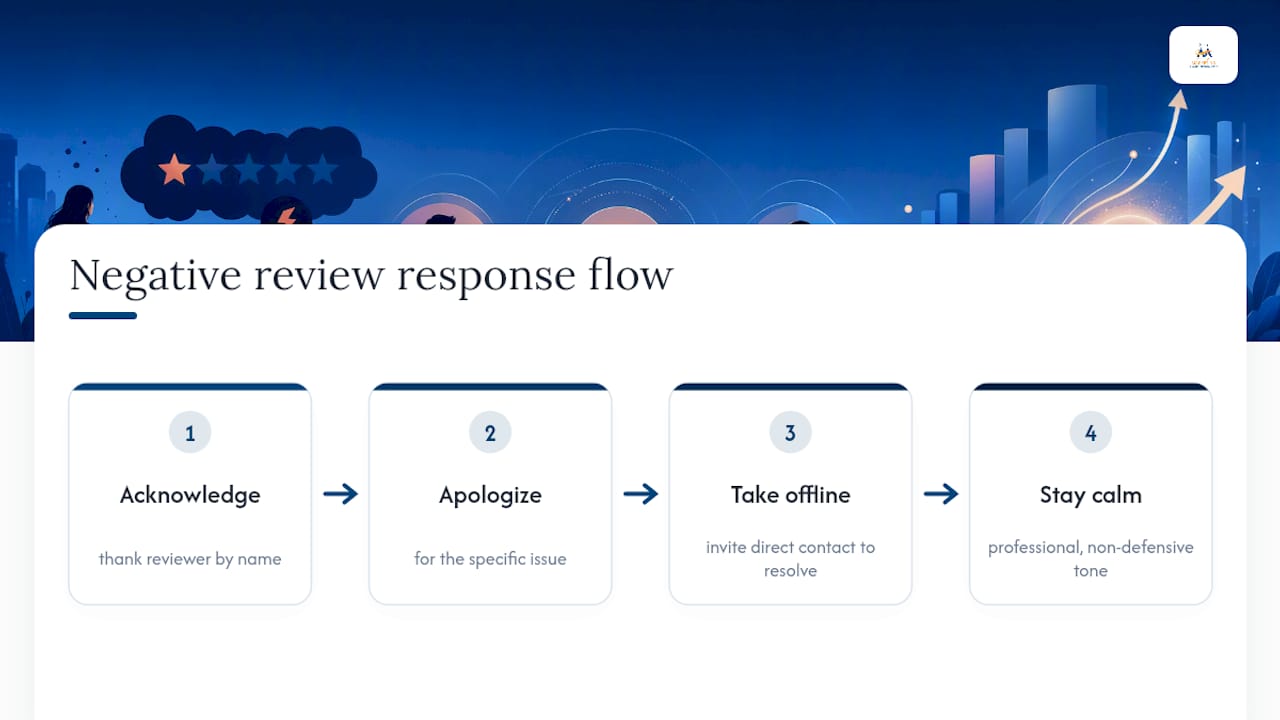
A workable template: "Thank you for bringing this to our attention, [Name]. We're sorry your experience with [Product/Service] at [Location] didn't meet the standard we aim for. We'd like to make this right, please reach out to us directly at [contact] so we can look into what happened."
Notice what that template doesn't do. It doesn't argue with the reviewer, restate their complaint in detail for other readers to dwell on, or promise a specific outcome you can't guarantee. It moves the conversation offline while still showing future readers that you take complaints seriously.
For a 1-star review with no specifics at all, just anger, a shorter version works: "We're sorry to hear this, [Name]. We'd genuinely like to understand what went wrong, please contact us at [contact] so we can address it directly." Never leave a 1-star review completely unanswered. Even a brief, calm reply shows other readers that an unresolved complaint didn't just vanish into silence.
What to Do About Fake or Unfair Reviews
Not every negative review is legitimate, and platforms give you real tools for the ones that clearly aren't. If a review mentions a product you don't sell, an interaction that couldn't have happened at your business, or comes from a competitor with no purchase history, flag it for removal through the platform's official reporting process before you do anything else.
While a flagged review is under review, resist the urge to argue publicly in the comments. A calm, professional holding reply works better: "We take all feedback seriously, but we're unable to locate a record of this visit. We'd welcome the chance to discuss this directly, please reach out to us at [contact]." That sentence does two things at once: it signals to other readers that something's off, without accusing the reviewer outright, and it opens a door for resolution if it turns out to be a genuine mix-up.
Don't expect instant removal. Platform review processes can take days or weeks, and not every fake review gets pulled even with a strong case. In the meantime, a measured public reply matters more than the eventual removal, since that's what most readers will actually see. Avoid language that sounds defensive or accusatory ("this never happened" or "clearly fake"), since that tone can make an uninvolved reader trust the complaint more, not less.
Handling Mixed and Neutral Reviews (3-Star Territory)
A 3-star review is usually the hardest to answer because it's rarely all praise or all complaint. Read it fully before replying, since the star rating alone won't tell you what actually went right and what didn't.
Structure a mixed review reply in two parts: acknowledge the positive first, then address the specific concern without being defensive. "Thank you for the honest feedback, [Name]. We're glad you enjoyed [positive detail], and we're sorry [specific issue] didn't meet expectations. We'd like to hear more, feel free to reach out at [contact] so we can improve."
Avoid treating a 3-star review like a 5-star one just because it isn't overtly hostile. Glossing over the complaint with pure enthusiasm reads as tone-deaf to anyone who reads the full review before your reply. At the same time, don't over-apologize for something the customer only mentioned in passing. Match the weight of your response to the weight of the complaint.
These reviews often reveal the most useful operational feedback you'll get, a genuinely happy customer who still flags one friction point. Treat the reply as an opportunity to show future customers that a small issue gets a real response, not silence or a canned line.
Legal and Ethical Lines You Shouldn't Cross
Never disclose private customer information in a public reply, even to defend yourself. Confirming an order number, a medical detail, a payment issue, or any personally identifying information in response to a bad review can expose you to privacy complaints and makes your business look worse regardless of who was originally at fault.
Don't offer compensation, refunds, or discounts in exchange for removing or editing a review. Platforms like Google explicitly prohibit incentivizing review changes, and it can get a business's entire review profile flagged. Keep resolution offers ("please contact us so we can make this right") separate from any mention of a review edit.
Be honest about who's writing the reply. Posting a positive reply to your own business's fake review, or having employees post reviews they're incentivized to write, violates most platform terms of service and can carry real penalties if discovered. The same goes for review-gating, only asking happy customers to leave public reviews while quietly diverting unhappy ones elsewhere; several platforms now treat this as a policy violation.
Finally, don't publicly diagnose or promise outcomes you can't guarantee, particularly in regulated industries like healthcare, legal services, or finance. A reply thanking a patient for praising "the surgery" can inadvertently confirm protected health information. When in doubt, keep the reply generic enough to avoid confirming service details tied to an identifiable person.
Authenticity vs. Scale: Where to Spend Your Effort
Bespoke replies earn their extra time on your most detailed reviews and anything mentioning a named employee. Everything else, the one-line five-star ratings, can run through a tight template without losing much.
If you're unsure whether your current approach works, run a simple test: pick one template family and use it consistently for 30 days, then compare rating trends and reply engagement against the prior month. You don't need a data scientist for this, just a spreadsheet and a calendar reminder.
Treat every reply as public marketing copy, because that's exactly what it is. The customer already left. Everyone else reading your review section hasn't decided yet.
— Diane O'Brien
Let Digital Marketing All Handle Your Review Responses
Writing great replies is one thing. Doing it consistently across every location, every platform, every week, is where most businesses fall behind. Digital Marketing All's Review Generation & Reputation service was built specifically for that gap: it pairs review generation with response governance so replies stay personalized without falling on one overworked manager's shoulders.
If your business operates across multiple locations, the Local Domination and Advanced Local Domination packages bundle Google Business Profile optimization with review response oversight, so your reputation work and your local search rankings move together instead of living in separate silos.
A discovery call walks through your current review volume, response rate, and platform mix, then maps out where templated replies, human oversight, or a fuller managed program makes sense for your team. Start with the Review Generation and Management page to see what a managed reputation program looks like for a business your size.
Sources
- Research linking review responses to rating and revenue changes (2025)
- Soothing the unsatisfied or pleasing the satisfied? (HKU Business School research summary)
- Yext: Data-backed facts on AI trust and consumer decision-making (2026)
FAQ
What is a good example of responding to a positive review?
A good reply thanks the customer, repeats a specific detail from their review, and invites them back, all in two to four sentences. For example: "Thank you, [Name]! We're so glad the custom fitting at [Location] worked out perfectly. Hope to see you again soon."
What makes a review response example "good" versus generic?
The difference is specificity: a good response mirrors an exact detail the customer mentioned, like a product name or staff member, rather than using boilerplate like "we value your feedback." Research on manager responses shows customized replies outperform standardized ones on positive reviews for future ratings and revenue.
Can you give examples of positive review response templates?
Yes. For a five-star review with detail: "Thank you for the thoughtful review, Name]! We're thrilled [Staff] made your experience at [Location] memorable, that's exactly what we aim for." Digital Marketing All's [Review Generation and Management service includes a broader library of these mapped to specific review scenarios.
What are some examples of short review responses for mobile replies?
Short replies still need a thank-you and one mirrored detail: "Thanks, [Name]! Glad you loved [Product]. See you soon!" Keep these under 75 words when replying from a phone during a busy stretch, and switch to the full five-step framework once you're back at a desk.
How much does review response management cost with Digital Marketing All?
Pricing depends on the service level. Digital Marketing All's Local Domination package starts at $450 one-time, while ongoing Pay Per Result SEO runs 650 to 2500 USD per month. Reputation-specific pricing is available on request through the Review Generation and Management page.