

The lead generation process is the repeatable system that moves a stranger from first awareness to a qualified conversation with your sales team. Before you read further, here is the three-step checklist you can apply today:
- Define your target. Name the company size, role, industry, and pain point you serve. Marketing owns this step.
- Create a conversion offer. Build one landing page with a specific lead magnet tied to that audience. Marketing executes; demand gen refines.
- Route and measure. Set a response-time rule, log every lead in your CRM, and track cost per lead from day one. Sales development reps (SDRs) and account executives (AEs) own the follow-through.
Everything else in this guide expands those three steps into a full operational playbook.
Table of Contents
- What is the lead generation process, and who owns each stage?
- Why a documented process drives predictable revenue
- The step-by-step lead generation process you can run this quarter
- KPIs and dashboards to track at every stage
- Realistic timelines and cost benchmarks for your first lead gen engine
- Which tech stack categories does your lead gen workflow actually need?
- How to align sales and marketing so leads don't disappear
- Why product-market fit matters more than any tactic you choose
- Key Takeaways
- The part most teams skip until it's too late
- How Digital Marketing All can accelerate your lead generation results
- Useful sources and further reading
- FAQ
What is the lead generation process, and who owns each stage?
Lead generation is a repeatable system, not a one-time campaign. The stages run in sequence: attract → capture → qualify → handoff → nurture. Each stage has a clear owner, and when ownership is ambiguous, leads fall through.
Owner map by stage:
- Attract: Marketing (content, SEO, paid ads, social)
- Capture: Marketing (landing pages, forms, lead magnets)
- Qualify: Demand gen or marketing ops (lead scoring, MQL criteria)
- Handoff: SDRs receive MQLs and convert them to SQLs
- Nurture: Marketing automation runs sequences; SDRs handle warm outreach
- Close: AEs own the SQL-to-close motion
Mini-glossary for shared language across your team:
- Lead: Any contact who has expressed interest, regardless of fit
- MQL (Marketing Qualified Lead): A lead that meets your scoring threshold and is ready for sales outreach
- SQL (Sales Qualified Lead): An MQL that an SDR has contacted and confirmed as a real opportunity
- CPL (Cost Per Lead): Total spend divided by total leads generated in a period
- Conversion rate: Leads who complete a desired action divided by total visitors or contacts
- Nurture cadence: A timed sequence of emails, calls, or messages designed to move a lead toward readiness
Why a documented process drives predictable revenue
A documented lead generation workflow does one thing that ad-hoc campaigns cannot: it makes your pipeline forecastable. When every stage has a defined input, output, and owner, you can spot exactly where volume drops and fix it without guessing.
The metrics that change when the process is working:
- CPL drops as you cut underperforming channels and double down on what converts
- Lead-to-qualified ratio rises when scoring criteria match what sales actually closes
- Qualified-to-close rate improves when SDRs follow up fast and with context
- LTV:CAC ratio strengthens as you acquire better-fit customers who stay longer
Stat to know: Predictable Revenue's methodology identifies product-market fit as the categorical prerequisite for any outbound motion. Tactics amplify fit; they cannot substitute for it.
A service-level agreement (SLA) between marketing and sales closes the most common leak: the handoff. When marketing commits to delivering leads with full context and sales commits to a response time, conversion rates rise measurably. Without that agreement, both teams optimize for their own metrics and the lead record sits untouched.
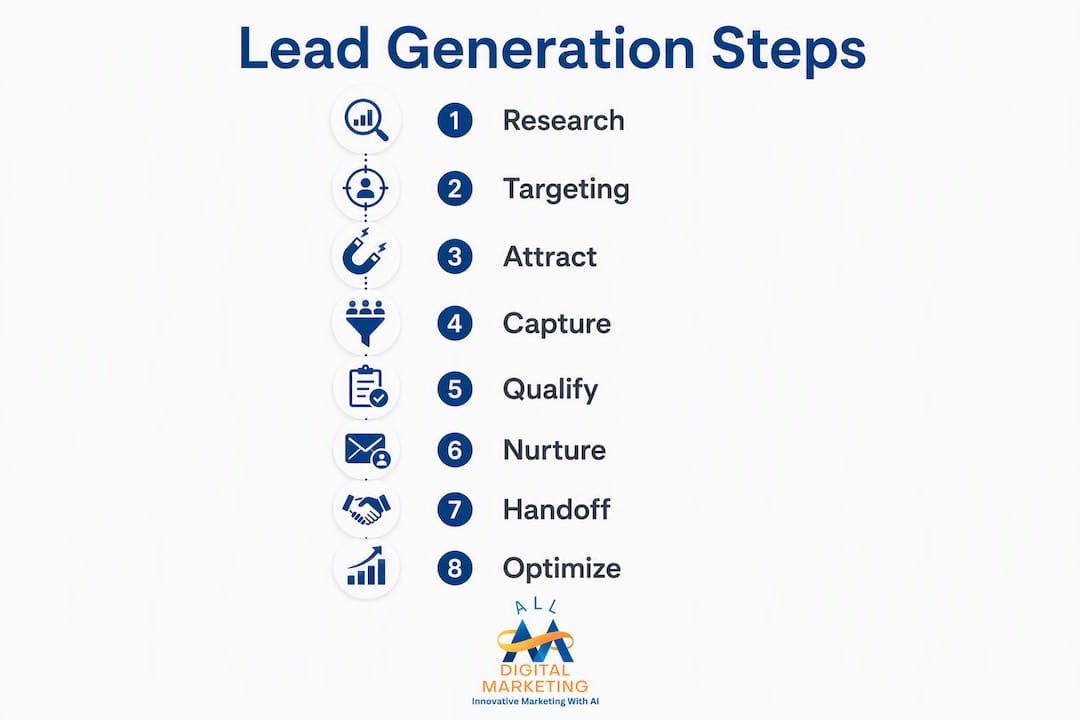
The step-by-step lead generation process you can run this quarter

A clear, repeatable flowchart with defined responsibilities and measurable outputs reduces leakage at every stage. Here is the full sequence:
Step 1: Research and targeting Owner: Marketing / Demand Gen Define your Ideal Customer Profile (ICP): company size, industry, role, geography, and the specific problem you solve. Output: a written ICP document and a prospect list of named accounts or audience segments.
Step 2: Attract Owner: Marketing Drive traffic through the channels your ICP uses. For B2B, that typically means SEO-driven content, paid search and social ads, LinkedIn outreach, and referral programs. Output: measurable traffic to your capture assets.
Step 3: Capture Owner: Marketing A high-converting landing page checklist:
- One specific headline that names the benefit
- A lead magnet matched to the ICP's most urgent question (checklist, calculator, short guide)
- A short form: name, work email, one qualifying field (company size or role)
- A single, clear call-to-action button
- Social proof (a client logo row or a specific result)
Output: form submissions with a good capture rate for paid traffic and a lower rate for organic.
Step 4: Qualify Owner: Marketing Ops / Demand Gen Score leads on 3–5 criteria. For SMBs, a simple spreadsheet tracking company size, role, industry, engagement level, and lead source outperforms complex automated models because it is easier to maintain and act on. Set a numeric threshold that defines an MQL.
Step 5: Nurture Owner: Marketing Automation A three-email example sequence for a new MQL:
- Day 1: Deliver the lead magnet + one relevant case result
- Day 3: Share a short how-to tip tied to their problem
- Day 7: Soft ask: "Would a 15-minute call be useful?"
Most sales require five to eight touchpoints, yet many reps stop after one or two. Automate the sequence so consistency is not dependent on memory.
Step 6: Handoff Owner: SDRs When a lead hits the MQL threshold, route it to an SDR with full context: source, activity history, lead score, and company data. The SDR's job is to confirm fit and book a meeting. Output: SQL created in CRM.

Step 7: Measure and optimize Owner: Marketing + Sales Ops Review stage-level metrics weekly. When a metric drops below its benchmark, investigate that stage before touching others.
Pro Tip: Specificity in your lead magnet drives higher-quality leads. "The 5-Question Checklist for Choosing a CRM" attracts decision-makers; "Free Marketing Guide" attracts everyone. Narrow the offer, and your MQL rate will rise even if raw lead volume falls.
KPIs and dashboards to track at every stage
Track metrics at the stage where they are generated, not just at the bottom of the funnel. Adobe's lead generation measurement guidance maps stage-specific metrics so teams can pinpoint leaks fast.
| KPI | Formula | Target range | Action trigger |
|---|---|---|---|
| Traffic to capture rate | Form submissions ÷ landing page visitors | 20–40% (paid), 2–5% (organic) | Below range: test headline, form length, or offer |
| Cost per lead (CPL) | Total spend ÷ total leads | Varies by channel; track trend | Rising CPL: audit ad targeting or landing page |
| MQL→SQL rate | SQLs created ÷ MQLs passed to sales | 40% | Below 40%: revisit MQL scoring criteria |
| Meeting acceptance rate | Meetings booked ÷ SQLs contacted | Open rate above 40% is recommended | Below 80%: review SDR messaging and ICP fit |
| Close rate by source | Closed-won ÷ SQLs by lead source | Track per channel | Low-close sources: reduce budget, improve nurture |
Dashboard checklist:
- Review traffic and capture rate weekly
- Review CPL and MQL volume bi-weekly
- Review MQL→SQL and meeting acceptance monthly
- Assign one owner per metric; no shared ownership
- Flag any metric that moves more than 20% in either direction for immediate review
Realistic timelines and cost benchmarks for your first lead gen engine
Setting up a working lead generation engine takes longer than most teams expect. Here is a practical milestone table:
| Milestone | Timeline | Expected output |
|---|---|---|
| ICP defined, landing page live, tracking set up | Days 1–30 | One capture asset, baseline CPL data |
| First campaign validated, nurture sequence running | — | First MQLs, initial MQL→SQL rate |
| Channel ROI confirmed, scoring refined | — | Repeatable pipeline contribution, SLA in place |
Cost bands by channel (approximate, U.S. market):
- Organic SEO + content: Lower upfront cost, 3–6 months to meaningful traffic; primary investment is time or content production fees
- Paid search / social: Faster results; budget varies widely by industry and competition, but even modest daily budgets can generate initial data within weeks
- Outbound / data subscriptions: Higher cost per contact; tools like LinkedIn Sales Navigator or data enrichment platforms add to monthly spend
Planning tips to reduce wasted spend:
- Validate your landing page and offer with organic or low-budget paid traffic before scaling
- Do not buy a large data list until your email sequence has a confirmed open rate above 40%
- Stage your tech stack investment: start with a CRM and one automation tool, then add enrichment and engagement layers once the core process is proven
Which tech stack categories does your lead gen workflow actually need?
A self-running lead generation engine compounds over time when traffic, capture, and nurture all work together. The tools below make that possible without overbuilding.
Core tool categories and what each must do:
- CRM: Single source of truth for every lead record; must capture source, activity history, and lead score. HubSpot CRM (free tier) or Salesforce work for most SMBs.
- Marketing automation: Runs nurture sequences and triggers handoffs at score thresholds. ActiveCampaign, Mailchimp, or HubSpot Marketing Hub cover most needs.
- Sales engagement: Manages SDR outreach cadences and logs touches automatically. Apollo.io or Outreach are common choices.
- Analytics: Tracks traffic sources and conversion events. Google Analytics 4 plus UTM parameters on every campaign link.
- Enrichment / data: Fills in company and contact data to improve scoring. Clearbit or ZoomInfo for mid-market; LinkedIn Sales Navigator for SMBs.
Three example stacks:
- Lean SMB stack: Google Analytics 4 + HubSpot CRM (free) + Mailchimp + LinkedIn Sales Navigator. Monthly cost: low. Covers capture, basic nurture, and CRM.
- Mid-market stack: HubSpot Marketing Hub + HubSpot Sales Hub + Apollo.io + Clearbit. Adds automated scoring, sales engagement, and enrichment.
- Enterprise-style stack: Salesforce + Marketo + Outreach + ZoomInfo + a dedicated BI tool. Full orchestration, but requires dedicated ops staff to maintain.
Integration checklist:
- Apply UTM parameters to every paid and email link (source, medium, campaign, content)
- Map CRM fields: lead source, lead score, MQL date, SQL date, first-touch channel
- Set automation rules: score threshold triggers MQL status; MQL status triggers SDR task
- Use AI-assisted lead qualification to triage high-volume inbound before it reaches your SDR queue
You can also automate your lead funnel with a CRM integration that routes and scores leads without manual intervention, which is especially useful when your team is small.
How to align sales and marketing so leads don't disappear
The most common pipeline failure is an undocumented handoff. Marketing passes a lead; sales does not follow up; the lead goes cold. A written SLA fixes most of this.
SLA example elements:
- MQL definition: Lead score ≥ [threshold], role matches ICP, company size matches ICP, at least one high-intent action (demo request, pricing page visit, content download)
- Required context in the lead record: Source, pages visited, content downloaded, lead score, company name and size
- Response time: Hot leads (demo requests, pricing inquiries) get a response within five minutes during business hours; all other MQLs within 24 hours
- Feedback loop: Sales marks each MQL as accepted, rejected (with reason), or recycled; marketing reviews rejections weekly
Common handoff failures and fixes:
- Slow follow-up: Automate an immediate email from the SDR's name the moment an MQL is created; the human call follows within the hour
- Missing CRM notes: Make source and activity history mandatory fields before an MQL can be routed; the form cannot submit without them
- Unclear ownership: Assign every MQL to a named SDR within the CRM routing rules; no unassigned leads
Fast follow-up on hot leads can improve conversion by large multiples compared to a 24-hour delay. The five-minute rule for demo requests is not a nice-to-have; it is the single highest-leverage change most SMB teams can make today.
Why product-market fit matters more than any tactic you choose
Predictable Revenue's playbook is direct on this point: strong product-market fit is the prerequisite for a predictable outbound motion. Channels and tactics amplify fit. They cannot create it.
Before you scale any paid channel or hire an SDR, run through these six signals:
- Customer retention: Are customers staying past their first contract or purchase?
- Repeat purchases: Do buyers come back without a promotional push?
- Referral rate: Are customers sending you new leads unprompted?
- Consistent conversion rates across channels: Does your offer convert at similar rates on LinkedIn, email, and paid search?
- Demo-to-close consistency: Does your close rate hold steady across different SDRs and time periods?
- CAC stability: Is your cost to acquire a customer flat or declining as you add volume?
If two or more of these signals are weak, refine your ICP and improve the product experience before scaling spend. Run small, low-budget experiments on one channel at a time. Fix the offer before you fix the funnel.
Pro Tip: Run a 30-day "signal audit" before committing budget to a new channel. Pull retention, referral, and close-rate data for your last 20 customers. If the numbers are inconsistent, the problem is upstream of lead generation.
Key Takeaways
A documented lead generation process with clear ownership, a written SLA, and stage-level KPIs is the fastest path from unpredictable pipeline to consistent, forecastable revenue.
| Point | Details |
|---|---|
| Start with ICP and one asset | Define your ideal customer profile and build one landing page before adding channels. |
| Score leads simply | Track 3–5 criteria in a spreadsheet; a simple model beats a complex one for most SMBs. |
| SLA closes the handoff gap | A written agreement on MQL definition and response time fixes the majority of pipeline leakage. |
| Validate before scaling | Confirm open rates, meeting acceptance, and close consistency before increasing budget or headcount. |
| Digital Marketing All | Digital Marketing All maps AI-powered qualification, conversion-focused web design, and paid campaigns directly to this playbook for SMBs. |
The part most teams skip until it's too late
Three mistakes show up repeatedly when teams build their first lead generation program, and all three are fixable.
The first is scaling before validating. Teams launch paid campaigns before their landing page converts, their offer resonates, or their CRM is set up to capture source data. The result is spend with no learning. The fix is simple: run a two-week organic or low-budget test on one channel, confirm your capture rate and CPL, then scale.
The second mistake is treating lead generation as a marketing-only problem. When sales does not participate in defining the MQL, the leads marketing passes are rarely the leads sales wants. Bring an SDR or AE into the ICP definition session. Their input on what actually closes will reshape your scoring criteria in ways no analytics report can.
The third is building a complex tech stack before the process is proven. A CRM and one email automation tool are enough to run a complete lead generation workflow. Add enrichment, sales engagement platforms, and AI qualification layers only after you have a validated sequence and a confirmed MQL→SQL rate. Complexity added too early becomes a maintenance burden that slows the team down.
When resources are limited, prioritize in this order: ICP clarity, one capture asset, one nurture sequence, one SLA. Everything else is optimization.
How Digital Marketing All can accelerate your lead generation results
Most SMBs have the intent to build a lead generation engine but stall on execution. The gap is usually not strategy; it is the combination of a conversion-ready website, a qualified traffic source, and a qualification layer that works without a full-time ops team.
Digital Marketing All delivers all three in a single engagement. The agency builds conversion-focused landing pages designed to hit the 20–40% capture rate target for paid traffic, sets up AI-powered lead qualification to triage inbound before it reaches your sales team, and manages paid campaigns across search and social to drive the right traffic from day one. A first engagement starts with a prioritized audit of your current capture and qualification setup, followed by a 90-day sprint to stand up the core engine.
Ready to move from playbook to pipeline? See how Digital Marketing All's services can map directly to your lead generation workflow, or book a short discovery call to get a prioritized roadmap for your business.
Useful sources and further reading
These are the primary references used throughout this guide, each with a note on what it offers:
- The Sales Development Methodology | Predictable Revenue — The foundational playbook for outbound sales development, including the PMF prerequisite and stage-by-stage structure.
- The Predictable Revenue Methodology (PDF) — Operational benchmarks for validating an outbound motion before scaling (open rates, meeting acceptance, data readiness).
- Lead Generation for Small Business: The Complete Guide | Nimble — Practical SMB-focused guidance on scoring, form design, CRM use, and follow-up cadences.
- Lead Generation Process Flowchart Explained | My B2B Network — A clear flowchart model with SLA and handoff guidance for B2B teams.
- Lead Generation Steps | Adobe Business Blog — Stage-to-metric mapping and measurement planning for marketing teams.
- Build a Self-Running Lead Generation Engine | Anova Growth — Framework for building compounding, automated lead generation systems.
- B2B Lead Generation Framework | The Starr Conspiracy — A four-stage Attract, Capture, Qualify, Nurture framework for consistent B2B pipeline growth.
- What Is Lead Generation Online: The SMB Owner's Guide | Digital Marketing All — A compact primer on inbound vs. outbound and basic capture mechanics for SMB owners.
- Why Use AI for Lead Qualification | Digital Marketing All — Explains how AI triage improves qualification speed and accuracy for growing teams.
- Optimize Your Lead Funnel: Boost Conversions with Automation | CallBack CRM — Practical guidance on funnel automation and CRM-driven conversion optimization.
FAQ
What are the four steps of the lead generation process?
The core steps are attract, capture, qualify, and nurture. Most B2B frameworks add a fifth step: handoff to sales, where a qualified lead becomes an active sales opportunity.
How do you generate leads step by step?
Define your ICP, build one conversion-focused landing page with a specific lead magnet, drive targeted traffic to it, score submissions against 3–5 criteria, and route leads that hit your MQL threshold to an SDR within 24 hours.
What is the method of lead generation?
Lead generation is a systematic process of identifying potential customers, attracting them with relevant content or offers, capturing their contact information, and qualifying them before passing them to sales. It runs as a repeatable workflow, not a one-time campaign.
What are the three stages of lead generation?
The three foundational stages are awareness (attract), consideration (capture and nurture), and decision (qualify and hand off). Every tactic you use maps to one of these three stages.
How long does it take to see results from a lead generation process?
Most teams see their first MQLs within 30–90 days of standing up a landing page and running initial traffic. Consistent, forecastable pipeline typically takes 90–180 days, once scoring and nurture sequences are validated.