

The average Google Ads search campaign in the U.S. now costs $5.42 per click, converts at 8.18%, and produces leads at an average cost per lead of $66.69, based on WordStream and LocaliQ's 2026 benchmark analysis of 13,474 U.S. search campaigns. Most small businesses need $1,000 to $2,500 a month in ad spend before that data means anything.
Those two facts should shape your entire 2026 budget conversation. A $1,000 monthly spend at the average CPC buys roughly 184 clicks. Whether that's a good deal depends entirely on what a lead is worth to your business, not on whether $5.42 sounds high or low in isolation.
Pro Tip: Stop evaluating Google Ads by CPC alone. Convert it into cost per lead, then compare that CPL against your average customer lifetime value. A $9 click is cheap if it turns into a $4,000 roofing job. A $2 click is expensive if your product margin is $15.
Here's what to do with this information right now:
- Calculate your target CPL by dividing your average profit per customer by how many customers you can afford to acquire per sale.
- Set a daily budget that lets you collect at least 15 to 20 clicks per day in your category, so you're not waiting weeks for a single data point.
- Compare your industry's benchmark CPC (covered below) against the $5.42 blended average, since that number hides massive swings by sector.
- Plan for a 60 to 90 day testing window before judging performance, since Google's bidding algorithms need time to stabilize.
Key Takeaways
Budgeting for Google Ads in 2026 works when spend is tied directly to your target cost per lead and customer lifetime value, not to a national average CPC.
| Point | Details |
|---|---|
| 2026 benchmarks | Average U.S. search CPC is $5.42, conversion rate 8.18%, CPL $66.69, CTR — |
| Starter budget range | Plan for $1,000 to $2,500 per month minimum to collect usable campaign data. |
| Tighten keywords first | Add negative keywords monthly to stop budget waste on irrelevant searches. |
| Build conversion-focused pages | Match landing pages to ad intent to lift conversion rate before cutting spend. |
| Get managed support | Digital Marketing All builds budget plans and landing pages around your specific industry benchmarks and lead goals. |
Table of Contents
- What Changed in Google Ads Pricing for 2026?
- What Do Google Ads Cost by Industry in 2026?
- How Do You Calculate a 2026 Google Ads Budget?
- How Can You Lower Google Ads Costs Without Losing Leads?
- How Long Should You Test a Google Ads Campaign in 2026?
- What Data Backs These 2026 Benchmarks?
- Why Businesses Struggle to Budget for Google Ads
- Get Expert Help Managing Your Google Ads Budget
- Sources
- FAQ
What Changed in Google Ads Pricing for 2026?
Costs didn't climb uniformly this year. For the first time in several years, average cost per lead actually decreased year over year, according to WordStream and LocaliQ's 2026 data, even as click prices in competitive verticals held steady or rose slightly. That's a meaningful shift from the steady CPL inflation advertisers dealt with for most of the early 2020s.
Three forces are driving the 2026 numbers. First, auction competition remains concentrated in high customer lifetime value sectors: legal, home services, and healthcare providers keep bidding aggressively because a single client can be worth thousands of dollars. Second, Quality Score still functions as a discount mechanism. Advertisers running tight, relevant campaigns pay less per click than competitors bidding on identical keywords with weaker ad relevance. Third, automated bidding and Performance Max adoption have matured. More advertisers are letting Google's machine learning systems optimize toward conversions rather than clicks, which shifts spend efficiency in ways that don't always show up in a simple average CPC figure.
Here's what actually moves your number within that broader trend:
- Rising advertiser sophistication means more competitors are using smart bidding, which raises the floor for effective campaigns and prices out lazy ones.
- Format mix matters more than ever. Search campaigns cost more per click than Display but convert at far higher rates.
- Seasonal and economic cycles still swing weekly averages, so a single bad week rarely signals a real trend.
Pro Tip: When you read a benchmark report, check whether it's reporting a mean or a median. A blended national average gets pulled upward by expensive verticals like legal, so your actual number in a lower-cost category could sit well below the headline figure.
What Do Google Ads Cost by Industry in 2026?
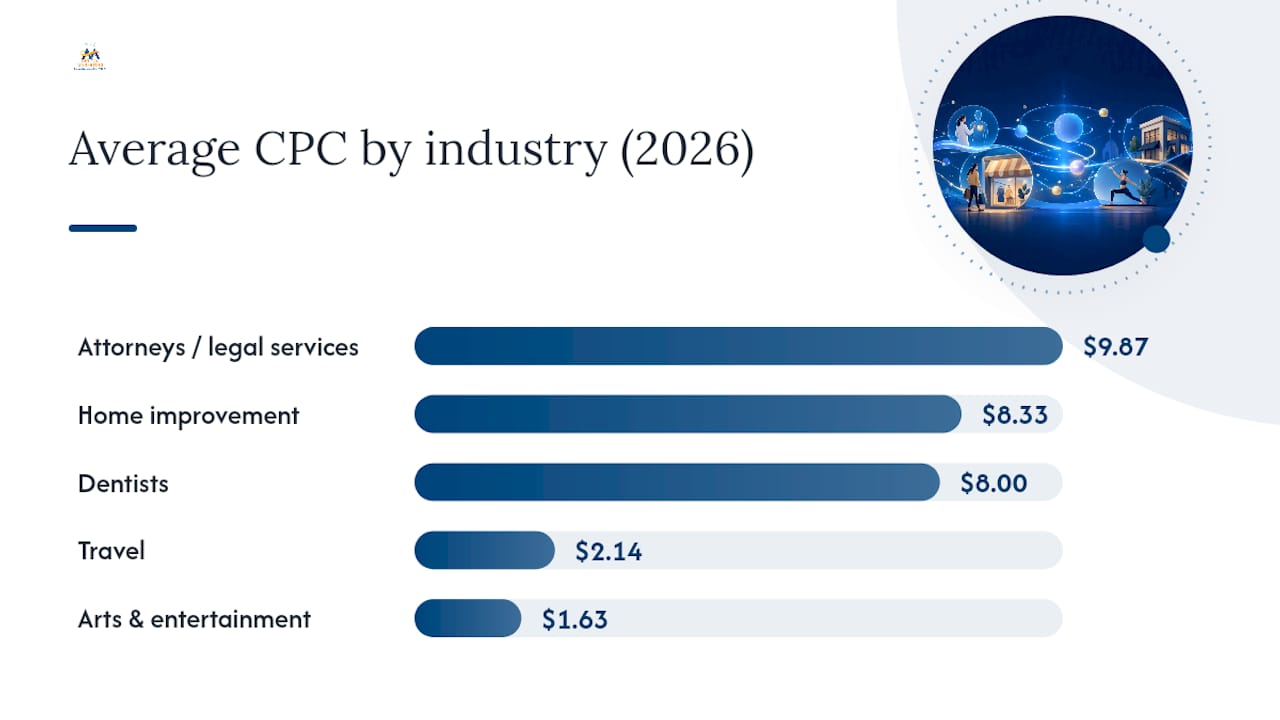
Averages hide the real story. WordStream and LocaliQ's 2026 data shows attorneys paying an average of $9.87 per click, home improvement companies at $8.33, and dentists at $8.00, while arts and entertainment businesses pay just $1.63, restaurants pay $2.05, and travel companies pay $2.14.
| Industry | Avg. CPC | Notes |
|---|---|---|
| Attorneys / legal services | $9.87 | High CLTV drives aggressive bidding |
| Home improvement | $8.33 | Competitive local service category |
| Dentists | $8.00 | High-value patient relationships |
| Travel | $2.14 | Lower intent, high volume clicks |
| Restaurants | $2.05 | Frequent, low-value transactions |
| Arts & entertainment | $1.63 | Least competitive auction |
A few things to keep in mind when you look at your own vertical against this table:
- These are averages within already broad categories. A single high-intent legal keyword like "personal injury lawyer near me" can run well past $20 per click, while a branded search term in the same account might cost $2.
- Databox's median CPC estimate sits around $1.53, far below the $5.42 blended mean, which confirms that a handful of expensive verticals skew the national average upward.
- If you're in a mid-tier category not listed here, benchmark against the closest comparable vertical rather than the national blended figure.
How Do You Calculate a 2026 Google Ads Budget?
The formula is simple: Monthly budget = (Target leads ÷ conversion rate) × average CPC. Each input matters, and getting any one of them wrong throws off the whole plan.
- Set your target lead count. Decide how many qualified leads you need per month to hit a revenue goal.
- Estimate your conversion rate. Use your own landing page history if you have it; otherwise start with the 8.18% U.S. search average as a placeholder and adjust once real data comes in.
- Plug in your industry's average CPC from the table above, not the blended $5.42 figure, unless your business genuinely falls in that middle range.
- Multiply clicks needed by CPC to get your raw ad spend estimate.
- Add management costs if you're outsourcing. Agencies typically charge either a flat retainer or a percentage of managed spend, so budget that separately from media spend.
A few worked examples make this concrete:
- Local plumber, home services: Target 20 leads/month, 8% conversion rate, $8.33 CPC. Needed clicks: 250. Monthly spend: roughly $2,082.
- Boutique ecommerce store: Target 50 conversions/month, 4.4% conversion rate (Display-heavy mix per AdPredictor's 2026 data), $0.63 CPC. Needed clicks: 1,136. Monthly spend: roughly $716.
- Independent restaurant: Target 100 leads/month (reservations or orders), 8% conversion rate, $2.05 CPC. Needed clicks: 1,250. Monthly spend: roughly $2,562.
BrandsImpacts' 2026 analysis shows 39% of accounts spend between $1,000 and $10,000 monthly, with an average account near $3,100. Use that range as a sanity check against your own math, and read our guide on limited advertising budgets if your target number feels out of reach on day one.
How Can You Lower Google Ads Costs Without Losing Leads?
Cutting your budget is the slowest way to fix a cost problem. Improving Quality Score and conversion rate almost always beats a blunt spending cut, because Google rewards relevance with lower prices for the same auction position.
Start with the keyword list itself. Tight, specific match types combined with an aggressive negative keyword strategy stop your budget from being wasted on searchers who were never going to convert. Pair that with ad copy that speaks directly to search intent, since a higher click-through rate feeds directly into a better Quality Score.
Landing pages matter just as much as the ads themselves. A page built specifically for the ad's promise, with a clear call to action and fast load time, routinely lifts conversion rate enough to offset a higher CPC. That's the lever most small businesses skip because it requires design work, not just budget adjustments.
Campaign type is a deliberate trade-off, not a default setting:
- Search campaigns cost more per click but capture buyers actively looking for your service.
- Display and remarketing cost far less per click and work well for staying visible to past visitors, but they need separate conversion-rate expectations.
- Video can build awareness cheaply but rarely drives immediate leads for local service businesses.
Pro Tip: Negative keywords are the most overlooked lever in the entire account. Reviewing your search terms report monthly and adding irrelevant queries to your negative list often cuts wasted spend faster than any bid adjustment. Our PPC campaign guide walks through the full setup.
How Long Should You Test a Google Ads Campaign in 2026?
Give a new campaign at least 30 days before drawing conclusions, and expect real stability closer to the 60 to 90 day mark, since Google's automated bidding systems need that window to learn your account's conversion patterns.
Watch these KPIs weekly, but judge trends monthly:
- Click-through rate (CTR) signals ad relevance and directly affects Quality Score.
- Cost per click (CPC) tells you what the auction is charging, but only matters in context of conversion rate.
- Conversion rate is the number that turns clicks into leads.
- Cost per lead (CPL) and cost per acquisition (CPA) or return on ad spend (ROAS) tell you whether the math actually works for your business.
- Impression share shows how much of the available auction you're capturing versus losing to budget caps or low bids.
A realistic timeline: expect noisy, unreliable numbers in weeks one through four. Months two and three usually reveal a real pattern once the algorithm has enough conversion data. By months three through six, you should have a defensible CPA benchmark to justify scaling spend. One important detail: Google's daily budget functions as an average, not a hard cap, meaning spend can run higher on strong days and lower on slow ones across the billing cycle.
Rule of thumb: scale a campaign that's hitting your target CPL, pause keywords burning budget with zero conversions after meaningful click volume, and pivot ad groups that show strong CTR but weak conversion, since that combination usually points to a landing page problem, not a targeting problem.
What Data Backs These 2026 Benchmarks?
The core figures in this article come from WordStream and LocaliQ's 2026 benchmark report, which analyzed 13,474 U.S. search advertising campaigns to produce average CPC, CTR, conversion rate, and CPL figures. AdPredictor's 2026 analysis contributed campaign-type comparisons between Search and Display spending. Tips for Digital Marketing's 2026 report supplied the budgeting formula used in the worked examples above, and BrandsImpacts' 2026 guide provided real account spend distribution data.
| Term | Definition |
|---|---|
| CPC | Cost per click, the price paid each time someone clicks your ad |
| CTR | Click-through rate, the percentage of people who see your ad and click it |
| Conversion rate | Percentage of clicks that complete a desired action, like filling out a form |
| CPL | Cost per lead, total spend divided by number of leads generated |
A key caveat: these benchmarks are U.S.-only and sector-level, meaning they hide wide keyword-level variation within any single account. Superscale's 2026 analysis makes the point clearly by comparing WordStream/LocaliQ's mean CPC of $5.42 against Databox's reported median of around $1.53. Compare your numbers to your specific vertical, not the blended national figure, and treat every benchmark here as a starting point for your own testing, not a guarantee.
Why Businesses Struggle to Budget for Google Ads
Most small business owners treat Google Ads pricing as a fixed number they either can or can't afford, and that's the wrong frame. The real question is never "can I afford $5 clicks." It's "what does a converted customer need to cost before this stops making sense for my business."
Home services and legal businesses can absorb $8 to $10 CPCs without blinking because a single closed customer pays for dozens of clicks. A restaurant running the same math on a $2 CPC can still lose money if the landing page doesn't convert, because volume without conversion efficiency just burns budget faster. High CPCs in expensive categories usually reflect high customer lifetime value in that market, so the smarter lever there is tightening conversion, not fighting the auction on price.
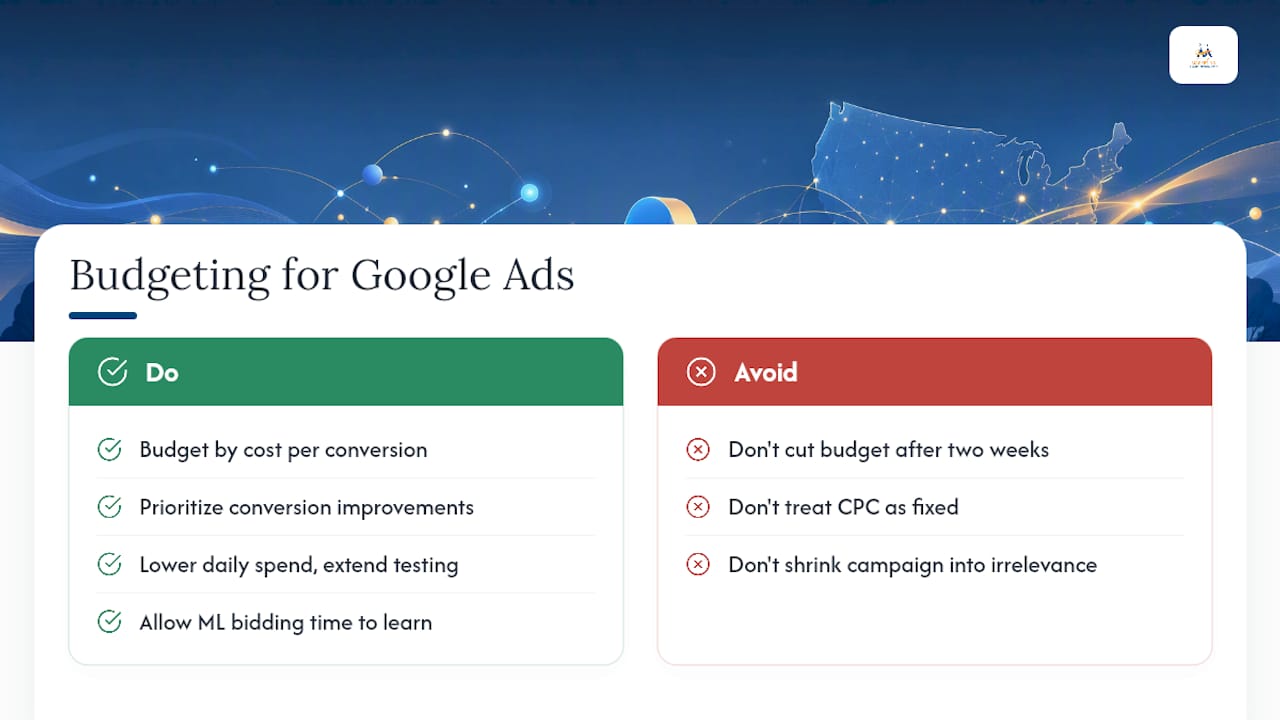
The bigger mistake I see is businesses pulling budget the moment a campaign looks shaky in week two. Machine learning bidding needs real time to find its footing, and a small starter budget stretched too thin just produces noisy, unreliable data that leads owners to kill campaigns that would have worked fine with another month of runway. If you're tight on cash, spend less per day and extend the testing window rather than shrinking the campaign into irrelevance. A locatehire.com guide on setting realistic small business budgets makes a similar point about staffing costs: undersized budgets that get abandoned early waste more money than slightly larger ones given time to prove out.
Get Expert Help Managing Your Google Ads Budget
Running the CPC-to-CPL math is only half the battle. Turning that budget into actual booked customers requires tight keyword management, conversion-focused landing pages, and constant testing, which is exactly where most small business owners run out of bandwidth. Digital Marketing All manages that entire process for you, from AI-driven bid strategy to landing page builds designed specifically to convert paid traffic, so your ad spend produces leads instead of just click data.
Rather than guessing at a starter budget and hoping the algorithm figures it out, you get a managed plan built around your actual industry benchmarks and lead economics. If lead quality and online reputation are part of what's holding your conversion rate back, start with a look at how review generation and management can strengthen the trust signals your landing pages depend on to close the loop between click and customer.
Sources
- Google Ads for Small Business (2026 Guide)
- How Much Does Google Ads Cost in 2026? Real Pricing Data by Industry | AdPredictor
- How Much Does It Cost To Run Google Ads In 2026? (Real Numbers By Industry)
- Google Ads Budget for Small Business (2026 Guide)
- Google Ads CPC Too High? Benchmarks + How to Lower It (2026)
This article is general information, not a substitute for advice from a qualified financial advisor. Consult a qualified financial professional about your own circumstances before acting on anything here.
FAQ
How much do Google Ads cost per month in 2026?
Most small businesses should plan for $1,000 to $2,500 per month as a realistic starting budget, though average account spend across the market sits closer to $3,100 monthly.
What is a good cost per lead for Google Ads in 2026?
The 2026 U.S. average CPL is $66.69, but a "good" CPL depends entirely on your customer lifetime value and profit margin per sale.
Why is my industry's CPC higher than the national average?
High-CPC industries like legal, dental, and home improvement have high customer lifetime value, so businesses in those sectors can profitably bid $8 to $10 per click.
How long should I test a Google Ads campaign before judging results?
Wait at least 30 days for initial signals, and give the campaign 60 to 90 days for automated bidding to fully stabilize before making major changes.
Should I manage Google Ads myself or hire help?
Self-management works if you have the time to review search terms and landing pages weekly; agencies like Digital Marketing All make sense once budget size or lack of bandwidth makes hands-on optimization impractical.