

TL;DR:
- Local SEO and Google Business Profile optimization significantly increase small business conversions.
- AI tools like chatbots and personalized pop-ups enhance customer engagement and lead quality.
- Consistent fundamental efforts, such as updating listings and responding to reviews, outperform complex strategies.
Every month your website fails to convert visitors, you're leaving real revenue on the table. Website conversions, meaning the actions visitors take that matter most to your business like form fills, calls, or purchases, are the true measure of your digital marketing effort. For small to medium-sized businesses, the gap between a low-converting site and a high-performing one often comes down to two factors: AI-driven marketing and local SEO. Local SEO tactics like Google Business Profile optimization can deliver 3-5 times higher conversions than national SEO for SMBs. This guide gives you a practical, step-by-step framework to close that gap fast.
Table of Contents
- Assess your current website performance
- Optimize your Google Business Profile for local SEO
- Leverage AI-powered marketing solutions
- Enhance conversion paths with local SEO best practices
- Why most SMB sites fail to convert—and what actually works
- Take your conversion strategy to the next level
- Frequently asked questions
Key Takeaways
| Point | Details |
|---|---|
| Local SEO drives more conversions | Optimizing for local search can yield up to five times more conversions than national approaches. |
| Google Business Profile is essential | Complete, optimized GBP listings dramatically increase visibility and trust with local customers. |
| AI marketing tools boost engagement | Affordable AI-powered solutions analyze user behavior and personalize the experience to improve conversion rates. |
| Consistent improvement wins | Regularly review your data, refine your process, and leverage new tools for ongoing growth. |
Assess your current website performance
To make meaningful improvements, you first need to know where you stand. Before changing a single button or headline, pull your baseline data. You need four core metrics on your radar.
Key conversion metrics to track:
- Conversion rate: The percentage of visitors who complete a desired action (industry average for SMBs is 2-5%).
- Bounce rate: The percentage of visitors who leave after viewing only one page. A high bounce rate signals a mismatch between your ad or search result and your landing page.
- Average session duration: How long visitors stay. Short sessions often mean your content isn't answering their questions.
- Lead and form completions: The raw count of people who actually contacted you or signed up.
Free tools like Google Analytics 4, Hotjar, and your CRM's built-in dashboard give you all of this data at no cost. Set up goals in Google Analytics so every form submission and phone click is tracked automatically.
Conversion rate benchmarks: local vs. national
| Traffic source | Average conversion rate |
|---|---|
| National SEO | 1-2% |
| Local SEO (SMBs) | 3-5% |
| Local mobile search | Up to 6.8% |
| Paid search (PPC) | 2-4% |
As this table shows, SMBs see 3-5x higher conversions from local SEO compared to broader national strategies. That's not a small edge. It's a fundamental reason to prioritize local.
The most common conversion leaks are slow page load times (anything over 3 seconds loses visitors fast), vague or buried calls-to-action, and forms that ask for too much information upfront. Check your site's speed with Google PageSpeed Insights and review your conversion optimization guide to identify which leaks apply to your site.
Pro Tip: Set a recurring monthly calendar reminder to review your conversion metrics. Trends matter more than single data points. A single bad week is noise. Three bad weeks in a row is a problem that needs fixing.
Optimize your Google Business Profile for local SEO
Once you know where your website stands, it's time to address one of the biggest conversion levers for SMBs: Google Business Profile (GBP). A complete, accurate GBP listing is often the first thing a local customer sees before they ever visit your website.
Steps to optimize your GBP:
- Claim and verify your profile at business.google.com if you haven't already. See our guide on setting up GBP for a full walkthrough.
- Update your Name, Address, and Phone number (NAP) so it matches exactly what appears on your website and all directories.
- Select the most accurate primary and secondary business categories.
- Add all services or products with descriptions and pricing where possible.
- Confirm your hours, including holiday hours, so customers always get accurate information.
- Upload at least 10 high-quality photos of your location, team, and work.
GBP optimization is proven to increase conversion rates for small businesses, and it's one of the few high-impact tactics that costs nothing but time.
Optimized vs. unoptimized GBP: conversion impact
| Profile status | Avg. monthly profile views | Conversion to website visit |
|---|---|---|
| Unoptimized | 200-400 | 2-3% |
| Fully optimized | 800-1,500 | 8-12% |
The difference is stark. An optimized profile doesn't just get more views. It converts those views into action at a dramatically higher rate. Getting into the Map Pack (the top 3 local results on Google) multiplies this effect even further.

Pro Tip: Post a GBP update at least once a week. Answer every question in the Q&A section promptly, and respond to every review, positive or negative. Active profiles rank higher and build trust faster with potential customers.
Leverage AI-powered marketing solutions
With your profile optimized, further boost conversions by reaching the right customer with the right message at scale using AI. AI tools are no longer reserved for large enterprises. Affordable options are available for businesses of any size.
Best low-cost AI tools for SMBs:
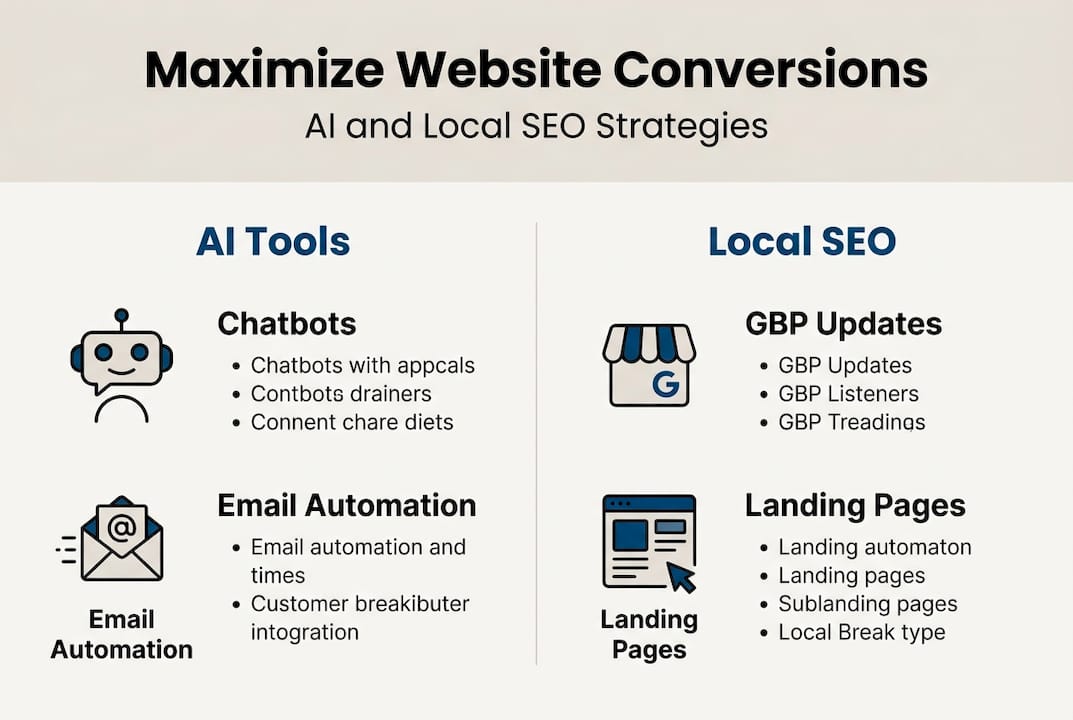
- Chatbots (Tidio, Intercom, Drift): Answer visitor questions instantly, 24/7, and qualify leads before they leave your site.
- Smart pop-ups (OptinMonster, Privy): Trigger personalized offers based on visitor behavior, like exit intent or time on page.
- Recommendation engines (Barilliance, LimeSpot): Show visitors products or services most relevant to their browsing history.
- Behavior analysis tools (Microsoft Clarity, Hotjar AI): Identify exactly where visitors drop off so you can fix friction points fast.
- Automated email sequences (Mailchimp AI, ActiveCampaign): Follow up with leads automatically based on their actions on your site.
AI personalizes the user journey in a way that static websites simply can't. When a visitor sees content, offers, or answers tailored to their specific need, they're far more likely to convert. Autocomplete marketing is one smart example of this, placing your business in front of customers at the exact moment they're searching.
Stat callout: Local mobile searches convert at 6.8%, more than three times the national average. AI tools that detect mobile visitors and serve them a click-to-call button or a location-specific offer capitalize directly on this behavior.
The key to integrating AI without disrupting your existing user flow is to start with one tool, measure its impact over 30 days, and then expand. Don't overhaul everything at once. Adding a chatbot to your contact page or a smart pop-up on your pricing page are low-risk starting points. Pair these with Search Price Optimization strategies to make sure your pricing signals are working in your favor across search results.
Enhance conversion paths with local SEO best practices
AI and smart tools are powerful, but they perform best alongside robust local fundamentals. Local SEO is the foundation that makes everything else work harder.
Quick-win local SEO steps:
- Audit your NAP (Name, Address, Phone) across Google, Yelp, Bing Places, Apple Maps, and all major directories. Even one inconsistency can hurt your rankings.
- List your business in the top 10 local directories relevant to your industry.
- Ask satisfied customers for Google reviews and respond to every one.
- Create individual landing pages for each city or neighborhood you serve, using local keywords naturally in the content.
- Add local schema markup (structured data) to your website so search engines understand your location and services.
- Feature local events, community stories, or neighborhood-specific content to build relevance and trust.
"Local SEO efforts directly increase SMB conversion rates by connecting businesses with high-intent nearby customers who are ready to act."
Local landing pages are especially powerful. A page titled "Plumbing services in Austin, TX" will outperform a generic "Our services" page for local searches every time. These pages give you a place to feature local reviews, photos, and specific service details that match exactly what nearby customers are searching for.
Managing your local SEO guide and reputation together creates a compounding effect. More reviews lead to better rankings, which drive more traffic, which generates more conversions. Understanding the full scope of local search power helps you see why these fundamentals matter so much for long-term growth.
Why most SMB sites fail to convert—and what actually works
Even with the best strategies in hand, many businesses are still stuck. Here's why: most SMBs chase the newest tool or trend while ignoring the basics that actually drive conversions.
We see it consistently. A business invests in a sophisticated AI chatbot but hasn't updated their address on Google in two years. Or they build a beautiful website that loads in 6 seconds on mobile. Or they copy a large competitor's homepage structure without considering that their customers have completely different needs and search behaviors.
The uncomfortable truth is that execution beats strategy every time. A business that consistently updates its GBP, responds to reviews, and keeps its NAP accurate will outperform one with a complex AI stack and poor fundamentals. The businesses that win at conversions aren't doing anything exotic. They're doing the right things repeatedly and measuring the results.
Our experience with conversion optimization strategies confirms this. The businesses that see the biggest gains are the ones that make small, consistent improvements, test one change at a time, and stay patient. There is no single silver bullet. There is only steady, focused effort.
Pro Tip: Pick one conversion metric to improve each month. Focus your effort there, measure the result, and move to the next. This approach builds momentum without overwhelming your team.
Take your conversion strategy to the next level
Ready to boost your conversions? The right partner can make all the difference. At Digital Marketing All, we specialize in helping small and medium-sized businesses implement the exact strategies covered in this guide, from local SEO and GBP optimization to AI-powered marketing solutions and Search Price Optimization.
Our team can audit your current website performance, identify your biggest conversion leaks, and build a custom plan to fix them. Whether you want to dominate local search, integrate smart AI tools, or explore geo-fencing tactics to reach nearby customers at the right moment, we have the tools and expertise to deliver results. The next step is simple: partner with us and let's build a conversion strategy that works for your business.
Frequently asked questions
What is a good website conversion rate for small businesses?
A strong conversion rate for SMB websites sits around 5-7%, but local mobile searches can push that as high as 6.8%, making local SEO one of the most effective ways to hit that target.
How does local SEO improve website conversions?
Local SEO connects your business with nearby customers who are actively looking to buy, delivering 3-5 times higher conversions than general national SEO strategies.
Which AI tools help increase website conversions?
Affordable options like chatbots, behavior-triggered pop-ups, and automated email sequences are fast to implement and directly improve engagement and conversion rates for SMBs.
Why is Google Business Profile so important for conversions?
A complete GBP ensures your business appears in local search results with accurate, trustworthy information, and optimized profiles consistently convert profile views into website visits and calls at a much higher rate than incomplete listings.
Recommended
- Website conversion optimization guide for SMBs in 2026
- AI Lead Generation 2025: Dominate Local Customers Now
- Local SEO Checklist 2026: 40% More Leads with AI Search Optimization
- Role of AI in Local SEO: Transform Your Business Visibility
- Why Optimise for AI Search: Impact on Local Business
- Boost Conversions with an Ajax-Powered WooCommerce Mini Cart - LSA SEO Agency