

Match the framework to the deal, not the other way around. Use BANT for high-volume, transactional sales; CHAMP or GPCT for consultative mid-market deals. MEDDIC or MEDDPICC for enterprise accounts with buying committees. Operationally, run a lightweight SDR filter first, hand qualified leads to a deeper AE framework, then score everything on fit, intent, and timing. Pick one system, run it for a full quarter, and resist the urge to swap frameworks before the data comes in.
TL;DR:
- Match qualification frameworks to deal size, cycle length, and stakeholder complexity to avoid slowing down simple sales or rushing complex enterprise deals.
- Use KPIs like MQL-to-SQL conversion rate, pipeline accuracy, and forecast variance to measure qualification effectiveness and adjust thresholds accordingly.
- Automate fit and intent scoring with AI, but retain human involvement for timing, champion validation, and complex judgment calls.
- Build a structured, repeatable process with clear ownership, scoring rubrics, CRM fields, and SLA-defined handoffs to ensure framework adoption.
- Conduct regular pipeline hygiene reviews, document disqualification reasons, and run a full-quarter test before switching qualification approaches.
Table of Contents
- What Is B2B Lead Qualification, and What Should You Measure?
- BANT, MEDDIC, CHAMP, and GPCT: Which Framework Fits Your Deal?
- How Do You Choose the Right Qualification Framework?
- How Do You Turn a Framework Into a Repeatable Process?
- How Should You Build a Lead Scoring Model?
- What Should You Automate, and Where Should Humans Stay Involved?
- What Mistakes Undermine Lead Qualification, and How Do You Fix Them?
- Where Digital Marketing All's Playbooks and Data Fit In
- Which Framework Should Most GTM Teams Actually Run?
- Sources
- FAQ
What Is B2B Lead Qualification, and What Should You Measure?
Lead qualification confirms whether a prospect has the fit, intent, authority, and timing to be worth your team's time before anyone commits real hours to the deal, according to Pipedrive. That's the whole point: separate leads that can actually become revenue from leads that will quietly die in your pipeline three months from now, wasting a rep's forecast in the process.
Every credible qualification approach, no matter what acronym it uses, is built on the same five dimensions:
- Fit: Does the prospect's company, industry, and use case match your ideal customer profile?
- Intent: Are they actively researching a solution, or did they just download a whitepaper out of curiosity?
- Authority: Who's in the room, and can that person actually approve a purchase or influence one?
- Timing: Is there a trigger event, budget cycle, or deadline pushing them to act now?
- Champion strength: Is there an internal advocate who will fight for your deal when you're not in the room?
You need KPIs that prove your qualification process is working, not just running. Track MQL-to-SQL conversion rate to catch marketing/sales misalignment early. Track time-to-qualified, since a lead that sits unscored for two weeks has already gone cold. Track pipeline accuracy (how many "qualified" deals actually close) and forecast variance (how far your predicted close dates and amounts drift from reality). If forecast variance is high, your qualification bar is probably too loose, not your sales team too slow.
BANT, MEDDIC, CHAMP, and GPCT: Which Framework Fits Your Deal?
Every framework claims to be the definitive way to qualify a lead. None of them are universal, and the biggest qualification failure sales teams make is applying a heavyweight enterprise framework to a transactional deal, or the reverse, which tends to slow simple sales and rush complex ones.
BANT (Budget, Authority, Need, Timeline) is IBM's decades-old original, and it still works for a reason. It's fast, checklist-driven, and built for deals under roughly $10,000 in annual contract value with a sales cycle under 30 days. The weakness: it front-loads the budget question, which can spook prospects who haven't fully diagnosed their problem yet, and it says nothing about multi-stakeholder politics.
CHAMP (Challenges, Authority, Money, Prioritization) flips BANT's order. It opens with the prospect's actual challenge instead of their wallet, which suits consultative selling where the rep needs to build a business case before talking price. It fits mid-market deals with moderate deal sizes and sales cycles of one to three months. A partner in consultative sales training, True Colors International, frames this challenge-first approach as the difference between selling a feature and selling a fix, and that framing is exactly why CHAMP outperforms BANT once a deal requires real discovery.
MEDDIC (Metrics, Economic Buyer, Decision Criteria, Decision Process, Identify Pain, Champion) and its extended cousin MEDDPICC (adding Paper Process and Competition) were built for enterprise software sales with six-figure contracts and cycles stretching six months or longer. Modern B2B buying groups increasingly involve multiple stakeholders and formal buying committees, and Forrester's research on buying groups confirms this is now the norm rather than the exception in mid-market and enterprise purchases. MEDDIC is built specifically to map that complexity: who owns budget, what the formal decision criteria are, and who internally will champion your deal. The tradeoff is real: MEDDIC demands more discovery time and more CRM discipline than many SDR teams typically have bandwidth for.
GPCT (Goals, Plans, Challenges, Timeline), and its extended versions GPCTBA and C&I, come from HubSpot's inbound methodology and work well for product-led or content-driven pipelines where prospects self-educate before talking to a rep. It's less rigid than MEDDIC, more strategic than BANT, and fits deals in the $15,000 to $50,000 band where the buyer already understands their problem.
SPIN and its modern successor SPICED (Situation, Pain, Impact, Critical Event, Decision) aren't qualification checklists so much as discovery question frameworks. They're most useful layered inside another framework, feeding the "Need" or "Pain" fields with sharper, more specific answers instead of vague pain statements.
Here's the quick-reference comparison:
| Framework | Best ACV Range | Cycle Length | Stakeholder Complexity |
|---|---|---|---|
| BANT | Under $10K | Under 30 days | Single decision-maker |
| CHAMP | $15,000 to $50,000 | 1 to 3 months | Small committee |
| GPCT | $15K to $50K | 1 to 4 months | Small committee |
| MEDDIC/MEDDPICC | six-figure contracts | six months or longer | Multi-stakeholder committee |
Most mature revenue teams don't pick one framework and stop. They run a hybrid: BANT or CHAMP as the SDR-level filter, MEDDIC at the AE discovery stage for anything above a certain deal size, and MEDDPICC specifically for deal review once procurement and security teams enter the picture, an approach echoed in Onsa's guide to lead qualification. That stage-specific layering solves the biggest complaint about any single framework: no one tool fits every deal in your pipeline.
How Do You Choose the Right Qualification Framework?
Skip the debate over which framework is "best" and run your deals through three filters instead, an approach Leadhaste's research on framework selection backs as the fastest way to avoid misapplying a heavy framework to a light deal.
- Average contract value (ACV). Lower-value deals typically suit BANT. Moderate deal sizes fit CHAMP or GPCT. Higher-value enterprise deals call for MEDDIC or MEDDPICC.
- Sales cycle length. A 30-day cycle can't absorb MEDDIC's discovery overhead. A six-month enterprise cycle can't survive on BANT's four questions.
- Stakeholder complexity. One decision-maker means BANT works fine. Five stakeholders across procurement, IT, and finance means you need MEDDIC's Decision Process and Paper Process fields, or you'll lose the deal to a signature you never mapped.
Run all three deals through the filter and you'll usually land on the same framework each filter independently suggests. When they disagree, weight stakeholder complexity heaviest. A $20,000 deal with seven approvers behaves more like an enterprise sale than a mid-market one.
Before you commit, be honest about team capacity. MEDDIC requires real training and CRM fields most small teams haven't built yet. If your CRM maturity is low, meaning reps aren't reliably logging fields today, adding MEDDPICC's eight data points will just create more empty fields, not better qualification.
Pro Tip: Don't retrofit your framework to your existing CRM fields. Build the fields to match the framework you actually need, then migrate your data. Teams that reverse this order end up qualifying leads against fields that don't measure what actually predicts a close.
How Do You Turn a Framework Into a Repeatable Process?
A framework on a slide deck changes nothing. It only works once it's built into daily workflow with clear ownership at every handoff.
- Define your ICP and disqualification rules first. Before scoring a single lead, write down what a "good fit" company looks like (industry, size, tech stack, budget signal) and, just as important, what automatically disqualifies a lead (wrong industry, no budget authority, non-serviceable region).
- Build a pre-call scoring layer. Automate firmographic and behavioral scoring in your CRM or marketing platform so SDRs see a score before they ever dial.
- Write an SDR quick-screen script. Four to six questions, mapped to BANT or CHAMP, designed to take under ten minutes and end in a clear qualify/disqualify decision.
- Build an AE deep-discovery template. This is where MEDDIC's Metrics, Decision Criteria, and Champion fields get filled in during a real conversation, not guessed at.
- Create a deal-review checklist. Before any deal enters forecast, a manager checks Economic Buyer confirmation, Decision Process mapping, and competitive positioning.
The artifacts that make this stick, according to HubSpot Academy's framework guidance, are concrete and reusable:
- A documented scoring rubric everyone on the team can point to
- CRM fields that map directly to your chosen framework's variables
- Service-level agreements for every handoff (SDR to AE within 24 hours, AE to deal review before forecast lock)
- A disqualification taxonomy with standardized reasons, so "not a fit" actually tells you something six months later
Cadence matters as much as the artifacts. Set an SLA for how fast a scored lead gets a first touch, ideally under an hour for high-intent signals. Run a weekly pipeline hygiene review where disqualified leads get logged with a reason code, not just archived. If your team is building this from scratch, a structured qualification workflow gives SDR managers a faster starting point than building every field from zero.
How Should You Build a Lead Scoring Model?
A single score beats a gut feeling, but only if it combines three distinct layers instead of collapsing everything into one number.
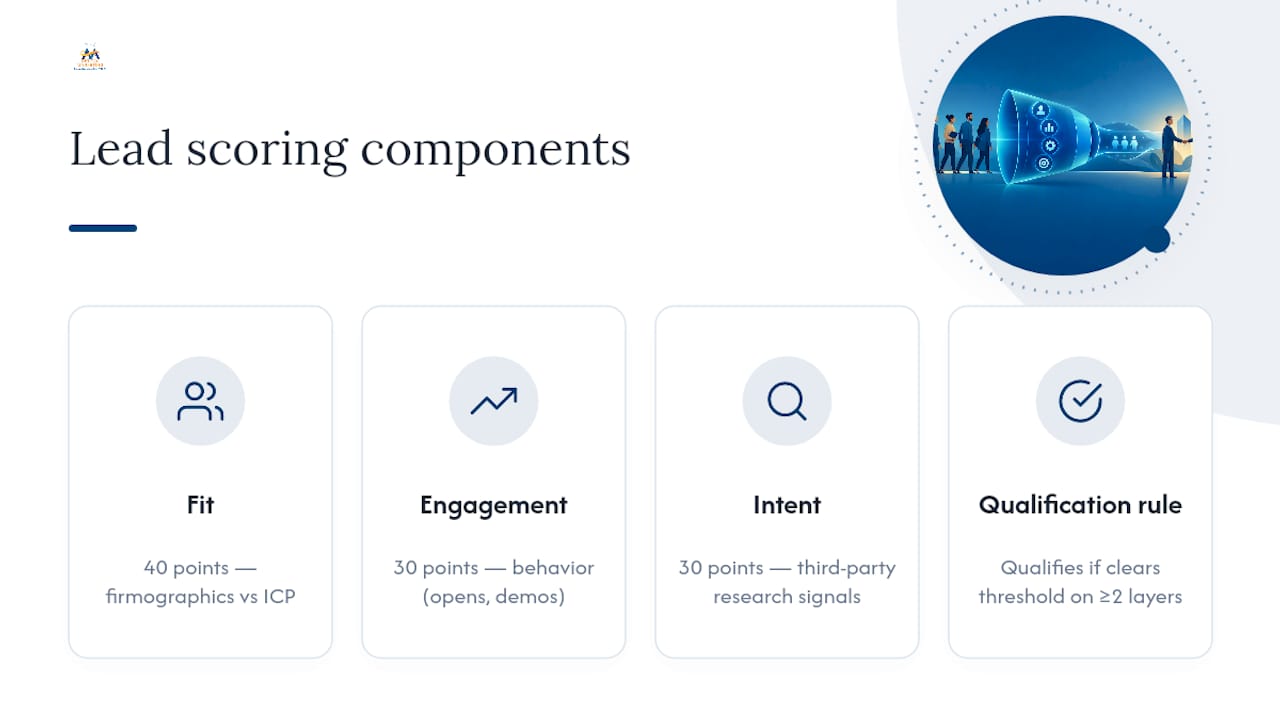
Fit covers firmographic data: company size, industry, tech stack, and geography matched against your ICP. Engagement covers behavior: email opens, webinar attendance, pricing page visits, demo requests. Intent covers third-party signals: a prospect researching competitor terms on G2 or actively comparing solutions, often surfaced through intent-data providers.
Weighting works best when it's simple enough for a rep to explain in one sentence. A common structure: fit worth 40 points, engagement worth 30, intent worth 30, out of 100 total. Leadhaste's scoring research recommends routing any lead that clears the threshold on at least two of the three layers, rather than requiring a perfect score across all three, since demanding all three at once filters out too many legitimately warm leads.
Statistic to watch: if your MQL-to-SQL conversion rate sits well below your team's historical average, that's usually a scoring model problem before it's a sales-execution problem. Check the weighting before you retrain the reps.
Scores should trigger action automatically. A lead clearing 80 points gets routed to an AE within the hour. A lead at 50 to 79 goes to an SDR for a quick-screen call. Anything under 50 goes into a nurture cadence, not a rep's queue. Timing signals, like a recent funding round or a leadership change, should bump a lead's priority regardless of its raw score, since urgency often beats fit when a buyer has a deadline.
What Should You Automate, and Where Should Humans Stay Involved?
AI and automation can reliably score fit and intent at scale, but timing and champion validation still generally require a human on the call, according to Harvard Business Review's research on AI-augmented sales teams. That's the right dividing line for any automation roadmap: let software handle pattern matching, keep a person handling judgment calls about whether someone will actually champion your deal internally.
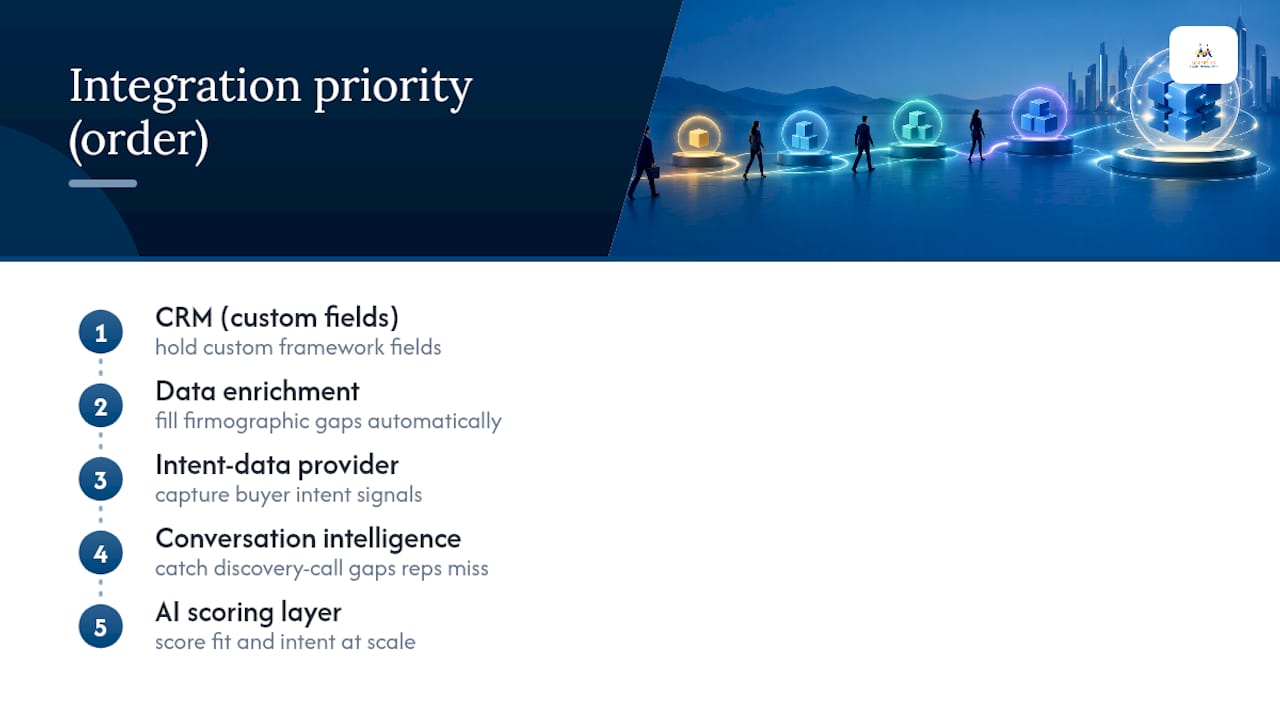
Your integration checklist should prioritize, in order: a CRM that can hold custom framework fields, a data enrichment tool to fill firmographic gaps automatically, an intent-data provider, conversation intelligence to catch discovery-call gaps reps miss, and an AI scoring layer on top. Tools like a chatbot lead qualification system can handle the initial BANT-style screen on your website before a human ever gets involved, cutting the SDR's quick-screen call down to confirmation rather than discovery.
Watch for three risks: false positives from over-weighted intent signals, model drift as your ICP shifts and nobody retrains the scoring model, and privacy or compliance exposure from third-party intent data that wasn't properly consented.
Pro Tip: Audit your AI scoring model's false-positive rate quarterly. If AEs are routinely disqualifying "high-score" leads on the first call, your model is scoring the wrong signals, not your reps missing opportunities.
What Mistakes Undermine Lead Qualification, and How Do You Fix Them?
The most common failure is a mismatch between framework and deal size, running full MEDDIC on transactional leads where BANT would qualify faster and just as accurately, a pattern ManageYourLeads' framework comparison flags repeatedly. Other recurring anti-patterns:
- Treating qualification as a checklist to complete instead of a conversation to have
- Asking about budget in the first thirty seconds, before establishing any pain
- Skipping champion mapping entirely, then losing the deal to a stakeholder nobody talked to
- Letting CRM fields go stale, so "qualified" leads from three months ago are still sitting in an SDR queue
Fix these with governance, not more training slides. Run a weekly hygiene review of stale opportunities. Require a documented disqualification reason on every closed-lost deal.
Pro Tip: Pick your framework, run it untouched for one full quarter, and measure MQL-to-SQL rate and forecast variance before you change anything. Frameworks fail from inconsistent application far more often than from being the wrong choice.
Where Digital Marketing All's Playbooks and Data Fit In
Some digital marketing agencies build AI-assisted lead-scoring systems that combine automated fit and intent scoring with a human-led discovery process.
- Author bio and background on AI-driven qualification approaches
- Case study data on conversion lift from AI lead scoring, typically visible within four to eight weeks
- Internal qualification templates for teams building their first scoring rubric
Which Framework Should Most GTM Teams Actually Run?
For most GTM teams, the answer isn't a single framework, it's a sequence. Run CHAMP or BANT as your SDR filter, escalate to MEDDIC for anything enterprise-sized, and let automated fit-plus-intent scoring decide who gets a human touch first. Measure MQL-to-SQL rate and forecast variance, not activity volume.
If you're unsure this will work for your motion, don't debate it. Run a 90-day trial with one coaching check-in at day 45, and let the KPIs, not opinions in a Monday meeting, decide whether it sticks.
— Diane O'Brien
Sources
- Lead qualification — Pipedrive blog
- The verdict is in: buying groups for the win — Forrester
- Why some sales teams are actually growing alongside AI — HBR
- B2B Lead Qualification Framework 2026: BANT, MEDDIC & Beyond — Leadhaste
- Developing a lead qualification framework — HubSpot Academy
FAQ
What Is Lead Qualification in B2B Sales?
Lead qualification is the process of confirming whether a prospect has the fit, budget authority, intent, and timing to justify a rep's time before they invest in a full sales cycle. It relies on structured criteria like BANT or MEDDIC rather than gut instinct, and it typically happens at multiple stages: SDR screening, AE discovery, and deal review.
What Are the Best Practices for B2B Lead Generation?
Strong B2B lead generation pairs targeted outreach with clear qualification criteria applied consistently from the first touch. Best practice means defining your ICP before you generate a single lead, then scoring every lead against fit, engagement, and intent so marketing and sales agree on what "qualified" actually means.
What Are the Best Tools for B2B Lead Generation?
The most effective setups combine a CRM with custom scoring fields, a data enrichment platform, an intent-data provider, and an AI scoring or chatbot layer for initial screening. The right combination depends on deal size and cycle length more than any single tool's feature list.
What Are the Key Criteria Used to Qualify Leads?
The five core criteria are fit, intent, authority, timing, and champion strength, the same dimensions every major framework, from BANT to MEDDIC, is built around. Teams that skip champion mapping or timing signals tend to see accurate short-term scoring but poor forecast accuracy over a full sales cycle.