

TL;DR:
- AI recommendation optimization shapes a brand's online presence to influence AI systems like ChatGPT and Perplexity. It focuses on building credibility signals across reviews, mentions, and structured content rather than traditional SEO rankings. Continuous measurement and broad external citations are essential for long-term AI visibility and business growth.
AI recommendation optimization is defined as the practice of shaping your brand's online presence so that AI-powered systems select and promote your business when users ask for suggestions. This is not a variation of traditional SEO. Tools like ChatGPT and Microsoft Azure-powered search engines pull from distributed credibility signals across the web, not just your website's page rank. Businesses that understand why optimize for AI recommendations matters in 2026 gain a measurable edge. AI product recommendations can drive up to 31% of ecommerce revenue and return $5.20 for every $1 invested. That is the scale of opportunity on the table.
Why optimize for AI recommendations in 2026?
AI recommendation optimization delivers business results that traditional SEO cannot replicate on its own. The core reason is structural. AI systems do not simply rank pages. They build a "consideration set" of credible candidates before surfacing any result. If your brand lacks sufficient entity clarity or third-party presence, on-site improvements will not increase your AI visibility at all. You are invisible before the ranking even begins.

The revenue case is direct. Recommendation technology drives significant conversion uplift in ecommerce, and the ROI figures reflect that. For local businesses, the stakes are equally high. Only about 1.2% of locations are recommended by ChatGPT compared to 35.9% appearing in Google's local 3-pack. That gap shows how selective AI systems are. Being in Google's local pack does not guarantee AI visibility.
The importance of optimizing AI presence also extends to customer behavior. AI recommendations reduce decision friction. When a customer asks ChatGPT for the best plumber in their city and your business appears, that customer arrives with high intent and minimal hesitation. That is a fundamentally different buyer than someone who scrolls through a list of ten search results.
How do AI recommendation systems select businesses and content?
AI recommendation engines prioritize distributed credibility signals over traditional page ranking. These signals include mentions across third-party sites, backlink patterns, review volume and quality, and how clearly your brand's identity is defined across the web. The best mental model is multi-source retrieval, not simple mention counting.
The selection process works differently from a standard Google crawl. AI systems scan multiple sources simultaneously and look for low-ambiguity passages they can extract and cite. Content that states clear facts, pricing, comparisons, and direct answers gets pulled more reliably than vague brand narratives. Semantic clarity is a technical requirement, not a stylistic preference.
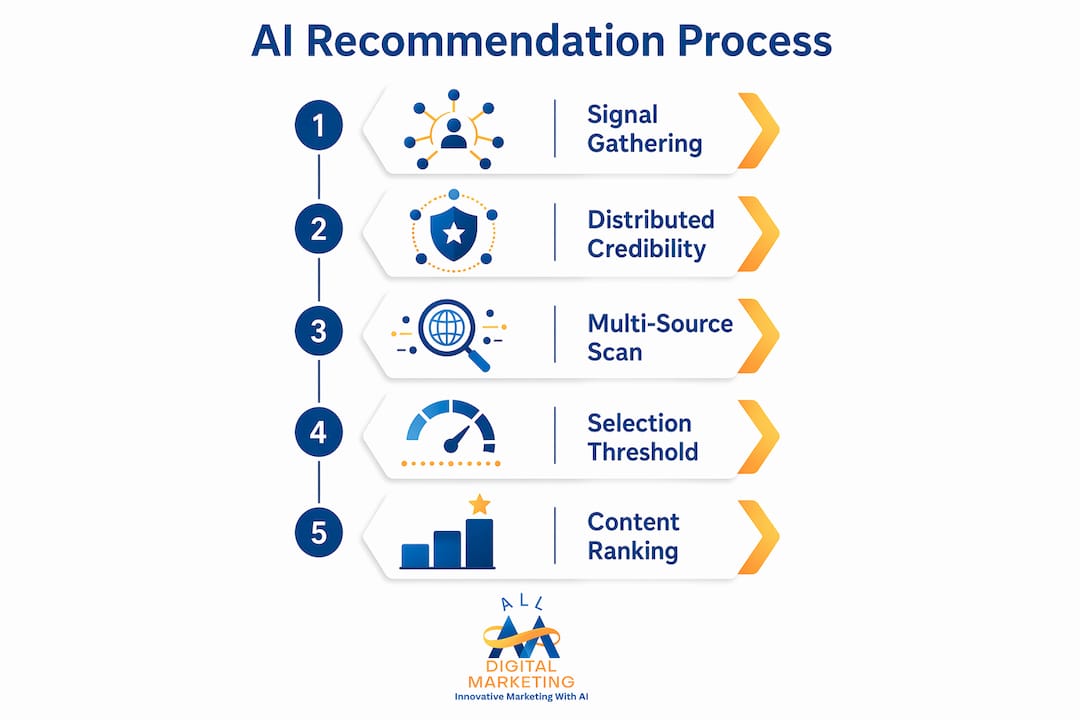
Platform variability adds another layer of complexity. Only 11% of recommendations overlap between ChatGPT and Perplexity, reflecting that each platform weighs credibility signals differently. No single optimization tactic guarantees visibility across all AI engines. That means businesses need a multi-platform presence strategy, not a single-channel fix.
Key signals AI systems evaluate include:
- Review ratings and volume: AI-recommended local businesses average 4.3+ stars, showing that review quality is a hard threshold.
- Third-party mentions: Citations from news sites, directories, and industry publications signal credibility to AI retrieval systems.
- Entity clarity: Your business name, category, location, and services must be consistently defined across all platforms.
- Extractable content: FAQs, pricing pages, and comparison content are easier for AI to cite than general brand copy.
- Backlink patterns: Links from authoritative external sources reinforce your brand's credibility signal weight.
Pro Tip: Run a search for your business name on ChatGPT and Perplexity before building your AI optimization plan. The gaps in those results tell you exactly which credibility signals are missing.
What are the key benefits of AI recommendations for businesses?
The benefits of AI recommendations go well beyond traffic. The first and most direct benefit is revenue impact. When AI systems surface your product or service in response to a high-intent query, the customer is already in decision mode. That context produces higher conversion rates than passive search browsing.
"AI recommendations reduce decision friction for customers, increasing order value and repeat purchases." — Shopify's overview of AI recommendation systems
The second benefit is discovery efficiency. Customers who find you through an AI recommendation did not have to know your brand name first. They asked a question and your business appeared as the answer. That is a fundamentally different acquisition channel than paid ads or organic search, and it requires no ongoing click cost.
Local businesses gain a specific structural advantage. AI systems reward businesses with complete, accurate, and hyperlocal data. A restaurant with detailed neighborhood-level structured data, consistent reviews, and clear menu information outperforms a competitor with better traditional SEO but weaker credibility signals. The playing field shifts toward evidence quality, not budget size.
Additional benefits include:
- Reduced ad dependency: Businesses that appear organically in AI recommendations lower their cost per acquisition over time.
- Brand authority signals: Repeated AI citations build perceived authority in your category, reinforcing trust with new customers.
- Competitive separation: Because AI recommendations are highly selective, appearing in them separates you from the majority of competitors who are not optimized.
- Compounding visibility: Each new third-party mention and review strengthens your credibility signal, making future AI citations more likely.
Microsoft advises board-level cost management for AI investments tied directly to performance and business impact. That guidance applies to your AI optimization budget as well. Track which channels drive AI citations and reinvest in what works.
How does AI recommendation optimization differ from traditional SEO?
The core difference is what gets measured and rewarded. Traditional SEO rewards keyword placement, page authority, and technical site health. AI recommendation optimization rewards entity clarity, citation density, and review completeness. These are not the same targets.
| Factor | Traditional SEO | AI Recommendation Optimization |
|---|---|---|
| Primary signal | Keyword relevance and page rank | Distributed credibility signals across the web |
| Content format rewarded | Long-form keyword-rich pages | FAQs, comparisons, direct definitions, pricing |
| Local ranking driver | Proximity and Google My Business | Review quality, hyperlocal structured data, entity clarity |
| Platform scope | Primarily Google and Bing | ChatGPT, Perplexity, Google AI Overviews, and others |
| Optimization target | Your own website | Your entire web presence including third-party mentions |
| Measurement metric | Rankings and organic traffic | AI citation frequency and recommendation appearance |
The structural threshold concept is critical here. AI visibility depends on meeting thresholds including entity clarity, citation density, and review quality before any ranking logic applies. A business below those thresholds does not rank poorly in AI results. It simply does not appear. That is a binary outcome, not a gradient.
Content format matters more than most marketers realize. AI systems prefer content structured as FAQs, pricing notes, and clear comparisons because those formats produce low-ambiguity passages that are easy to extract and cite. A 2,000-word brand story is harder for an AI to quote than a single sentence that says "We offer same-day plumbing service in Austin starting at $89."
Multi-platform presence also outweighs technical site fixes in AI optimization. A business with strong Yelp reviews, consistent Google Business Profile data, and mentions in local news articles will outperform a competitor with a faster website but no external credibility signals. The AI selection process rewards breadth of evidence, not depth of on-site optimization.
Pro Tip: Audit your Google Business Profile, Yelp listing, and top three industry directories before touching your website. External credibility signals carry more weight in AI recommendation systems than most on-site changes.
What practical strategies improve AI recommendation visibility?
Building AI recommendation visibility requires a structured approach across five areas. Each one addresses a specific signal that AI systems evaluate when assembling their consideration sets.
-
Build entity clarity across all platforms. Your business name, category, address, phone number, and service description must be identical on Google Business Profile, Yelp, Facebook, and every relevant directory. Inconsistency creates ambiguity that AI systems penalize by excluding your brand from consideration sets.
-
Pursue third-party mentions and citations actively. Optimizing only your own website is insufficient. Reach out to local news outlets, industry blogs, and community directories for coverage. Each external mention adds a credibility signal that AI retrieval systems can detect and weight.
-
Structure your content for AI extraction. Write FAQ sections with direct question-and-answer formatting. Include a pricing page with specific numbers. Add a comparison page that names your service against common alternatives. AI systems extract clear, low-ambiguity statements far more reliably than narrative paragraphs.
-
Build topical authority through comprehensive content. Publishing guides, how-to articles, and industry insights repeatedly exposes AI retrieval systems to your brand's expertise. A local HVAC company that publishes detailed guides on seasonal maintenance, energy efficiency, and equipment comparisons builds topical authority that AI systems recognize as a credibility signal.
-
Apply hyperlocal signals for local businesses. Review completeness, velocity, and hyperlocal structured data can outweigh proximity in local AI recommendations. Tag your Google Business Profile with neighborhood-level service areas. Respond to every review. Include city and neighborhood names in your FAQ answers. These signals tell AI systems exactly where and what you serve.
-
Measure and iterate continuously. Treat AI recommendation optimization as a lifecycle process, not a one-time project. Track how often your business appears in AI-generated answers by testing queries monthly. Identify which content pieces generate citations and produce more content in the same format. Continuous measurement tied to business impact prevents budget waste and keeps your strategy aligned with how AI systems evolve.
The businesses that gain the most from AI recommendations are those that treat their entire web presence as the optimization target. Your website is one signal among many. Reviews, mentions, structured data, and topical content work together to build the credibility profile that AI systems reward. For a deeper look at how this plays out in local search, the local business search ranking guide from Digitalmarketingall covers the 2026 landscape in detail.
Key Takeaways
Businesses that optimize for AI recommendations build distributed credibility across reviews, third-party mentions, and structured content, which is the only reliable path to AI visibility in 2026.
| Point | Details |
|---|---|
| AI visibility is binary | Brands below credibility thresholds do not rank poorly. They simply do not appear in AI results. |
| Revenue impact is measurable | AI recommendations can drive up to 31% of ecommerce revenue and $5.20 ROI per $1 invested. |
| External signals outweigh on-site fixes | Third-party mentions, reviews, and citations carry more weight than technical website improvements. |
| Content format determines extractability | FAQs, pricing pages, and direct comparisons are the formats AI systems cite most reliably. |
| Optimization is a continuous process | Monthly testing and iteration tied to business impact prevents budget waste and maintains AI visibility. |
Why I think most businesses are still solving the wrong problem
I have watched business owners spend months perfecting their website's technical SEO while their AI visibility stays at zero. The frustration is real, and the cause is a mental model that no longer fits the tools customers are using.
The shift I keep seeing is this: traditional SEO is a ranking problem. AI recommendation optimization is a credibility assembly problem. Those require completely different solutions. A faster website does not help if ChatGPT has never encountered your brand in a third-party context. A perfectly structured sitemap does not matter if your review profile is thin or inconsistent.
What actually works is treating your entire web presence as the product. That means your Google Business Profile, your Yelp reviews, your mentions in local news, your FAQ page, and your industry directory listings all matter equally. The businesses I see gaining AI visibility fastest are the ones that build evidence of credibility everywhere, not just on their own domain.
The other mistake I see constantly is treating AI optimization as a one-time project. AI systems update their retrieval patterns. New platforms emerge. Perplexity and ChatGPT do not share the same consideration sets, and both will evolve. The businesses that win long-term are the ones that build a measurement habit, test their AI visibility monthly, and adjust based on what they find.
The AI-powered SEO strategies that Digitalmarketingall documents reflect this same shift. The businesses getting found first in AI search are not the ones with the biggest budgets. They are the ones with the clearest, most consistent, most widely cited presence across the web.
— Diane
How Digitalmarketingall helps businesses gain AI visibility
Digitalmarketingall works with local and national businesses that want to appear in AI recommendations, not just traditional search results. The agency's approach covers the full credibility stack: Google Business Profile optimization, reputation management, structured content creation, and multi-platform citation building. These are the exact signals that AI systems evaluate when assembling recommendation sets. If your business is not appearing in ChatGPT or Perplexity results for your category, the gap is almost always in one of these areas. Digitalmarketingall's AI recommendation visibility services give you a clear path from invisible to recommended.
FAQ
What does it mean to optimize for AI recommendations?
Optimizing for AI recommendations means building distributed credibility signals across reviews, third-party mentions, and structured content so that AI systems like ChatGPT and Perplexity select your business when users ask for suggestions.
How is AI recommendation optimization different from SEO?
Traditional SEO targets keyword rankings on Google. AI recommendation optimization targets the credibility thresholds that AI systems use to build consideration sets, including review quality, entity clarity, and external citations.
Why do local businesses need AI recommendation optimization?
Only about 1.2% of locations are recommended by ChatGPT compared to 35.9% appearing in Google's local 3-pack. Local businesses that meet AI credibility thresholds gain a significant visibility advantage over competitors who rely solely on traditional local SEO.
Which content formats do AI systems prefer?
AI systems extract and cite FAQs, pricing pages, direct comparisons, and clear definitions most reliably. Vague brand narratives and long-form keyword content are harder for AI retrieval systems to quote accurately.
How often should businesses measure their AI visibility?
AI recommendation optimization requires continuous measurement. Testing your business's appearance in AI-generated answers monthly and adjusting your content and citation strategy based on results prevents budget waste and keeps your visibility aligned with how AI platforms evolve.