

TL;DR:
- Zero-click search results now account for about 60% of Google queries and are increasing with AI integration. Content must be structured, concise, and schema-marked to be cited in AI summaries like Featured Snippets and Knowledge Panels. Marketers should focus on brand authority and citation frequency rather than solely traditional click-based metrics.
Zero-click search is defined as any search query where the user receives a complete answer directly on the results page without clicking through to an external website. Approximately 60% of all Google searches end this way as of 2026. That number climbs to 93% in AI-powered search modes. Google AI Overviews, Featured Snippets, Knowledge Panels, and platforms like ChatGPT and Perplexity are the primary drivers. For digital marketers and business owners, this is not a minor metric shift. It is a structural change in how your brand gets found, evaluated, and trusted online.
What is zero-click search and how does it work?
Zero-click search results arise when a search engine or AI platform provides a synthesized answer directly on the interface, removing any need to click. The user types a question, gets the answer, and leaves. Your website never enters the picture.
The technology behind this falls into two categories. Traditional extraction pulls a direct passage from a single webpage and displays it as a Featured Snippet. AI synthesis, the newer and faster-growing model, pulls from multiple sources and generates a composed answer. Google AI Overviews operate on synthesis. So do ChatGPT and Perplexity. The distinction matters because synthesis requires your content to be structured, factual, and citable at the sentence level, not just well-ranked.
The six search features driving zero-click results
Search features causing zero-click include the following formats, each serving a different query type:
- AI Overviews: Google's AI-generated summaries appear above organic results for informational queries. They synthesize content from multiple sources.
- Featured Snippets: A single extracted paragraph, list, or table pulled from one page and displayed at position zero.
- Knowledge Panels: Brand, person, or entity cards pulled from Google's Knowledge Graph. Common for branded searches.
- People Also Ask (PAA): Expandable question boxes that answer related queries without requiring a click.
- Local Packs: Map-based results showing business name, address, hours, and reviews. Critical for local businesses.
- Video Carousels: YouTube video results that answer how-to queries directly in the SERP.
Each format serves a different user intent. A Local Pack answers "dentist near me." A Featured Snippet answers "what is zero-click search." An AI Overview answers complex, multi-part questions. Knowing which format applies to your target queries tells you exactly how to structure your content.
Pro Tip: Search your own brand name in Google. If a Knowledge Panel appears, claim and verify it through Google Search Console. An unclaimed panel is a missed authority signal.
How zero-click search impacts SEO metrics and traffic
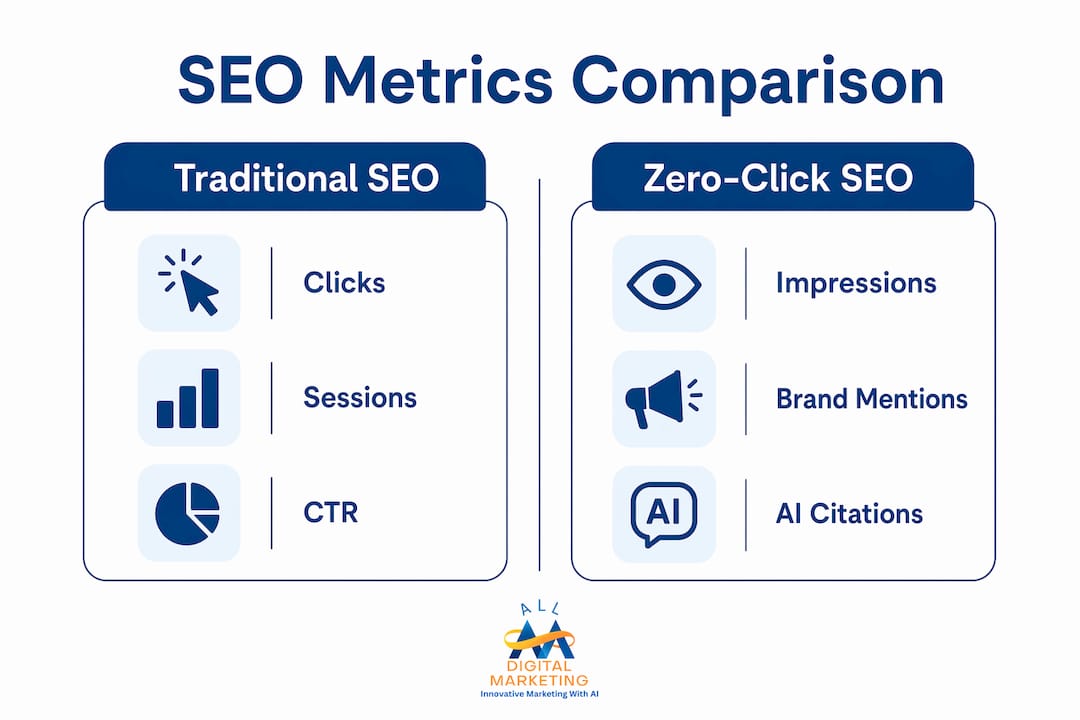
Zero-click search is a shift from traffic acquisition to answer consumption where brand mentions and visibility in AI citations replace clicks as the primary performance signal. This is the most important reframe in modern SEO.
Traditional SEO measured success through organic click-through rate (CTR), sessions, and page views. Those metrics are declining. When 60% of searches end without a click, a page ranking number one may generate far fewer visits than it did three years ago. The ranking still has value. The click is no longer guaranteed.
Why google analytics misses the full picture
Google Analytics data underrepresents zero-click performance. A user who sees your brand cited in an AI Overview, reads your definition, and then searches your brand name directly will show up in Analytics as direct traffic, not organic. The zero-click impression that triggered the brand search is invisible. This creates a systematic undercount of AI-driven brand exposure.
The fix is to expand your measurement stack. Google Search Console shows impressions and clicks separately, so you can track queries where your content appears but earns no click. Reputation monitoring tools track brand mentions across the web and in AI-generated answers. Share of Voice and Brand SERP analysis tell you how often your brand appears in the answer layer, not just the link layer.
Traditional SEO vs. zero-click SEO: a metric comparison
| Metric Category | Traditional SEO Focus | Zero-Click SEO Focus |
|---|---|---|
| Primary success signal | Organic clicks and sessions | Brand impressions and AI citations |
| Ranking goal | Position 1 in blue links | Featured in AI Overviews or Snippets |
| Traffic measurement | Google Analytics sessions | Search Console impressions + brand mentions |
| Content format priority | Long-form, keyword-dense pages | Concise, structured, citable answers |
| Competitive benchmark | Keyword ranking position | Share of Voice in answer features |
Zero-click interactions are forecasted to grow through 2028 as Google and AI providers prioritize keeping users engaged on their own platforms. That trajectory makes adapting now a competitive advantage, not an optional upgrade.
Pro Tip: In Google Search Console, filter your Performance report by "Impressions" and sort by queries with high impressions but near-zero clicks. Those are your zero-click exposure queries. Optimize that content for Featured Snippets and AI extraction.
How to optimize your content for zero-click visibility
Zero-click content should be designed with clear, concise definitions under 50 words, structured data markup, and lists or tables for easy AI extraction. That is the core formula. Everything else builds on it.
The biggest mistake marketers make is writing introductions that spend three paragraphs on context before delivering the answer. AI models read your page the same way a time-pressed editor does. If the answer is buried, it gets skipped. If it is in the first sentence, it gets cited.
Content characteristics that earn AI citations
Strong zero-click content shares these traits:
- Direct definitions in sentence one. Start every article, FAQ answer, and product description with a declarative claim. "X is defined as..." signals to AI that this is a citable answer.
- Answers under 50 words for discrete questions. Featured Snippets and AI Overviews favor tight, complete answers. A 200-word paragraph rarely gets extracted whole.
- Schema markup. Structured data using Schema.org vocabulary tells Google and AI crawlers exactly what type of content each block represents. FAQ Schema, HowTo Schema, and Article Schema all increase extraction probability.
- Question-based headings. Headings phrased as questions match user query patterns directly. They also signal to AI that the following content answers that specific question.
- Lists and tables. Structured formats are easier for AI to parse and reproduce than dense prose paragraphs.
Step-by-step optimization process
- Audit your top 20 pages in Google Search Console. Identify which queries generate high impressions but low CTR. These are your zero-click candidates.
- Rewrite introductions to lead with a direct answer or definition. Remove any context-setting preamble from the first paragraph.
- Add FAQ sections to every informational page. Use FAQ Schema markup. Each question should mirror a real user query.
- Implement structured data using Google's Rich Results Test to verify your Schema markup is valid and eligible for rich results.
- Monitor brand mentions using tools like Google Alerts, Mention, or Brand24. Track how often your brand appears in AI-generated answers by querying ChatGPT and Perplexity directly for your target topics.
- Update content quarterly. AI models favor fresh, accurate information. Stale content loses citation priority over time.
AI models require highly factual and structured content to select a source for synthesis. Vague, opinion-heavy, or poorly organized content does not get cited regardless of its ranking position.
Pro Tip: Test your own content by pasting your article's first paragraph into ChatGPT and asking it to summarize the topic. If the AI produces a vague or inaccurate summary, your content lacks the structural clarity needed for zero-click extraction. Rewrite until the AI summary matches your intended message.
What does the future of zero-click search look like?
The future of zero-click search is an answer-first internet where AI platforms function as the primary interface between users and information. Google's AI Mode, currently expanding in the U.S., operates as a conversational search experience where users ask follow-up questions and receive synthesized responses across an entire session. Google's AI Mode changes the search experience fundamentally by replacing the list of links with a dialogue.
This shift has a direct implication for how you measure marketing success. If a user asks Google AI Mode "what is the best local accountant in Denver," receives a synthesized answer citing three firms, and books an appointment without ever visiting a website, the entire conversion happened inside Google's interface. The firm that got cited won. The firm that ranked fourth in blue links lost, even if its website is technically superior.
From referral engine to answer engine
Search engines were built to refer users to websites. AI platforms are built to answer questions. That distinction defines the next phase of search. Platforms like Perplexity AI already operate as pure answer engines, citing sources inline but keeping users within their interface. ChatGPT's browsing mode does the same. The shift from referral to answer-based search is not a future scenario. It is the current reality for millions of daily queries.
Marketers who adapt their success measures will find real opportunity here. Brand frequency in AI-generated answers builds recognition and trust even without a click. A user who sees your brand cited three times across different AI queries is far more likely to search your name directly, recognize you in a paid ad, or convert on a future visit. Zero-click visibility is top-of-funnel brand building at scale.
The strategic mindset shift is straightforward. Stop asking "how do I get more clicks from this keyword?" Start asking "how do I become the most cited source for this topic?" Those are different questions with different answers. The second question leads to better content, stronger authority signals, and more durable visibility across both traditional and AI-powered search. You can explore ranking beyond page one to understand why this shift is already reshaping competitive strategy.
Key takeaways
Zero-click search has permanently shifted SEO success from counting clicks to measuring brand authority and citation frequency across AI-powered search features.
| Point | Details |
|---|---|
| Zero-click is the majority | 60% of Google searches end without a click, making zero-click the default search experience, not the exception. |
| AI synthesis demands structure | Content must lead with direct answers, use Schema markup, and include lists or tables to be cited by AI models. |
| Traditional metrics undercount exposure | Google Analytics misses zero-click impressions; add Search Console and brand monitoring to your measurement stack. |
| New KPIs define success | Track Brand SERP, Share of Voice, and AI citation frequency alongside traditional rankings. |
| Future growth is confirmed | Zero-click interactions are forecasted to grow through 2028, making early optimization a lasting competitive advantage. |
Zero-click search is a structural shift, not a trend
I have worked with dozens of businesses over the years that treated zero-click search as a threat to fight rather than a reality to work with. That instinct is understandable. When you have spent years building content to drive traffic, watching impressions climb while clicks stagnate feels like a broken system. It is not broken. It changed.
The brands I have seen succeed in this environment share one characteristic: they stopped measuring their SEO by what they could count in Google Analytics and started measuring by how often their name appeared in the answer layer. One regional law firm I worked with had flat organic traffic for 18 months. Their brand searches doubled. Their phone calls increased by 30%. Zero-click impressions in Search Console told the real story. Their content was being cited in AI Overviews for high-intent legal queries. Users were calling without ever visiting the site.
That is the opportunity most marketers are missing. Zero-click visibility is not a consolation prize for not getting the click. It is a direct path to brand recognition, trust, and conversion for users who never needed to visit your site to decide you were credible. The businesses that build brand authority in AI-driven search now will hold a significant advantage as AI Mode and answer-engine platforms continue to grow. Adapt your content structure, expand your measurement tools, and start tracking citation frequency. The click was never the goal. The customer was.
— Diane
Build the online presence that gets you cited
Zero-click search rewards brands with authoritative, well-structured digital presences. If your website is outdated, slow, or poorly organized, AI models and Google's extraction algorithms will pass you over for a competitor whose content is cleaner and more credible. Digitalmarketingall.org helps businesses build and maintain websites designed for exactly this environment. From professional website development built around modern SEO standards to fully managed rental website solutions that keep your brand current without the technical overhead, Digitalmarketingall.org offers the infrastructure your zero-click strategy needs. Contact us to learn how we can help your brand appear where your customers are already looking.
FAQ
What is the definition of zero-click search?
Zero-click search is a search query that ends without the user clicking to an external website because the search engine or AI platform delivers a complete answer directly on the results page. Common triggers include Featured Snippets, AI Overviews, and Knowledge Panels.
What is a featured snippet and how does it relate to zero-click?
A Featured Snippet is an extracted passage from a single webpage displayed at the top of Google's results page, above organic links. It is one of the most common causes of zero-click behavior because users read the answer without needing to visit the source.
How does zero-click search affect my website traffic?
Zero-click search reduces organic click-through rates because users get answers without visiting your site. However, brand visibility in AI citations still drives brand recognition and direct searches, which means traffic impact varies by query type and brand strength.
How do i optimize content for zero-click search results?
Lead every page with a direct answer or definition in the first sentence, use Schema markup, structure content with question-based headings, and keep discrete answers under 50 words. Structured, factual content is the primary requirement for AI extraction and Featured Snippet selection.
What metrics should i track for zero-click search performance?
Track impressions and CTR in Google Search Console, monitor brand mentions through tools like Google Alerts or Brand24, and measure Share of Voice across AI platforms. Standard analytics tools do not capture zero-click exposure, so a broader measurement stack is required.