
TL;DR:
- Zero-click SEO is transforming search success measurement by emphasizing visibility in AI features over traditional clicks. Optimizing extractable, answer-first content and tracking brand citations and AI Overviews provide a clearer picture of influence beyond click metrics. Strategic content that engages users deeper can convert zero-click impressions into meaningful site visits.
Most SEO professionals still measure success by one thing: clicks. But that assumption is quietly breaking down. Zero click SEO, the practice of optimizing for search visibility that delivers value before a user ever lands on your site, has shifted from a curiosity to a defining challenge of modern search strategy. Google's AI Overviews, featured snippets, and knowledge panels now resolve millions of queries directly on the results page. If your content isn't structured to appear in those surfaces, you're invisible where attention lives. This guide shows you exactly how to adapt.
Table of Contents
- Key Takeaways
- Zero click SEO explained: what it is and why it matters now
- Optimizing content for featured snippets and AI Overviews
- Measuring zero-click SEO success beyond click-through rate
- Turning zero-click exposure into real site visits
- My take: what actually works in the zero-click era
- How Digitalmarketingall can strengthen your zero-click presence
- FAQ
Key Takeaways
| Point | Details |
|---|---|
| Zero-click rates are accelerating | AI Mode drives nearly 93% no-click searches, making traditional click metrics increasingly incomplete. |
| Answer-first content wins extractions | Structuring 40–60 word answers under question-style headings dramatically improves featured snippet and AI Overview eligibility. |
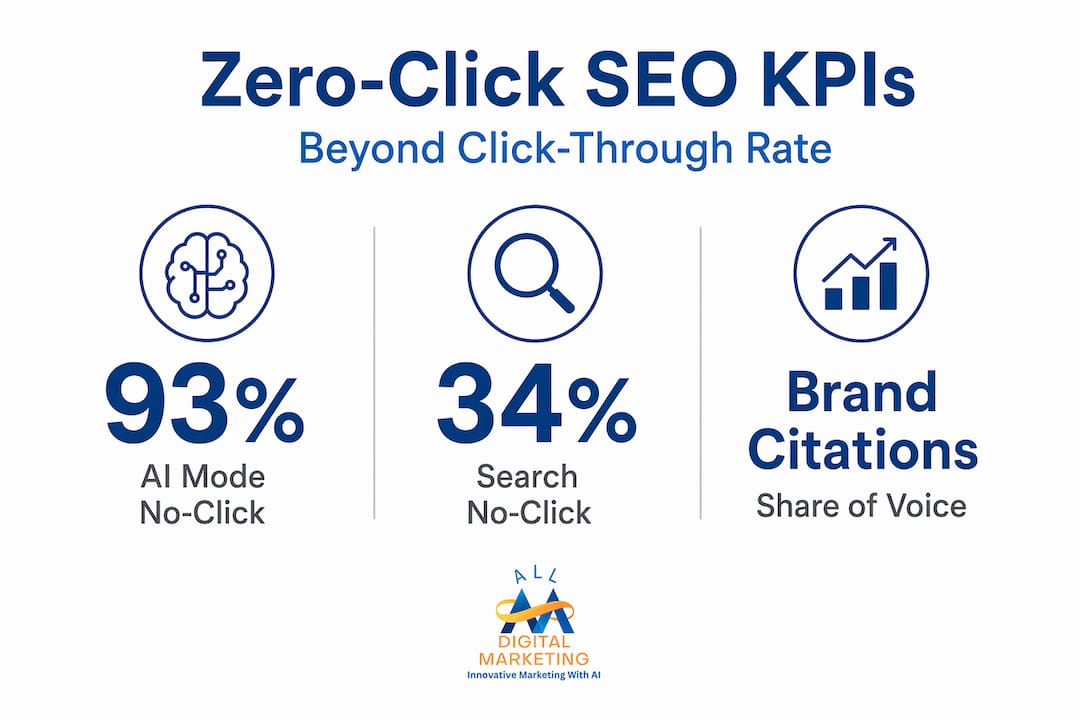
| New KPIs replace CTR | Brand citation frequency, share of voice in AI answers, and branded search lift reveal impact that clicks never show. |
| Depth beats breadth | Covering all sub-questions on one URL builds the passage-level utility Google's AI systems reward most. |
| Clicks still matter strategically | Content that teases deeper exploration after a direct answer can convert zero-click impressions into genuine site visits. |
Zero click SEO explained: what it is and why it matters now
Zero click SEO is the discipline of optimizing content to appear in search features that answer queries directly on the results page. The industry also refers to this work as Answer Engine Optimization (AEO), a term that more precisely captures the goal: becoming the source an AI or search engine trusts to answer a question, with or without sending traffic.
The shift is statistical and it's significant. Traditional organic search already produced a ~34% zero-click rate before AI entered the picture. Google's AI Overviews pushed that figure to roughly 43%. AI Mode, Google's most conversational interface, now sees nearly 93% of queries resolved without a single site visit. That last number should recalibrate how you think about organic search strategies entirely.
There are three main categories of zero click search results you need to understand. First, traditional zero-click scenarios: featured snippets, knowledge panels, local packs, and calculator-style results that have existed for years. Second, AI Overview inclusions, where Google synthesizes multi-source answers above the organic listings. Third, AI Mode responses, which function more like a chat session than a search page and rarely send users anywhere.
The measurement challenge is real. Google Search Console reports featured snippet appearances as "position 1," but it does not separately flag AI Overview inclusions or distinguish impressions where your content was cited but never clicked. Conventional KPIs like click-through rate and session starts simply do not capture those touchpoints. You need a different framework, and we'll build that framework in detail below.
Optimizing content for featured snippets and AI Overviews
The technical foundation of zero-click visibility starts with one deceptively simple requirement: your pages must be extractable. Pages blocked from extraction by max-snippet directives, noindex tags on critical sections, or JavaScript-rendered content that Googlebot cannot parse will never win snippet placements, regardless of how well-written the content is.
Once indexability is confirmed, the editorial structure becomes the primary lever. The answer-first content pattern is the most reliable approach available. Place a concise, standalone answer of 40 to 60 words directly beneath a question-formatted H2 or H3 heading. This structure improves AI Overview citation probability more than any other single editorial tactic, because it mirrors exactly how Google's extraction systems scan for passage-level utility.
Formatting your content for extraction
Tables, numbered lists, and bullet lists all improve extraction accuracy because they present information in pre-structured units that AI systems can lift intact. Use tables when comparing attributes, numbered lists for sequential steps, and bullet lists for non-hierarchical features or criteria. Avoid burying these structures inside long narrative paragraphs where extraction tools have to work harder to isolate the answer.
One counterintuitive point: featured snippets appear above regular results and a page ranked seventh can beat a page ranked first if the lower-ranked page contains a cleaner extractable answer block. That means passage-level utility matters more than your overall domain authority for snippet capture. Writing one tight, well-formatted answer paragraph is worth more than three paragraphs of loose prose.
Here is a practical checklist for snippet-eligible content:
- Confirm your pages are indexable and free of max-snippet restrictions
- Use question-style H2 and H3 headings that mirror real search queries
- Write a 40 to 60 word answer block immediately below each question heading
- Follow the direct answer with supporting detail, examples, and data
- Add structured data (FAQ schema, How-To schema) where semantically appropriate
- Include comparison tables for multi-attribute topics
- Keep sentence structure simple inside answer blocks; complex clauses reduce extraction accuracy
Pro Tip: Never hide your answer inside the introduction to a section. If the answer to a question is "yes, and here's why," write the "yes" first, then the "why." Hiding answers in long preambles is the single most common reason well-optimized pages still lose snippet selections.
Covering every sub-question on a single URL rather than splitting topics across multiple pages is another critical structural decision. Google's AI Mode fans out queries into multiple sub-questions and rewards pages that resolve several of them in one place. Thin pages covering one narrow angle each are less competitive than deep pages with organized, passage-level coverage of the full topic.
Measuring zero-click SEO success beyond click-through rate
The measurement problem with no-click searches is attribution, specifically, the tendency to count only what's immediately traceable. Last-click attribution models assign zero value to a branded search that came two days after a user saw your content cited in an AI Overview. That's not an accurate picture. Zero-click exposure drives delayed conversions through brand lift and direct search behavior that analytics platforms miss entirely unless you're looking for it.
Zero-click visibility functions as top-of-funnel influence, building brand recall and trust in ways that eventually convert, just not through the path your current reports track. Reframing this is not a concession. It's an accurate description of how modern search works.
Here is a structured approach to measuring zero-click SEO performance:
- Audit featured snippet and AI Overview appearances for your ten to fifteen highest-priority queries using query-level data in Google Search Console. Filter by query, then check average position alongside impression trends even when CTR is low.
- Track branded search volume in Google Trends and your analytics platform week over week. A rising branded search curve against flat organic CTR is strong evidence that zero-click impressions are working.
- Monitor share of voice in AI answers using tools that track AI Overview inclusions. Document which queries surface your content and which surface competitors.
- Set up assisted conversion tracking in your analytics platform so that sessions initiated by direct search or branded queries are attributed to the content touchpoints that preceded them.
- Run monthly brand citation audits by querying your brand name in AI Mode and noting whether your content, products, or opinions are cited, even without a direct link.
Pro Tip: AI visibility signals like brand citation frequency and share of voice in AI answers are now better predictors of SEO success than CTR alone. Build a dashboard that tracks these alongside traditional metrics so executives see the full picture, not just the clicks.
Recurring audits of AI Overview appearances for business-critical queries help you reconcile zero-click influence with actual brand engagement. The goal is not to replace click tracking. It's to add a layer of measurement that captures what happens before the click decision is made.
Turning zero-click exposure into real site visits
Not every zero-click result has to stay zero-click. The question is not whether to optimize for snippets but how to write answers that satisfy the immediate query while creating enough curiosity to pull users further in. This is the craft challenge of modern organic search strategies.
When a snippet answers a simple factual question completely ("What is the capital of France?"), clicks are gone and that's fine. But most commercial or professional queries are not that simple. "How do I choose between two CMS platforms?" has a direct answer that a snippet can carry, but the risks, the comparison table, the case studies, and the implementation steps are all reasons to click through. Writing content that resists full AI summarization protects your click potential without sacrificing snippet eligibility.
Specific tactics for keeping clicks in play:
- After your 40 to 60 word answer block, add a "What you also need to know" section with data, risks, and edge cases that no snippet can fully cover
- Use numbered comparison frameworks (e.g., "5 scenarios where Option A beats Option B") because numbered lists hint at depth that snippets rarely reproduce completely
- Include first-person observations or proprietary research that AI tools cannot synthesize from other sources
- Add a results section or case study reference directly after the answer block; this signals that there's proof below the fold
- Write subheadings that tease rather than summarize. "The mistake most marketers make here" pulls readers forward; "Summary of key points" does not
The underlying principle is this: let the snippet do its job answering the surface question, then make the rest of your page undeniably worth the click. Featured snippets and AI Overviews co-occur on about 19% of queries, meaning your snippet placement can appear alongside an AI summary and still drive traffic if the supporting content is strong enough to justify it.
Maximizing search intent means understanding which part of a query a snippet can satisfy and which parts it cannot. Transactional intent, comparison intent, and "how-to in practice" intent almost always require more than a snippet can hold. Build your pages around those remaining gaps and you maintain click value even in a zero-click world.
My take: what actually works in the zero-click era
I've been watching search strategy evolve for long enough to recognize when a real shift happens versus when it's just noise. The zero-click trend is the real thing. What surprises me is how many experienced marketers are still treating it as a traffic problem rather than a visibility problem.
In my experience, the professionals who adapted fastest stopped asking "how do I recover lost clicks?" and started asking "how do I become the brand that Google's AI trusts to answer this category of question?" That's a fundamentally different strategy. It requires building entity depth, meaning your brand, your authors, and your organization need to be verifiable, cited, and associated with your topic across multiple surfaces.
I've found that focusing on transactional intent content first builds the most resilience. Informational queries are increasingly satisfied by AI without clicks, but queries with purchase or evaluation intent still drive users to sites because the answer requires context that AI can't fully resolve. Start there and work outward.
The measurement piece is where most teams struggle. I've seen brands dismiss their zero-click SEO efforts as ineffective because the dashboard showed flat traffic, only to discover that branded search volume had climbed 30% over the same period. That's real value. It was just invisible in the wrong report. If you're not tracking AI citation frequency and brand search lift as primary signals, you're flying partially blind.
My advice: keep your technical SEO fundamentals solid, structure every major content page for extraction, and build measurement that captures indirect brand impact. The professionals who do this now will have a significant head start as AI Mode continues to expand.
— Diane
How Digitalmarketingall can strengthen your zero-click presence
Adapting to a zero-click world requires more than content adjustments. It requires an infrastructure that signals trust to AI systems, including reviews, brand mentions, structured web content, and authoritative local signals. Digitalmarketingall offers review generation and management services that build the brand credibility AI Overviews draw from when selecting citation sources. A stronger review profile directly supports AI visibility.
The agency also provides website design and optimization focused on making your content fully extractable and snippet-ready, from clean HTML structure to schema markup implementation. If you're looking for a strategic partner to audit your current content architecture and build an AI-first visibility plan, Digitalmarketingall's team has the expertise to get it done. Explore how their services translate directly into better search engine visibility and measurable brand growth, without guessing at what works.
FAQ
What is zero-click SEO?
Zero-click SEO (also called Answer Engine Optimization) is the practice of structuring content to appear in search features like featured snippets and AI Overviews that answer queries directly on the results page, without requiring a site visit.
How common are no-click searches in 2026?
Zero-click rates vary by interface: roughly 34% for traditional search, 43% for AI Overviews, and nearly 93% for AI Mode sessions, making no-click searches the dominant search behavior in AI-powered environments.
How do featured snippets help with zero-click visibility?
Featured snippets appear above regular results and give your content prominent placement even when users don't click. They also co-occur with AI Overviews, increasing your citation probability across both surfaces.
What metrics should I track instead of CTR?
Track brand citation frequency in AI answers, branded search volume trends, share of voice in AI Overviews, and assisted conversions. These metrics capture the indirect influence that zero-click exposures create before a user ever visits your site.
Can I still drive clicks if my content is optimized for snippets?
Yes. Writing answer blocks that satisfy the surface question while leaving deeper value below the fold (case studies, comparisons, proprietary data) gives users a reason to click through even after a snippet appears.