

TL;DR:
- Almost half of all Google searches include a brand name, signaling high user intent and opportunity for conversions.
- Developing a branded search strategy involves PPC protection, segmentation, and building entity authority across platforms for long-term visibility.
Almost half of all Google searches contain a brand name. That single fact changes how you should think about search strategy. What is branded search, and why does it deserve its own dedicated plan? Branded search covers every query that includes a company name, product name, or trademark, and it signals something far more valuable than curiosity. It signals intent. When someone types your brand into a search bar, they already know you exist. Your job is to capture that moment, own it, and convert it. This guide covers definitions, strategy, emerging platforms, and what the AI era means for your brand's search presence.
Table of Contents
- Key Takeaways
- What is branded search and how it works
- Why branded search matters for your business
- Building a branded search campaign that delivers
- Emerging trends reshaping branded search in 2026
- Common pitfalls in branded search strategy
- My take on branded search in 2026
- Strengthen your branded search presence today
- FAQ
Key Takeaways
| Point | Details |
|---|---|
| Branded search drives high intent | Users searching by brand name are already aware of you, making them far more likely to convert. |
| Nearly half of Google is branded | 45.7% of Google search volume is branded, proving this channel is too large to ignore. |
| PPC defense protects your traffic | Competitors can bid on your brand name, so running branded paid ads is often a necessary defense move. |
| AI search rewards entity authority | In 2026, AI-powered search ranks brands by authority and consistency, not just keyword repetition. |
| Segmentation improves ROI | Separating new vs. existing customer campaigns in branded search significantly improves performance tracking and budget allocation. |
What is branded search and how it works
Branded search refers to any search query that includes a specific brand, company, or product name. The definition of branded search is straightforward: if someone types "Nike running shoes" instead of "running shoes," that is a branded search. If someone types "Salesforce pricing" instead of "CRM software pricing," that is also a branded search.
Branded keywords fall into a few categories:
- Exact brand name searches: "Apple," "Nike," "Digitalmarketingall"
- Brand plus product or service: "Amazon Prime membership," "HubSpot free CRM"
- Brand plus intent modifier: "Digitalmarketingall SEO services," "Nike return policy"
- Misspellings and variations: "Adiddas shoes," "Goggle ads" (users still mean the brand)
- Branded taglines or slogans: Searches that reference a brand's known phrase or campaign
Generic or non-branded search, by contrast, contains no brand reference whatsoever. "Best running shoes under $100" is generic. "Nike Air Max under $100" is branded. The user intent behind these two queries is completely different. Branded search vs. generic search is not just a keyword classification exercise. It reflects where the user sits in the buyer journey. Generic searches tend to be exploratory. Branded searches are often decision-stage queries.
One common misconception is that branded search only matters for large corporations. That is wrong. Any business with a recognizable local name, a product with a distinct title, or a service brand earns branded search volume as its reputation grows. A regional HVAC company can absolutely generate "Smith's Heating and Cooling" queries once word of mouth starts working.
Why branded search matters for your business
The importance of branded search goes well beyond protecting your own name in search results. This channel directly shapes brand visibility, revenue quality, and competitive positioning.
Branded searches convert at significantly higher rates than generic queries. When a user already knows your name and types it into Google, the consideration phase is largely over. They want you specifically. This is why branded search benefits your bottom line in ways that top-of-funnel generic traffic simply cannot match.
Branded search also plays a critical role in pay-per-click strategy. Competitors can and do bid on your brand name. If you are not running your own branded PPC campaign, a rival's ad could appear above your organic listing when someone searches your name. That is a genuinely costly scenario. Branded search advertising acts as a defensive moat, keeping your traffic from being redirected to a competitor at the exact moment someone is looking for you.
The SEO impact is real too. Structured brand presence and consistent branded content tend to improve your rankings not just for branded terms but for related generic terms as well. Google's understanding of your brand as an entity strengthens its confidence in ranking your pages broadly.
Pro Tip: Set up a Google Search Console filter specifically for branded queries. This lets you separate branded and non-branded traffic in your reporting and makes it far easier to measure the true organic impact of any awareness campaign you run.
"Branded search remains a cornerstone of brand equity: investing upstream in brand awareness feeds downstream branded search demand."
The channel also matters for reputation management. What appears when someone searches your brand name is essentially your first impression. Google's Knowledge Panel, reviews, news articles, and social profiles all surface in branded SERPs. Owning and optimizing each of these touchpoints is part of a serious branded search strategy.
Building a branded search campaign that delivers
Knowing the value is one thing. Putting a branded search strategy into practice requires real decisions about budget, segmentation, and measurement. Here is a structured approach to get it right.
-
Assess whether PPC is worth it for your brand. If you operate in a category with three or more active competitors, branded PPC can add 10 to 20% incremental traffic beyond what you capture organically. If you have minimal competition, branded ads offer less lift and your budget may work harder elsewhere.
-
Separate new customers from returning ones. Branded search drives 1.7x higher lift in new customers compared to existing ones. Segment your campaigns accordingly. Use audience exclusion lists to suppress ads for people who have already purchased, and redirect that spend toward acquisition.
-
Protect channel attribution. Branded search ads often shift sales away from third-party marketplaces like Amazon and toward your direct-to-consumer site. If you sell on multiple channels, tracking this shift is critical to understanding true ROI.
-
Write ad copy that earns the click. Generic branded ads that just repeat your company name underperform. Use ad copy to reinforce your unique value, highlight current promotions, or surface a specific product line. If a competitor is bidding on your terms, your ad needs to be clearly more relevant.
-
Track branded vs. non-branded KPIs separately. Monitor click-through rate, conversion rate, cost per acquisition, and impression share for branded campaigns as distinct metrics from your generic campaigns. Mixing the two inflates generic performance and hides real gaps.
-
Review your branded organic share of voice. Check how many of the top ten results for your brand name you actually control. Aim to own your homepage, key product pages, social profiles, and at least one third-party review platform in that first page.
Pro Tip: Use Google Ads' auction insights report for your branded campaigns to see exactly which competitors are showing up on your brand terms and how often. This data can justify your branded ad spend far more convincingly than impression share alone.
Optimizing for branded search in paid channels works best when it runs parallel to strong organic and reputation efforts. Neither channel replaces the other.

Emerging trends reshaping branded search in 2026
The mechanics of how branded search works are shifting quickly. Two forces are driving most of the change: AI-powered search and the rise of social platforms as serious search destinations.
AI search and entity authority
AI-powered search tools like Google's AI Mode and other large language model search experiences do not rank brands by keyword density. They rank brands by entity authority, a measure of how well your brand is recognized, documented, and trusted across the web. This is a fundamental shift. You can read more about AI's impact on search rankings if you want to understand how the ranking dynamics have changed.
Brand visibility in AI search depends on unique, authoritative content that AI systems can identify, trust, and surface. That means structured data markup, consistent brand information across all platforms, and content that answers real questions with genuine depth. For branded search specifically, this also means your brand's Knowledge Graph entries, Wikipedia presence (where applicable), and third-party mentions all carry more weight than they once did.
Entity-based optimizations and brand authority signals are no longer optional extras. They are the foundation of branded search visibility in AI environments.
TikTok's new branded search products
TikTok has quietly become a major search platform. 57% of TikTok users use the search function, and 23% perform a search within the first 30 seconds of opening the app. That is not casual browsing. That is intent-driven behavior.
TikTok's Search Hubs and Branded Buzz products connect creator content directly to search results. When Brand Ads are paired with Search Hubs, ad click-through rates improve by 42%. That is a dramatic performance lift, and it reflects how creator-led content paired with branded search placements creates a direct path from discovery to conversion.
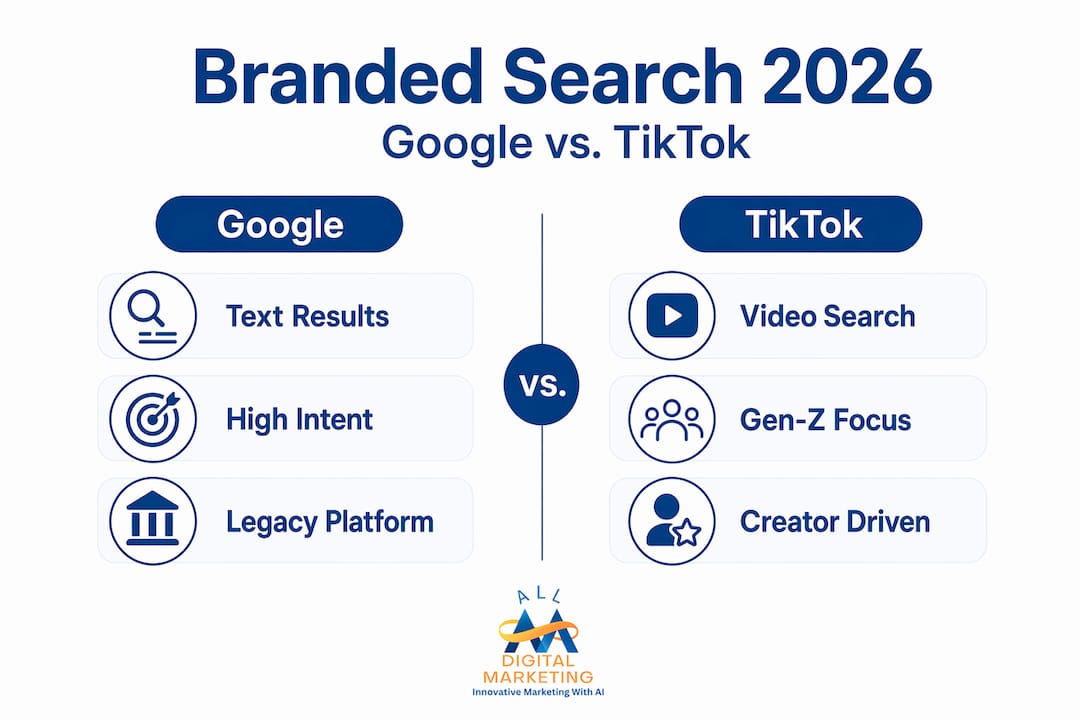
Here is how TikTok's branded search approach compares to Google's:
| Feature | Google Branded Search | TikTok Branded Search |
|---|---|---|
| Primary format | Text ads and organic listings | Short video with search overlays |
| Intent signal | Direct brand query | Active in-app search plus content discovery |
| Ad product | Search and Shopping campaigns | Search Hubs plus Branded Buzz |
| CTR improvement with ads | Varies by competition level | 42% lift when paired with Brand Ads |
| Audience behavior | Decision-stage queries | Dual discovery and decision stage |
| Best for | Capturing existing demand | Building and capturing brand awareness |
For digital marketers managing multi-platform strategies, this comparison matters. Google remains the primary channel for high-intent branded searches. TikTok is increasingly where branded discovery happens, and its search products are now monetizing that moment in ways that connect directly to conversion. Ignoring TikTok's search functionality means leaving a growing share of younger, mobile-first branded search volume unaddressed. You can compare platform advertising approaches in this breakdown of paid advertising channels.
Common pitfalls in branded search strategy
Even experienced marketers make consistent mistakes with branded search. Knowing them in advance saves real budget and missed opportunity.
-
Overbidding in low-competition environments. If no competitor is bidding on your brand terms and you rank number one organically, paying for branded clicks may not generate incremental conversions. Test incrementality before committing a significant budget to branded PPC.
-
Skipping segmentation. Running a single branded campaign without segmenting by audience type (new visitors, past purchasers, loyalty members) leads to wasted spend and inaccurate attribution. Different audiences respond to branded ads very differently.
-
Ignoring AI search visibility. Many brands still optimize exclusively for traditional keyword rankings and overlook the entity-level signals that now govern AI search results. If your brand does not appear in AI-driven answers, you are missing a fast-growing share of branded search impressions. This guide on why brands vanish in AI search is worth your time.
-
Underestimating brand's effect on non-branded rankings. A strong branded search presence signals to Google that your domain is authoritative. Brands that neglect their branded keyword strategy often see slower gains in generic keyword rankings as a side effect.
-
Treating branded search as isolated. Branded search does not operate in a vacuum. It is influenced by offline advertising, social media campaigns, PR, and word of mouth. Marketers who track branded search volume as a standalone metric miss how upstream brand investment feeds it. When paid search ROI starts declining, branded search volume is often one of the first indicators that broader brand awareness campaigns need attention.
My take on branded search in 2026
By Diane
I've spent years watching marketers treat branded search as a set-it-and-forget-it tactic. Bid on your name, write a basic ad, done. What I've learned is that branded search is actually one of the most revealing indicators of overall brand health, and most teams are not using it that way.
In my experience, the brands that win at branded search are not the ones with the biggest PPC budgets for their own name. They are the ones that have invested consistently in making their brand worth searching for. Awareness campaigns, content that people actually share, a reputation that generates word of mouth. All of that feeds branded search volume in ways that no amount of bidding can manufacture.
The AI shift has made this even more pronounced. I've seen brands with solid traditional SEO rankings lose significant visibility in AI-generated answers because their entity footprint was thin. No structured data, inconsistent NAP (Name, Address, Phone) across directories, sparse third-party mentions. Those brands are effectively invisible in AI search, regardless of their paid branded spend. Building your brand's entity authority is no longer optional.
What I find encouraging is that branded search strategy is genuinely learnable and executable for businesses of any size. You do not need a massive brand to benefit from it. You need consistency, quality, and a clear understanding of how the channel works. The marketers who take that seriously right now will have a real advantage as AI search continues to grow.
— Diane
Strengthen your branded search presence today
Your branded search results are only as strong as the website behind them. When someone searches your brand name and lands on a slow, outdated, or hard-to-navigate site, you lose the very conversion that branded search was designed to deliver.
At Digitalmarketingall, we build websites specifically designed to convert branded search traffic into real leads and sales. Whether you need a fully custom site or a professionally managed rental website solution that requires zero maintenance on your end, we have options built for businesses serious about their search presence. Our website design and development services are focused on performance, local visibility, and AI search readiness. A strong website is not just your digital storefront. It is the foundation your entire branded search strategy depends on.
FAQ
What is branded search in simple terms?
Branded search is any online search query that includes a specific company, product, or brand name. It signals that the user already knows the brand and is actively looking for it.
What are some branded search examples?
Examples include "Nike running shoes," "Apple iPhone 16 price," or "Digitalmarketingall SEO services." Any search that names a specific brand rather than a generic category is a branded search.
How does branded search differ from generic search?
Branded search includes a specific brand name and indicates high user intent toward that brand. Generic search uses category terms like "best CRM software" with no brand preference expressed.
Should I run PPC ads on my own brand name?
Yes, especially if competitors are bidding on your brand terms. Branded PPC campaigns can add 10 to 20% incremental traffic when competition is present, and they protect your conversions from being redirected.
How does AI search affect branded search strategy?
AI-powered search prioritizes entity authority over keyword repetition. Brands need consistent structured data, authoritative content, and strong third-party mentions to appear prominently in AI-driven branded search results.