

TL;DR:
- AI-generated content is now common in nearly three-quarters of new webpages and social media images. It is produced by models trained on large datasets, with quality varying across generation, transformation, research, and ideation tasks, requiring human oversight. Ethical use involves transparency, human review, and focusing AI on tasks like structuring and summarizing to support accurate, trustworthy content.
AI-generated content is defined as any media, text, image, audio, or video, produced by a machine learning model in response to a human prompt or instruction. As of early 2026, 74.2% of new webpages contain AI-generated components, and 71% of social media images involve AI creation. Those numbers confirm that AI content creation is no longer experimental. It is the operational standard for businesses that publish at scale. Whether you are a solo marketer or a growing company, understanding AI content, its capabilities, its risks, and its proper role in your workflow, is now a baseline business skill.
What is AI-generated content and how does it work?
AI-generated content is produced by large language models, image generators, text-to-speech systems, and video synthesis tools. Each model is trained on massive datasets and learns to predict what output best matches a given input. A language model, for example, does not look up facts. It predicts the most statistically likely next word based on patterns in its training data. That distinction matters enormously for anyone relying on AI writing tools for business communication.

The industry term for this broader category is AIGC, short for AI-Generated Content. You will see both terms used interchangeably, but AIGC is the recognized technical label in platform documentation, regulatory discussions, and academic research. Knowing both terms helps you follow the conversation wherever it happens.
The process starts with a prompt. A user types an instruction, a question, or a description. The model processes that input and generates an output. The output can be a paragraph, a product image, a voiceover, or a short video clip. The quality of the output depends on the model's training, the clarity of the prompt, and the human review that follows.
AI models predict outputs based on training data patterns, not live fact verification. Unless a model is connected to an external data source, it has no access to current events or real-time information. That architectural reality is the single most important thing to understand before deploying AI content in any professional context.
What types of content can AI generate?
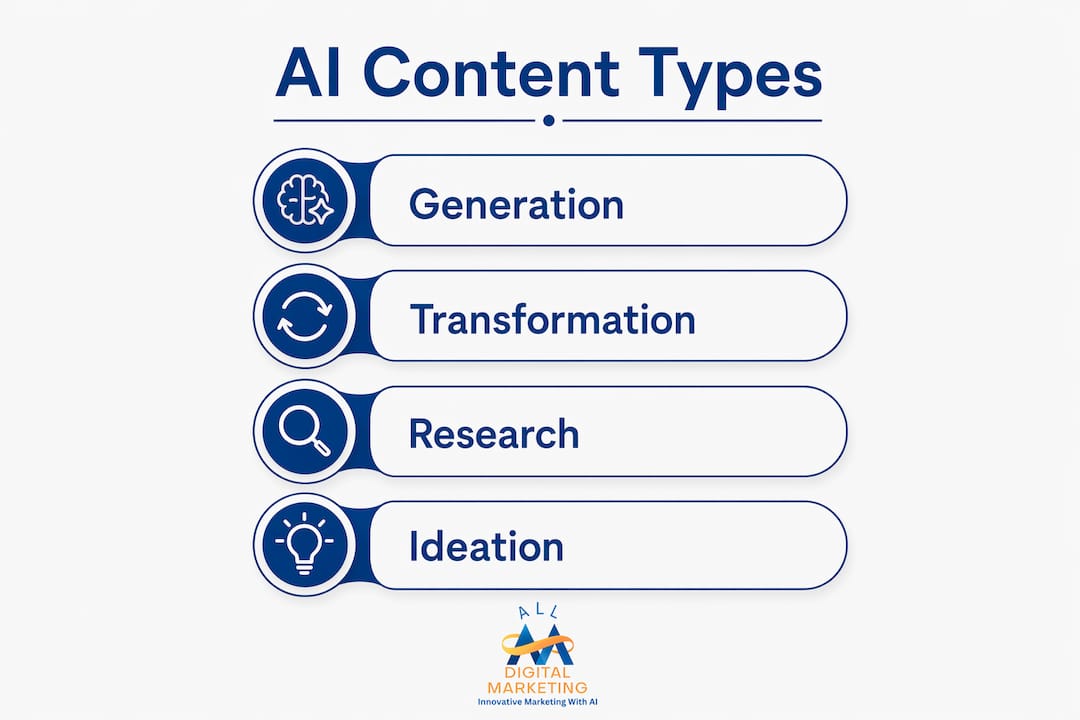
AI content generation breaks into four core categories: generation, transformation, research, and ideation. Each category carries a different level of risk and requires a different level of human involvement.
Generation
Generation means creating new content from scratch. A user provides a topic or brief, and the AI produces an original draft. Blog posts, product descriptions, ad copy, and social media captions all fall here. This category carries the highest risk of inaccuracy because the model has no anchored source material to reference.
Transformation
Transformation means converting existing content into a new format. Summarizing a long report, translating a webpage, or turning a podcast transcript into a blog post are all transformation tasks. Transformation is the safest and most reliable category for business use because the AI works from verified source material rather than generating facts independently.
Research and ideation
Research tasks include pulling key points from documents, comparing sources, or identifying trends in data. Ideation tasks include brainstorming headlines, campaign angles, or content structures. Both categories benefit from AI speed but still require human judgment to filter and apply the output.
| Category | Primary use | Risk level | Human effort required |
|---|---|---|---|
| Generation | Blog posts, ad copy, captions | High | Heavy editing and fact-checking |
| Transformation | Summaries, translations, repurposing | Low | Light review |
| Research | Data synthesis, source comparison | Medium | Validation of findings |
| Ideation | Headlines, angles, campaign concepts | Low | Selection and refinement |
Pro Tip: Start new AI workflows with transformation tasks. Summarizing your own verified documents or repurposing existing content gives you the reliability of AI speed without the accuracy risks of pure generation.
What are the benefits and limitations of AI-generated content?
The benefits of AI-generated text are real, but they are not unconditional. Speed and volume are the clearest wins. A content team that once produced four blog posts per month can produce forty with AI assistance. That scale advantage is significant for businesses competing in content-heavy markets.
Quality, however, is uneven. 36% of buyers of AI content platforms report high satisfaction with quality and usefulness. That means nearly two-thirds do not rate their results as high quality. The gap between expectation and output is the central challenge for any business adopting AI writing tools.
The core benefits of AI-generated content include:
- Speed at scale. AI drafts content in seconds. A 1,000-word article that takes a writer three hours takes an AI model under a minute.
- Cost reduction. Producing first drafts with AI lowers the per-piece cost of content production significantly.
- Consistency in structure. AI reliably follows formatting instructions, making it useful for templated content like product listings or FAQ sections.
- Ideation support. AI generates dozens of headline options, topic angles, or campaign concepts faster than any brainstorming session.
- Multilingual output. AI tools translate and adapt content across languages without requiring separate specialist teams.
The core limitations are equally concrete:
- Hallucinations. AI confidently fabricates statistics and citations when fabricated text fits the language pattern it predicts. This is not a bug that will be fully patched. It is a structural feature of how language models work.
- Brand voice dilution. AI output tends toward a generic, neutral tone. Without heavy editing, AI-written content sounds like every other AI-written content.
- No live data access. Unless connected to external sources, AI models work from training data with a knowledge cutoff. Time-sensitive content requires human updates.
- 13% of platform buyers report consistent performance issues, including inaccurate outputs and unreliable quality across content types.
Pro Tip: Never publish AI-generated statistics without independently verifying each number. AI models cite sources that do not exist. Treat every figure in an AI draft as unverified until you confirm it yourself.
How can businesses ethically integrate AI-generated content?
Ethical AI content use starts with transparency. Organizations should clearly disclose AI use to maintain audience trust and explain content origins. Disclosure does not mean burying a footnote. It means being upfront with your audience about how your content is produced.
Detection tools are not a reliable substitute for disclosure. AI content detection yields false positives, and the industry is shifting toward cryptographic content credentials and metadata-based provenance verification instead. In practical terms, this means you cannot rely on a detection tool to catch AI content before it goes live. You need a human review process built into your workflow from the start.
A responsible integration process follows these steps:
- Define which content types are AI-eligible. Transformation tasks and ideation are low-risk starting points. Pure generation tasks for high-stakes content, such as medical, legal, or financial topics, require the most human oversight.
- Build a human-in-the-loop review step. Every AI draft should pass through a human editor before publication. The editor checks for factual accuracy, brand voice, and tone consistency.
- Set a disclosure policy. Decide how and where you will tell your audience that AI assisted in content creation. Apply that policy consistently across all channels.
- Track output quality over time. Log which AI tasks produce reliable results and which require heavy revision. Use that data to refine your workflow and prompt templates.
- Stay current on regulatory guidance. Disclosure standards for AI content are evolving in 2026 across multiple jurisdictions. Assign someone on your team to monitor updates from relevant regulatory bodies.
Human-in-the-loop workflows consistently produce the best results. AI handles drafting and ideation. Humans handle accuracy, brand voice, and final judgment. That division of labor is not a compromise. It is the most effective structure available.
What practical applications does AI-generated content have in digital marketing?
AI content creation has the most immediate impact in digital marketing because marketing requires high volume, fast turnaround, and consistent messaging across multiple channels. The use cases below are not theoretical. They are active workflows at businesses of every size.
High-impact AI content applications in digital marketing:
- Blog drafting. AI produces structured first drafts from a brief or outline. A human editor refines the argument, adds original examples, and verifies all claims before publication. This cuts drafting time by a large margin without sacrificing editorial control.
- Social media content. AI generates caption variations, hashtag sets, and post schedules from a single content brief. Teams use these outputs as starting points, not finished posts.
- Personalized ad copy. AI writes multiple versions of ad headlines and descriptions for A/B testing. This accelerates the testing cycle and surfaces winning copy faster than manual writing alone.
- Video scripts and voiceovers. AI drafts video scripts from a topic brief and generates voiceover audio from text. This is especially useful for explainer videos and product demos.
- Email subject line testing. AI generates dozens of subject line options in seconds, giving email marketers more variants to test without additional writing time.
For businesses that want to see real results from these workflows, AI content marketing examples from actual campaigns show what works and what does not across different industries.
The most common pitfall in AI content marketing is treating AI output as finished work. Teams that publish unedited AI drafts produce content that reads as generic, misses brand-specific nuances, and occasionally contains fabricated information. The fix is simple. Build editing into the process as a non-negotiable step, not an optional review.
Pro Tip: Use AI for the first 80% of a content piece, then spend your human effort on the final 20%. That final layer of editing, fact-checking, and voice refinement is what separates publishable content from AI filler.
For businesses building out their AI content workflows, AI-powered marketing strategies for SMBs offer a practical framework for integrating these tools without overextending your team.
Key Takeaways
AI-generated content delivers real speed and scale advantages, but human oversight is the non-negotiable factor that determines whether that output is accurate, on-brand, and trustworthy.
| Point | Details |
|---|---|
| AI content is everywhere | 74.2% of new webpages contain AI-generated components as of early 2026. |
| Four content categories exist | Generation, transformation, research, and ideation each carry different risk levels. |
| Quality satisfaction is mixed | Only 36% of AI platform buyers report high satisfaction with output quality. |
| Hallucinations are structural | AI fabricates facts that fit language patterns; human fact-checking is mandatory on every draft. |
| Disclosure builds trust | Clearly telling your audience when AI assisted in content creation is both ethical and increasingly expected. |
Where AI content strategy gets misread
I have watched businesses adopt AI content tools with genuine enthusiasm, then quietly scale back six months later because the results did not match the pitch. The pattern is almost always the same. The team treats AI as a replacement for editorial judgment rather than a support for it.
The most useful reframe I have found is this: AI is a co-pilot, not an autopilot. A co-pilot handles the mechanical load so the pilot can focus on decisions that require real judgment. That is exactly how AI content works at its best. It handles volume, structure, and first-draft momentum. You handle accuracy, voice, and strategy.
The tasks where AI genuinely excels are the ones most people undervalue: generating ten headline options so you can pick the best one, summarizing a 40-page report into a usable brief, or drafting a product description from a spec sheet. These are not glamorous tasks. They are time-consuming ones. AI removes that friction.
Where AI consistently falls short is in tasks that require original perspective, real-world experience, or verified current data. A blog post that makes a genuine argument, a case study that reflects an actual client outcome, a market analysis that draws on live data: these still require human authorship at their core. Effective AI content use depends on matching AI strengths in volume and structure with human skills in nuance and brand voice.
My honest advice for 2026 is to stop asking whether AI content is good or bad and start asking which specific tasks in your workflow are best suited for AI assistance. That question has a concrete answer. The other one does not.
— Diane
How Digitalmarketingall supports your AI content strategy
AI-generated content works best when it is part of a broader digital presence that audiences trust. Digitalmarketingall helps businesses build that trust through review generation and management services that complement AI-driven content workflows. When your content volume increases with AI, your reputation signals need to keep pace. Verified reviews give search engines and potential customers the credibility markers that AI content alone cannot provide. Digitalmarketingall's team works with businesses to generate authentic reviews, manage responses, and integrate reputation signals into a complete digital marketing strategy that performs in both traditional search and AI-powered recommendations.
FAQ
What is AI-generated content in simple terms?
AI-generated content is any text, image, audio, or video produced by a machine learning model from a human prompt. The model predicts outputs based on training data patterns rather than looking up or verifying facts.
Is AI-generated content reliable?
AI content is reliable for structure and volume but not for factual accuracy without human review. AI models fabricate statistics and citations when the language pattern fits, making human fact-checking mandatory before publication.
How does AI generate written content?
AI writing tools use large language models that predict the most statistically likely next word or phrase based on billions of training examples. The model does not understand meaning. It recognizes and replicates patterns.
Does Google penalize AI-generated content?
Google's stated position is that it rewards high-quality, helpful content regardless of how it is produced. Content that is thin, inaccurate, or clearly unedited performs poorly, whether written by a human or an AI.
Should businesses disclose when content is AI-generated?
Yes. Clear disclosure of AI use maintains audience trust and aligns with emerging regulatory guidance in 2026. Transparency about content origins is both an ethical standard and an increasingly expected practice.