

TL;DR:
- AI-driven keyword research analyzes user intent and semantic relationships to discover long-form search prompts rapidly. It shifts focus from ranking specific keywords to establishing topical authority and AI citation potential. Combining AI idea generation with validated SEO data improves accuracy and speeds content strategy development.
AI-based keyword research is the process of using artificial intelligence to discover, cluster, and prioritize search terms by analyzing user intent, semantic relationships, and vast data sources at a speed no human team can match. The industry term for this practice is AI-driven keyword strategy, and it sits at the center of modern SEO planning. Where traditional research targets short 3.4-word queries, AI tools process conversational prompts averaging 60 words, capturing the way people actually talk to ChatGPT, Perplexity, and Google's AI Overviews. Tools like Ahrefs, Semrush, and Claude now make this process faster, more accurate, and more aligned with how AI search engines surface content in 2026.
What is AI-based keyword research and how does it differ from traditional methods?
Traditional keyword research and AI-driven keyword strategy share the same goal but operate on completely different logic. Understanding that gap is the first step to using either approach well.

Traditional tools like Google Keyword Planner and early versions of Ahrefs were built around one question: how many people search for this exact phrase? That model worked when Google matched keywords literally. It breaks down when users type full questions into ChatGPT or ask Google's AI Overview to explain a concept.
Here is where the core difference shows up most clearly:
| Factor | Traditional keyword research | AI-based keyword research |
|---|---|---|
| Average query length | 3.4 words | 60 words |
| Primary input | Search volume data | Semantic intent and context |
| Clustering method | Manual grouping | Automated semantic clustering |
| Speed | Hours to days | Minutes |
| Output focus | Ranking for a single keyword | Topical authority and AI citation |
The shift in query length matters more than it looks. A 60-word prompt contains multiple sub-intents, related entities, and implied questions. AI tools parse all of them at once, then map them to content opportunities your competitors may have missed.
Pro Tip: When you start an AI keyword session, paste a real customer question from your support inbox as your seed prompt. The AI will surface intent clusters you would never find by typing a two-word phrase into a traditional tool.
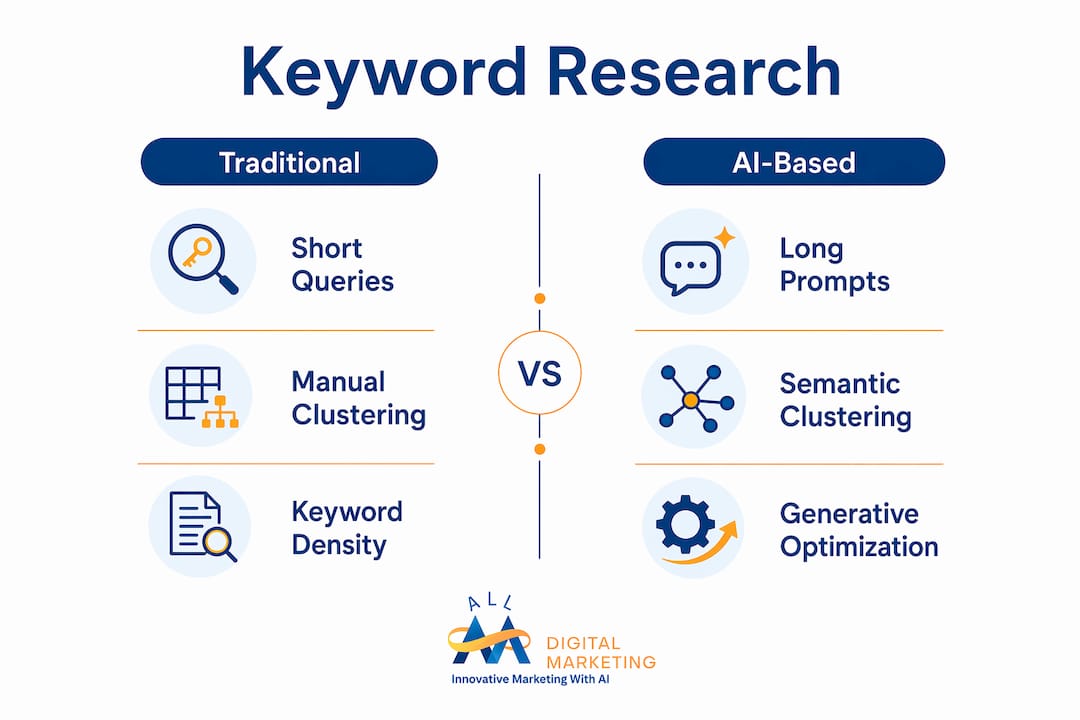
The other major shift is the move from keyword density to Generative Engine Optimization (GEO). GEO means structuring your content so AI models can parse, lift, and cite it in generated answers. Ranking for a single blue link is no longer the only goal. Being cited as an authoritative source inside an AI-generated answer is now equally valuable.
Automated keyword research techniques also change how teams work. Instead of one analyst spending a day sorting a spreadsheet, an AI tool groups hundreds of terms by intent in minutes. That time savings compounds across every content project.
What are the main AI tools used for keyword research in 2026?
The AI keyword research tool market splits into three distinct categories. Knowing which category fits your workflow prevents you from using the wrong tool for the job.
AI assistants vs. AI SEO tools vs. integrated models
AI assistants like ChatGPT and Claude excel at idea generation, prompt expansion, and intent clustering. They do not have live access to search volume data. Use them to brainstorm, group, and prioritize. Do not use them alone to confirm that a keyword has real search demand.
AI SEO tools like Ahrefs and Semrush combine language model capabilities with live keyword databases. Integrated AI-powered tools deliver real-time volume, difficulty scores, and intent labels inside a single interface. These are the workhorses for professional SEO teams.
Integrated MCP models are a newer category where AI agents connect directly to SEO data APIs, pulling live metrics into a language model conversation. This approach is growing fast among technical SEO teams in 2026.
Here is a practical workflow for combining all three:
- Generate ideas. Open ChatGPT or Claude and paste your seed topic or customer question. Ask for 30 related questions your audience might ask. This takes under two minutes.
- Expand and cluster. Feed those questions back into the AI and ask it to group them by search intent: informational, navigational, commercial, or transactional. Label each cluster.
- Validate with real data. Export your clusters into Ahrefs or Semrush. Check monthly search volume and keyword difficulty for each term. Drop any keyword with zero volume or difficulty above your site's current authority.
- Prioritize by opportunity. Sort the validated list by a combination of volume, difficulty, and business relevance. The best targets have moderate volume, low difficulty, and direct relevance to your product or service.
- Map to content. Assign each cluster to a specific page type: pillar page, supporting article, FAQ section, or landing page.
Modern AI keyword analysis tools can return up to 500 related keywords with volume and intent labeling in under 60 seconds. That speed means a single analyst can cover a content calendar in one morning instead of one week.
Pro Tip: Ask Claude or ChatGPT to label each keyword cluster with a content format recommendation: "long-form guide," "comparison page," or "FAQ answer." This saves a separate planning step and keeps your content strategy tightly aligned with intent.
You can explore a broader set of AI tools for business to see how these keyword research capabilities fit into a full AI-powered marketing stack.
How does AI improve keyword clustering and content strategy?
Keyword clustering is the process of grouping related search terms so one page can rank for many queries at once. Done manually, clustering a list of 500 keywords takes a skilled analyst several hours. AI compresses that work by 80–90%. That is not a marginal improvement. It changes what is possible for a small team.
How semantic clustering works in practice
AI clustering works by measuring the semantic distance between terms. Two queries that use different words but share the same meaning get grouped together. For example, "how to write a meta description" and "meta description best practices" both target the same informational intent and should live on the same page.
The technique that confirms this grouping is called URL Intersection Validation. It checks whether the same URLs rank for multiple queries. If the top five results for two different keywords are nearly identical, those keywords share the same intent and belong in the same content cluster. This removes guesswork from content grouping.
AI keyword research platforms also identify content gaps automatically. They compare your existing content against the full keyword universe for your topic and flag clusters you have not covered. This is one of the clearest benefits of AI in SEO: the tool tells you what to write next, not just what words to use.
Internal linking is another area where AI adds speed. After clustering, AI tools suggest which pages should link to each other based on topical overlap. Building internal link paths this way strengthens topical authority faster than manual audits.
Structuring content for GEO
GEO-focused content optimization prioritizes clear headings, bullet points, tables, and direct factual answers. AI models scan for structured, "liftable" content when generating answers. A wall of unbroken prose rarely gets cited. A well-organized page with a clear H2 question and a two-sentence answer directly below it gets cited far more often.
This is why keyword research and content structure are now the same conversation. You are not just finding words to rank for. You are building pages that AI assistants will quote.
Pro Tip: After clustering, run your top cluster through a GEO check: does your existing page have a direct answer in the first paragraph, a summary table, and at least one bulleted list? If not, those are your first edits before you publish anything new.
| AI content strategy output | What it does for your SEO |
|---|---|
| Semantic keyword clusters | Groups related queries so one page ranks for many terms |
| Content gap reports | Identifies topics competitors cover that you do not |
| Internal link suggestions | Builds topical authority faster across your site |
| GEO-ready structure | Positions your content to be cited in AI-generated answers |
What are the best practices for integrating AI into keyword research?
The biggest mistake teams make with AI keyword research is treating AI output as final. Language models alone often hallucinate keyword data, inventing plausible-sounding search volumes that do not exist. The fix is a two-step validation loop that every serious SEO team should follow.
The two-step validation workflow
- Brainstorm with AI. Use ChatGPT, Claude, or a similar assistant to generate and cluster keyword ideas. Focus on intent, question formats, and topical coverage. Do not worry about volume at this stage.
- Validate with SEO data. Take your AI-generated clusters into Ahrefs or Semrush. Confirm that each keyword has real monthly search volume. Check keyword difficulty against your domain authority. Remove any term the AI invented that has no data behind it.
This hybrid workflow is now the standard practice among professional SEO teams. It combines the creative speed of AI with the factual accuracy of real search databases. Neither tool alone does the full job.
Filtering and mapping keywords effectively
After validation, filter your list by two criteria: search demand and ranking feasibility. A keyword with 50 monthly searches and a difficulty score of 10 is often more valuable than a keyword with 5,000 searches and a difficulty score of 80. New pages on newer sites win by targeting the former.
Map each validated cluster to a specific content page by intent type. Informational clusters go to blog posts and guides. Commercial clusters go to comparison pages and product descriptions. Transactional clusters go to landing pages and service pages. This mapping prevents keyword cannibalization, where two pages on your site compete for the same query.
AI also supports continuous content refresh. Feed your existing top pages back into an AI tool every quarter and ask it to identify new related queries that have emerged. Search behavior shifts, and your content strategy should shift with it.
Avoiding common AI keyword research pitfalls
- Never publish a keyword list that has not been validated against a live SEO database.
- Do not target AI-generated keywords with zero search volume, even if the topic sounds relevant.
- Avoid clustering by topic alone. Use URL Intersection Validation to confirm that intent actually matches before grouping.
- Do not skip GEO structure. A well-researched keyword cluster loses value if the page is not formatted for AI citation.
Pro Tip: Set a quarterly calendar reminder to re-run your top 10 content clusters through an AI tool. Ask it: "What new questions are people asking about this topic that I have not covered yet?" This keeps your content authority growing without starting from scratch.
For a deeper look at how AI keyword research connects to winning visibility in Google's AI layer, the guide on keyword gap analysis is worth your time.
Key takeaways
AI-based keyword research combines AI-generated clustering with validated SEO data to build content strategies that rank in both traditional search and AI-generated answers.
| Point | Details |
|---|---|
| AI vs. traditional query length | AI prompts average 60 words vs. 3.4 words for traditional search, changing how you target intent. |
| Hybrid workflow is non-negotiable | Generate ideas with ChatGPT or Claude, then validate every keyword in Ahrefs or Semrush. |
| Clustering saves 80–90% of time | AI semantic clustering replaces hours of manual sorting with minutes of automated grouping. |
| GEO structure drives AI citations | Pages with clear headings, tables, and direct answers get cited in AI-generated results. |
| Content gaps are now automated | AI tools identify uncovered topic clusters, telling you exactly what to write next. |
Why I think most SEO teams are still underusing AI keyword research
I have watched a lot of marketing teams adopt AI tools and then use them exactly like they used their old spreadsheets. They paste in a seed keyword, grab the first 20 suggestions, and call it done. That approach misses the entire point.
The real power of AI keyword research is not speed. It is depth. When you feed a well-constructed prompt into Claude or ChatGPT, you get a map of how your audience thinks about a topic, not just a list of phrases they type. That map tells you which questions to answer first, which content gaps your competitors have left open, and which pages deserve a structural overhaul before you write anything new.
The shift toward Generative Engine Optimization is real and it is accelerating. I have seen sites with modest domain authority earn AI citations in ChatGPT and Perplexity simply because their content was structured clearly and covered a topic with genuine depth. That is a competitive opening that traditional SEO rarely offered smaller sites.
My honest caution is this: do not let AI replace your judgment. The hybrid AI and SEO tool approach exists for a reason. AI hallucinates. It invents search volumes. It clusters terms that look related but target completely different intents. Every AI output needs a human review and a data check before it drives a content decision.
The teams winning in 2026 are not the ones using the most AI tools. They are the ones who know exactly where AI is reliable and where it needs a human to catch its mistakes. Build that discipline into your workflow now, and you will be ahead of most of your competitors.
— Diane
Ready to build an AI-driven keyword strategy?
Digitalmarketingall works with local and national businesses to build AI-powered SEO strategies that go beyond traditional keyword lists. If you want to show up in AI-generated answers, dominate local search, and build content authority that compounds over time, the team at Digitalmarketingall can map out a strategy built around your market and your goals. Explore the full range of AI SEO services and see how AI-driven keyword research fits into a complete search visibility plan. The 2026 search environment rewards structured, authoritative content. Now is the right time to build it.
FAQ
What is AI-based keyword research in simple terms?
AI-based keyword research uses artificial intelligence to find, group, and prioritize search terms by analyzing user intent and semantic relationships. It processes conversational, long-form queries that traditional tools miss.
How does AI improve keyword research compared to traditional tools?
AI reduces manual clustering time by 80–90% and surfaces intent-driven keyword clusters from prompts averaging 60 words, far beyond the 3.4-word queries traditional tools are built around.
Which AI tools are best for keyword research in 2026?
Ahrefs and Semrush offer integrated AI and live search data. ChatGPT and Claude are strong for idea generation and clustering. The best workflow combines both: AI for brainstorming, SEO tools for validation.
What is GEO and why does it matter for keyword research?
Generative Engine Optimization (GEO) is the practice of structuring content so AI models can cite it in generated answers. AI keyword research now targets GEO alongside traditional ranking, making content structure part of the keyword strategy.
Can AI keyword research replace traditional SEO keyword tools?
No. AI language models often hallucinate search volume data. The standard practice is a hybrid workflow: generate and cluster with AI, then validate every keyword against a live SEO database like Ahrefs or Semrush.