

TL;DR:
- Blogging helps small businesses attract organic traffic, build credibility, and generate leads over time. Consistent, high-quality posts serve as lasting assets that improve search rankings and authority. AI search engines favor experience-backed content, making blogging vital even in 2026.
Blogging is defined as the practice of publishing regular, topic-focused articles on a business website to attract search traffic, build authority, and generate leads. The importance of blogging for small and medium-sized businesses has never been stronger. Companies with active blogs generate 67% more leads and see 13 times higher chances of positive marketing ROI than businesses that do not blog. That single gap explains why content marketing, the broader discipline that includes blogging, sits at the center of every serious digital marketing plan in 2026. Tools like HubSpot, Google Search Console, and Grammarly have made blogging more measurable and more accessible than ever before.
Why blogging is important for SEO and organic traffic
Blogging is the most cost-effective way to grow organic search traffic without paying for every click. Each new post creates a new indexed page, which gives Google and other search engines one more reason to rank your site. Businesses with blogs see 434% more indexed pages than those without one. More indexed pages mean more entry points for potential customers to find you.
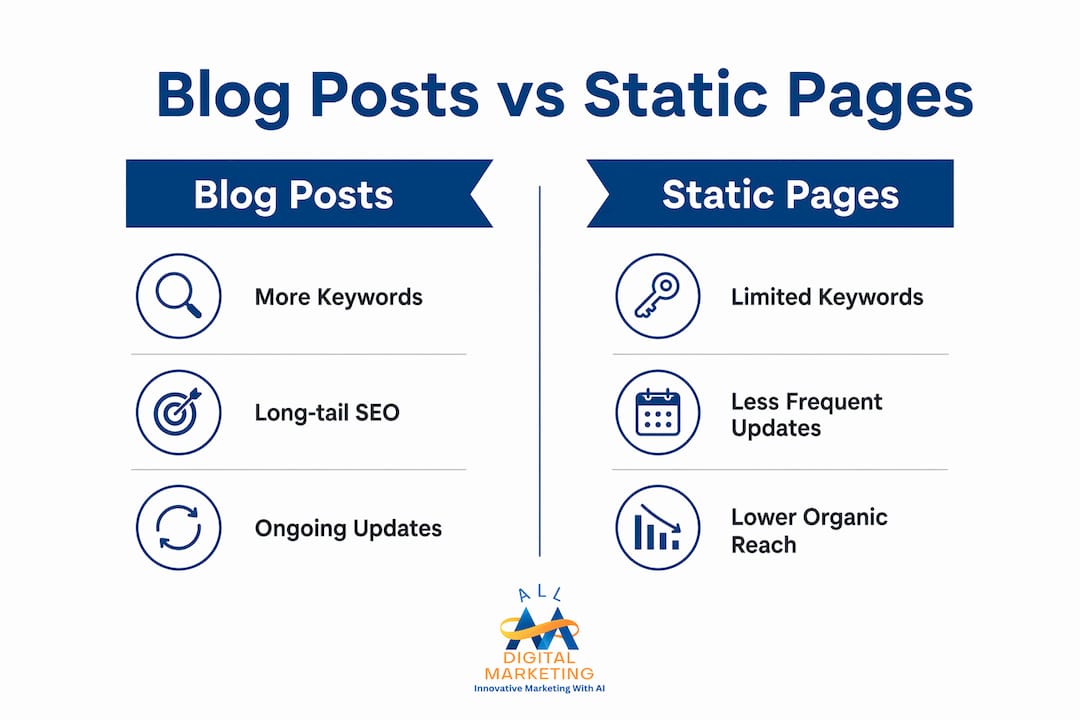
Static product and service pages target a limited set of keywords. Blog posts fill the gaps by targeting long-tail search queries, the specific, multi-word phrases that buyers type when they are close to making a decision. A plumbing company's service page might rank for "plumber in Austin." A blog post titled "Why your water heater is making noise" captures a different, highly motivated reader at an earlier stage of the buying process. That reader is far more likely to call after reading a helpful article than after landing on a generic services page.
The cost comparison between blogging and paid advertising is significant. Pay-per-click ads stop delivering traffic the moment you stop paying. A well-written blog post continues attracting visitors for months or years after publication. With 5.5 billion people online as of may 2026, the audience for organic content has never been larger, and the cost per lead from blogging drops over time as older posts compound their traffic.
Blogs vs. static pages: SEO impact at a glance
| Factor | Blog-driven site | Static site only |
|---|---|---|
| Indexed pages | Grows with every post | Fixed at launch |
| Long-tail keyword coverage | Broad and expanding | Narrow |
| Traffic over time | Compounds month over month | Flat or declining |
| Cost per lead | Decreases as posts age | Tied to ad spend |
| AI search visibility | High (fresh, authoritative content) | Low |
The table above shows why static websites lose ground over time. Search engines reward freshness and topical depth. A blog delivers both automatically when you post consistently.
- Publish at least two posts per month to maintain indexing momentum.
- Target one primary keyword and two to three related phrases per post.
- Use Google Search Console to identify which posts already rank and update them with new data.
- Link each new post to at least one existing post and one product or service page.
Pro Tip: Write posts that answer specific questions your customers ask during sales calls. Those questions are real long-tail keywords, and answering them in writing builds trust before a prospect ever contacts you.
How blogging builds authority, trust, and lasting customer relationships
Authority in search is earned by demonstrating expertise consistently over time. Blogging builds authority by showing readers and search engines that your business understands its field at a deep level. A single well-researched post on a niche topic signals expertise. Fifty posts on related topics signal dominance.
Trust follows authority. Readers who find genuinely useful answers on your blog begin to associate your brand with reliability. That association does not happen after one visit. It builds across multiple interactions, each one reinforcing the last. A landscaping company that publishes monthly posts on lawn care, seasonal planting, and pest control becomes the obvious first call when a homeowner needs professional help. The blog did the selling before the phone ever rang.
"Blogging builds trust as readers engage with insightful, transparent business content over time." — HubSpot
The contrast with social media is stark. A Facebook or Instagram post has a lifespan measured in hours. Blog posts produce compounding returns by attracting organic traffic for years. Older posts often account for a large share of total web traffic, which means content you wrote two years ago is still working for you today. Social media requires constant feeding. A blog builds an asset.
Engagement deepens the relationship further. When readers leave comments, share posts, or reply to a newsletter that links to your blog, they are signaling genuine interest. That engagement gives you direct feedback on what your audience cares about most. You can use that feedback to write better posts, create better products, and serve customers more effectively.
- Share expert opinions on industry trends, not just how-to instructions.
- Write transparently about common mistakes, including ones your business has made and corrected.
- Respond to every comment on your blog to show readers that a real person is behind the content.
- Reference credible third-party sources like industry reports or government data to reinforce your claims.
The businesses that win with blogging are not the ones that post the most. They are the ones that post with the clearest intention to help their readers. That distinction separates a blog that builds a brand from one that fills a content calendar.
How blogging supports lead generation and conversion funnels
Blogging is a primary lead conversion tool when posts include strategic calls to action that guide readers toward the next step. A reader who lands on a post about "how to choose a business accountant" is already interested in accounting services. A well-placed call to action offering a free consultation converts that interest into a lead. HubSpot confirms that blogs build sales pipelines by integrating these CTAs directly into the content flow.

The placement of a call to action matters as much as its wording. Readers who reach the end of a post have already spent time with your content and trust your perspective. A CTA at the end of a post converts at a higher rate than a banner ad on the same page. Mid-post CTAs work well when they appear after a specific problem is described, right before the solution is presented. That timing mirrors the reader's mental state and feels helpful rather than intrusive.
The compounding ROI effect of blogging is one of its most underappreciated advantages. Each post strengthens your domain authority, which makes every future post easier to rank. Blogging compounds marketing ROI over time in a way that paid advertising cannot replicate. A business that blogs consistently for two years has built a content library that generates leads around the clock, without additional ad spend.
Here is a practical sequence for turning blog traffic into leads:
- Write a post that answers a specific question your ideal customer is searching for.
- Include a relevant internal link to a product or service page within the first 300 words.
- Add a mid-post CTA offering a free resource, such as a checklist or guide, in exchange for an email address.
- Place a closing CTA at the end of the post inviting readers to book a call or request a quote.
- Follow up with new subscribers using an email sequence that links back to related blog posts.
This sequence works because it meets readers where they are. They arrived looking for information. You gave them information, then offered a natural next step. That is how lead generation landing pages work at their best, and the same logic applies to blog-driven funnels across every industry.
Pro Tip: Audit your top five blog posts in Google Analytics. Add or update the CTA on each one. Posts that already rank well are your fastest path to more leads without writing a single new word.
Is blogging still relevant in the age of AI search?
Blogging is not obsolete because of AI. The opposite is true. AI search engines favor human-written, experience-backed content over generic text, which means high-quality blogs are now more valuable than they were before tools like ChatGPT and Google AI Overviews became mainstream. AI systems are trained on the web. The businesses that publish authoritative, well-sourced blog content are the ones that get cited in AI-generated answers.
Google's AI Overviews pull from pages that demonstrate expertise, authority, and trustworthiness. A blog post that cites real data, shares first-hand experience, and answers a specific question clearly is exactly what those systems are looking for. Generic, thin content gets filtered out. Detailed, original content gets featured. The shift to AI-driven search has raised the floor for content quality, not eliminated the need for it.
"AI has made high-quality, human-written content more valuable and prioritized by search algorithms." — Why Blogging Is Important in 2026
Blogging also fuels every other marketing channel. A single post can become a social media caption, an email newsletter, a short video script, or a podcast talking point. Blog content repurposed across email and social media amplifies reach without requiring entirely new creative work. That integration makes blogging the most efficient content investment a small business can make.
Blogging vs. AI-generated content: what search rewards
| Content type | AI search visibility | Trust signals | Long-term traffic |
|---|---|---|---|
| Human-written, experience-backed blog | High | Strong | Compounding |
| AI-generated generic article | Low to medium | Weak | Flat |
| Static service page | Low | Neutral | Minimal |
| Social media post | None (not indexed) | Variable | Zero |
Best practices for creating blog content that AI search engines favor:
- Write from direct experience or cite credible, named sources.
- Answer one specific question per post rather than covering a broad topic shallowly.
- Update older posts with new data and examples at least once per year.
- Use structured headings so AI systems can extract clear answers from your content.
- Publish consistently. Fresh blog content signals to AI systems that your site is active and authoritative.
The businesses that treat blogging as a core marketing function, not an afterthought, are the ones that show up in AI-generated answers, voice search results, and traditional search rankings simultaneously.
Key Takeaways
Blogging is the single most cost-effective content marketing tool for small and medium-sized businesses because it compounds traffic, authority, and leads over time while requiring no ongoing ad spend.
| Point | Details |
|---|---|
| Blogging drives organic traffic | Each post adds an indexed page and expands keyword coverage beyond static service pages. |
| Leads increase with consistent blogging | Businesses with active blogs generate 67% more leads than those without one. |
| Authority builds over time | Regular, expert-level posts signal credibility to both readers and search engines. |
| AI search rewards quality blogs | Google AI Overviews and conversational search favor experience-backed, human-written content. |
| CTAs convert blog readers | Strategic calls to action placed within posts turn organic traffic into measurable leads. |
What I have learned from watching SMBs blog their way to growth
Most small business owners I work with start blogging with the wrong goal. They want volume. They think posting three times a week will outrank a competitor who posts once. That is not how it works. Search engines and readers both reward depth over frequency. One genuinely useful, well-researched post outperforms five thin ones every time.
The businesses I have seen grow the fastest from blogging share one habit. They treat every post as a permanent asset, not a social media update. They ask, "Will this post still be useful in three years?" before they write a single word. That question forces clarity. It eliminates filler. It produces content that ranks for years and generates leads long after the publish date.
The other mistake I see constantly is ignoring the connection between blogging and the rest of the marketing funnel. A blog post with no internal links, no CTA, and no connection to a product page is a dead end. Every post should have a job. It should move the reader one step closer to becoming a customer. When you build blogs that rank in AI search, you are not just writing content. You are building a sales system that runs without you.
My honest advice: commit to one high-quality post per month before you commit to anything else. Get the quality right. Then scale the frequency. Sporadic, low-quality posting does more damage to your brand than no blog at all.
— Diane
How Digitalmarketingall can help you turn blogging into real business growth
Blogging builds the foundation. Customer reviews build the proof. When a potential customer reads your blog and then sees dozens of verified five-star reviews, the decision to contact you becomes easy. Digitalmarketingall's review generation and management service works alongside your blog content to create a complete trust signal for both search engines and real buyers. Consistent blog content attracts the traffic. A strong review profile converts that traffic into customers. Together, they produce a marketing return that neither channel achieves alone. If you are ready to pair your content strategy with a reputation that closes deals, Digitalmarketingall has the tools and experience to make that happen.
FAQ
What is the importance of blogging for a small business?
Blogging helps small businesses attract organic search traffic, build credibility, and generate leads without ongoing ad spend. Businesses with active blogs generate 67% more leads than those without one.
How often should a business publish blog posts?
Consistency matters more than frequency. Publishing one high-quality, well-researched post per month produces better long-term results than publishing several thin posts per week.
Does blogging still work with AI-powered search in 2026?
Yes. AI search engines like Google AI Overviews actively favor human-written, experience-backed content. High-quality blog posts are more likely to be cited in AI-generated answers than generic or AI-produced text.
How does blogging help with lead generation?
Blog posts attract readers who are already searching for solutions. Strategic calls to action placed within those posts guide readers toward product pages, contact forms, or free resources, converting traffic into leads.
How long does it take for a blog to show SEO results?
Most blog posts begin ranking within three to six months of publication, depending on competition and domain authority. Older posts often grow in traffic over time, producing compounding returns well beyond the initial publish date.