

The fastest way to reduce your cost per lead is to convert and qualify more of the traffic you already pay for, before buying more clicks. Raising conversion rate and tightening lead qualification lowers blended CPL faster than any bid adjustment ever will. The three levers that move the needle first are landing page conversion optimization, a narrower ideal customer profile, and automated qualification. Everything below breaks those levers into steps, shows the math behind them, and covers channel-specific tactics you can put to work this week.
TL;DR:
- Improving landing page relevance, load speed, and minimizing form fields can significantly increase conversions and lower cost per lead within days.
- Narrowing target audiences and focusing more on remarketing initiatives tend to produce faster CPL reductions than bid adjustments or channel shifts.
- Tracking the appropriate quality-based CPL metrics, such as MQL or SQL CPL, is essential to accurately measure improvement and avoid misleading results.
- Channel-specific tactics like negative keyword management for paid search and creative rotation for social ads effectively reduce their respective CPLs when applied consistently.
- Automating lead qualification processes and aligning marketing and sales definitions can increase lead quality, boosting conversion rates and optimizing CPL long-term.
Table of Contents
- Prioritized Tactics to Reduce Cost Per Lead
- How Do You Calculate Cost Per Lead Correctly?
- Channel-by-Channel Ways to Lower Lead Costs
- Why Lead Quality Matters More Than Lead Volume
- What Landing Page Changes Cut Cost Per Lead Fastest?
- How Do You Track and Test CPL Improvements Reliably?
- What Marketers Get Wrong About Lowering CPL
- Get Expert Help Lowering Your Cost Per Lead
- Sources
- FAQ
Prioritized Tactics to Reduce Cost Per Lead
Not every fix carries equal weight. Some tactics move cost per lead within days; others take weeks to show up in your reporting. Here's the order that tends to produce the biggest wins with the least effort, based on how each lever changes your funnel math.
- Fix the landing page first. A page that matches your ad's headline and cuts form fields to the essentials can lift conversion rate meaningfully within a single testing cycle, which drops CPL without touching your media budget at all.
- Narrow your ICP and targeting. Broad targeting fills your funnel with people who will never buy. Tightening audience parameters to match your best current customers raises both click-through rate and conversion rate at once.
- Test creative in batches, not one at a time. Running three to five ad variations simultaneously and killing underperformers weekly keeps your click-through rate from decaying, which is one of the quiet reasons CPL creeps up over time.
- Layer in remarketing. Visitors who already know your brand convert at a much lower cost than cold traffic, so shifting even 15 to 20 percent of budget toward retargeting audiences usually pulls blended CPL down fast.
- Optimize bidding toward the right conversion event. Bidding on form starts instead of form completions, or leads instead of link clicks, tells the algorithm to chase quantity over quality. Align bid targets with your actual sales-qualified outcome.
- Convert anonymous traffic into identified leads. Most of your paid traffic never fills out a form. Tools that identify and re-engage those visitors turn media spend you already committed into leads you'd otherwise lose. A service like Connect Sight exists specifically for this gap.
- Repurpose high-performing content. A webinar, guide, or case study that already converts well in one channel can be sliced into landing pages, email sequences, and social posts, spreading the cost of that one asset across more leads.
- Pause underperforming channels quickly. Sunk cost thinking keeps too many campaigns alive. If a channel's CPL sits well above your benchmark after a fair testing window, redirect that budget to what's already working.
Pro Tip: Multi-step forms often outperform single-page forms because they ask for less upfront. A visitor who commits to step one (just an email) is far more likely to finish step two than someone facing five fields at once.
Pro Tip: Build a swipe file of landing page and ad creative templates that already converted well. Reusing a proven structure with new copy cuts your testing cycle from weeks to days.
Each of these tactics moves a specific metric: CTR, conversion rate, or lead-to-opportunity rate. Knowing which metric a tactic touches helps you diagnose why CPL moved and repeat what worked.
How Do You Calculate Cost Per Lead Correctly?
Most teams calculate CPL one way and make decisions off a different, more useful number. Raw CPL divides total spend by total leads, full stop. It's the easiest to compute and the least useful for decision-making, because it treats a form-filler who ghosts you the same as one who becomes a customer.
MQL CPL (spend divided by marketing-qualified leads) and SQL CPL (spend divided by sales-accepted leads) both filter for quality. Klipfolio's guide to CPL recommends anchoring decisions to whichever variant reflects a lead your sales team would actually work, which for most B2B and service businesses means MQL CPL as the default.
Here's the math that makes conversion optimization worth prioritizing. Say you spend $5,000 and generate 100 raw leads, for a raw CPL of $50. If your landing page converts at 2% and you improve it to 4% through faster load times and a shorter form, your lead volume doubles to 200 without spending another dollar. Your CPL drops to $25. That's the entire argument for fixing conversion before buying more traffic.
Track these KPIs alongside CPL:
- Conversion rate (visitor to lead)
- Click-through rate (impression to click)
- Lead-to-opportunity rate (how many leads sales actually pursues)
- Customer acquisition cost payback period
Prioritization framework: score every proposed fix on impact, confidence, and effort. A landing page headline test scores high on all three. A full CRM migration scores high impact but low confidence and high effort, so it waits.
Channel-by-Channel Ways to Lower Lead Costs
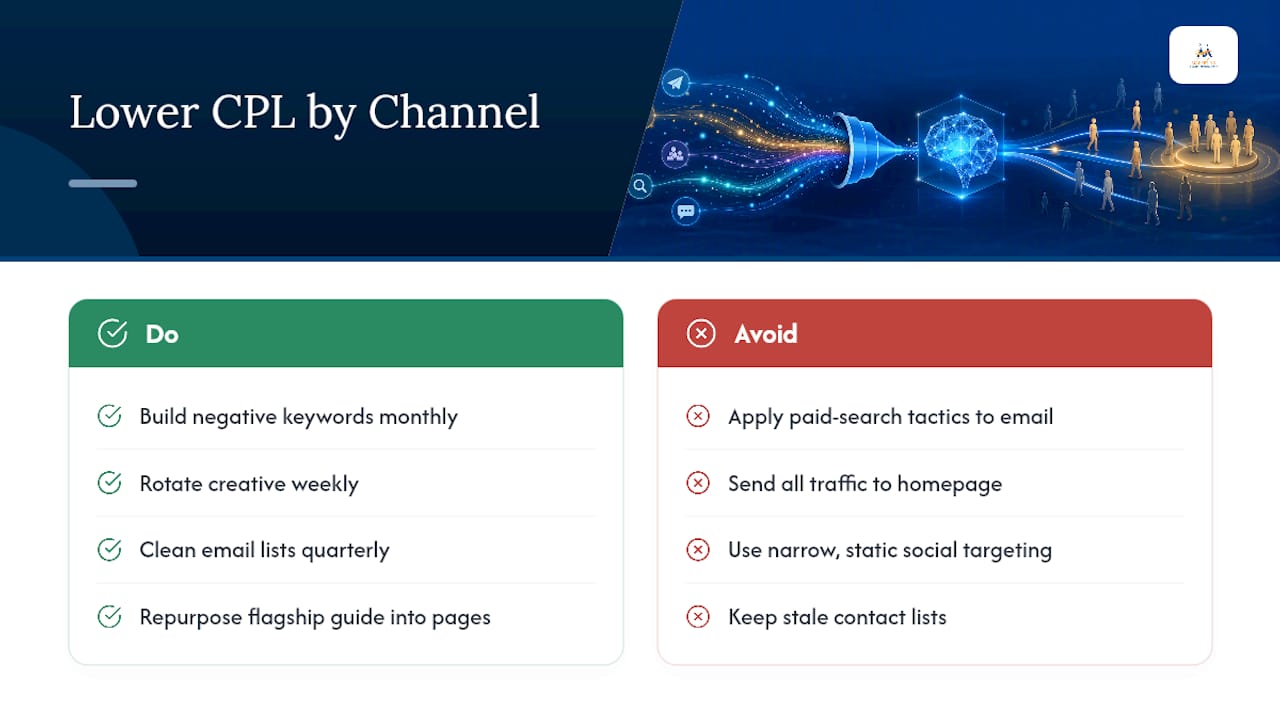
Every channel has its own CPL levers, and applying paid-search tactics to email (or vice versa) wastes effort. Here's what actually moves cost per lead in each one.
Paid search. Build out negative keyword lists monthly to stop paying for irrelevant clicks, match landing pages to search intent instead of sending all traffic to your homepage, and adjust bids by audience segment and past conversion behavior. PPC Hero's guide to reducing CPL points to dayparting and automated bidding as underused levers most accounts leave on the table.
Paid social. Rotate creative on a weekly cadence to fight ad fatigue, and choose deliberately between expanding your audience for reach or refining it for quality. Meta's own best practices recommend broader audiences paired with strong creative variety over narrow, static targeting. Native lead-gen forms convert faster but often produce lower-intent leads than sending traffic to your own landing page, so test both before committing budget.
Email and outbound. Clean your list quarterly. A stale list drags down deliverability and inflates the effective cost of every send. Segment by behavior, not just demographics, and personalize outbound sequences based on what a prospect actually did on your site.
SEO and content. Repurposing one flagship guide into multiple landing pages captures organic demand at a marginal cost near zero once it ranks, which is why organic tends to have the lowest long-run CPL of any channel.
Referral and partnerships. A structured referral program with a clear incentive typically produces the cheapest, highest-trust leads in your entire mix. It just takes longer to scale than paid channels.
Why Lead Quality Matters More Than Lead Volume
Cost per lead only tells half the story if half your leads never talk to sales. Improving qualification changes the denominator in your CPL math and frees up selling time that's currently wasted on unqualified conversations.
- Align marketing and sales on what "qualified" means. If marketing counts a lead the moment a form submits and sales only counts one after a discovery call, you're measuring two different funnels. Get both teams agreeing on one definition and track MQL to SQL conversion rate as your health check.
- Score leads at the form stage. Adding two or three qualifying questions (company size, budget range, timeline) lets you filter out poor fits before they ever reach a sales rep.
- Enrich data automatically. Appending firmographic or intent data to a lead record the moment it comes in gives reps context without manual research.
- Use a two-stage AI triage flow. Run every incoming lead through a lightweight model for initial scoring, then escalate only the top percentile to a more thorough qualification process. This keeps processing costs low while protecting accuracy on the leads that matter most.
- Build a routing and feedback loop. Tag leads by source and score, set clear service-level agreements for follow-up speed, and route sales feedback on lead quality back to marketing weekly.
Pro Tip: Manual qualification eats more SDR time than most managers realize. Automating the triage step doesn't just cut cost per lead. It gives your reps back hours to spend on leads that are actually ready to buy.
What Landing Page Changes Cut Cost Per Lead Fastest?
Landing page fixes are the cheapest, fastest lever available because they don't require new budget, just better execution on traffic you're already paying for.
- Cut form fields to the minimum sales actually needs. Every extra field costs you conversions.
- Match your headline to the exact ad copy that brought the visitor there. Mismatched messaging is one of the most common conversion killers.
- Place social proof (reviews, logos, testimonials) above the fold, not buried at the bottom.
- Strip the main navigation menu from landing pages so visitors can't wander off before converting.
- Get load time under three seconds. Given how many visitors arrive on mobile devices, according to Pew Research's mobile usage data, a slow mobile page bleeds conversions before anyone reads a word of copy.
Mobile matters more than most teams assume. Statista's device distribution data for Facebook users shows mobile as the dominant access point, which means a landing page tested only on desktop is being graded on the wrong device.
Multi-step forms tend to outperform single-page forms for higher-consideration offers, while single-page forms still win for simple, low-commitment asks like a newsletter signup. Whichever format you choose, attribute the resulting CPL change to the specific channel that sent the traffic, not to your overall average. A CRO win on paid search shouldn't get credited to organic's numbers.
How Do You Track and Test CPL Improvements Reliably?
Bad tracking makes every optimization decision a guess. Before you trust any CPL number, confirm your measurement setup is actually sound.
- Write a specific hypothesis before testing anything ("shortening the form from seven fields to three will raise conversion rate").
- Calculate the sample size you need before launching, and commit to a runtime instead of checking daily and stopping early.
- Avoid peeking at results before the test reaches significance. Early leads are noisy and mislead you.
- Run a holdout test periodically to confirm a channel's reported lift is incremental, not just correlated with a seasonal trend.
Tracking essentials worth locking down:
- Consistent UTM tagging across every campaign and channel
- Server-side or conversion API tracking to reduce data loss from browser restrictions
- Offline conversion uploads so sales-closed revenue feeds back into your ad platforms
Once tracking is clean, the loop is simple: test, measure, and scale whatever wins. Kill what doesn't within a set window instead of letting it linger on autopilot.
What Marketers Get Wrong About Lowering CPL
The most common mistake is chasing raw CPL down while lead quality quietly collapses. A team celebrates a $10 drop in average cost per lead without noticing that lead-to-opportunity rate fell by half. Overbidding on volume-based conversion events and ignoring the post-click experience both create this trap.
Quick wins, like a landing page fix or a new ad angle, show up within days to a few weeks. Structural wins, like fixing qualification workflows or building a referral program, take months. A realistic engagement should show early movement in conversion rate or lead-to-opportunity rate within the first month, with fuller CPL gains compounding after that.
— Diane O'Brien
Get Expert Help Lowering Your Cost Per Lead
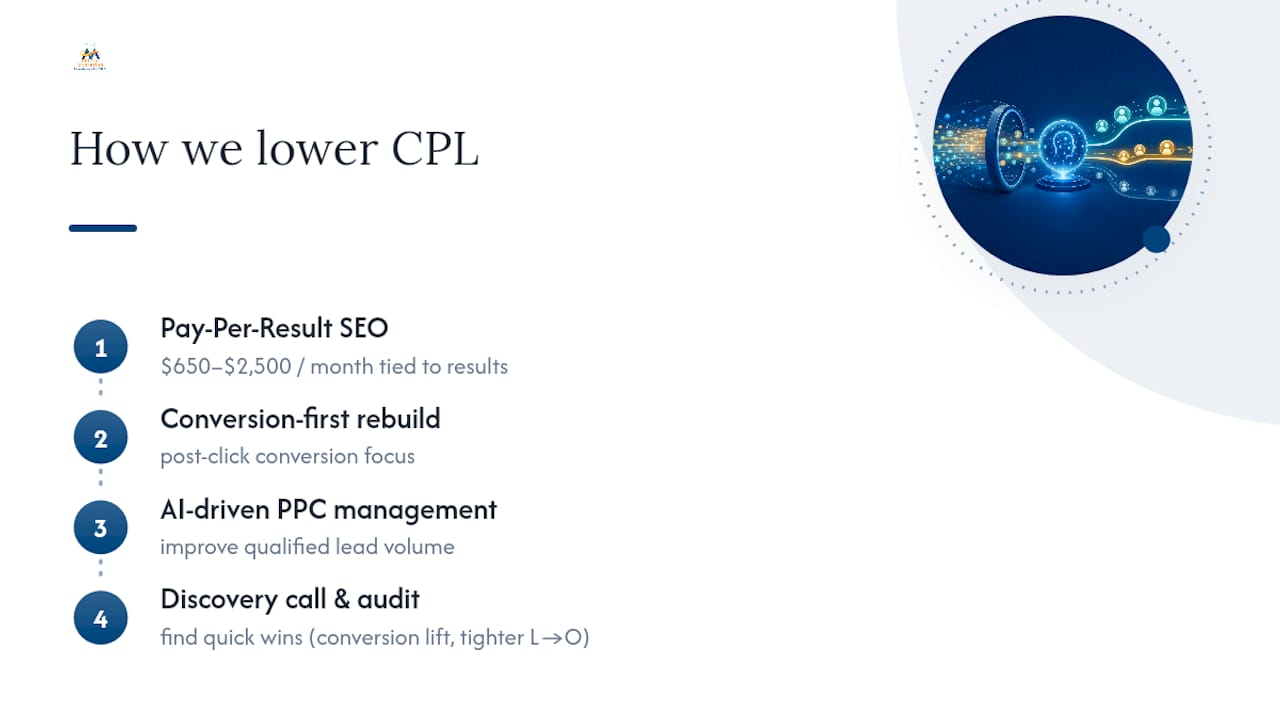
Most agencies bill for clicks and impressions regardless of whether those clicks turn into leads worth having. Digital Marketing All's Pay Per Result SEO service ties cost directly to results, starting at $650 to $2,500 per month depending on scope, so you're not paying for traffic that never converts. Pairing that with a conversion-first website rebuild and AI-driven PPC management addresses the two biggest CPL levers covered above: post-click conversion rate and qualified lead volume.
A typical discovery call starts by auditing your current landing pages and funnel data to find the fastest wins available, often a conversion rate lift or a tighter lead-to-opportunity rate within the first few weeks. From there, the plan expands into the channels and qualification workflows that fit your business. If you're ready to see where your funnel is leaking budget, explore the full range of services and book a discovery call to get a specific plan for your numbers.
Sources
The recommendations above draw on Klipfolio's CPL benchmarks and formula guide, Mailchimp's explainer on cost per lead, PPC Hero's tactical CPL tips, Meta's ad performance best practices, and mobile usage data from Pew Research and Statista.
- Statista — Distribution of Facebook users by device
- Pew Research Center — Mobile fact sheet
- Klipfolio — Cost per lead (CPL): formula, benchmarks, and tips
- PPC Hero — 9 Tips To Reduce Cost-Per-Lead
- Facebook Business Help — Best practices to potentially reduce cost per result
FAQ
How Do You Reduce Cost Per Lead?
Raise your conversion rate and tighten lead qualification before increasing ad spend, since converting more of your existing traffic lowers CPL without adding budget. Landing page fixes, narrower targeting, and remarketing are the three fastest levers, followed by channel-specific tactics like negative keyword management and creative rotation.
What Is a Reasonable Cost Per Lead?
A reasonable CPL varies widely by industry, channel, and how you define a lead, which is why Klipfolio recommends benchmarking against MQL or SQL CPL rather than a single universal number. Compare your CPL against your own historical baseline and your customer acquisition cost payback period rather than a generic industry figure.
What Does "Cost Per Lead" Mean?
Cost per lead measures total marketing spend divided by the number of leads generated in a given period. Mailchimp's definition notes that the metric only becomes actionable once you segment it by channel and by lead quality, since a raw lead count can hide a quality problem.
How Do I Calculate the Cost Per Lead?
Divide total campaign spend by the number of leads that spend generated: $5,000 in spend divided by 100 leads equals a $50 CPL. For sharper decisions, calculate MQL CPL or SQL CPL instead of raw CPL, since those variants filter out leads sales never actually pursues.
Can an Agency Help Lower My Cost Per Lead?
Yes, an agency that ties pricing to performance, rather than billing flat for ad management regardless of outcome, aligns its incentives with yours. Digital Marketing All's Pay Per Result SEO service works this way, and combining it with conversion-focused website design typically improves both lead volume and lead quality at once.