

TL;DR:
- Large language models enable faster content creation and smarter customer service for businesses.
- Most successful AI adoption involves focusing on one workflow, quality data, and thorough testing.
A large language model (LLM) is an AI system trained on billions of text examples that understands and generates human language at near-human quality. For businesses and marketers, that capability translates directly into faster content production, smarter customer service, and more personalized communication at scale. The Stealth Agents 2026 AI Adoption report found that 67% of small businesses using AI automation achieved revenue growth over 20%, with an average ROI of 250% within 18 months. That figure signals a clear shift: large language models are no longer experimental tools. They are core business infrastructure.
What is an LLM and how does it work?
A large language model is built on a transformer architecture, a neural network design that processes language by learning statistical relationships between words, phrases, and ideas. The transformer reads text in parallel rather than word by word, which makes it far faster and more accurate than earlier AI approaches. Natural language processing (NLP) is the broader field that LLMs sit within, covering everything from grammar parsing to intent detection.
Training an LLM requires feeding it massive text datasets, often hundreds of billions of words drawn from books, websites, and structured documents. The model learns patterns, context, and meaning by predicting what word comes next, billions of times over. After training, the model can generate coherent paragraphs, answer questions, summarize documents, and translate languages without being explicitly programmed for each task.
Two technologies extend what a base LLM can do in real business settings:
- Retrieval-augmented generation (RAG): The model pulls live information from a connected knowledge base before generating a response. This keeps answers current and grounded in your specific data rather than generic training content.
- Orchestration layers: A routing and logging system that sits between your application and the model. Building an orchestration layer before selecting a model enables flexible updates and integrations without re-engineering your entire stack.
- Guardrails: Rules and filters that prevent the model from producing off-brand, inaccurate, or harmful outputs.
- Workflow automation: Connecting the LLM to your CRM, email platform, or support system so it acts on data rather than just responding to prompts.
Pro Tip: Start your LLM project by designing the orchestration layer first. Choosing a model before you have routing, logging, and guardrails in place forces expensive re-engineering later.
Understanding these layers matters because most LLM failures in business settings come from skipping them. A well-configured orchestration layer is what separates a reliable AI system from an unpredictable one.
What are the key business applications of LLMs for marketers?
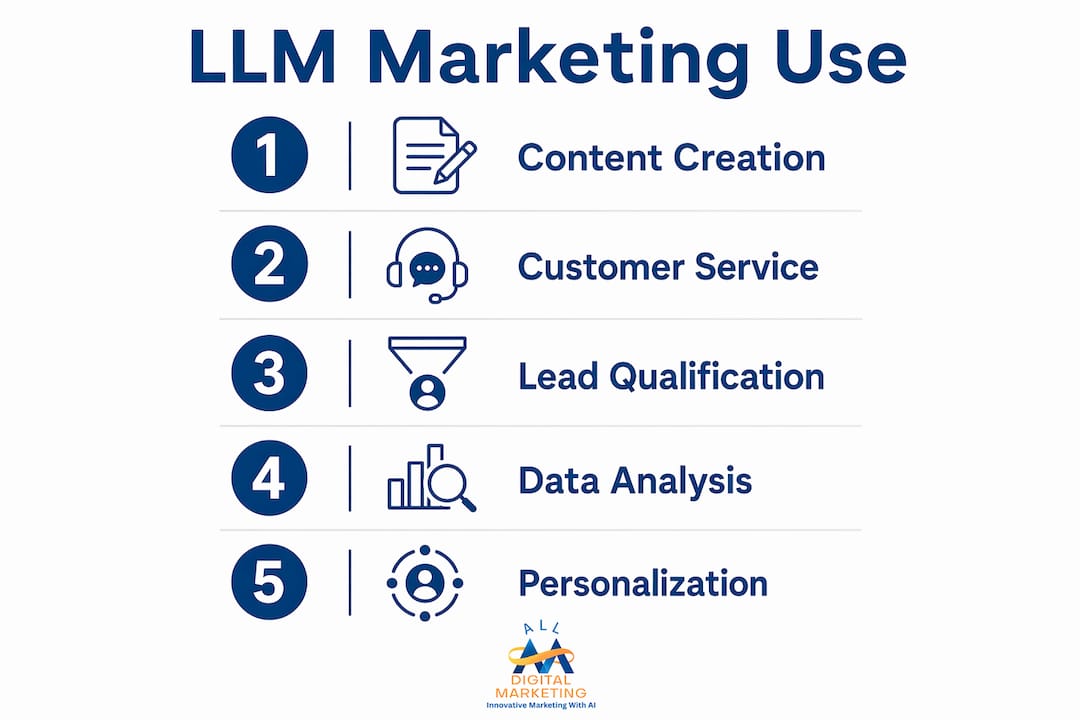
Content creation is the most immediate win. A GoodFirms 2025 survey found that 78% of SMBs cite faster content creation as the leading benefit of LLMs for digital marketing. That speed advantage compounds quickly when you apply it to blog posts, email sequences, product descriptions, and social media copy simultaneously.

Customer service is the second major application. The same survey documents that AI chatbots now handle 30–50% of inbound customer queries. That volume shift frees your human team to focus on complex, high-value conversations rather than answering the same FAQ for the hundredth time.
Here is where LLMs create the most measurable impact for marketing and customer service teams:
- Marketing content generation: Draft blog posts, ad copy, landing page text, and email campaigns in minutes. The LLM uses your brand guidelines and past content as context.
- Lead qualification: AI asks qualifying questions via chat, scores responses, and routes high-intent leads to your sales team automatically.
- Internal knowledge bots: Employees ask questions and get instant answers drawn from your SOPs, product docs, and training materials.
- Hyper-personalized messaging: The model analyzes past customer interactions and generates messages tailored to each segment's specific language and concerns.
- Support ticket summarization: Long email threads or chat logs get condensed into one-paragraph summaries before reaching a human agent.
The table below shows the primary application areas and their direct business benefits.
| Application area | Primary benefit | Time to value |
|---|---|---|
| Content creation | Faster output, lower production cost | Days |
| Customer service chatbots | Reduced ticket volume, 24/7 coverage | Weeks |
| Lead qualification | Higher conversion rate, less manual sorting | Weeks |
| Internal knowledge bots | Faster employee onboarding and support | Months |
| Personalized email sequences | Higher open and click rates | Days |
AI-driven personalization powered by LLMs works because the model reads your customer data and mirrors the language your buyers already use. Generic messaging loses to specific messaging every time.
What best practices help businesses implement LLMs successfully?
The single most common mistake in LLM adoption is platform thinking. Businesses try to automate everything at once and end up with a fragmented system that delivers mediocre results across the board. Implementing one well-defined LLM workflow at a time and measuring results consistently leads to higher success rates than attempting broad solutions simultaneously.
Follow this sequence when rolling out your first LLM workflow:
- Identify one high-impact use case. Pick the workflow that currently costs the most time or money. Customer support FAQ responses or first-draft blog content are common starting points.
- Audit your data quality. The LLM will only perform as well as the data you feed it. Clean, structured inputs produce reliable outputs.
- Build the orchestration layer. Set up request routing, logging, and output guardrails before connecting the model to any live system.
- Run automated evaluation and regression testing. Testing LLM outputs with labeled datasets before launch prevents quality failures and protects your brand reputation.
- Measure ROI on a defined timeline. Set a 30, 60, or 90-day checkpoint with specific metrics: ticket deflection rate, content output volume, or lead qualification speed.
- Expand iteratively. Once the first workflow proves its value, apply the same process to the next use case.
Data security and compliance deserve direct attention before you launch. Keep customer data within your own infrastructure where possible. Use enterprise-grade API agreements that specify data retention and usage policies. For regulated industries, confirm that your LLM provider meets relevant compliance standards such as SOC 2 or HIPAA before processing sensitive information.
ROI and data security are the top barriers to AI adoption, but both are manageable with phased implementation and clear governance policies. Businesses that plan for these concerns upfront avoid the costly retrofits that derail later-stage deployments.
Pro Tip: Resist the urge to evaluate five different models before you have a working workflow. Pick one well-supported model, get the workflow running, and optimize from there. Model-switching is far easier than workflow re-engineering.
How can businesses use customer data to improve AI-driven content?
The most effective AI marketing content comes from real customer conversations, not from assumptions about what customers want. Clean data from real customer interactions builds content clusters that reflect authentic pain points. That authenticity is what makes AI-generated content convert rather than just fill space.
Your business already holds a rich content source in its support transcripts, chat logs, and email threads. The process of turning that data into marketing content follows a clear path. Sentiment analysis identifies which topics generate frustration or enthusiasm. Keyword extraction surfaces the exact phrases customers use when describing their problems. Those phrases become the foundation for landing page copy, email subject lines, and blog post titles.
Key techniques for turning customer data into AI content:
- Sentiment analysis on support tickets: Flag recurring negative sentiment around specific product features or service gaps. Address those gaps directly in your content.
- Keyword extraction from chat logs: Pull the natural language customers use. If buyers consistently say "I can't figure out how to set it up," your content should use that exact phrasing, not "onboarding complexity."
- Dynamic landing pages: Feed customer segment data into the LLM and generate page variants that speak to each segment's specific concerns. A retail buyer and a wholesale buyer need different language even for the same product.
- Tailored email sequences: Use purchase history and past support interactions to generate email content that references what each customer has already experienced with your brand.
- Feedback loop integration: Route new customer interactions back into your content system regularly. The model improves as your data grows.
AI-powered marketing strategies that use this feedback loop consistently outperform campaigns built on demographic assumptions alone. The data your customers generate every day is the most accurate signal you have about what they need next.
The brand voice consistency benefit is underrated. When the LLM trains on your actual customer communications, it learns the tone, vocabulary, and concerns specific to your audience. That produces content that sounds like your brand rather than generic AI output.
Key Takeaways
Large language models deliver the highest business value when deployed on a single, well-defined workflow with clean data, a tested orchestration layer, and measurable success criteria before expanding.
| Point | Details |
|---|---|
| Start with one workflow | Focus on one high-impact use case first; prove ROI before expanding to other applications. |
| Orchestration comes first | Build request routing, logging, and guardrails before selecting or connecting any model. |
| Customer data drives quality | Use real support transcripts and chat logs to feed the LLM and produce authentic content. |
| Test before you launch | Run automated regression testing with labeled datasets to catch output failures before they reach customers. |
| Measure ROI at fixed checkpoints | Set 30, 60, or 90-day milestones with specific metrics to confirm the workflow is delivering value. |
Why most businesses get LLM adoption wrong
I have watched businesses spend months evaluating models and almost no time thinking about the workflow they want to automate. That is the wrong order of operations. The model matters far less than the quality of your data, the clarity of your use case, and the discipline of your testing process.
The businesses I have seen get the most out of large language models share one trait: they treat AI as an efficiency multiplier for work humans already do well, not as a replacement for human judgment. A well-configured LLM handles the volume. Your team handles the strategy, the relationships, and the edge cases the model cannot navigate.
The European Commission's Digital Economy Report found that European SME AI adoption doubled from 22% in 2024 to 38% in 2026, with adopters reporting 15–25% productivity gains within a year. That productivity gain does not come from deploying the most advanced model. It comes from deploying the right workflow with the right data.
The uncomfortable truth about LLM adoption is that most of the work is operational, not technical. Cleaning your CRM data, documenting your brand voice, and defining what "good output" looks like for your specific use case. Those are the decisions that determine whether your AI investment pays off. The model itself is almost secondary.
My advice: pick one workflow, define success in concrete numbers, and run it for 90 days before touching anything else. That discipline separates the businesses that build durable AI capabilities from those that cycle through tools without results.
— Diane
How Digitalmarketingall helps businesses put LLMs to work
Digitalmarketingall works with small and medium-sized businesses that want to apply AI-driven marketing without building an internal technical team from scratch. The agency combines content marketing expertise with AI-powered search strategies to help clients produce more content, rank in more places, and convert more visitors. For businesses ready to connect their marketing spend directly to measurable search performance, Digitalmarketingall's Search Price Optimization service aligns AI content strategy with the specific search terms that drive your highest-value customers. The result is a marketing system that works harder without requiring more hours from your team.
FAQ
What does LLM stand for in AI?
LLM stands for large language model. It refers to an AI system trained on massive text datasets that can understand, generate, and summarize human language across a wide range of tasks.
How does a large language model differ from a standard chatbot?
A standard chatbot follows scripted rules and predefined decision trees. A large language model generates contextually relevant responses based on learned language patterns, making it far more flexible and capable of handling open-ended questions.
What are the most practical LLM use cases for small businesses?
The most practical applications are content creation, customer service automation, lead qualification, and internal knowledge management. AI business communication that uses LLMs to draft, summarize, and route messages frees human teams for higher-value work.
How long does it take to see ROI from an LLM implementation?
Businesses that focus on a single, well-defined workflow typically see measurable ROI within 30–90 days. The Stealth Agents 2026 report documents an average ROI of 250% within 18 months for SMBs that fully implement AI automation.
Is customer data safe when used with an LLM?
Data safety depends on your implementation choices. Use enterprise API agreements that specify data retention policies, keep sensitive data within your own infrastructure where possible, and confirm your provider meets compliance standards such as SOC 2 before processing customer information.