

TL;DR:
- Auditing local SEO involves systematically evaluating factors that affect local search rankings across six core areas. Regular quarterly audits help identify gaps early, with geogrid rank tracking revealing hyper-local visibility issues that single-point checks miss. Fixing quick wins like Google Business Profile errors and citation inconsistencies improves rankings and builds a stronger local market presence.
Auditing local SEO performance is the process of systematically evaluating every factor that influences your business's visibility in geographically relevant search results. A local SEO analysis covers six core areas: Google Business Profile accuracy, citation consistency, review health, on-page website signals, keyword targeting, and competitor positioning. Industry best practice calls for quarterly audits to catch ranking gaps before they cost you customers. When done correctly, an audit produces a prioritized fix list that directly improves local visibility and drives more foot traffic and calls to your business.
How to audit local SEO performance: tools and data you need
The right tools determine how accurate and useful your audit results are. Three categories of tools cover the full picture: Google's own platforms, citation checkers, and rank trackers.
Google Business Profile Insights and Google Search Console are the starting point for any local SEO analysis. Google Business Profile Insights shows how customers find your listing, what actions they take, and which search queries trigger your profile. Google Search Console reveals organic click-through rates, impressions, and indexing issues for your website. Both tools are free and give you first-party data directly from Google.
Geo-grid rank trackers are the most important upgrade you can make to your audit process. Traditional rank trackers check your position from one location. Geo-grid tools scan up to 441 geographic points within 90 seconds, producing a heatmap that shows your ranking at street level across your entire service area. That granularity reveals gaps that a single-point tracker will never catch.
Citation audit tools check whether your business name, address, and phone number (NAP) appear consistently across directories like Yelp, Apple Maps, and data aggregators. Inconsistent NAP data confuses Google and suppresses local rankings.
| Tool category | What it measures | Best for |
|---|---|---|
| Google Business Profile Insights | Queries, impressions, actions | Profile performance baseline |
| Google Search Console | Organic clicks, indexing, Core Web Vitals | Website SEO signals |
| Geo-grid rank tracker | Street-level ranking heatmap | Hyper-local visibility gaps |
| Citation checker | NAP consistency across directories | Citation accuracy |
| Review monitoring platform | Review volume, rating, response rate | Reputation signals |
Pro Tip: Connect directly to the Google Business Profile API for the most accurate local SEO metrics. Generic tools pull approximated public data. The GBP API connection gives you real search query counts, impression history, and conversion actions that generic tools simply cannot replicate.
Step-by-step process to assess local SEO ranking factors
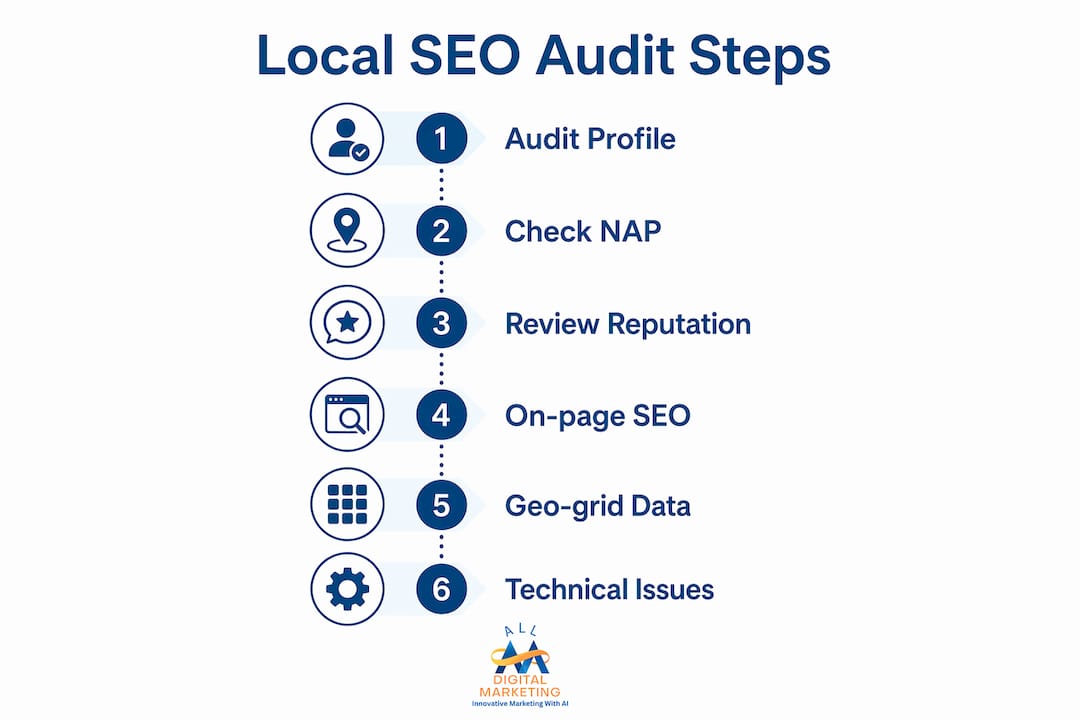
A systematic local SEO audit follows a clear sequence. Skipping steps or auditing out of order leads to missed issues and wasted effort. Work through these six steps in order.
Step 1: Audit your Google Business Profile
Open your Google Business Profile dashboard and check every field. Confirm your business name matches exactly what appears on your storefront and website. Verify your primary and secondary categories reflect what customers actually search for. Check that your hours are current, your photos are recent, and your services list is complete. A missing or wrong category is one of the fastest ways to lose local rankings without knowing why.

Step 2: Check NAP consistency across citations
Search your business name on Google, Bing, Yelp, Apple Maps, and the top data aggregators. Record every variation in your name, address, or phone number. Even small differences like "St." versus "Street" or a missing suite number create citation conflicts. Fix the most authoritative directories first: Google, Apple Maps, and Facebook carry the most weight with search engines.
Step 3: Review your reputation signals
Count your total reviews, calculate your average rating, and check how recently reviews have come in. Google favors businesses with a steady stream of new reviews over those with a large but stagnant review count. Check your response rate. Businesses that respond to reviews signal active management to both Google and potential customers. A low response rate is a quick fix with a measurable impact.
Step 4: Evaluate on-page SEO for local relevance
Check that your homepage and key service pages include your city and service area in the title tag, H1 heading, and first paragraph. Look for a dedicated contact page with your full NAP. Confirm your site has an embedded Google Map and structured data markup (Schema.org LocalBusiness). These on-page signals tell Google exactly where you operate and what you offer.
Step 5: Analyze geo-grid rank tracking data
Run a geo-grid scan for your top three to five target keywords. Review the heatmap to identify which zones around your location rank in the top 3 and which fall below position 10. Pay attention to the edges of your service area. Rank fluctuations within short distances are common. A business might rank second at its own address but drop to fourteenth just a few miles away. That gap is your priority target.
Step 6: Identify technical SEO issues
Run your website through Google Search Console and check for crawl errors, mobile usability issues, and Core Web Vitals failures. Broken pages, slow load times, and non-mobile-friendly layouts all suppress local rankings. Fixing foundational issues like incorrect phone numbers, broken pages, or GBP category errors must happen before any new optimization campaign begins. These are the quick wins that unblock your rankings immediately.
Pro Tip: After completing your technical check, test every phone number on your site by tapping it on a mobile device. If it does not trigger a call, fix the tap-to-call formatting. Mobile users searching locally expect to call with one tap, and a broken link costs you conversions and signals poor user experience to Google.
How to analyze audit results and prioritize improvements
Raw audit data only becomes useful when you know how to read it and what to fix first. Start with a clear framework for separating quick wins from longer-term projects.
Quick wins are issues that block customers from reaching you right now. These include wrong phone numbers, duplicate GBP listings, incorrect business hours, and broken website pages. Fix these before anything else. They require minimal effort and produce immediate results.
Strategic projects take more time but build lasting ranking strength. These include earning more reviews, building new citations on authoritative directories, improving website content for local keywords, and running a sustained geo-grid improvement campaign.
Reading geo-grid heatmaps accurately
A geo-grid heatmap color-codes your ranking at each scan point. Green points indicate top-3 rankings. Yellow points show positions 4 through 10. Red points reveal where you are invisible. Focus your first round of improvements on converting yellow zones to green, especially in high-traffic areas near your business address.
Using Share of Local Voice instead of average rank
Share of Local Voice measures the percentage of geo-grid points where your business ranks in the top 3. Average rank position hides the truth. A business with an average rank of 4.2 might still be invisible in the most valuable blocks of its service area. Share of Local Voice gives you a single number that reflects real market presence.
Tracking Share of Local Voice rather than average rank isolates high-priority local zones and helps businesses allocate resources closer to customer concentrations. Average ranks can disguise a complete lack of presence in the zones that matter most.
- Prioritize GBP corrections first. They affect every point on the geo-grid simultaneously.
- Fix citation inconsistencies next. They undermine the trust signals Google uses to verify your location.
- Address review volume and recency third. A steady review flow signals active business operations.
- Improve on-page local signals fourth. Title tags, Schema markup, and local content reinforce your geographic relevance.
- Run a second geo-grid scan after 30 days to measure movement in your Share of Local Voice score.
Schedule your next audit before you finish the current one. Quarterly audits keep you ahead of algorithm updates, competitor moves, and seasonal ranking shifts. Put it on the calendar now.
What are common mistakes when auditing local SEO performance?
Most local SEO audits fail not because of missing data but because of predictable errors in how the data gets collected and interpreted. Recognizing these mistakes saves time and prevents bad decisions.
- Single-point rank snapshots. Checking your rank from one location gives you one data point out of hundreds. A business that ranks third at its front door may rank fifteenth two miles away. Geo-grid scanning is the only way to see the full picture.
- Ignoring GBP data inconsistencies. An outdated address, a wrong phone number, or a mismatched business name on your Google Business Profile directly suppresses your rankings. Many businesses update their website but forget to update their GBP, creating a conflict that Google penalizes.
- Overlooking review signals. Reviews are a direct local ranking factor. A business with 200 reviews from three years ago will lose ground to a competitor with 40 recent reviews from the past six months. Recency matters as much as volume.
- Misreading average rank. Average rank position misleads because it averages strong zones with invisible zones. A business can look like it ranks well on paper while being completely absent from its most profitable neighborhoods.
- Skipping technical SEO checks. Broken internal links, slow page speed, and missing mobile optimization all reduce your local rankings. These issues are easy to find with Google Search Console and fast to fix with the right developer.
Pro Tip: When you find a citation with a wrong phone number, do not just update the directory listing. Trace that number back to its source. Data aggregators like Data Axle and Neustar Localeze feed dozens of directories automatically. Fix the error at the aggregator level and the correction spreads across the network.
Key Takeaways
A complete local SEO audit covers Google Business Profile accuracy, citation consistency, review health, on-page signals, geo-grid rank data, and technical SEO, with quarterly reviews keeping rankings on track.
| Point | Details |
|---|---|
| Audit quarterly | Schedule audits every 90 days to catch ranking gaps before competitors do. |
| Use geo-grid tracking | Scan hundreds of location points to find hyper-local visibility gaps a single tracker misses. |
| Fix quick wins first | Correct phone numbers, GBP errors, and broken pages before starting new campaigns. |
| Track Share of Local Voice | Use this metric instead of average rank to measure real market presence in top-3 positions. |
| Connect to GBP API | Pull real query and impression data from Google directly for fact-based decisions. |
What geo-grid data taught me about local SEO audits
I have reviewed local SEO audits for businesses across dozens of markets, and the single most consistent finding surprises people every time. A business owner assumes they rank well because they checked their position from their office and saw a top-3 result. Then we run a geo-grid scan and find they are invisible in the neighborhoods where their best customers actually live.
That gap between perceived performance and actual market coverage is the reason I push every local business to adopt geo-grid tracking before anything else. Average rank is a comfort metric. It tells you what you want to hear. Share of Local Voice tells you the truth.
The second thing I have learned is that most local SEO problems trace back to two root causes: an incomplete or inaccurate Google Business Profile, and citation data that has drifted over time. Before you invest in content, links, or paid ads, fix those two things. They are the foundation. Everything else builds on top of them.
A hyperlocal SEO strategy only works when the underlying audit data is accurate. Businesses that audit regularly, act on what they find, and track Share of Local Voice over time consistently outperform competitors who rely on gut feel and occasional rank checks. The discipline of the audit process matters as much as the tactics it uncovers.
— Diane
How Digitalmarketingall supports your local SEO audit goals
Digitalmarketingall works with local businesses to turn audit findings into real ranking improvements. The agency's services cover the areas most audits flag as priorities: website performance, review generation, and Google Business Profile optimization. If your audit reveals a weak review profile, Digitalmarketingall's review generation service builds a steady flow of verified customer reviews that strengthen your local rankings. If your website is holding back your local visibility, the team's website optimization services address speed, mobile usability, and local on-page signals. Every service connects directly to the ranking factors your audit identifies, so improvements are targeted and measurable.
FAQ
What does a local SEO audit include?
A local SEO audit covers Google Business Profile accuracy, NAP citation consistency, review profile health, on-page website signals, geo-grid rank tracking, and technical SEO issues. The output is a prioritized list of fixes ranked by impact.
How often should I audit local SEO performance?
Quarterly audits are the industry standard. Running an audit every 90 days catches algorithm changes, competitor moves, and data drift before they cause significant ranking losses.
What is Share of Local Voice?
Share of Local Voice measures the percentage of geo-grid scan points where your business ranks in the top 3. It is a more accurate measure of local market presence than average rank position.
Why does my rank vary so much by location?
Local search rankings change block by block because Google personalizes results based on the searcher's exact location. A geo-grid scan reveals these variations across your full service area, showing exactly where you are strong and where you are losing visibility.
What is the fastest fix in a local SEO audit?
Correcting errors on your Google Business Profile, such as wrong phone numbers, outdated hours, or incorrect categories, produces the fastest ranking improvement. These fixes take minutes and affect your visibility across every location on the geo-grid simultaneously.