

TL;DR:
- A hyperlocal SEO strategy focuses on optimizing online presence for neighborhood-level searches rather than citywide queries. It emphasizes completing Google Business Profiles, creating unique location pages with local content, and earning relevant backlinks and reviews to boost local rankings. Businesses that actively maintain their hyperlocal efforts see improved visibility and higher customer engagement in their service areas.
A hyperlocal SEO strategy is the practice of optimizing your online presence to rank for neighborhood-level searches, not just broad city queries. 46% of all Google searches carry local intent. That number means nearly half of every search happening right now is someone looking for a business near them. Local business owners who create hyperlocal SEO strategy plans built around micro-locations, Google Business Profile, and neighborhood-specific content consistently outperform competitors stuck at the city level. This guide walks you through every step, from foundational directory listings to technical site architecture, so you can increase local visibility and attract customers in the exact neighborhoods you serve.
Why optimize Google Business Profile and local directory listings first?
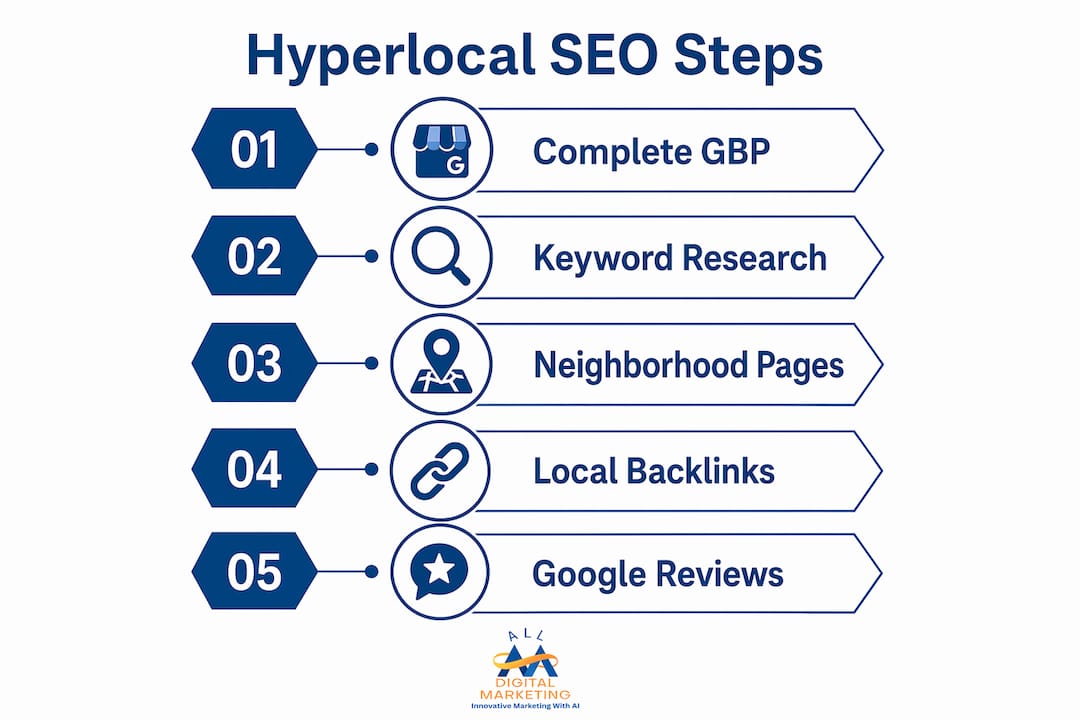
Google Business Profile (GBP) is the single most powerful tool for local search engine optimization. Complete GBP listings appear 80% more often in local results and generate four times as many website visits compared to incomplete profiles. That gap is not marginal. It means a fully built-out profile is the fastest lever you can pull to increase local visibility before touching anything else on your website.
What a complete GBP profile actually requires
Verification is the starting point, but it is not the finish line. A complete profile includes your primary and secondary business categories, a keyword-rich business description, your service areas, business hours, and at least ten high-quality photos. Google rewards profiles that use every available attribute, such as "women-owned," "outdoor seating," or "free Wi-Fi," because these attributes match specific search filters customers use. Regular posts, meaning weekly updates about offers, events, or new services, signal to Google that your listing is active and relevant.
NAP consistency is equally non-negotiable. NAP stands for name, address, and phone number. Every directory listing, from Yelp and Bing Places to Apple Maps and local chamber of commerce sites, must show identical NAP data. A single discrepancy, like "St." in one listing and "Street" in another, creates a trust gap that suppresses your local pack ranking. Tools like Moz Local and BrightLocal help you audit and correct these inconsistencies across hundreds of directories at once.
Local citations act as votes of confidence for your business. The more authoritative directories that list your business with accurate information, the stronger your prominence signal becomes in Google's local algorithm. Prominence is one of Google's three core local ranking factors, alongside relevance and proximity. Building citations on industry-specific directories, such as Houzz for contractors or Healthgrades for medical practices, carries more weight than generic directories alone.
Pro Tip: After verifying your GBP, use the Q&A section proactively. Post your own frequently asked questions and answer them. This content appears directly on your profile and can match long-tail neighborhood searches.
Key actions for GBP and directory optimization:
- Verify your Google Business Profile and fill every available field
- Upload geo-tagged photos from actual job sites or your physical location
- Select the most specific primary category available for your business type
- Audit NAP consistency across Yelp, Bing Places, Apple Maps, and niche directories
- Respond to every review, positive or negative, within 48 hours
- Post weekly updates using your city and neighborhood names naturally in the text
For a detailed walkthrough of every GBP field and how to use it, the GBP optimization guide from Digitalmarketingall covers the full process step by step.
How to conduct neighborhood-specific keyword research and create location pages
Google does not rank businesses by city boundaries alone. Google uses invisible neighborhood polygons to determine local rankings, which means a city-level page for "plumber in Chicago" will not rank for someone searching in Logan Square or Wicker Park. You need pages that match those micro-locations precisely.
Finding the right geo-specific keywords
Start by mapping every neighborhood, suburb, and zip code you actually serve. Then use Google Search Console to find queries already driving impressions to your site. Layer in Google Keyword Planner, filtering by location, to find search volume for terms like "roof repair Logan Square" or "dog groomer Wicker Park." Ahrefs and Semrush both offer location-based keyword filtering that surfaces neighborhood-level terms your competitors may be ignoring.
Search intent matters more than raw volume at the hyperlocal level. A term with 50 monthly searches in a specific neighborhood is worth more than a 5,000-search city term you cannot realistically rank for. Focus on transactional and "near me" style queries. Phrases like "emergency electrician near Bucktown" or "best Italian restaurant in Pilsen" signal high buying intent and low competition compared to generic city terms.
Building neighborhood pages that Google actually ranks
Doorway pages with only swapped location names are filtered out by Google. This is the most common mistake local businesses make when building location-based strategy. Each neighborhood page must contain genuinely unique content that proves you operate in that area.
Effective neighborhood pages include local landmarks as reference points, photos from actual jobs completed in that area, mentions of community events or local organizations you have supported, and a FAQ section addressing questions specific to that location. A roofing company serving Oak Park, for example, might note the age of homes in the area, common roofing materials used in that neighborhood, and local permit requirements. That specificity is what separates a rankable page from a filtered-out doorway page.
Pro Tip: Embed a Google Map showing your service area on each neighborhood page. This reinforces geographic relevance and gives Google a clear location signal tied to that specific page.
Internal linking ties your location pages together. Build an "Areas We Serve" hub page that links to every individual neighborhood page. Each neighborhood page then links back to the hub and to relevant service pages. This structure passes location relevance throughout your site and helps Google understand the geographic scope of your business.
| Strategy | Effective approach | Ineffective approach |
|---|---|---|
| Page content | Unique text with local landmarks, photos, and FAQs | Same template with only the city name swapped |
| Keyword targeting | Neighborhood-level terms like "plumber in Pilsen" | Broad city terms like "plumber in Chicago" |
| Visual proof | Photos from actual jobs in that neighborhood | Stock images with no location context |
| Internal linking | Hub page linking to each neighborhood page | Isolated pages with no internal links |
| Local references | Community events, local organizations, area history | Generic service descriptions |
Granular hyperlocal targeting consistently outperforms broad city-level SEO for local businesses. The reason is simple: neighborhood searches carry stronger buying intent and face less competition than city-wide terms.
Building local backlinks and reviews to boost hyperlocal authority
Local backlinks are links from websites that are geographically and topically relevant to your business. A link from a neighborhood blog, a local news site like a city paper, or a community organization carries more weight for hyperlocal rankings than a generic link from a national directory. Backlinks from trusted community sites directly boost your authority and prominence in local search results.
Earning links from your local community
Sponsoring a local little league team, a neighborhood festival, or a school fundraiser almost always results in a backlink from the event's website. These links are natural, relevant, and trusted. Reach out to local bloggers and journalists who cover your industry or neighborhood. Offer to be a source for a story, provide a guest post, or share data about your service area. A single link from a respected local news outlet can move your local pack ranking noticeably.
Supplier and partner relationships are another underused source. If you use local suppliers, ask them to list you as a featured customer on their website. If you refer business to complementary local services, propose a mutual link exchange. These links are topically relevant and geographically anchored, which is exactly what Google's local algorithm values.
Growing Google reviews the right way
Positive, frequent Google reviews with user-generated photos improve both local ranking and customer trust. Review quantity and recency both matter. A business with 200 reviews averaging 4.6 stars will outrank a competitor with 20 reviews averaging 4.9 stars in most cases, because the volume signals consistent customer engagement.
The most effective review growth tactic is a direct ask at the point of service. Train your team to request a review immediately after a successful job. Send a follow-up text or email with a direct link to your GBP review page. Never offer incentives for reviews, as Google's policies prohibit this and it risks your listing being suspended.
Pro Tip: When responding to reviews, naturally include your neighborhood name and service type. For example: "Thank you for trusting us with your HVAC repair in Lincoln Park." This response text is indexed by Google and reinforces your hyperlocal relevance.
Backlink and review growth tactics that work:
- Sponsor local events, sports teams, and school programs for natural backlinks
- Pitch local news sites and neighborhood blogs as an expert source
- Ask suppliers and partners to feature your business on their websites
- Send a review request text or email within 24 hours of service completion
- Respond to every review using neighborhood names and service keywords
- Encourage customers to upload photos with their reviews for added authenticity
How to structure your website for ongoing hyperlocal SEO success
A clear website hierarchy is the foundation of any effective location-based strategy. The structure flows from a main service hub page down to city pages, then to individual neighborhood pages. This hierarchy tells Google exactly what you do and where you do it, without relying on a single overloaded homepage to carry all the local relevance.
Using schema markup to clarify your local signals
LocalBusiness schema combined with a clear site hierarchy strengthens how Google indexes and ranks your local content. Schema markup is structured data code added to your pages that explicitly tells search engines your business name, address, phone number, hours, and service area. Google uses this data to populate rich results and verify the accuracy of your GBP listing.
A basic LocalBusiness schema block should include your business name, address with street, city, state, and zip, phone number, URL, and opening hours. For neighborhood pages, add a areaServed property listing the specific neighborhood. This removes ambiguity and gives Google a direct signal about which geographic area each page targets.
| Schema property | What to include | Why it matters |
|---|---|---|
@type | LocalBusiness or specific subtype | Tells Google your business category |
name | Exact business name matching GBP | Confirms NAP consistency |
address | Full street address with zip code | Anchors your location signal |
areaServed | Specific neighborhood or service zone | Targets micro-location ranking |
openingHours | Days and hours of operation | Matches time-sensitive local searches |
Mobile speed and duplicate content
Mobile optimization is not optional for local SEO. The majority of "near me" searches happen on mobile devices. Google uses mobile-first indexing, meaning it ranks the mobile version of your site, not the desktop version. Pages that load in under three seconds on mobile retain significantly more visitors than slower pages. Use Google PageSpeed Insights to identify and fix load time issues on every neighborhood page.
Duplicate content across location pages is a direct ranking penalty risk. If your neighborhood pages share more than 30% of their text, Google may treat them as near-duplicate content and suppress them. Write each page from scratch. Use different opening paragraphs, different local references, and different photo sets for each location.
Internal linking with descriptive anchor text that includes neighborhood names passes topical and geographic relevance between pages. Instead of linking with "click here" or "learn more," use anchor text like "roof repair in Oak Park" or "HVAC service in Wicker Park." This practice reinforces the location signal on both the linking page and the destination page.
Pro Tip: Set a quarterly calendar reminder to update each neighborhood page. Add a recent job photo, update a local reference, or refresh the FAQ. Fresh content signals to Google that your pages are actively maintained, which supports sustained ranking.
For a complete roadmap on ranking in Google's local map pack, the local search optimization guide from Digitalmarketingall covers technical and content strategies in depth.
Key takeaways
A hyperlocal SEO strategy succeeds when you combine a complete Google Business Profile, neighborhood-specific pages with genuine local content, authoritative local backlinks, and a clear website structure with schema markup.
| Point | Details |
|---|---|
| Complete your GBP first | A fully built-out Google Business Profile generates 4x more website visits than an incomplete listing. |
| Target neighborhood keywords | Use micro-location terms like "plumber in Logan Square" instead of broad city-level phrases. |
| Write unique location pages | Each neighborhood page needs original content, local photos, and area-specific references to avoid Google's doorway page filter. |
| Build local backlinks actively | Sponsorships, supplier partnerships, and local press outreach earn geographically relevant links that boost local pack rankings. |
| Add LocalBusiness schema | Structured data markup clarifies your location signals and strengthens how Google indexes each neighborhood page. |
What I have learned from years of hyperlocal SEO work
The biggest mistake I see local business owners make is treating hyperlocal SEO as a one-time project. They build ten neighborhood pages, set up their GBP, and then walk away expecting results to hold indefinitely. Local SEO is a living system. Competitors update their profiles, new reviews shift prominence scores, and Google's neighborhood polygon boundaries shift with population and search behavior changes. Businesses that schedule monthly audits consistently outperform those that do not.
Templated location pages are the second most common failure point. I have audited sites with 50 neighborhood pages where every single page was identical except for the city name. Google filtered every one of them. The fix required rewriting each page with genuine local proof: photos from actual jobs, mentions of specific streets, and references to local community organizations. After the rewrite, three of those pages ranked in the local pack within 90 days.
The detail that surprises most business owners is how much visual evidence matters. A roofing company that uploads geo-tagged photos from a job in Pilsen, tags the location in Google Photos, and references that neighborhood in the GBP post gets a compounding signal that text alone cannot replicate. Customers trust photos. Google trusts the metadata attached to them.
One more thing: offline community engagement feeds online results. Sponsoring a neighborhood cleanup event, attending a local business association meeting, or partnering with a nearby complementary business generates the kind of authentic local links and mentions that no paid link campaign can replicate. The businesses I have seen dominate their local markets treat their neighborhood as a community they belong to, not just a geographic filter to rank for.
— Diane
How Digitalmarketingall supports your local SEO growth
Digitalmarketingall works with local businesses to build the technical and content foundation that hyperlocal search requires. From professionally designed local business websites built with GBP integration and LocalBusiness schema to neighborhood-level content strategies, the team handles the details that most business owners do not have time to manage. If you want a site that is ready to rank in your specific neighborhoods without the burden of ongoing maintenance, the website rental program offers a zero-maintenance solution built for local visibility. Contact Digitalmarketingall to discuss a custom plan for your service area.
FAQ
What is hyperlocal SEO?
Hyperlocal SEO is the practice of optimizing your online presence to rank for neighborhood-level searches rather than broad city queries. It targets micro-locations using Google Business Profile, neighborhood-specific pages, and local backlinks.
How does Google determine local search rankings?
Google ranks local businesses based on relevance, proximity, and prominence. It uses invisible neighborhood polygons to determine which businesses appear for specific micro-location searches, making neighborhood-level content signals critical.
How many Google reviews do I need to rank locally?
Review quantity and recency both influence local pack rankings. A business with consistent, frequent reviews will outrank a competitor with fewer but higher-rated reviews, because volume signals ongoing customer engagement.
What makes a neighborhood page rank instead of getting filtered?
Each neighborhood page must contain genuinely unique content, including local landmarks, area-specific photos, and community references. Pages that simply swap location names on a template are filtered out by Google as doorway pages.
How long does hyperlocal SEO take to show results?
Hyperlocal SEO typically shows measurable ranking improvements within 60–90 days for neighborhood pages with strong unique content and active GBP profiles. Sustained results require ongoing updates and consistent review growth.