

TL;DR:
- Customer reviews are a critical factor influencing local search rankings and visibility.
- Building a strong, diverse, and recent review profile enhances local SEO and trust signals.
- Active review management, including requesting, responding, and encouraging genuine feedback, boosts rankings effectively.
Most local business owners pour their energy into keywords and backlinks, assuming those are the only levers that move search rankings. But there's a factor sitting right in front of you that search engines weigh heavily: your customer reviews. Reviews are one of the top local search ranking factors, and businesses that ignore them are leaving serious visibility on the table. This guide breaks down exactly how reviews influence your local SEO, which review elements matter most, and what you can do today to build a review profile that drives real results.
Table of Contents
- How reviews influence search engine rankings
- The key elements of a review profile that drive SEO
- How to earn high-impact reviews for local SEO
- Blending reviews with your broader SEO strategy
- What most experts miss about reviews and SEO
- Ready to supercharge your SEO with better reviews?
- Frequently asked questions
Key Takeaways
| Point | Details |
|---|---|
| Reviews boost local rankings | Genuine, fresh reviews are critical signals that influence your business’s search placement. |
| Optimize every review element | Volume, recency, diversity, and your replies all help search engines and customers trust your business. |
| Consistent review requests work | Asking for feedback regularly is the simplest way to improve review profiles and SEO impact. |
| Blend reviews with marketing | Integrating review generation with broader SEO drives sustained digital visibility and growth. |
How reviews influence search engine rankings
Google's local ranking algorithm evaluates businesses across three core dimensions: proximity, relevance, and prominence. Proximity is fixed. Relevance depends on your content and categories. But prominence, which is how well-known and trusted your business appears online, is where reviews do a lot of the heavy lifting.
When Google scans your business profile, it reads your reviews as trust signals. A business with 200 reviews averaging 4.7 stars tells the algorithm something very different than one with 12 reviews at 3.2 stars. High review volume and ratings correlate with better map pack rankings, and that map pack placement is prime real estate for local searches.
Reviews don't just affect the local map pack. They also influence organic results. When review content contains relevant keywords, those terms reinforce your business's relevance to specific searches. A plumber whose customers mention "emergency water heater repair" in reviews gets a relevance boost that no amount of internal keyword stuffing can fully replicate.
Here's a quick look at how review signals interact with other ranking factors:
| Ranking factor | How reviews support it |
|---|---|
| Prominence | High volume and strong ratings signal authority |
| Relevance | Keyword-rich reviews reinforce topic relevance |
| Trust | Consistent positive feedback builds credibility |
| Engagement | Owner responses show active business management |
| Diversity | Reviews across platforms expand your digital footprint |
Key ways reviews move your local rankings:
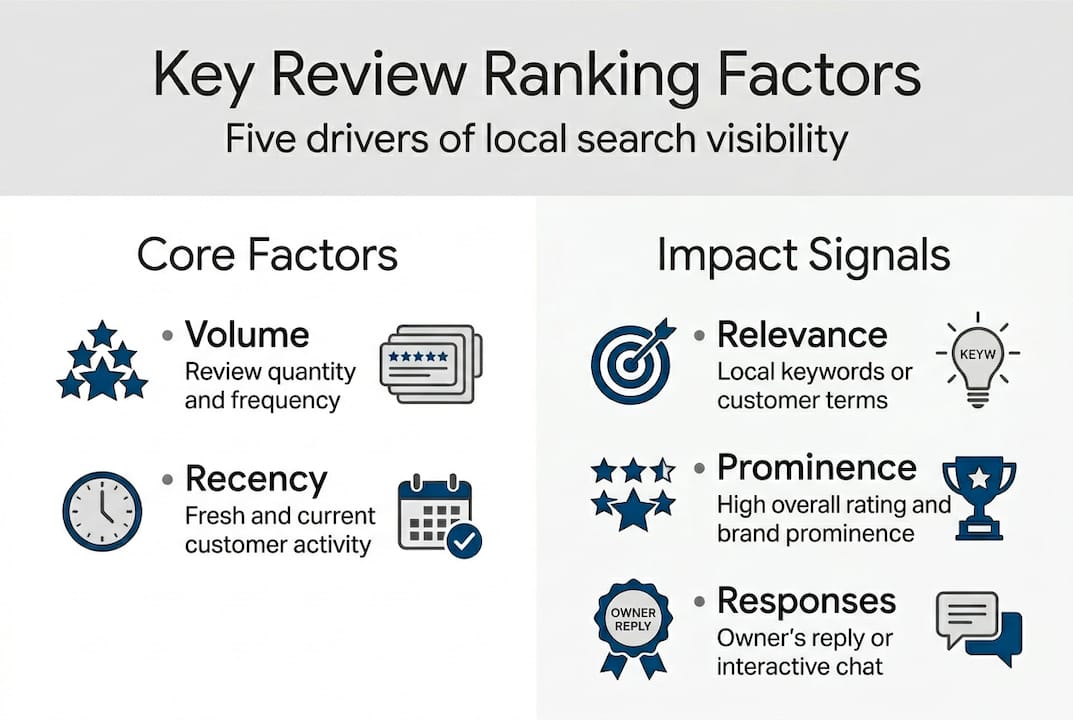
- Volume: More reviews signal an active, trusted business
- Rating average: Higher scores improve click-through rates and ranking weight
- Recency: Fresh reviews tell Google your business is currently operational
- Keyword relevance: Customer language reinforces your service categories
- Response rate: Responding to reviews signals engagement to the algorithm
As Moz notes, the influence of reviews on SEO goes beyond simple star ratings. Review signals work together with your Google Business Profile completeness, local citations, and on-page SEO to create a composite picture of your business's authority. No single factor wins alone, but reviews are one of the few ranking signals you can actively grow every week.
The key elements of a review profile that drive SEO
Not every review carries the same weight, and understanding the anatomy of a strong review profile helps you focus your energy where it counts. Recent reviews, review diversity, and response rates all influence SEO, so you need to think about your profile as a living asset, not a static score.

Here's how the most important review elements compare for SEO impact versus customer impact:
| Review element | SEO impact | Customer impact |
|---|---|---|
| Volume | High | Medium |
| Recency | High | High |
| Average rating | High | Very high |
| Keyword usage | Medium-high | Low |
| Platform diversity | Medium | Medium |
| Owner response rate | Medium | Very high |
The local SEO elements that drive rankings aren't always the ones customers notice first. Customers care about your star rating and whether you responded to complaints. Search engines care about all of that, plus how often reviews come in and whether they appear on multiple platforms.
Here's how to optimize each element of your review profile:
- Boost volume consistently. Set a monthly goal for new reviews. Even five to ten new reviews per month compounds over time into a substantial profile.
- Prioritize recency. A review from three years ago counts less than one from last week. Build review requests into your regular customer touchpoints so the flow never stops.
- Improve your average rating. Address service issues before they become bad reviews. A proactive follow-up call after a job is done can prevent a frustrated customer from going straight to Google.
- Diversify your platforms. Don't rely only on Google. Encourage reviews on Yelp, Facebook, and any industry-specific directories relevant to your field. This builds what SEO professionals call "prominence" across the web.
- Increase your response rate. Aim to respond to every review within 48 hours. Google notices active management, and customers do too.
Pro Tip: When asking customers for a review, gently suggest they mention the specific service they received. A review that says "fantastic HVAC tune-up" does more SEO work than one that just says "great service." You can't write their review, but you can guide the conversation naturally.
How to earn high-impact reviews for local SEO
With the core elements in mind, here's how to actively build a review profile that works for your SEO goals.
Actively requesting reviews and simplifying the process increases both the volume and frequency of feedback you receive. Most satisfied customers simply don't think to leave a review unless you ask. The good news is that asking doesn't have to feel awkward.
Effective ways to ask for reviews:
- In person: Train your team to mention reviews at the end of a positive interaction. A simple "We'd really appreciate a Google review if you have a moment" goes a long way.
- Post-purchase email: Send a follow-up email within 24 to 48 hours of a completed service. Include a direct link to your Google review page.
- SMS requests: Text messages have much higher open rates than email. A short, friendly text with a review link is one of the most effective tactics available.
- Signage: Place a QR code at your counter, on receipts, or on business cards that links directly to your review page.
- Automated sequences: Use CRM tools or review management software to schedule follow-up requests automatically after a transaction closes.
Automation is a game-changer for consistency. When review requests happen automatically, you stop relying on memory and start building a steady stream of feedback.
One critical caution: avoid review gating, incentives, or fake reviews. Incentivized or fake reviews violate Google policy and can result in your reviews being removed or your profile being penalized. The short-term boost is never worth the long-term damage to your rankings and reputation.
For more on getting found locally, your review strategy needs to work alongside your broader presence efforts, not as a standalone tactic.
Pro Tip: Respond to every review, including negative ones. A thoughtful, professional response to a complaint shows potential customers and Google that you take feedback seriously. It's one of the simplest ways to strengthen both trust and SEO signals simultaneously.
Blending reviews with your broader SEO strategy
Earning reviews is one part; let's look at how to fold review management into a winning SEO strategy for ongoing results.
Businesses that consistently manage their reviews see stronger overall search performance compared to those who treat reviews as an afterthought. The reason is straightforward: review management keeps your business profile active, relevant, and trusted, which are exactly the signals search engines reward.
According to consumer review statistics, 79% of consumers trust online reviews as much as personal recommendations. That number alone should change how you prioritize your review strategy. When reviews carry that much weight with real people, and with algorithms, ignoring them is simply not an option.
Best practices for integrating reviews into your full SEO approach:
- Respond to every review within 48 hours to signal active management and build customer trust
- Integrate review requests into every campaign, whether it's an email newsletter, a social media post, or a post-service follow-up sequence
- Monitor all major review platforms weekly using tools like Google Alerts or dedicated reputation management software
- Share positive reviews on social media to extend their reach and reinforce your brand credibility
- Track measurable outcomes such as increases in Google Business Profile clicks, direction requests, and phone calls after review campaigns
Reviews also connect directly to your content marketing and social media efforts. A glowing customer review can become a testimonial on your website, a social media post, or even a video feature. This kind of content reuse amplifies the value of every review you earn.
For a full picture of how to integrate these tactics, our AI local SEO checklist walks through the steps in detail. And if you want to understand how AI search and reviews are converging, that's a trend worth getting ahead of now.
What most experts miss about reviews and SEO
Most local SEO guides focus on technical fixes: fix your NAP (name, address, phone) consistency, build citations, optimize your Google Business Profile. All of that matters. But the advice rarely goes deep enough on why reviews have become the single most human element of an otherwise technical ranking system.
Here's the uncomfortable truth: you can do everything "right" technically and still lose to a competitor with fewer backlinks but a genuinely warmer, more active review presence. Google's AI is getting better at detecting authenticity. A flood of generic five-star reviews with no detail raises flags. Thoughtful, specific reviews from real customers build something algorithms increasingly recognize: community trust.
Responding to negative reviews thoughtfully is where most businesses miss a real opportunity. A well-handled complaint, visible to anyone who reads your profile, often does more for your reputation than ten positive reviews. It shows you're accountable. It shows you're human. And it signals to Google that your business is actively engaged.
We'd encourage you to stop thinking of review management as a checkbox and start seeing it as an ongoing conversation with your market. That shift in mindset, supported by the emotion in SEO principles that are reshaping rankings, is what separates businesses that grow from those that plateau.
Ready to supercharge your SEO with better reviews?
If you've made it this far, you already understand that reviews are not just a reputation tool. They're a ranking tool. The businesses winning in local search right now are the ones treating review generation and management as a core part of their marketing, not an afterthought.

At Digital Marketing All, we specialize in helping local businesses build review profiles that drive real search visibility. From reputation management to full-scale local advertising solutions, our team combines proven SEO strategies with smart automation to get you results you can measure. Ready to put reviews to work for your rankings? Partner with us and let's build a strategy tailored to your market.
Frequently asked questions
Do negative reviews hurt my SEO ranking?
A few negative reviews typically don't harm your ranking and can actually add credibility by showing authenticity. However, a consistently high proportion of bad reviews can reduce trust signals and deter potential customers, which both positive and mixed reviews are a natural part of a healthy profile.
How quickly do new reviews affect my local SEO?
New reviews can begin to improve your local rankings within a few weeks, since Google updates business profiles frequently. Recency of reviews is a confirmed ranking factor, so a steady flow of fresh feedback matters more than a one-time burst.
Which review sites matter most for local SEO?
Google reviews carry the most direct weight for local search rankings, but Yelp, Facebook, and industry-specific platforms also contribute to your overall prominence. Diversity across platforms strengthens your visibility in multiple channels beyond Google alone.
Is it safe to ask customers for reviews?
Yes, asking for reviews is completely acceptable as long as you follow platform guidelines and never offer incentives or fabricate feedback. Fake or incentivized reviews violate Google's policies and can result in penalties that damage both your profile and your rankings.
Recommended
- Local Search Ranking Factors 2026: Boost Your Visibility | Digital Marketing All
- 7 Local SEO Strategies & AI Tips to Boost Rankings | Digital Marketing All
- Local search power: drive more customers in 2026
- Local SEO Checklist 2026: 40% More Leads with AI Search Optimization
- Hotel-Website Sichtbarkeit: KI-Suchsysteme nutzen 2026