

Most Google Ads management follows one of five pricing models: flat monthly fee, percentage of ad spend, hybrid, hourly, or performance-based. For a typical small to medium-sized business, agency fees run roughly $1,500 to $5,000+ per month, on top of actual ad spend, and first-month setup work can add several thousand dollars more.
TL;DR:
- Flat fee models suit small budgets under $10,000 per month but may offer less attention as costs remain fixed regardless of effort.
- Hybrid and percentage-based models become more appropriate for accounts exceeding $15,000 monthly, aligning management costs with growth and scale.
- Managing expectations around setup costs, ongoing creative expenses, and clear scope of work can prevent surprise invoices and hidden charges.
- For spends under $3,000, DIY or freelancer management is usually more cost-effective than agency retainers; larger budgets benefit from multi-channel, dedicated agency services.
- Accurate tracking infrastructure and results-based attribution are crucial for fair pricing and maximizing return on ad spend.
Table of Contents
- What Are the Main Google Ads Pricing Models?
- How Much Does Google Ads Management Cost by Provider Type?
- What's Included in a Google Ads Management Package?
- How Do You Choose the Right Pricing Model?
- What Do Real Google Ads Budgets Look Like?
- Why Experience and Tracking Infrastructure Change the Math
- A Practical Take on Hiring for Google Ads
- Ready to Stop Guessing on Your Ad Budget?
- Sources
- FAQ
What Are the Main Google Ads Pricing Models?
Every quote you get for Google Ads management traces back to one of five structures. Understanding how each one calculates your bill tells you what incentive you're actually paying for.
Flat fee. You pay a fixed monthly amount regardless of how much you spend on ads. A local HVAC company spending $3,000/month might pay a $1,200 flat fee for management, no matter whether the agency spends 10 hours or 25 hours on the account that month. This model is predictable and easy to budget, but it can mean less hands-on attention once you're locked in, since the agency's revenue doesn't grow with your results.
This model aligns incentives somewhat (the agency wants you spending more), but that alignment can backfire. Percentage-based fees sometimes push agencies to recommend higher budgets than your business actually needs, especially once you cross into diminishing returns.
Hybrid. A base retainer plus a smaller percentage cut, often used to balance predictability with scalability. Hybrid structures are common once an account grows past small-budget territory, giving the agency a fee floor while still rewarding growth.
Hourly. You pay for actual time worked, usually $75 to $250+ per hour depending on the provider's experience level. This suits businesses with narrow, well-defined needs, like a one-time account audit or a seasonal campaign refresh, rather than ongoing management.
Performance-based. Fees tied to results, such as cost-per-lead targets or a share of revenue generated. This model sounds appealing on paper, but it requires airtight tracking to work fairly for both sides, and it's the least common structure for standard account management.
Here's how the five stack up for a typical SMB:
- Flat fee: Best for stable, predictable budgets under $10,000/month where you want cost certainty.
- Percentage of spend: Best for larger budgets ($15,000+/month) where scaling fees make sense for both sides.
- Hybrid: Best for growing accounts that need a fee floor plus upside alignment.
- Hourly: Best for narrow, project-based work like audits or one-time setup.
- Performance-based: Best only when tracking and attribution are already solid.
How Much Does Google Ads Management Cost by Provider Type?
Fee bands shift dramatically depending on who's managing your account, and matching provider type to your ad-spend tier is the single biggest lever you control.
Freelancers typically charge a few hundred to a few thousand dollars per month, making them the most economical option for businesses just getting started or running lean budgets under $3,000/month in ad spend. Small agencies sit above that, usually building in more process and reporting infrastructure. Mid-market agencies bring dedicated strategists and often minimum monthly spend requirements. Enterprise firms charge the most but bring dedicated teams, custom dashboards, and multi-channel integration that smaller operators can't match.
Run the math against real budgets and the pattern gets clearer. At $1,000/month ad spend, a freelancer or DIY approach usually makes more sense than an agency, since most agencies won't take an account that small, and management fees would eat too much of the budget. At $5,000/month, a small agency charging a flat fee of roughly $1,000 to $1,500 fits well. At $15,000/month, you're in mid-market territory, where a hybrid model, maybe a $1,500 base plus a smaller percentage, starts to make sense. At $50,000/month, enterprise-level service with dedicated account teams becomes worth the premium, since the fee percentage often drops as spend scales.
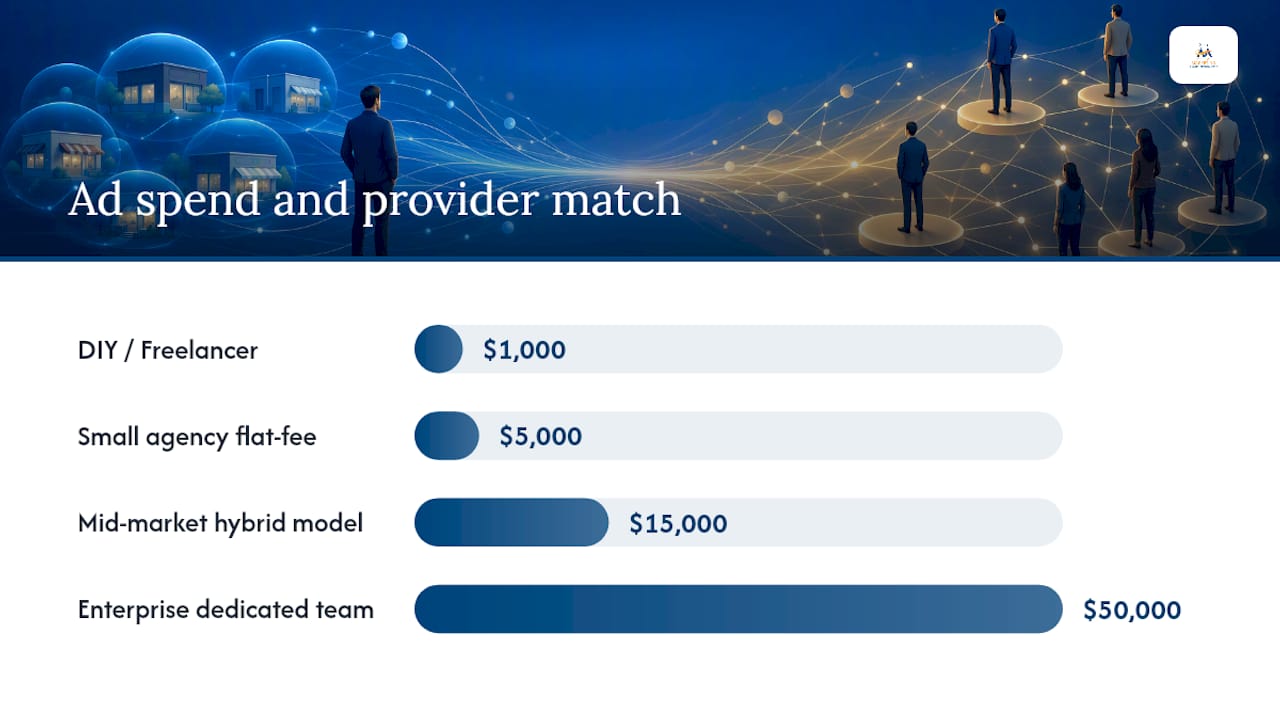
Agency minimums matter here too. Many agencies won't onboard an account below $2,500 to $3,000 in monthly ad spend, because the labor to manage it properly doesn't pencil out at a low percentage fee. If you're under that threshold, a freelancer or an in-house hire will almost always be more economical than an agency retainer.
What's Included in a Google Ads Management Package?
A management retainer typically covers account setup, ongoing bid and budget optimization, ad copy testing, keyword refinement, and a recurring reporting cadence, usually weekly check-ins with a monthly deep-dive report. What it often does not cover is where SMBs get surprised.
Standard inclusions usually look like this:
- Initial account audit and campaign structure setup
- Daily or weekly bid and budget monitoring
- Ad copy and extension testing
- Negative keyword management
- Monthly performance reporting and strategy calls
Pro Tip: Ask for a written scope of work before signing anything. If "reporting" isn't defined by frequency and format, you'll likely get a generic dashboard link instead of a real strategy conversation.
One-time setup costs are the most common surprise. Server-side tagging, Enhanced Conversions, and GA4-to-BigQuery pipelines commonly cost thousands of dollars as separate project fees, and most agencies don't fold this into the monthly retainer. If your current tracking setup is outdated, expect this as a line item in your first invoice.
Ongoing add-ons pile up too. Tooling subscriptions and creative production frequently run $100 to $1,500 per month, depending on how much fresh ad creative and landing page work your account needs. A business running seasonal promotions will burn through creative budget faster than one running evergreen search campaigns. Landing page builds, if not already covered by an in-house web team, often run as separate quotes per page rather than a flat monthly rate. Understanding what to budget for Google Ads overall before you start shopping for a provider prevents sticker shock once the real invoice arrives.
How Do You Choose the Right Pricing Model?
Your decision should hinge on four factors: your monthly ad spend, how many channels you're running, whether you need ongoing creative and landing page work, and how much you can handle in-house.
If your budget is under $5,000/month and your needs are narrow, a flat fee from a freelancer or small agency keeps costs predictable. If you're scaling past $15,000/month across search, shopping, and display, a hybrid or percentage model starts making more sense, since the labor required genuinely grows with the account. If you have strong in-house creative and analytics support already, you may only need hourly strategic guidance rather than full management.
Before signing with any provider, ask these questions directly:
- How exactly is the fee calculated, and does it change if my ad spend changes?
- What's included in the monthly fee versus billed separately (setup, creative, landing pages)?
- Is there a minimum monthly ad spend or contract length required?
- How often will I receive reports, and what metrics will they include?
- What attribution model and conversion window do you use for reporting results?
- What happens if I want to terminate the contract, and what's the notice period?
- Who owns the ad account and historical data if we part ways?
Watch for red flags during this conversation. An agency that won't specify what's included, that dodges questions about attribution windows, or that requires a 12-month contract with no early exit is worth a second look. A clear understanding of retainer structures before you sign protects you from vague scopes that balloon into surprise invoices.
What Do Real Google Ads Budgets Look Like?
Numbers on a fee schedule only mean so much until you see them applied to an actual business situation. Here's how the math plays out across common SMB scenarios.
- A local service business spending $1,500/month on ads: DIY management or a low-cost freelancer at $500 to $800/month makes the most sense here, since agency minimums typically exceed this budget entirely.
- A growing SMB spending $8,000/month across search and shopping: A small agency on a flat fee of $1,200 to $1,800/month, plus modest tooling costs of $100 to $200/month, brings the all-in total to roughly $9,300 to $10,000.
- An established multi-location business spending $25,000/month: A mid-market agency on a hybrid model, say a $2,000 base plus 8%, runs about $4,000/month in fees, plus creative and landing page work in the $500 to $1,000 range.
- An ecommerce brand spending $60,000/month across multiple channels: Enterprise-level service at 8% to 12% of spend, roughly $4,800 to $7,200/month, often justified by dedicated account teams and custom attribution builds.
The trigger point for switching providers is usually growth-driven. Once your ad spend outpaces what your current freelancer or small agency can strategically manage, or once you need multi-channel coordination beyond Google Ads alone, it's time to move up a tier. Reducing wasted spend through better tracking often matters more at this stage than simply paying for a bigger name.
Why Experience and Tracking Infrastructure Change the Math
Poor tracking is the single biggest driver of wasted ad spend, regardless of which pricing model you choose. Digital Marketing All builds campaigns on AI-enabled optimization and proper attribution infrastructure from day one, which means budget goes toward qualified leads instead of guesswork. For local and national businesses alike, that combination of experience and clean data typically means a full-service agency earns back its fee through reduced waste, not just added convenience. When your tracking is solid, a percentage-based or hybrid fee becomes fair for both sides instead of a gamble.
A Practical Take on Hiring for Google Ads
Most businesses under $3,000/month in ad spend are better off DIY or with a freelancer. Once you cross into multi-channel territory or need dedicated strategy, an agency retainer starts paying for itself.
Whoever you hire, run a 3 to 6 month trial with clear terms: weekly reporting, defined conversion metrics, and a written scope. Judge early results by lead quality and cost-per-acquisition trends, not just impressions or clicks.
— Diane O'Brien
Ready to Stop Guessing on Your Ad Budget?
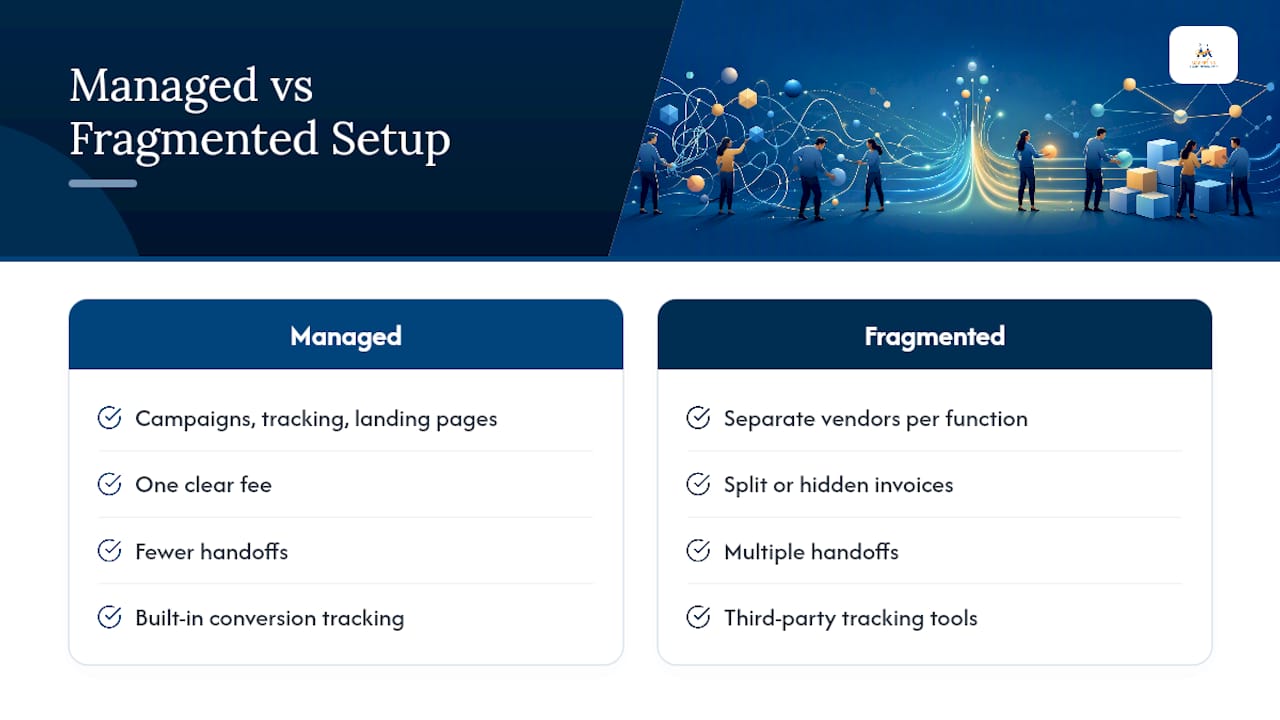
Digital Marketing All manages Google Ads with the tracking infrastructure and reporting transparency this guide just walked you through, so you're not stuck reverse-engineering hidden fees after the fact. Instead of piecing together a freelancer for strategy, another vendor for landing pages, and a third tool for tracking, you get managed campaigns, conversion tracking, and landing page optimization under one roof and one clear fee structure. That means fewer handoffs, fewer surprise invoices, and a team that already understands how attribution windows and Enhanced Conversions affect your reported results.
If you want a straightforward starting point, book time with our team for an initial account audit. You'll get a clear breakdown of what your current setup is costing you and what a properly managed account should run, before you commit to anything.
Sources
The fee ranges and pricing-model breakdowns in this guide draw from current market research on agency and freelancer pricing, including agency fee benchmarks for 2026, freelancer versus agency cost comparisons, and agency pricing structure analysis. For agency vetting, the 11-question checklist for choosing a Google Ads agency covers fee transparency and contract terms in more depth.
For deeper budget planning, see our own breakdown of Google Ads costs for U.S. SMBs, our comparison of PPC management software and agencies, and a third-party glossary on percentage-of-spend pricing if you want an outside definition of that model.
- Google Ads Management Cost 2026: How Much to Pay Agencies
- Google Ads Management Cost: Agency Vs Freelancer Vs DIY (2026 Prices)
- How to Choose a Google Ads Agency: 11 Questions to Ask | COREPPC
FAQ
How Much Should I Budget for Google Ads Management?
Most SMBs should budget $1,500 to $5,000+ per month for agency management, or $500 to $3,000 for a freelancer, on top of actual ad spend.
Is a Flat Fee or Percentage of Spend Better for Small Businesses?
A flat fee is usually better for accounts under $15,000/month in ad spend because it keeps costs predictable, while percentage-of-spend models tend to fit larger budgets where fees scale fairly with account complexity.
What Hidden Costs Should I Watch for in Google Ads Pricing?
The most common hidden costs are one-time setup fees for tracking infrastructure like server-side tagging and Enhanced Conversions, plus ongoing charges for creative production and landing pages that aren't always included in the base retainer.
How Long Before I See Results From a New Google Ads Provider?
Most accounts need 30 days for meaningful optimization data to accumulate, though a proper 3 to 6 month trial period gives a clearer picture of sustained performance.
Can I Negotiate Google Ads Management Fees?
Yes. Agencies often have flexibility on percentage rates for larger budgets, contract length in exchange for lower fees, and bundled pricing when you combine services like tracking setup or landing pages with ongoing management, which is one reason a full-service provider like Digital Marketing All can offer more competitive all-in pricing than piecing together separate vendors.