

Brand mentions help SEO by strengthening the entity and topical signals that both Google and AI platforms use to decide who to cite, whether the mention carries a link or not. They are not a replacement for backlinks. They are a parallel signal, and in 2026, they are arguably the faster-growing one, since AI-generated answers draw heavily on descriptive, third-party context rather than raw link equity.
The evidence is correlational, not causal. An analysis of 410,000 brand mentions found that contextual, descriptive mentions track closely with AI answer presence, but nobody has proven that adding mentions directly causes a ranking or citation bump. Treat it as a strong, actionable pattern rather than a guaranteed lever.
Here's what to run this week:
- Run an unlinked-mention audit. Search your brand name in quotes, minus your own domain and major social platforms, and see what's already out there uncredited.
- Set up alerts today. A free Google Alert plus a paid tool like Semrush or Ahrefs catches new mentions as they publish.
- Draft one original data asset. A small proprietary study or survey gives journalists and bloggers a reason to name you.
- Shortlist three recent unlinked mentions on high-authority pages and start outreach this week.
Pro Tip: Expect early wins in mention volume and sentiment within 30 to 60 days. Backlink conversions and measurable AI-visibility shifts usually take several months to show up.
Key Takeaways
Brand mentions strengthen entity and AI-visibility signals through context and placement, and they convert into backlinks fastest when outreach is prioritized and timed well.
| Point | Details |
|---|---|
| Mentions complement links | Treat brand mentions as a parallel signal to backlinks, not a substitute for them. |
| Context beats volume | Descriptive mentions near category terms correlate more strongly with AI visibility than raw mention counts. |
| Prioritize before outreach | Filter unlinked mentions by authority, traffic, sentiment, freshness, and relationship potential before contacting anyone. |
| Track more than the exact name | Monitor product names, founder names, and misspellings to catch implied mentions standard alerts miss. |
| Reviews feed the pipeline | Digital Marketing All's review-generation service supports mention volume by keeping positive, descriptive mentions flowing. |
Table of Contents
- What Counts as a Brand Mention in SEO?
- How Search Engines and LLMs Actually Process Brand Mentions
- Four Ways to Earn High-Value Brand Mentions
- Building a Monitoring Stack That Catches Every Mention
- Which Unlinked Mentions Are Worth Chasing?
- How to Measure a Brand Mention Program
- A Repeatable Workflow for Brand-Mention Programs
- Why Most Teams Are Still Fighting the Wrong Battle
- Get More Out of Every Mention With Digital Marketing All
- Sources
- FAQ
What Counts as a Brand Mention in SEO?
A brand mention is any reference to your company, product, or founder that appears online, whether or not it links back to you. For brand mentions SEO purposes, four types matter, and they don't all carry the same weight.
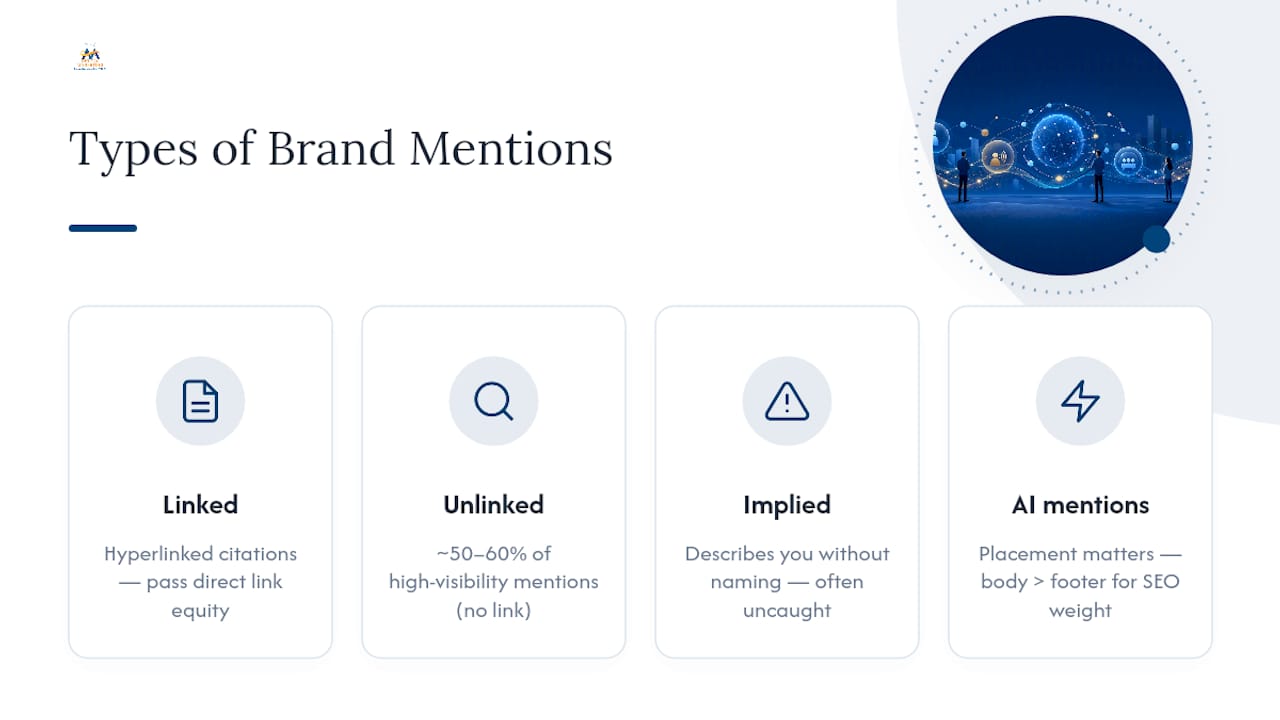
Linked mentions are the classic case: a news article cites your company and hyperlinks to your site. These pass direct link equity and remain valuable for traditional ranking signals.
Unlinked mentions name your brand in text with no hyperlink. A blog post might write "tools like [Your Brand] handle this well" without ever linking out. According to guidance from Search Engine Land, unlinked mentions make up roughly 50 to 60% of high-visibility brand references, while linked mentions account for only 25 to 35% of what most monitoring tools observe. That gap is the entire reason unlinked-mention outreach exists as a discipline.
Implied mentions skip the brand name entirely. A forum thread describing "the review-management agency with the AI-powered autosuggest tool" is talking about you without naming you, and most monitoring tools won't catch it. Track product names, founder names, and common misspellings alongside your exact brand string to close this gap.
AI mentions happen when a chatbot cites your brand in a generated answer, sourced from any of the above. Placement matters here more than anywhere else: a name buried in a footer or byline carries far less weight than one embedded in the main body, next to the descriptive category terms an AI model uses to decide who's relevant.
How Search Engines and LLMs Actually Process Brand Mentions
Google and AI models don't read a brand mention the way a link-counting algorithm reads a backlink. They read it as evidence for entity recognition, the process of matching a name to a specific, real-world thing in a knowledge graph, then reinforcing that thing's associated topics and categories.
Every time a third party describes your brand in the same sentence as "local SEO agency" or "AI visibility tools," that phrase strengthens the topical association search engines and language models attach to your entity. Do it often enough, across high-authority sources, and you start showing up when someone asks an AI platform to recommend options in that category.
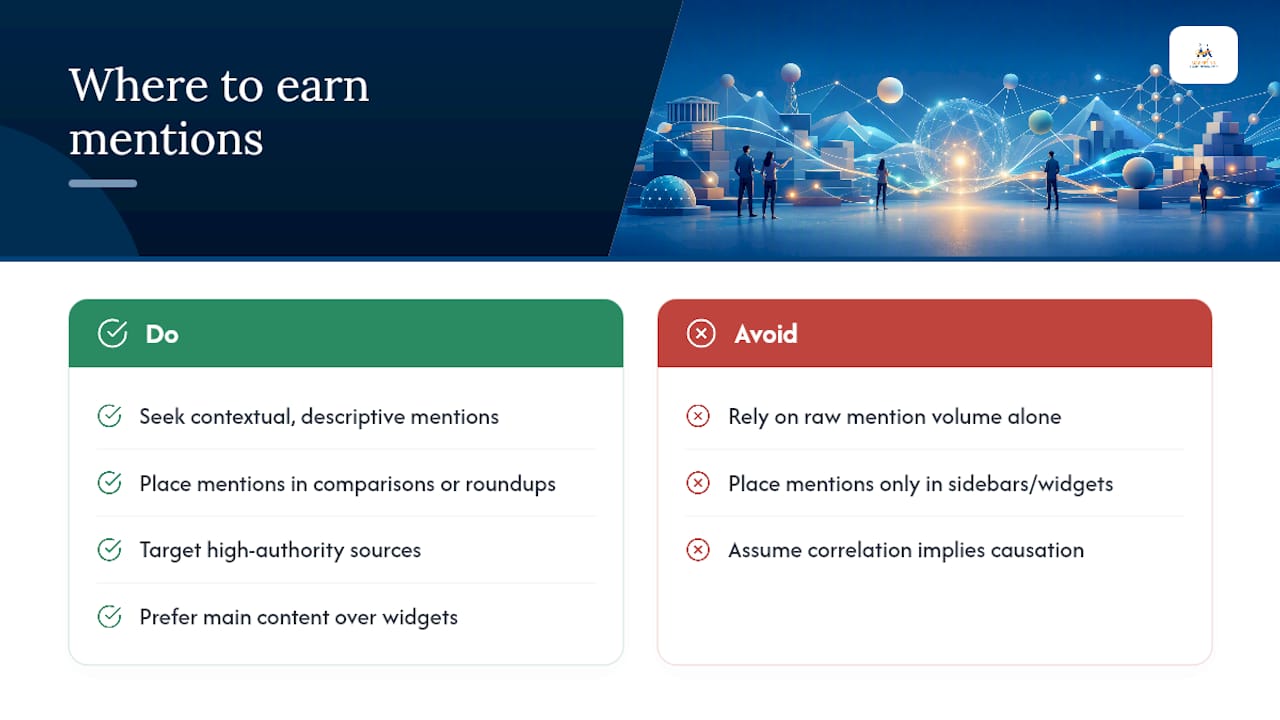
Contextual, descriptive mentions correlate more closely with AI answer inclusion than raw mention volume does. A brand named a hundred times in shallow, generic contexts can lose out to one named a dozen times inside detailed, comparison-style content.
That's the core finding from the BrandMentions analysis of 410,000 mentions, and it should reshape how you think about "more is better." Volume alone doesn't move the needle; context does.
Two caveats deserve attention before you overreact to any of this. First, correlation studies like this one can't isolate mentions from the dozens of other signals moving alongside them, so a spike in AI visibility that follows a mention surge might share causes with that surge rather than being caused by it. Second, Search Engine Land's guide to brand mentions notes that unlinked mentions are still processed as authority signals independent of whether they ever convert to a link, meaning the mention itself does work even before any outreach happens.
The practical takeaway: chase mentions placed in main content, ideally inside comparisons, roundups, or explainer paragraphs where your brand sits next to the category terms you want to rank and get cited for. A mention in a "best tools for X" listicle beats ten mentions in unrelated sidebar widgets.
Four Ways to Earn High-Value Brand Mentions
Not all mention-earning tactics deserve equal budget. Rank these by the leverage they generate relative to the effort they take.
-
Publish original research or a citable data asset. Nothing earns descriptive, in-context mentions faster than a number nobody else has. Run a small survey among your client base, pull an anonymized trend from your own campaign data, or aggregate a public dataset into a fresh angle. Package it as a single-page findings summary with one headline statistic, a chart, and a plain-English takeaway journalists can lift in thirty seconds. This is the highest-leverage tactic on the list because one well-placed study can generate dozens of mentions over its lifespan, not just one.
-
Build co-created assets with partners. Pairing up with a complementary business (a web designer, a CRM vendor, a local chamber of commerce) on a joint webinar, template, or checklist doubles your mention surface, since both partners' audiences and press contacts get pitched. A short outreach plan: draft the asset together, agree on a two-week promotion window, and have each partner pitch it to their own media list separately rather than jointly, which multiplies unique placements.
-
Feature experts, customers, and guest voices. Naming a real customer or industry expert in a case study, interview, or roundup gives that person a reason to share it, and their share pulls in secondary mentions from their own network. Ask contributors to link back from their own bio or company page. It costs almost nothing and pays in both mentions and social amplification.
-
Run targeted digital PR outreach. Pitch journalists directly, and use a source-matching service like HARO's successor Connectively to respond to reporter queries with expert quotes. Keep pitches under 100 words: name the data point or angle, why it's timely, and one line of credibility. Editorial mentions from an established outlet carry disproportionate weight, since a single high-authority citation can outweigh multiple self-published pages for AI overview inclusion.
Pro Tip: Pair tactic one with tactic four. A data asset with nowhere to land is wasted effort; give your research a home before you build it, by lining up a journalist contact or partner willing to cover it on publication day.
Building a Monitoring Stack That Catches Every Mention
Most teams monitor for their exact brand name and stop there, which means they miss most of what's actually said about them. A three-layer stack closes that gap without requiring an enterprise budget.
Layer one: free alerts and manual searches. Set up Google Alerts for your brand name, product names, and founder names. Supplement with manual quoted searches using operators like "Digital Marketing All" -site:digitalmarketingall.org -site:twitter.com -site:facebook.com, which surfaces third-party mentions while filtering out your own properties and social noise.
Layer two: social listening. Alerts miss most social platforms and forums. A dedicated listening tool catches Reddit threads, LinkedIn posts, and niche community mentions that never get indexed the same way blog content does.
Layer three: backlink and mention databases. Tools like Semrush and Ahrefs combine mention discovery with authority metrics, letting you see a mention and its source's domain strength in one view. Semrush's brand mention guide recommends this combined approach specifically because no single tool covers linked mentions, unlinked mentions, and AI mentions completely on its own.
A few operator habits make the biggest difference in what you actually find:
- Track product names and founder names separately from the brand string; a founder quoted by name in a trade article is a mention your alert setup will otherwise miss.
- Search common misspellings and abbreviated versions of your brand name.
- Exclude your own domain and major social platforms from every search to cut noise.
Pro Tip: Once mentions come in, route them through a simple triage tag: "PR" for press-worthy context, "SEO" for outreach-ready unlinked mentions, and "community" for forum or review-site activity that needs a reputation response rather than a backlink pitch.
Which Unlinked Mentions Are Worth Chasing?
Not every unlinked mention deserves an outreach email. Chasing all of them burns time on placements that will never move a metric, so filter first.
- Authority. Prioritize domains with genuine topical relevance and strong backlink profiles over high traffic alone.
- Page traffic. A mention on a low-authority page that still pulls meaningful search traffic is worth more than a high-authority page nobody visits.
- Sentiment and context. A mention inside a genuine comparison or recommendation converts to outreach success far more often than a mention buried in a passing list.
- Freshness. Recently published content is more likely to still be actively edited, and site owners are more responsive to update requests soon after publishing.
- Relationship potential. A site you can build a recurring relationship with, for future mentions or guest contributions, outranks a one-off placement even if the one-off has slightly higher authority.
Outreach timing matters almost as much as the target you pick. Reach out within one to two weeks of finding the mention, while it's still fresh in the author's mind. Keep the message under 100 words: name the specific article, thank them for the mention, and ask plainly if they'd consider adding a link. Practitioner data from qualified outreach programs shows conversion rates between 25% and 50% for well-targeted requests, a sharp contrast to the low single digits typical of cold link-building outreach.
Skip mentions that fail two or more filters, especially low-authority pages with negative or neutral sentiment. Log every outreach attempt, whether it converts or not, with the domain, date contacted, and outcome. That log becomes the data you use to refine your prioritization criteria every quarter.
How to Measure a Brand Mention Program
Brand mention tracking only earns its budget if you report on it with the right metrics and resist the urge to claim more causation than the data supports.
Five KPIs cover the program well:
- Mention volume by source type, split between news, blogs, forums, and social, so you can see where your program is gaining traction.
- Authority-weighted mentions, which counts a mention on a high-domain-authority page differently than one on an obscure blog.
- Backlink conversion rate, the share of unlinked mentions that become linked mentions after outreach.
- Sentiment trend, tracked over time rather than as a single snapshot.
- AI mention checks, meaning direct prompt tests across major AI platforms to see whether your brand shows up in generated answers for target queries. Semrush's monitoring guidance recommends running these prompt checks on a recurring schedule rather than once, since AI answers shift as models update.
On attribution, be honest with stakeholders: a rise in mentions alongside a rise in organic traffic is a trend correlation, not proof. The strongest approach available to most teams is a pre/post comparison window around a specific campaign, such as a data-asset launch, paired with a note on what else changed during that period. True controlled experiments are rare outside large enterprises with dedicated data science support.
Report monthly for operational tracking and quarterly for executive dashboards, pairing a simple mention-volume line chart with a short table of the highest-value conversions from that period.
A Repeatable Workflow for Brand-Mention Programs
Running a brand-mention program well comes down to a five-stage loop: monitor, prioritize, reach out, convert, and measure. Each stage benefits from a clear owner, whether that's a dedicated SEO specialist, a PR lead, or a hybrid marketing generalist handling all five at a smaller company.
- Monitor: one person owns the alert and listening-tool setup, checking weekly.
- Prioritize: apply the five-filter rubric before any outreach goes out.
- Reach out: short, specific requests sent within two weeks of discovery.
- Convert: track link additions and log every response.
- Measure: report the five core KPIs on a fixed monthly or quarterly cadence.
Review generation ties directly into this loop. A steady stream of positive, detailed customer reviews on Google and industry directories generates a form of brand mention that's both easy to earn and highly credible to AI models scanning for sentiment and third-party validation. Digital Marketing All's review-generation and management service is built around exactly this gap, giving teams a structured way to keep positive, descriptive mentions flowing without relying solely on press hits.
| Stage | What it delivers |
|---|---|
| Monitor | Full visibility into linked, unlinked, and implied mentions across the web |
| Prioritize | A shortlist of mentions worth the outreach effort |
| Convert | Backlinks and stronger entity association from qualified placements |
| Measure | Defensible reporting that separates correlation from proof |
Why Most Teams Are Still Fighting the Wrong Battle
Most brand-mention advice still frames the whole exercise as link building with extra steps: find a mention, get a link, move on. That misses what's actually changed. AI platforms don't care whether a mention links anywhere; they care whether the surrounding text describes what you do clearly enough to extract and cite. A program built entirely around backlink conversion rates will chase the wrong mentions and ignore the implied, unlinked ones doing the real entity-building work.
The correlation-not-causation caveat isn't a hedge to skip past. It changes what you should actually spend on. If mentions caused AI visibility directly, you'd chase volume. Since the real pattern is about context and placement, the better bet is fewer, more descriptive mentions in comparison-style content over a flood of shallow name-drops. That's a smaller, more disciplined program, and it's uncomfortable for teams used to reporting raw mention counts as a win.
Reviews are the most underused lever here. They're descriptive, third-party, and constantly refreshed, exactly the traits that correlate with AI citation. Treat review generation as a mention-acquisition channel, not just a reputation task, and the program gets stronger without adding a single press pitch.
— Diane O'Brien
Get More Out of Every Mention With Digital Marketing All
Building a mention-earning program from scratch takes a research asset, an outreach cadence, and a steady stream of fresh third-party content, resources many in-house marketing teams stretch to cover alongside everything else on their plate. Digital Marketing All's review generation and management service gives you a done-for-you way to keep descriptive, positive brand mentions flowing on Google and industry directories without building that pipeline yourself.
It suits small and midsize businesses that already understand the value of brand mentions but don't have a dedicated PR or outreach team to chase them consistently. Since reviews are among the fastest-earned, most AI-legible mention types available, this service pairs naturally with the monitoring and outreach workflow outlined above. If you're ready to turn customer sentiment into a steady mention stream, start by requesting a review-generation audit from Digital Marketing All to see where your current gaps are.
Sources
- Do Brand Mentions Influence AI Visibility? 2026 Data
- How to harness the power of brand mentions across the search universe
- Unlinked Mentions: How to Find Them and Turn Them Into Backlinks (2026)
- Brand Mentions: Complete Guide to Tracking, Measuring & Optimizing
FAQ
What Are Brand Mentions in Off-Page SEO?
Brand mentions are any reference to your company, product, or founder that appears on a third-party website, whether linked or unlinked, and off-page SEO treats them as an entity and authority signal separate from traditional backlinks.
How Do You Increase Brand Mentions?
Publish original research or data assets, feature real customers and experts by name, pursue co-created content with partners, and run targeted digital PR outreach to journalists and source-matching services like Connectively.
How Should You Use Brand Mentions Once You Find Them?
Prioritize unlinked mentions using authority, traffic, sentiment, freshness, and relationship potential, then reach out within one to two weeks with a short, specific request to add a link.
Do Brand Mentions Help With AI Visibility Specifically?
Yes. Descriptive, context-rich mentions correlate strongly with AI answer inclusion, though the relationship is correlational rather than proven causal, so context and placement matter more than raw mention counts.
Can Digital Marketing All Help Generate More Brand Mentions?
Digital Marketing All's review-generation and management service helps businesses build a steady stream of descriptive, positive mentions across Google and directory listings, complementing PR and outreach efforts.