

TL;DR:
- Customer reviews are vital ranking factors influencing local search visibility and click-through rates.
- Encouraging keyword-rich reviews and adding schema markup maximize review impact on SEO.
- Consistent review collection, prompt responses, and review quality improve local search rankings actively.
Most local business owners treat customer reviews as a reputation tool, something that sways new customers but has nothing to do with where your business shows up on Google. That assumption is costing you visibility. Customer reviews are a core ranking factor for local search, directly influencing whether you appear in Google's local pack, on Google Maps, and in broader organic results. This article breaks down exactly how reviews shape your rankings, what signals search engines actually measure, and what you can do today to turn your review strategy into a powerful local SEO advantage.
Table of Contents
- Why customer reviews matter for local SEO
- How search engines use review signals
- Maximizing review value: Keywords and structured data
- Reputation management: Building and maintaining a review strategy
- What most businesses miss: The hidden power of review quality and velocity
- Supercharge your reviews and local rankings
- Frequently asked questions
Key Takeaways
| Point | Details |
|---|---|
| Reviews drive local search visibility | High-quality, recent reviews directly influence where your business appears in local Google searches. |
| Optimize with keywords and schema | Encourage customer keyword use and implement structured data for richer search listings and more clicks. |
| Respond fast and monitor competitors | Engage with new reviews quickly and track your review presence compared to local competitors for best SEO results. |
| Consistency beats volume alone | Steady review velocity and genuine responses build trust and outperform sporadic review spikes over time. |
Why customer reviews matter for local SEO
If you've ever wondered why one business consistently shows up at the top of local search results while a competitor with a better product sits buried below, reviews are often a major part of the answer. Google's algorithm for local rankings rewards businesses that demonstrate trust, relevance, and engagement. Reviews do all three simultaneously.
Reviews feed directly into Google's proximity, relevance, and prominence signals, the three pillars that determine your local pack placement. Prominence, in particular, is heavily influenced by your review profile. A business with 200 reviews averaging 4.7 stars sends a very different signal than one with 12 reviews at 3.9 stars.
But reviews don't just help with rankings. They also directly affect how many searchers actually click on your listing. A strong star rating and a healthy review count increase click-through rates, which in turn sends Google more positive engagement signals. It's a reinforcing cycle.
Here are the core review factors that influence your local SEO performance:
- Review quantity: The total number of reviews your business has across key platforms.
- Review quality: Your average star rating and the depth of feedback customers leave.
- Review velocity: How frequently new reviews are coming in. A steady stream signals an active, credible business.
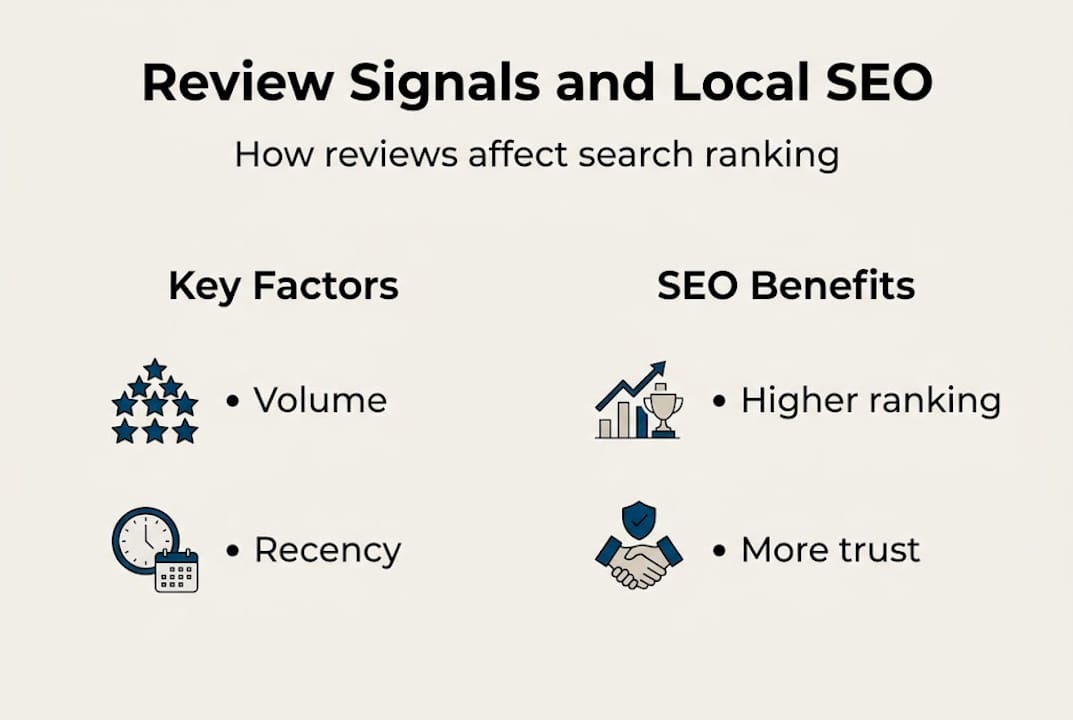
- Review recency: Recent reviews carry more weight than older ones. A review from last week matters more than one from two years ago.
- Owner responses: Responding to reviews tells Google your business is engaged, which supports your prominence signal.
"Reviews are not just social proof. They are active ranking signals that Google uses to evaluate how much trust and attention your business deserves in local search."
For a deeper look at how to build your local presence from the ground up, the local SEO guide covers the full picture. And if you want to understand what separates top-ranked Google Business Profiles from the rest, explore these GBP ranking secrets that most businesses overlook.
How search engines use review signals
Knowing that reviews matter is one thing. Understanding exactly what Google measures gives you a real competitive edge. Google doesn't just count stars. It reads your reviews, tracks patterns over time, and compares your profile against competitors in your area.

The four primary signals Google evaluates are volume, rating, recency or velocity, and keyword content. Volume sets a baseline of credibility. Rating reflects overall customer satisfaction. Recency and velocity tell Google whether your business is actively serving customers right now. Keyword content is the most overlooked signal of the four. When customers naturally use words like "best plumber in Denver" or "fast HVAC repair" in their reviews, Google reads those keywords and connects your business to those search queries.
Here's a comparison that shows the difference review signals can make:
| Factor | Business A (Strong reviews) | Business B (Weak reviews) |
|---|---|---|
| Total reviews | 180+ | 22 |
| Average rating | 4.8 stars | 3.7 stars |
| Reviews in last 30 days | 12 | 1 |
| Keyword mentions | Frequent | Rare |
| Owner responses | Consistent | Occasional |
| Local pack visibility | High | Low |
The gap is clear. Business A doesn't just look better to customers. It looks better to Google's algorithm. Benchmark reviews consistently and track how your numbers compare to nearby competitors on a monthly basis.
Google also uses the "Newest" sort in its review display, which means recent reviews appear prominently. This is why velocity matters as much as volume. Getting 10 reviews this month is more valuable than sitting on 50 reviews from three years ago.
Pro Tip: Set up your Google Business Profile properly from the start. A fully optimized profile amplifies every review signal you generate. Also stay current with latest GBP updates so algorithm changes don't catch you off guard.
Maximizing review value: Keywords and structured data
Now that you understand what Google measures, the next step is shaping your reviews and your website to maximize those signals. Two strategies give you the most leverage: encouraging keyword-rich reviews and adding structured data to your site.
Keywords in reviews work because Google's natural language processing reads the text of your reviews, not just the star rating. When a customer writes "great family dentist in Austin who takes same-day appointments," that review is doing SEO work for you. You can encourage this without putting words in customers' mouths. Simply ask for specific feedback: "Tell us which service you used and what you liked most about it." That gentle prompt naturally produces more detailed, keyword-rich responses.
Structured data, also called schema markup, is code you add to your website that tells search engines how to display your review information. Schema markup helps showcase reviews as rich snippets, the star ratings that appear directly in search results, boosting click-through rates significantly.
Here's what that impact looks like in practice:
| Metric | Before schema markup | After schema markup |
|---|---|---|
| Search result appearance | Standard text listing | Stars + rating + review count |
| Click-through rate | ~3% | ~8-11% |
| Perceived credibility | Neutral | High |
| Conversion from click | Baseline | 15-20% increase |
The lift in click-through rate alone is worth the setup effort. More clicks send stronger engagement signals back to Google, reinforcing your ranking position.
Here are the key actions to maximize review value:
- Ask customers to describe the specific service they received.
- Include your city and service type in your response to their review.
- Add LocalBusiness schema to your website's homepage and contact page.
- Use AggregateRating schema to display your overall star rating in search results.
- Audit your schema every quarter to make sure it reflects your current review data.
For more technical guidance on implementation, the guide on schema markup strategies walks through the setup in practical terms.
Pro Tip: When you respond to reviews, include your business name, city, and a relevant service keyword naturally. For example: "Thank you for choosing Green Leaf Landscaping in Phoenix for your lawn care needs." That response text is indexed by Google and adds to your local relevance signals.
Reputation management: Building and maintaining a review strategy
A one-time push to gather reviews won't sustain your rankings. What works is a consistent, repeatable process that generates new reviews, handles feedback well, and keeps you informed about where you stand relative to competitors.
Here is a practical framework to follow:
- Ask at the right moment. Request a review right after a positive service experience, not days later. Timing matters because the emotion is still fresh.
- Make it easy. Send a direct link to your Google review page via text or email. Every extra step reduces follow-through.
- Respond to every review. Positive or negative, each response is an opportunity. For positive reviews, thank the customer and reinforce a service keyword. For negative reviews, acknowledge the issue, apologize, and offer to resolve it offline.
- Track your velocity. Set a monthly goal for new reviews and monitor whether you're hitting it.
- Benchmark competitors. Check how many reviews your top three local competitors have and what keywords appear in their best-rated feedback. This tells you where to focus.
Statistic to note: Businesses that respond to reviews are seen as significantly more trustworthy by both customers and Google's prominence algorithm, which directly affects local pack placement.
Negative reviews are not disasters if managed correctly. A business with 4.6 stars and 300 reviews, including a handful of critical ones with thoughtful responses, often outranks a competitor with a perfect 5.0 rating and only 15 reviews. Authentic engagement beats artificial perfection.
For businesses thinking ahead, AI Overviews SEO is becoming a major factor in local discovery. Reviews play a role there too. And if you want to streamline the entire process, you can automate review requests so no satisfied customer slips through without being asked.
Pro Tip: Use a dedicated review management tool that sends automated follow-up messages after purchases or service completions. Consistent outreach is the single biggest driver of review velocity.
What most businesses miss: The hidden power of review quality and velocity
Most businesses chase star ratings. They celebrate getting to 4.5 stars and then go quiet. What we've seen consistently is that the businesses with the strongest local SEO traction are the ones obsessing over velocity and response quality, not just the number on the dial.
Here's the insight worth sitting with: a business that earns 8 thoughtful reviews per month will outrank a competitor with 200 old reviews in many competitive markets, because Google reads recency as relevance. Fresh reviews mean active customers. Active customers mean a healthy, trustworthy business.
Responding to reviews is where most businesses leave SEO value on the table. A generic "Thanks for the feedback!" does almost nothing. A specific, keyword-aware response does real work. It signals engagement to Google, adds indexed text to your profile, and shows prospective customers that you actually pay attention.
Review text also feeds your broader content strategy. When customers repeatedly mention the same phrases, those are real search terms your audience uses. That insight flows directly into your content and keyword targeting. Understanding the customer journey SEO helps you connect review insights to the full path from search to sale. Businesses that treat reviews as data, not just feedback, build compounding SEO advantages over time.
Supercharge your reviews and local rankings
You now have a clear picture of what review signals matter and how to act on them. The next step is putting the right systems in place so this work happens consistently, not just when you remember to ask.

At Digital Marketing All, we help local businesses generate more reviews automatically, monitor their reputation in real time, and integrate everything into a broader local SEO strategy. Our review management tools make it easy to request, track, and respond to reviews across all major platforms. Combined with our professional website solutions that include schema markup and conversion-focused design, you get a complete foundation for local search dominance. Let's help you turn every satisfied customer into a ranking signal.
Frequently asked questions
Which review platforms influence local SEO the most?
Google reviews carry the most weight for local ranking, but platforms like Yelp and industry-specific directories can also boost your visibility in local searches.
How fast should I respond to customer reviews for SEO benefits?
Aim to respond within 24 to 48 hours. Quick response times generate stronger engagement signals that positively influence your local SEO standing.
Do negative reviews hurt my SEO rankings?
A handful of negative reviews won't damage your rankings if you respond thoughtfully and maintain a steady flow of positive feedback. Review management, including responses to criticism, is part of Google's local prominence scoring.
How can I ethically encourage more customer reviews?
Ask for reviews right after a positive experience and provide a direct link to make it simple. Ethical review solicitation means no incentives, as offering rewards violates most platform policies and can result in penalties.
Recommended
- Local Search Ranking Factors 2026: Boost Your Visibility | Digital Marketing All
- 7 Local SEO Strategies & AI Tips to Boost Rankings | Digital Marketing All
- Local search power: drive more customers in 2026
- Local SEO Checklist 2026: 40% More Leads with AI Search Optimization
- 7 Essential Local Business Marketing Tips for Success