

Yes, YouTube Shorts are worth a small business's time, but only when treated as a discovery layer that funnels viewers to long-form content and measurable actions, not as a standalone growth strategy. The single best operational move is simple: repurpose clips from your long-form videos, front-load a hook in the first two seconds, and track what happens after someone watches, not just how many people watched.
TL;DR:
- Shorts should serve as a discovery tool linking viewers to longer content, with high retention metrics necessary to increase distribution.
- A consistent Shorts workflow involves batch filming, editing with a repeatable template, and posting two to three times weekly for at least three months.
- Focus on formats like quick tips, demos, behind-the-scenes clips, and customer transformations, tailored to your business type for best engagement.
- Early two-second hooks, captions, and short 15 to 45-second durations significantly improve retention and overall Shorts performance.
- Track metrics like average view duration, subscriber gains, and downstream conversions to optimize Shorts for actual business results rather than just view counts.
Table of Contents
- Why YouTube Shorts Matter for Business Discovery
- Getting Started: Channel Setup and Technical Specs
- High-Performing Shorts Formats Businesses Should Try
- Production and Optimization Best Practices That Improve Retention
- Which YouTube Studio Shorts Metrics Actually Matter?
- The Shorts to Long-Form Workflow That Turns Views Into Leads
- Agency Experience Behind This Shorts Strategy
- What a Realistic Shorts Timeline Looks Like
- Let Digital Marketing All Handle Your Shorts Strategy
- Sources
- FAQ
Why YouTube Shorts Matter for Business Discovery
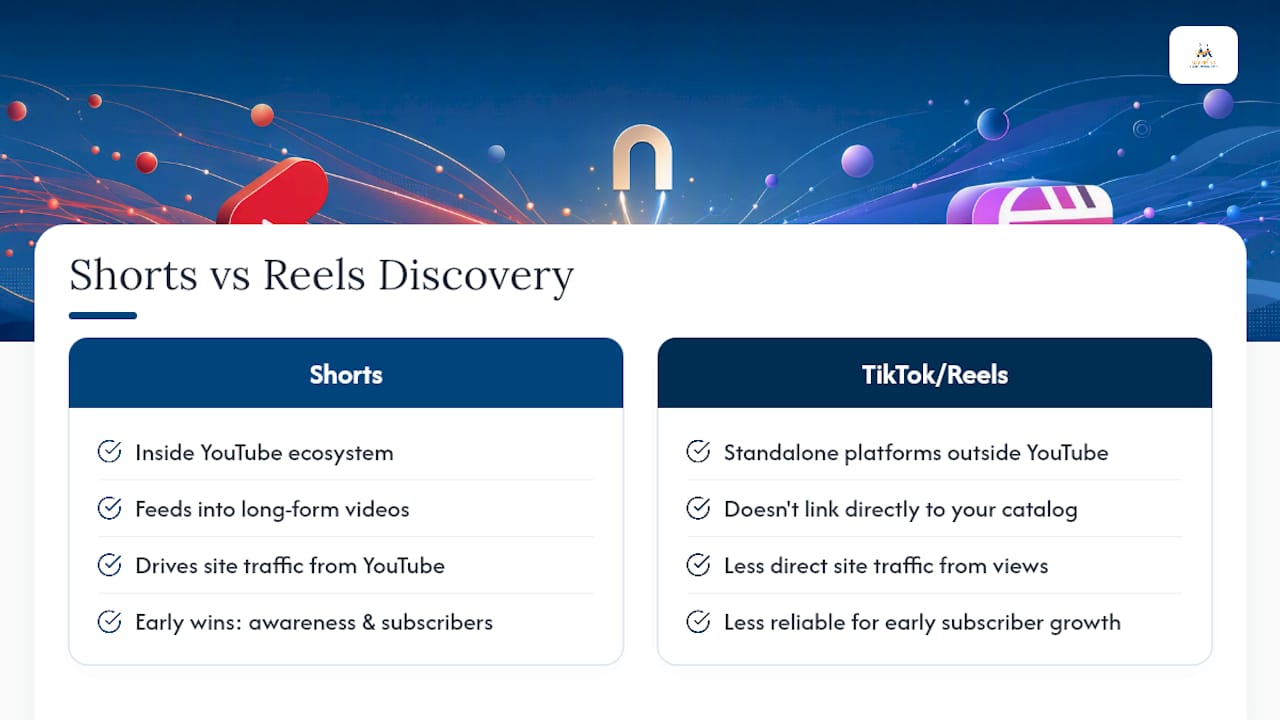
Shorts get discovered differently than a typical social video. They live inside YouTube's search and recommendation system alongside your long-form catalog, which means a viewer who lands on a 30-second Short can click straight into a 10-minute demo or a customer story without leaving the platform. That structural advantage is why Shorts function as a discovery channel that feeds deeper content and site traffic in a way a standalone TikTok or Reel cannot.
Set your expectations accordingly. Shorts build channel awareness and subscriber growth far more reliably than direct sales in the first few weeks. Watch two numbers closely: completion rate and subscriber conversion rate.
What the benchmarks show: Retensis reports that completion rate and average view duration are the primary signals YouTube uses to decide how widely to distribute a Short, and channels with strong retention frequently outperform larger channels that lose viewers early. A Short that holds attention to the end tells the algorithm to show it to more people.
Getting Started: Channel Setup and Technical Specs
Before you film anything, get your channel foundation right. A Short that performs well but points to an empty or messy channel wastes the click.
Run through this setup checklist first:
- Write a clear channel description that states what you do and where you serve customers.
- Upload a banner and profile image that match your other social branding.
- Build playlists that group Shorts by topic (tips, demos, behind-the-scenes) so new visitors can binge.
- Keep a consistent intro style, color palette, and voice across every Short.
On the technical side, shoot vertical at 9:16, aim for 1080x1920 resolution, and keep most business Shorts under 60 seconds. Burn in captions since most viewers watch muted.
For workflow, batch-film six to eight Shorts in one session, edit them using one repeatable template for captions and text overlays, and schedule releases roughly two weeks ahead. This keeps output consistent without demanding daily attention.
High-Performing Shorts Formats Businesses Should Try
Five formats consistently outperform generic content for small businesses:
- Quick tips or FAQ answers — Answer one specific question your customers ask repeatedly.
- Product or service demos — Show the thing working in 20 to 40 seconds, no narration required.
- Behind-the-scenes clips — Film the process, the team, or the space customers never see.
- Customer transformations — Before-and-after results build trust faster than any pitch.
- Repurposed long-form highlights — Pull the sharpest 30 seconds from a webinar, podcast, or tutorial.
Match the idea to your business type. A local service business might film a "three signs you need X" tip with a call-now overlay. An e-commerce brand can turn unboxing moments into a Short with a link-in-bio CTA. A B2B company does better clipping a client-question moment from a longer explainer than chasing a dance trend.
Trend participation can boost initial reach, but chasing trends unrelated to your niche tends to produce vanity views without leads. Solving a specific problem your audience actually has almost always beats a viral sound with no connection to what you sell.
Pro Tip: Keep a running list of the exact questions customers ask in emails, calls, and reviews. Every one of those is a ready-made Shorts topic that already proves demand.
Production and Optimization Best Practices That Improve Retention
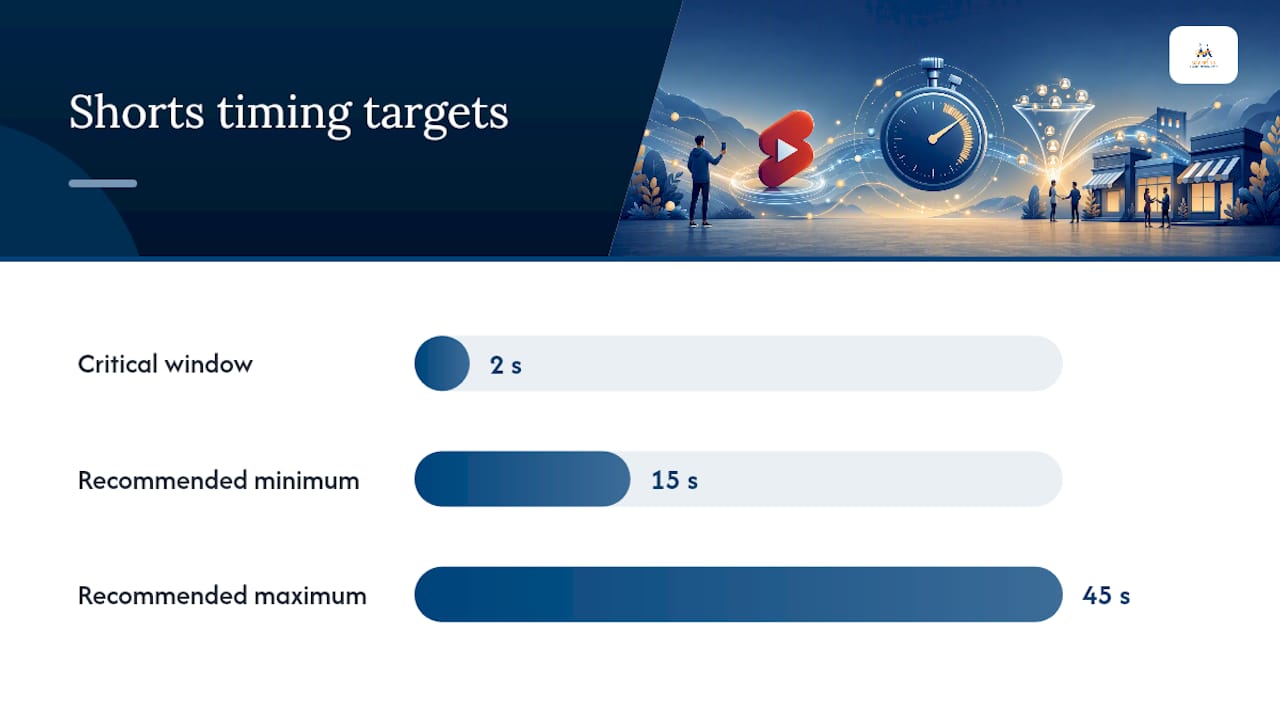
The first two seconds decide whether a Short gets distributed or buried. YouTube's algorithm treats early drop-off as a signal to stop showing the video, so open with the payoff, a bold claim, or an unexpected visual instead of a logo animation or a slow "hey guys" intro.
A few production habits make a measurable difference:
- Put the hook in your first sentence, not after a branded intro card.
- Add burned-in captions and short overlay text for key phrases, since silent viewing is the default.
- Skip the long branding sequence; a subtle logo in the corner works better than a five-second opener.
- Keep most business Shorts between 15 and 45 seconds, since retention and completion rate directly drive how widely YouTube distributes the video.
Titles and descriptions still matter for search, even on Shorts. Use the phrase a customer would type, not a clever tagline, and add one relevant hashtag rather than five generic ones. Thumbnails matter less on Shorts than long-form, but a clear first frame still helps with browse discovery. For deeper tactics on tightening hooks and captions, see this breakdown of short-form video secrets for faster views.
Which YouTube Studio Shorts Metrics Actually Matter?
Open the Shorts chip inside YouTube Studio and prioritize a short list of metrics over raw view count:
- Average view duration and completion rate — the strongest predictors of future distribution.
- Top Shorts by views — tells you which formats to repeat.
- Remix and traffic-source reports — show whether people found you through Shorts feed, search, or a remix.
- Subscribers gained per Short — the clearest sign a video moved someone from viewer to audience.
None of that matters if it does not connect to business results, especially when you use tools like call tracking to measure offline conversions triggered by Shorts. Cross-reference your top Shorts against long-form click-throughs, website clicks, and call or lead volume for the same week. Set a simple diagnostic habit: review these numbers every two to four weeks, drop formats that get views but zero downstream clicks, and double down on whatever Short sent the most traffic into your funnel.
The Shorts to Long-Form Workflow That Turns Views Into Leads
A repeatable sequence beats random posting every time:
- Mine your long-form catalog for a moment worth 20 to 40 seconds, ideally a strong opinion, a demo, or a result.
- Cut it as a Short and pin a comment linking directly to the full long-form video.
- Add the long-form video to a themed playlist so anyone who clicks through keeps watching related content.
- Post a follow-up Short a few days later that answers a question raised in the comments of the original clip.
Without a long-form foundation, this sequence breaks down. SellOnTube's analysis found that Shorts posted alone, with no long-form video behind them, tend to rack up views but generate almost no demo requests or leads. Aim for two to three Shorts a week alongside your regular long-form uploads.
Agency Experience Behind This Shorts Strategy
The batching and repurposing tactics in this guide are based on proven strategies for integrating Shorts into video and local search marketing: film once, cut multiple Shorts, and route every one back to a long-form asset or a local action.
Teams without a dedicated video person get the most out of a structured Shorts-to-long-form calendar rather than sporadic posting. A typical starting engagement audits your existing long-form library, identifies clip-worthy moments, and sets a publishing cadence your team can actually sustain. For background on why this repurposing approach outperforms one-off content, see why short-form video works as a growth lever.
What a Realistic Shorts Timeline Looks Like
Shorts earn a place in a disciplined marketing funnel, not as a replacement for it. Expect 60 to 90 days of consistent posting before downstream signals like website clicks, call volume, or lead forms show a real pattern. Businesses that quit at week three usually stop right before the data gets useful. Resource-limited teams do better committing to two Shorts a week for a full quarter than posting daily for two weeks and stopping.
— Diane O'Brien
Let Digital Marketing All Handle Your Shorts Strategy
Running a consistent Shorts-to-long-form pipeline while also managing local reviews, a website, and paid ads is a lot for one small business team to carry alone. Using a digital marketing agency can be an alternative to hiring a full in-house video team: specialists can batch-produce your Shorts, build the pinned-comment and playlist bridges into your long-form catalog, and connect the whole system to your local visibility and reputation work.
An initial engagement may begin with an audit of your existing video library, developing a content calendar built around your busiest service or product lines, and preparing a Shorts-to-long-form sequence ready to publish within weeks. Since local trust signals compound alongside video visibility, pairing your Shorts strategy with active review generation and reputation management gives new viewers a reason to convert once they find you. For those interested in a structured plan, consider starting with a review and visibility audit.
Sources
This guide draws on YouTube's own Shorts reporting documentation, Adobe's analysis of Shorts' marketing potential, and industry benchmarks from Retensis and Socialk.it.
FAQ
How many views do you need on YouTube Shorts to make $10,000?
Shorts monetization depends on the YouTube Partner Program's ad-revenue share, audience location, and content niche; most businesses should treat Shorts as a lead-generation tool rather than a direct ad-revenue play.
How many YouTube views do I need to make $2,000 a month?
This varies widely by niche and monetization method, but for businesses, the more reliable path to a specific monthly revenue number is converting Shorts viewers into long-form subscribers and leads rather than chasing ad-revenue thresholds.
What is the 7-second rule on YouTube?
It refers to the idea that a viewer decides within the first several seconds whether to keep watching, which is why YouTube's distribution system weighs early retention so heavily; on Shorts, that window is even tighter, closer to two seconds.
How many YouTube views do I need to make $3,000 per month?
Ad revenue per view varies too much by audience and niche to give one number; a more useful goal for a small business is tracking how many Shorts views convert into long-form watches, website clicks, or calls each month.
How often should a business post YouTube Shorts?
Two to three Shorts per week, paired with a long-form video, gives most small businesses enough volume to test formats without burning out the team producing them.