

Nearly 46% of all Google searches are looking for local information, yet most small businesses haven't optimized their online presence to capture this traffic. While you focus on general marketing strategies, potential customers in your area are searching for exactly what you offer, but they're finding your competitors instead. Local search connects ready-to-buy customers with nearby businesses at the precise moment they need a product or service. In 2026, prioritizing local search isn't just smart marketing, it's essential for survival and growth. This guide reveals why local search should be your top digital marketing priority and how AI-driven strategies can help you dominate your local market.
Table of Contents
- The Impact Of Local Search On Business Visibility And Customer Behavior
- Understanding The Core Factors Driving Local Search Rankings In 2026
- Common Challenges And Mistakes Small Businesses Make In Local Seo
- Leveraging Ai-Driven Strategies To Boost Local Search Rankings In 2026
- Boost Your Local Business With Expert Digital Marketing Solutions
Key takeaways
| Point | Details |
|---|---|
| Local search drives immediate action | Most consumers who perform local searches visit a store within days and convert at remarkably high rates. |
| Google prioritizes three core factors | Relevance, distance, and prominence determine your local rankings, with Google Business Profile signals accounting for 25% of influence. |
| Most businesses remain unoptimized | Nearly 60% of local businesses haven't properly optimized for local search, creating massive opportunities for those who do. |
| AI strategies amplify results | Automated profile optimization, reputation management, and citation building significantly improve rankings and conversion rates. |
| Consistency matters more than ever | Regular profile updates and accurate business information across all platforms directly impact your visibility and customer trust. |
The impact of local search on business visibility and customer behavior
Local search fundamentally changes how customers discover and choose businesses. When someone searches for a service near them, they're not browsing casually. They have immediate intent and are ready to make a decision quickly. Understanding this behavior shift is crucial for positioning your business effectively.

The statistics reveal the power of local search intent. An impressive 72% of consumers who perform a local search visit a store within 5 miles, demonstrating that these searches translate directly into foot traffic. Even more compelling, nearly 80% of local mobile searches result in a conversion, whether that's a purchase, phone call, or store visit. Mobile users searching locally aren't just looking, they're actively seeking solutions.
The immediacy of local search creates unique opportunities. Most consumers act on their local searches within 24 hours, meaning your business needs to appear prominently when these high-intent searches happen. Missing from local search results means losing customers to competitors who invested in why focus on local search optimization.
Consider these critical local search behaviors:
- Consumers use local searches to find business hours, directions, and contact information before visiting
- Mobile users rely heavily on map features and location-based results for immediate needs
- Local searchers often compare multiple businesses before making final decisions
- Reviews and ratings visible in local search results heavily influence purchase choices
- Voice search queries increasingly include local intent phrases like "near me" or specific neighborhood names
The conversion rates speak for themselves. Local searches consistently outperform general searches because they capture customers at the decision stage, not the research phase. When someone searches for "plumber near me" or "best Italian restaurant downtown," they're ready to act. Your visibility in these moments directly impacts your revenue.
Pro Tip: Track which local search terms drive the most foot traffic and phone calls to your business, then optimize your Google Business Profile and website content specifically for those high-converting queries.
Understanding the core factors driving local search rankings in 2026
Google evaluates local businesses using specific criteria that determine which companies appear in valuable local search results. Mastering these factors gives you a competitive advantage in your market. The algorithm isn't mysterious, it's methodical and rewards businesses that align with user needs.
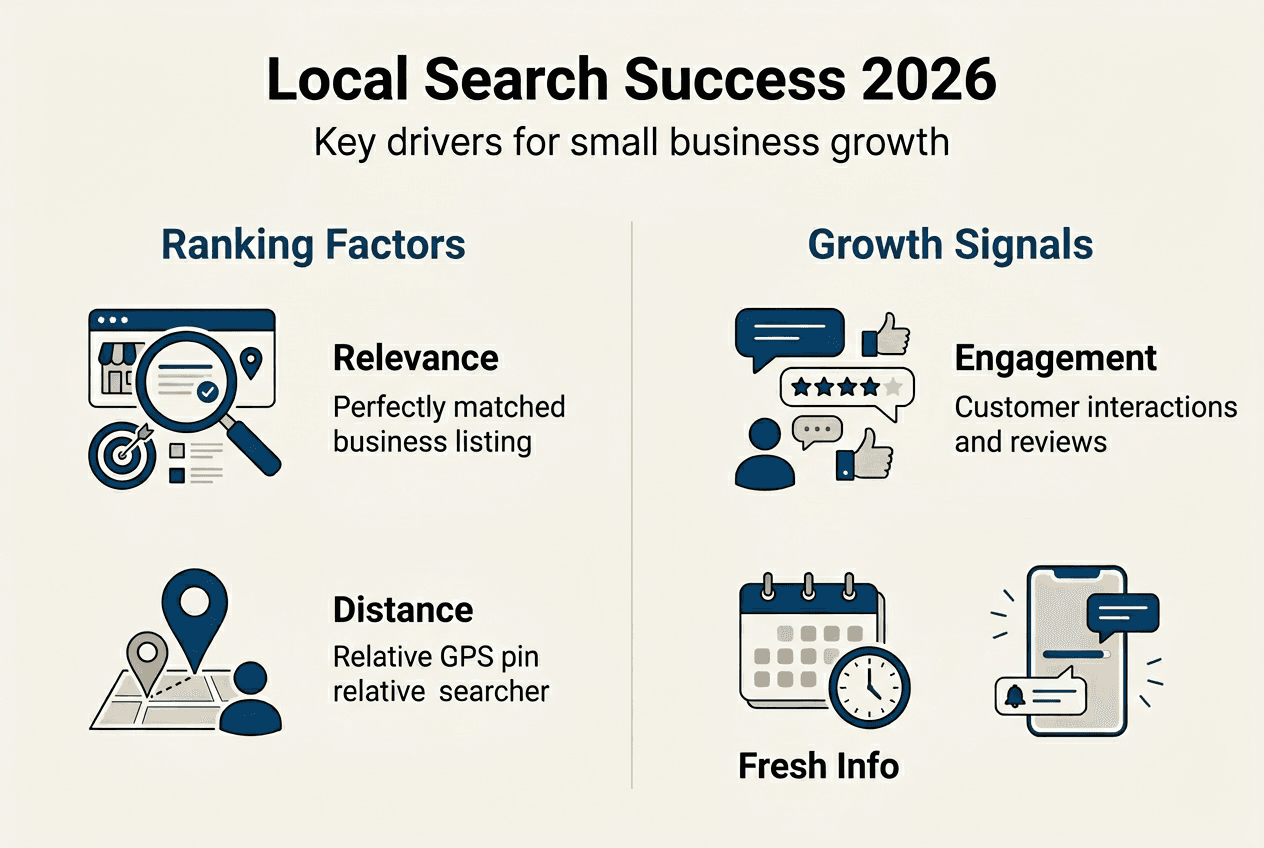
Google uses three primary factors to determine local rankings: Relevance, Distance, and Prominence. Relevance measures how well your business matches what the searcher wants. Distance considers your physical proximity to the searcher or the location mentioned in their query. Prominence reflects how well-known and authoritative your business appears online through reviews, citations, and backlinks.
The weight of different ranking signals has evolved significantly. Google Business Profile signals account for approximately 25% of ranking influence, making your profile optimization critical. This percentage has increased as Google prioritizes first-party data from verified business owners over third-party signals.
Here's how ranking factors have shifted:
- Google Business Profile optimization now carries more weight than ever, including complete information, regular posts, and photo updates
- Review signals including quantity, quality, and recency of customer reviews directly impact rankings
- On-page SEO factors like location-specific content and proper schema markup remain foundational
- Citation consistency across directories and platforms validates your business legitimacy
- Behavioral signals such as click-through rates and user engagement tell Google which results satisfy searchers
- Link signals from authoritative local websites and industry sources boost prominence
| Ranking Factor Category | 2024 Influence | 2026 Influence | Change | | --- | --- | --- | | Google Business Profile | 20% | 25% | +5% | | Review Signals | 15% | 18% | +3% | | On-Page SEO | 18% | 16% | -2% | | Citation Signals | 12% | 10% | -2% | | Link Signals | 10% | 8% | -2% | | Behavioral Signals | 10% | 13% | +3% |
The trend is clear. Google increasingly values direct engagement signals and verified business information over traditional SEO factors. This shift rewards businesses that actively manage their online presence rather than those relying solely on technical optimization.
Your google business profile optimization guide strategy should focus on completeness and freshness. Businesses with fully completed profiles, regular updates, and consistent customer interaction rank higher than those treating their profile as a static listing. Google rewards active participation because it indicates a legitimate, engaged business.
Understanding local search ranking factors 2026 guide principles helps you prioritize efforts effectively. Rather than spreading resources thin across dozens of tactics, focus on the factors with the highest impact for your specific business type and market.
Pro Tip: Audit your Google Business Profile monthly to ensure all information remains accurate, add fresh photos regularly, and respond to every review within 48 hours to maximize your profile's ranking power.
Common challenges and mistakes small businesses make in local SEO
Even businesses that recognize local search importance often sabotage their own efforts through preventable mistakes. Understanding these pitfalls helps you avoid wasting time and money on ineffective tactics while competitors gain ground.
The most damaging error is inconsistent business information. Your name, address, and phone number must match exactly across every online platform. Even minor variations like "Street" versus "St." or different phone number formats confuse Google's algorithms. Inconsistent NAP information leads to weaker rankings and reduced visibility because Google can't confidently verify which information is correct.
Many businesses also fail to properly set up their Google Business Profile. They claim the listing but leave sections incomplete, never add photos, or ignore the posts feature entirely. This incomplete approach signals to Google that the business isn't actively managed, reducing trust and rankings.
Almost 60% of businesses still haven't optimized for local search, creating a massive opportunity for those who invest in proper optimization strategies.
Common local SEO mistakes include:
- Treating local SEO as a one-time setup task instead of an ongoing process requiring regular attention
- Ignoring or poorly responding to customer reviews, missing opportunities to demonstrate engagement
- Using generic website content without location-specific keywords and information
- Failing to build citations on relevant local directories and industry-specific platforms
- Neglecting mobile optimization despite most local searches happening on smartphones
- Not tracking local search performance metrics to understand what's working
Another frequent mistake is keyword stuffing location terms unnaturally into content. Google's algorithms easily detect this manipulation and may penalize your site. Instead, naturally incorporate location references where they genuinely add value for readers.
Businesses also underestimate the importance of category selection in their Google Business Profile. Choosing irrelevant or too many categories dilutes your relevance signals. Select the single most accurate primary category and only add secondary categories that truly represent your services.
The google business profile updates landscape changes frequently, and businesses that don't stay informed risk violations leading to suspension. Understanding current guidelines prevents devastating profile removals that can tank your local visibility overnight.
Many businesses also ignore their competitors' local search strategies. Analyzing what top-ranking competitors do differently reveals gaps in your own approach. Study their profiles, review responses, content strategies, and citation sources to identify opportunities.
The local business search ranking guide framework shows that success requires consistent effort across multiple factors simultaneously. Focusing on just one element while neglecting others creates an unbalanced profile that underperforms.
Pro Tip: Set up a quarterly local SEO audit checklist covering NAP consistency, profile completeness, review response rates, citation accuracy, and ranking positions to catch and fix issues before they significantly impact your visibility.
Leveraging AI-driven strategies to boost local search rankings in 2026
Artificial intelligence has transformed local search optimization from a manual, time-intensive process into a data-driven, automated system that delivers faster results with less effort. Smart businesses are leveraging AI tools to gain competitive advantages their rivals can't match through traditional methods alone.
AI excels at analyzing massive datasets to identify patterns humans miss. Ranking factors categories include AI Search Visibility, Organic Rankings, and Local Pack/Maps Rankings, and AI tools can optimize for all three simultaneously by understanding how they interconnect. This holistic approach produces better results than optimizing each factor in isolation.
AI-powered local SEO tactics include:
- Automated Google Business Profile optimization that suggests improvements based on top-performing competitors
- Intelligent review monitoring and response generation that maintains consistent engagement
- Citation building and management systems that identify and correct inconsistencies across hundreds of platforms
- Content generation tools that create location-specific pages optimized for local keywords
- Predictive analytics that forecast ranking changes and recommend proactive adjustments
- Sentiment analysis of customer reviews revealing actionable insights about service improvements
Implementing AI tools into your local SEO workflow follows a strategic sequence:
- Audit your current local search presence using AI-powered analysis tools to establish baseline metrics
- Deploy automated monitoring for your Google Business Profile, citations, and review platforms
- Set up AI-driven content optimization to enhance existing pages with location-specific improvements
- Implement chatbots and automated response systems to maintain consistent customer engagement
- Use predictive analytics to identify emerging local search trends before competitors
- Continuously refine strategies based on AI-generated performance insights and recommendations
The measurable impact of AI-enhanced strategies validates the investment. Data from agencies implementing AI tools shows significant improvements across key metrics:
| Metric | Traditional Approach | AI-Enhanced Approach | Improvement |
|---|---|---|---|
| Time to First Page Rankings | 6-9 months | 3-5 months | 40-50% faster |
| Review Response Rate | 45-60% | 90-95% | +50-60% |
| Citation Accuracy | 70-80% | 95-98% | +20-25% |
| Conversion Rate | 2-4% | 5-8% | +100-150% |
Consistent engagement with Google Business Profile signals relevance and reliability to Google, and AI tools make maintaining this consistency effortless. Automated posting schedules, photo uploads, and update reminders ensure your profile stays fresh without requiring daily manual attention.
The role of AI in local SEO extends beyond automation to strategic intelligence. AI analyzes competitor movements, algorithm updates, and market shifts to recommend tactical adjustments before changes impact your rankings. This proactive approach keeps you ahead rather than constantly reacting to drops.
AI also personalizes local search strategies based on your specific business type, market conditions, and customer behavior patterns. Generic advice fails because every local market has unique characteristics. AI identifies what actually works in your situation rather than applying broad best practices that may not fit.
Understanding local search ranking factors 2026 guide principles becomes more actionable when AI tools show you exactly which factors need attention for your business. Instead of guessing where to focus efforts, you get data-driven priorities ranked by potential impact.
Pro Tip: Start with one AI tool focused on your biggest weakness, whether that's review management, citation building, or content optimization, then expand to additional tools as you see results and understand the technology better.
Boost your local business with expert digital marketing solutions
While understanding local search principles helps, implementing comprehensive strategies requires expertise, tools, and consistent execution that most small business owners struggle to maintain alongside running their operations. Digital Marketing All specializes in AI-driven local SEO strategies designed specifically for businesses like yours that need results without the learning curve.
Our approach combines advanced geo-fencing tactics that target customers in your exact service area with sophisticated review generation and management systems that build your reputation automatically. We handle the technical complexity while you focus on serving customers. Our waiting room solutions even help you engage customers before they arrive, turning wait time into relationship-building opportunities. We implement the AI-powered strategies discussed in this guide, customized for your specific market and business goals, ensuring you appear prominently when local customers search for what you offer.
Why prioritize local search? Frequently asked questions
What are the main benefits of focusing on local search?
Local search captures high-intent customers at the exact moment they need your services, resulting in conversion rates up to 80% for mobile searches. It drives immediate foot traffic and phone calls from nearby customers ready to buy.
How quickly can I see results from improving my local SEO?
With AI-enhanced strategies, businesses typically see first-page rankings within 3 to 5 months, compared to 6 to 9 months with traditional methods. However, some improvements like increased profile views and calls can appear within weeks of optimization.
Do I need special tools to optimize for local search?
While basic optimization can be done manually, AI-powered tools significantly accelerate results and reduce effort. They automate citation management, review monitoring, and content optimization tasks that would otherwise consume hours weekly.
How often should I update my Google Business Profile?
Update your profile at least weekly with new posts, photos, or offers to signal active management to Google. Respond to all reviews within 48 hours and verify information accuracy monthly to maintain strong ranking signals.
Can AI really improve local search rankings for small businesses?
Yes, AI tools analyze competitor strategies, automate consistent engagement, and optimize multiple ranking factors simultaneously, delivering 40 to 50% faster ranking improvements and significantly higher conversion rates compared to manual optimization approaches.
Recommended
- Local Search Ranking Factors 2026: Boost Your Visibility | Digital Marketing All
- Local Search SEO & AI Strategies for Small Business Growth | Digital Marketing All
- Outrank Big Brands with Search Price Optimization in 2025
- Autocomplete Marketing vs. Traditional PPC | Digital Marketing All
- Business Intelligence Archívum - AI tanácsadás és megvalósítás
- Top 5 Alternatives à mapstr.com en 2026 pour découvrir de nouveaux lieux