

TL;DR:
- Website authority reflects a domain's predicted search ranking strength based on backlinks, content depth, and technical health. Building authority requires a long-term strategy focusing on quality backlinks, topical content hubs, technical SEO, and consistent brand information to improve rankings and AI search citations. Proxy metrics like Moz's Domain Authority and Semrush's Authority Score help benchmark progress, but genuine authority depends on meaningful work across all SEO pillars.
Website authority is defined as a domain's predicted ranking strength and trustworthiness in search engines, scored on a 0–100 scale using backlink quality, content depth, and technical health as primary inputs. The term covers third-party metrics like Moz's Domain Authority, Ahrefs' Domain Rating, and Semrush's Authority Score. None of these are official Google signals, but all correlate strongly with real ranking performance. Understanding what is website authority, and more importantly how to build it, is one of the highest-leverage moves any digital marketer or business owner can make in 2026.
What is website authority and why does it matter?
Website authority is an SEO concept representing a domain's predicted ranking strength and trust level, scored 1–100 as a proxy metric based on backlinks, content, and brand signals. Think of it as a credit score for your website. A higher score signals to SEO tools, and indirectly to search engines, that your site earns trust from other credible sources.

Google does not publish its own authority score. However, a 2024 API leak revealed that Google uses an internal sitewide signal called "siteAuthority," influenced by link quality, topical depth, and brand demand. This confirms that the concept behind third-party scores reflects something real inside Google's algorithm, even if the exact formula stays private.
The practical meaning is straightforward. Sites with higher authority tend to rank faster for competitive keywords, earn featured snippets more often, and get cited by AI search engines like Gemini and Perplexity. For business owners, that translates directly into more organic traffic, more leads, and lower dependence on paid advertising.
What factors contribute to website authority in 2026?
Authority is not a single signal. It is the output of several overlapping inputs, and each one compounds the others.
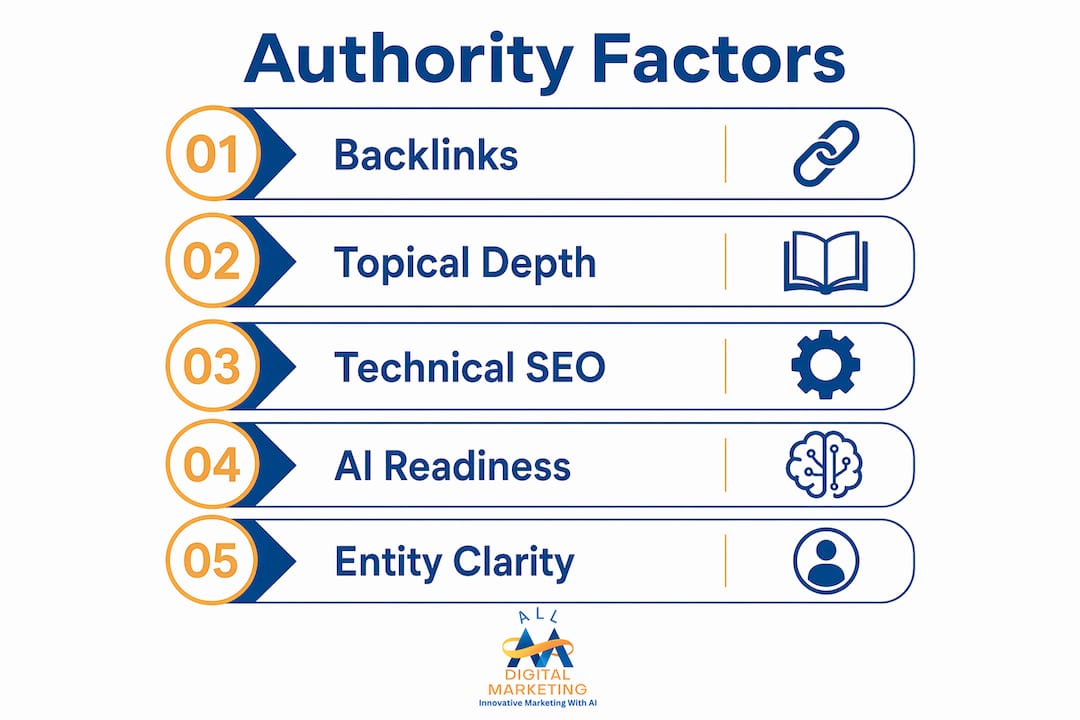
Backlink profile quality and diversity sit at the foundation. Sites with diverse and authoritative backlink profiles consistently show higher authority scores and stronger ranking ability. One link from a respected industry publication outweighs dozens of links from low-traffic directories.
Beyond backlinks, the following factors now carry significant weight:
- Topical depth: Comprehensive coverage of a subject, including subtopics and related queries, signals expertise to both Google and AI engines. A single blog post does not build topical authority. A structured content hub does.
- Technical SEO health: Site speed, mobile-friendliness, and clean architecture all affect how efficiently link equity flows through your site. Poor technical foundations create what SEO professionals call an "authority ceiling."
- E-E-A-T signals: Google's framework of Experience, Expertise, Authoritativeness, and Trustworthiness now shapes how content is evaluated. Real author credentials, verifiable claims, and transparent sourcing all contribute. You can explore how E-E-A-T drives authority in detail to understand how this framework applies to your content strategy.
- Entity clarity and structured data: AI search engines rely on structured data and consistent author profiles to identify authoritative sources. Mismatched brand information across platforms damages perceived authority.
- Brand and entity reputation: Consistent brand information and entity clarity through structured data help AI systems recognize and prioritize your site as a credible source.
Building website authority now requires a dual approach: traditional SEO signals combined with AI readiness, including E-E-A-T, structured data, entity clarity, and factual consistency. AI search engines like Gemini and Perplexity actively prioritize sites that demonstrate expertise and trustworthiness across all these dimensions.
Pro Tip: Run a structured data audit using Google's Rich Results Test before you invest heavily in content. Fixing schema errors costs almost nothing but directly improves how AI engines read and cite your site.
How is website authority measured?
Domain Authority from Moz, Domain Rating from Ahrefs, and Authority Score from Semrush are the three most widely used proxy metrics, each calculated differently and each with its own limitations. Similarweb also offers a Domain Score. All four use a 0–100 scale, but a score of 40 means something very different in a low-competition niche than in financial services or healthcare.
Here is how the major metrics compare:
| Metric | Provider | Primary Input | Best Used For |
|---|---|---|---|
| Domain Authority (DA) | Moz | Linking root domains and MozRank | Benchmarking against competitors in Moz's index |
| Domain Rating (DR) | Ahrefs | Quantity and quality of backlinks | Evaluating backlink profile strength |
| Authority Score (AS) | Semrush | Backlinks, organic traffic, and spam signals | Holistic site health and authority assessment |
| Domain Score | Similarweb | Traffic data combined with link signals | Cross-referencing authority with actual traffic |
None of these scores are Google ranking factors. They are proxies. Their value comes from benchmarking: if your competitor holds a Domain Rating of 55 and you sit at 30, you understand the gap you need to close to compete for the same keywords.
Chasing authority scores without improving actual backlink quality, topical coverage, or technical health results in vanity metrics that do not reliably improve rankings. Experts consistently advise focusing on the underlying inputs rather than the raw score itself.
Pro Tip: Do not compare your Domain Rating to your Domain Authority and expect them to match. Each tool uses a different index and calculation. Always benchmark within the same tool against the same competitors.
Why website authority matters for SEO, AI search, and business growth
The importance of website authority extends well beyond a number on a dashboard. Authority compounds. High authority improves rankings, which drives more traffic, which earns more backlinks, which raises authority further. Competitors who fall behind this cycle find it increasingly difficult to catch up.
Here is where authority creates measurable business impact:
- Google rankings: Higher-authority sites rank faster for competitive keywords and hold positions longer under algorithm updates.
- AI search citations: Sites with strong authority are preferentially cited by AI engines like Gemini and Perplexity. If your brand does not appear in AI-generated answers, low authority is often the root cause. Learn why your brand may be missing from AI search and what signals you need to earn those citations.
- Featured snippets: Google's featured snippets disproportionately pull from high-authority domains. Earning a snippet for a high-volume query can double or triple click-through rates.
- Brand credibility: Consumers trust brands that appear at the top of search results. Authority reinforces that trust signal before a visitor even clicks your link.
- Link acquisition: High-authority sites attract inbound links passively. Publishers and journalists naturally cite sources they recognize as credible.
AI systems prioritize brands that combine factual content with a consistent point of view and proof-backed third-party signals. This is called POV-led authority, and it is becoming the defining factor in which brands get cited versus which ones get ignored by AI search engines.
Successful SEO teams treat website authority as an output of comprehensive underlying programs, not a standalone goal. The score reflects the work. The work is what drives rankings.
How to improve website authority: strategies that actually work
Improving authority is a long-term process requiring quality backlinks, topical depth through comprehensive hubs, strong internal linking, and technical health. Results compound over multiple quarters, not weeks. Here is a proven sequence to follow:
- Audit your backlink profile first. Use Ahrefs or Semrush to identify your current referring domains, spot toxic links, and find gaps compared to top-ranking competitors. You need to know your baseline before you can improve it. Resources like building backlinks that move rankings offer practical frameworks for this step.
- Earn editorial backlinks from relevant, authoritative sites. Guest posts, original research, expert quotes in industry publications, and digital PR campaigns all generate the kind of links that move authority scores. Volume matters less than relevance and source quality.
- Build topical content hubs. Map out every sub-query related to your core topics and create dedicated pages for each. A hub-and-spoke content model signals comprehensive expertise to both Google and AI engines.
- Fix internal linking gaps. Ensuring at least 3 contextual internal links to key pages prevents link equity waste. Poor internal linking is one of the most common and most overlooked causes of an authority ceiling.
- Maintain technical SEO fundamentals. Site speed, HTTPS security, mobile performance, and crawlability all affect how efficiently your authority flows. Technical issues create drag on every other investment you make.
- Demonstrate E-E-A-T through verifiable content. Add real author bios with credentials, cite primary sources, update content regularly, and build a track record of accuracy. Explore the full E-E-A-T and AI authority framework to see how these signals interact.
- Standardize your entity information. Your brand name, address, and structured data should be consistent across your website, Google Business Profile, social profiles, and any third-party directories. Inconsistency confuses AI systems and weakens perceived authority.
The most common pitfall is treating authority as a score to chase rather than a byproduct of real SEO work. Buying low-quality links, spinning thin content, or ignoring technical debt will raise a metric temporarily while damaging your actual ranking potential. Sustainable authority comes from balanced investments across all pillars: backlinks, content, technical health, and entity clarity working together.
Pro Tip: Set a quarterly authority review cadence. Track Domain Rating or Authority Score alongside organic traffic and keyword rankings. If your score rises but traffic stays flat, your content targeting or technical health needs attention.
Key takeaways
Website authority is the compounding output of backlink quality, topical depth, technical SEO health, and entity clarity, and it directly determines your visibility in both Google and AI-driven search.
| Point | Details |
|---|---|
| Authority is a proxy metric | Domain Authority, Domain Rating, and Authority Score estimate ranking strength but are not direct Google signals. |
| Google has its own internal signal | A 2024 API leak confirmed Google uses a "siteAuthority" signal based on links, topical depth, and brand demand. |
| AI search raises the stakes | Gemini and Perplexity preferentially cite high-authority sites, making authority critical for next-gen search visibility. |
| Technical health sets the ceiling | Poor internal linking and slow load times create an authority ceiling that limits rankings even with strong backlinks. |
| Authority compounds over time | Higher authority drives more traffic, which earns more links, creating a widening competitive advantage. |
Authority in the AI era: what i've learned after years in the field
I have watched the definition of website authority shift considerably over the past several years, and the pace of that shift is accelerating. When I started in SEO, authority was almost entirely a backlink conversation. Get links from strong domains, watch your rankings rise. That model still holds, but it now accounts for maybe half of the picture.
The part most marketers underestimate is entity clarity. I have seen sites with genuinely strong backlink profiles fail to appear in AI-generated answers because their structured data was inconsistent or their author information was scattered across platforms with no coherent identity. AI engines like Perplexity and Gemini do not just reward link counts. They reward recognizable, verifiable entities. If your brand looks different on your website than it does on your Google Business Profile or your LinkedIn page, you are losing citation opportunities you earned.
The other shift I find underappreciated is the role of point-of-view content. Generic, comprehensive guides still rank. But the sites getting cited in AI answers increasingly have a distinct perspective backed by real data or direct experience. That is not a soft editorial preference. It is a measurable signal. Brands that publish original research, take clear positions, and back those positions with verifiable proof are building the kind of brand authority for AI search that compounds faster than any link-building campaign alone.
My honest recommendation: stop treating authority as a number to report in monthly dashboards. Treat it as the cumulative reputation your site earns through every content decision, every technical choice, and every link you pursue. The score will follow. The rankings will follow. The citations will follow. But only if the underlying work is real.
— Diane
How Digitalmarketingall helps you build real website authority
Understanding website authority is one thing. Building it consistently, across backlinks, content, technical SEO, and AI readiness, is where most businesses need expert support. Digitalmarketingall offers full-service digital marketing solutions designed to grow your site's authority and search visibility from the ground up. Whether you need a professionally built website optimized for ranking from day one or a complete SEO program covering content, links, and technical health, the team at Digitalmarketingall has the tools and experience to get you there. Explore professional website solutions built specifically to support authority growth, or check out the website rental option for a zero-maintenance path to a high-performing online presence.
FAQ
What is website authority in simple terms?
Website authority is a score from 0 to 100 that estimates how likely a domain is to rank well in search engines, based on backlink quality, content depth, and technical health. Higher scores generally indicate stronger ranking potential.
Does google use domain authority as a ranking factor?
Google does not use Moz's Domain Authority or any third-party authority score as a direct ranking factor. Google uses its own internal sitewide authority signal, partially revealed in a 2024 API leak, which reflects link quality, topical depth, and brand demand.
How long does it take to improve website authority?
Building website authority is a long-term process measured in quarters, not weeks. Consistent investment in quality backlinks, topical content hubs, and technical SEO typically produces measurable score improvements within three to six months.
What is the difference between domain authority and domain rating?
Domain Authority is calculated by Moz and focuses primarily on linking root domains. Domain Rating is calculated by Ahrefs and emphasizes the quality and quantity of backlinks. Both use a 0–100 scale but should only be compared within the same tool.
Why does website authority matter for AI search?
AI search engines like Gemini and Perplexity preferentially cite sites with strong authority signals, including high-quality backlinks, consistent entity information, and E-E-A-T-aligned content. Low authority is one of the primary reasons brands fail to appear in AI-generated answers.