

TL;DR:
- Most local businesses still rely on exact keyword phrases, but Google now interprets queries by understanding meaning and intent. Building content that addresses customer questions and local context, combined with structured data, improves visibility in semantic search results. Hybrid strategies that merge keyword and semantic approaches are essential for optimal local search performance and lead generation.
Most local business owners still build their web pages around exact phrases like "best pizza downtown" or "emergency plumber near me," assuming Google needs that precise wording to surface their business. The reality is that Google processes queries by interpreting meaning and intent, not just scanning for matching words. That shift changes everything about how you should structure your content, your service pages, and your local presence online. This article breaks down what semantic search actually is, how the technology works, how it compares to traditional keyword tactics, and what specific steps you can take right now to improve your visibility and generate more qualified leads.
Table of Contents
- Defining semantic search: More than keywords and synonyms
- How semantic search works: Technology powering modern search engines
- Semantic vs. keyword search: Key differences and why hybrid strategies win
- Semantic search applied: Boosting your business's local visibility and leads
- Why thinking like your customer beats chasing keywords
- Ready to bring semantic search to your business?
- Frequently asked questions
Key Takeaways
| Point | Details |
|---|---|
| Semantic search defined | Semantic search matches meaning and intent, not just exact keywords or synonyms. |
| Advanced tech explained | Modern search uses AI and context-awareness to connect queries with the right results. |
| Hybrid strategies excel | Combining semantic and keyword search is proven to yield broader and more accurate results. |
| Practical business actions | Structuring your web presence for semantic search can drive more local leads and customer engagement. |
| Mindset shift needed | Prioritizing intent-based content over keywords empowers you to reach today's searchers more effectively. |
Defining semantic search: More than keywords and synonyms
The term "semantic" refers to meaning. Semantic search, at its core, is not about matching the words someone types into a search box. It is about understanding what that person actually wants to accomplish and then delivering results that genuinely satisfy that goal.
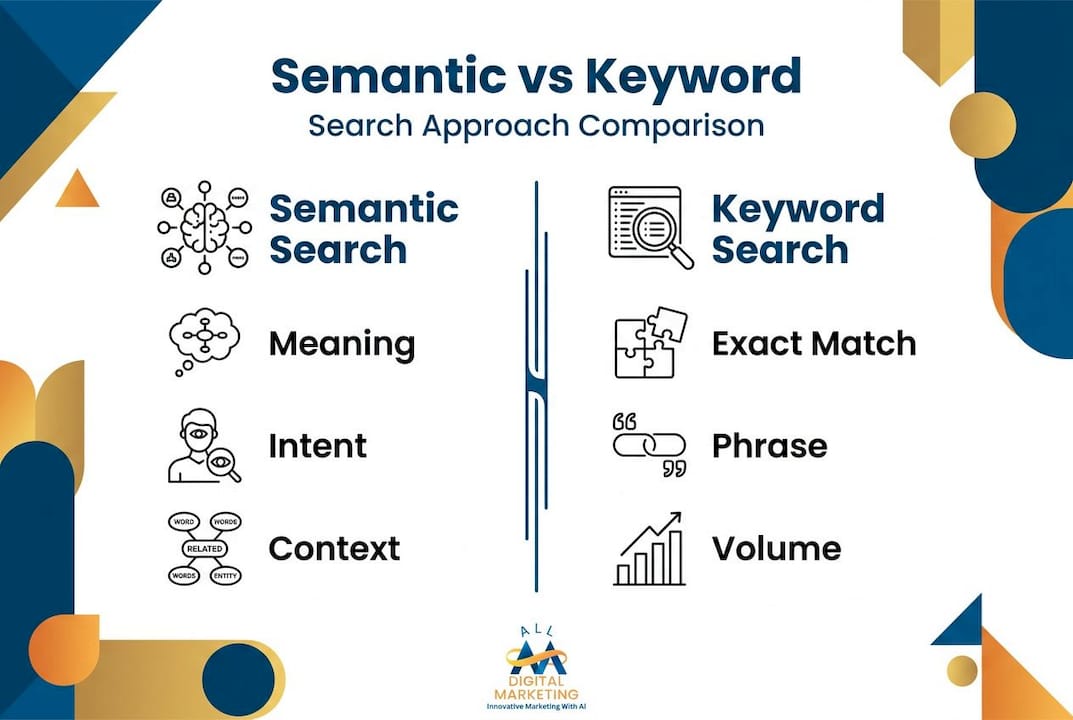
According to Google Cloud, semantic search is a retrieval approach that aims to match the meaning and intent of a query, including context, entities, and relationships, rather than relying only on exact keyword matches. That distinction is fundamental for any local business owner trying to figure out why some competitors rank well without repeating keywords obsessively across their pages.
Here is what semantic search actually analyzes when someone submits a query:
- Intent: Is the person looking to buy, to learn, to compare, or to find a location?
- Entities: Who or what is involved? Is this about a business category, a specific service, a geographic area, or a person?
- Relationships: How do the entities connect? For example, "electrician" relates to "wiring," "permits," "residential," and "licensed contractor" in ways that go beyond just synonyms.
- Context: What device is the person on? What is their location? What did they search for five minutes ago?
- Local factors: Proximity, business hours, reviews, and service area signals all feed into results for searches with local intent.
Semantic search does not just expand your keyword list. It reframes the entire question. Instead of asking "what words does Google want to see," you ask "what does my ideal customer actually need to accomplish, and does my website prove I can deliver that?"
This matters enormously for small and medium-sized businesses (SMBs). When a potential customer searches "my toilet keeps running and it's wasting water," they are not typing the exact phrase a plumber might target. But a plumber whose website clearly addresses running toilets, water waste, common causes, and repair options will rank for that query because the content matches the intent. Learning how semantic search drives leads starts with understanding this shift from words to meaning.
The practical takeaway is simple but powerful. Your website content needs to reflect real human questions, local context, and clear service descriptions. It does not need to repeat any single phrase a set number of times.
How semantic search works: Technology powering modern search engines
Understanding what semantic search is sets the groundwork. Now let's look at the actual technology behind it and why these advances directly affect whether your business appears in front of local customers or gets buried.
Modern semantic search runs on three interconnected technologies: natural language processing (NLP), text embeddings (also called vector representations), and knowledge graphs. As Meilisearch explains, semantic search is commonly implemented using NLP combined with vector-based representations of text, often layered with knowledge graphs or other contextual signals. Each of these components plays a distinct role.
Natural language processing (NLP) is how search engines "read" your content and a user's query the way a human would. Instead of seeing a string of characters, NLP allows the system to identify grammar, sentence structure, named entities (like a city name or service type), and the overall topic of a piece of content. Google's BERT and MUM models are examples of NLP systems that process language bidirectionally, meaning they consider words before and after a given term to determine its meaning in context.
Text embeddings take that understanding a step further. Every word, sentence, and document is converted into a numerical vector, essentially a point in a high-dimensional space where similar meanings cluster together. When someone searches for "fix a leaky faucet," the query's vector lands close to vectors for "faucet repair," "dripping tap," and "plumbing maintenance" in that space. This means your content does not need to contain the exact query words. It just needs to be semantically close in meaning.
Knowledge graphs connect entities and facts about them. Google's Knowledge Graph, for instance, links your business to its category, service area, reviews, hours, and associated services. When someone in your city searches for your type of service, the knowledge graph helps Google understand that your business is a relevant, credible entity for that query, even before looking at your page keywords.
Here is a quick comparison of how these three technologies contribute:
| Technology | What it does | Why it matters for your business |
|---|---|---|
| NLP | Interprets query meaning and grammar | Matches your content to questions, not just keywords |
| Text embeddings | Converts meaning into searchable math | Lets you rank for related queries without exact matches |
| Knowledge graphs | Connects entities and their relationships | Builds your business's relevance as a trusted local entity |
Pro Tip: Claiming and fully completing your Google Business Profile is one of the fastest ways to get your business into Google's Knowledge Graph. Fill in every field, including service areas, categories, hours, and a detailed business description.
Context signals matter just as much as content. Search optimization technology now factors in device type, user location, search history, and even the time of day to decide which results best match a query. A search for "coffee shop" at 7 a.m. on a mobile device near a business district carries very different intent than the same phrase typed on a desktop at 10 p.m. from a residential neighborhood.
AI-driven marketing personalization has become the natural extension of these capabilities, and businesses that understand the technology are already positioning themselves ahead of competitors who are still counting keyword density.
Semantic vs. keyword search: Key differences and why hybrid strategies win
What makes semantic search so different in practice? To truly optimize your local findability, you need to know how semantic and keyword methods interact and when to use each.

Traditional keyword search, also called token-based search, works by matching specific words or phrases in a query to the same words or phrases in a document. If someone types "Italian restaurant Chicago," the engine looks for pages that contain those exact words. This approach has clear strengths. It is fast, it handles brand names and product codes very precisely, and it works well when users type exact, well-formed queries.
The weaknesses are equally clear. Keyword search does not understand that "trattoria in Chicago" and "Italian restaurant Chicago" mean the same thing. It penalizes creative, natural writing that avoids repetition. And it entirely misses queries that describe a problem rather than naming a solution, such as "where to eat pasta near downtown."
Semantic search solves these problems. It understands synonyms, related concepts, and user intent. But it has its own limitations.
As Google Cloud Vertex AI notes, semantic search differs meaningfully from keyword search, and many production systems use hybrid approaches that combine both methods to improve quality and handle edge cases. The same source identifies cases where semantic-only approaches can underperform on identifiers like product SKUs or brand-new terms that fall outside the embedding model's training data.
This is why hybrid search is the current standard for high-quality results. A hybrid system runs both a semantic relevance check and a keyword match check, then fuses the scores to surface the best results. For your business, this means both approaches matter.
Here is a numbered breakdown of when each method works best for local SMBs:
- Use keyword-focused tactics for your business name, specific product names, unique service offerings, and any trademarked terms. These are cases where exact matching matters.
- Use semantic-focused tactics for your service description pages, FAQ content, blog posts, and any content designed to answer customer questions naturally.
- Combine both on your homepage and core service pages. Use natural, intent-driven language while including the specific local and category terms that define your business.
- Structure data clearly so search engines can extract entities and facts from your pages, supporting both keyword indexing and knowledge graph placement.
- Test regularly. Run searches for the questions your customers actually ask and see which results appear. Then evaluate whether your pages are answering those questions better than your competitors.
Curious how keyword vs. semantic search compares in real-world ranking? The gap between businesses that embrace both and those that stick to pure keyword tactics is growing wider every year.
Understanding SEO, GEO, and SEM as distinct but connected strategies also helps you build a more complete online presence that accounts for all three dimensions of modern search visibility.
Semantic search applied: Boosting your business's local visibility and leads
Having seen the tools and technologies available, here is how to translate semantic search principles into real, measurable growth for your business.
The foundation of a semantically optimized website is content that answers the actual questions your customers ask before, during, and after choosing your service. Google Cloud confirms that FAQs and service-detail pages that map directly to customer questions can be more effective than repeating exact query terms, because they align with how semantic search interprets intent, entities, and relationships.
Structuring your content for semantic readiness
Start by listing every question a first-time customer might ask about your service. Think about what they would type into Google before they even know your business exists. A local bakery might address questions like: "What cakes are made fresh daily?" "Do you offer gluten-free options?" "How far in advance do I need to order a wedding cake?" Each of these deserves either a dedicated page section or a FAQ entry.
A local plumber provides another clear example. Instead of a service page that simply says "We offer leak repair," a semantically strong page would describe the types of leaks the business handles (pipe leaks, slab leaks, fixture leaks), explain what causes them, describe the repair process, include service area neighborhood names, and answer common customer concerns like cost, timeline, and whether permits are needed. This approach does not just target one keyword. It covers the entire topic in depth, which is exactly what semantic search rewards.
Using structured data to reinforce entity clarity
Structured data markup (schema.org) tells search engines precisely what your content means. For a local business, this includes your business name, address, phone number, service area, hours, and accepted payment types. When this data is clean and accurate, it strengthens your presence in the Knowledge Graph and improves your chances of appearing in rich results like local packs and featured snippets.
Hybrid ranking systems like Reciprocal Rank Fusion (RRF) are used by modern search engines to combine semantic and keyword scores. Clean structured data improves your standing in both scoring systems.
Semantic readiness checklist for your website
Use this checklist to audit your current site:
- Does each service page describe the service fully, not just name it?
- Does your content use natural language that reflects how customers speak about their problems?
- Do you have FAQ sections that address the most common pre-purchase questions?
- Is your Google Business Profile fully completed and regularly updated?
- Does your homepage clearly state who you serve, where, and what problems you solve?
- Are your service area pages specific to neighborhoods, not just a city name?
- Do you use structured data markup to define your business entities?
- Is your content free of keyword stuffing in favor of clear, readable explanations?
Pro Tip: Use Google's "People Also Ask" boxes for your primary service terms as a free research tool. Every question that appears there is a real query that users submit, and each one represents an FAQ or content section opportunity for your site.
Following an intent optimization guide helps you consistently create content that aligns with the stages of your customer's decision process. Pair that approach with search box optimization to also capture your share of auto-suggest visibility. And creating AI-optimized content ensures your pages are structured in ways that both human readers and AI systems can interpret accurately.
The results of getting this right are significant. Businesses that align their content with semantic search principles consistently see higher engagement rates, lower bounce rates, and stronger conversion rates because the customers who find them are genuinely looking for exactly what they offer.
Why thinking like your customer beats chasing keywords
Here is an uncomfortable truth we have observed working with local and regional businesses across many industries. The business owners who invest the most time obsessing over keyword rankings are often the ones whose lead quality suffers most. They optimize for traffic, but that traffic does not convert, because the content was built for an algorithm rather than a person with a real need.
Chasing keywords leads to a specific trap. You create content around high-volume terms, you rank for those terms, and then you discover the visitors arriving from those terms are not ready to buy or are not in your service area. The keyword was right but the intent was wrong. That is a semantic mismatch, and it is entirely avoidable.
The businesses we see performing consistently well in local search share one approach. They map their content to the questions, concerns, and decisions their customers face at each stage of the buying process. Not keyword stages. Not ranking stages. Human decision stages.
When you build content this way, something interesting happens. The semantic signals your page sends become naturally rich and varied. You cover the topic from multiple angles. You address objections. You describe your service in terms of outcomes, not just features. And search engines respond by trusting your page as a genuine, comprehensive answer to a broad cluster of related queries.
There is also a competitive advantage worth naming directly. Most of your local competitors are still thinking in keywords. Their pages are thin, repetitive, and built for bots rather than buyers. By building for humans first, you differentiate yourself in a way that is genuinely hard to copy quickly, because it requires a real understanding of your customer and your service.
Reviewing real-world marketing strategies that account for how customers actually search and decide reinforces why this mindset shift is the real competitive advantage, more so than any single tactic or tool.
The technical tools, NLP, embeddings, knowledge graphs, are simply the mechanism by which search engines try to recognize and reward this kind of customer-centered thinking. They exist to identify businesses whose content genuinely serves the searcher. So when you build for your customer, you are not working against the algorithm. You are building exactly what the algorithm is trying to find.
Ready to bring semantic search to your business?
Applying semantic search principles to your website is one of the highest-return investments a local business can make right now. But pulling together content strategy, structured data, local entity optimization, and ongoing updates takes real time and expertise. That is exactly where we come in.
At Digital Marketing All, our affordable business websites are built with semantic search readiness at their core. Every page is structured to answer real customer questions, signal your local entity clearly, and perform in both keyword and semantic ranking systems. If you are not ready for a full build, our website rental solutions give you a professionally optimized web presence with a low monthly commitment, no large upfront cost, and ongoing updates that keep your site aligned with how search continues to evolve. Let us handle the technical side so you can focus on running your business.
![CTA Image]
Frequently asked questions
What makes semantic search different from traditional keyword search?
Semantic search interprets query meaning and intent rather than matching exact words, so it delivers more relevant results even when a user's phrasing differs from standard industry terms.
Can semantic search improve my business's local visibility?
Yes. Because semantic search considers context and location when matching intent, businesses with locally relevant, clearly described services are more likely to appear for nearby customers actively looking for what they offer.
How can I optimize my website for semantic search?
Focus on building content that answers real customer questions, apply structured data markup for your business details, and write service-detail pages that map to the problems your customers want to solve rather than repeating keyword phrases.
Is semantic search only useful for big businesses?
Not at all. Small and local businesses often see the fastest gains because their service areas and customer intent are highly specific, which means semantically aligned content connects with motivated local customers at exactly the right moment.
What are hybrid search strategies and when should I use them?
Hybrid strategies combine semantic and keyword matching, and they are especially important when your content includes product names, new service terms, or technical identifiers. Hybrid search is recommended precisely for cases where semantic-only approaches may miss out-of-domain terms, ensuring no relevant query goes unmatched.