

Managing multiple business locations means juggling local visibility across different markets. Yet businesses with multiple locations often see wildly inconsistent search performance, losing customers to competitors who appear prominently in local results. In 2026, AI-powered tools transform how you optimize each location, making multi-location SEO both powerful and achievable for small to medium-sized businesses.
Table of Contents
- Understanding Multi-Location SEO: The Basics And Why It Matters
- How AI Is Transforming Multi-Location SEO In 2026
- Creating Geo-Targeted Content And Landing Pages For Each Location
- Best Practices For Managing SEO Across Multiple Locations
- Enhance Your Multi-Location SEO With Expert Digital Marketing Services
Key takeaways
| Point | Details |
|---|---|
| Multi-location SEO optimizes each physical location separately for local search visibility | Each location needs tailored strategies to compete effectively in its specific market |
| AI tools automate keyword research, content creation, and competitor tracking across locations | Using AI for local SEO increases organic traffic by 15-25% and conversions by 10-20% |
| Geo-targeted landing pages deliver 30-40% higher conversion rates than generic pages | Custom content for each location addresses local search intent and builds trust |
| Consistent local SEO practices improve overall performance | NAP consistency, Google Business Profile optimization, and regular audits maintain strong rankings |
Understanding multi-location SEO: The basics and why it matters
Multi-location SEO means optimizing search presence for each physical business location individually. Rather than treating your brand as one entity, you build distinct local authority for every store, office, or franchise.
Why does this matter? Local customers search differently than national audiences. Someone in Austin searching for your services needs Austin-specific information, not generic brand messaging. Ignoring location-specific optimization means missed traffic, lost leads, and customers choosing competitors who show up first in local results.
The foundation starts with three core elements:
- Google Business Profile for each location: Every physical address needs its own verified profile with unique content, photos, and reviews
- NAP consistency: Name, Address, Phone must match exactly across all online directories and citations
- Local citations: Directory listings on platforms like Yelp, Yellow Pages, and industry-specific sites build local authority
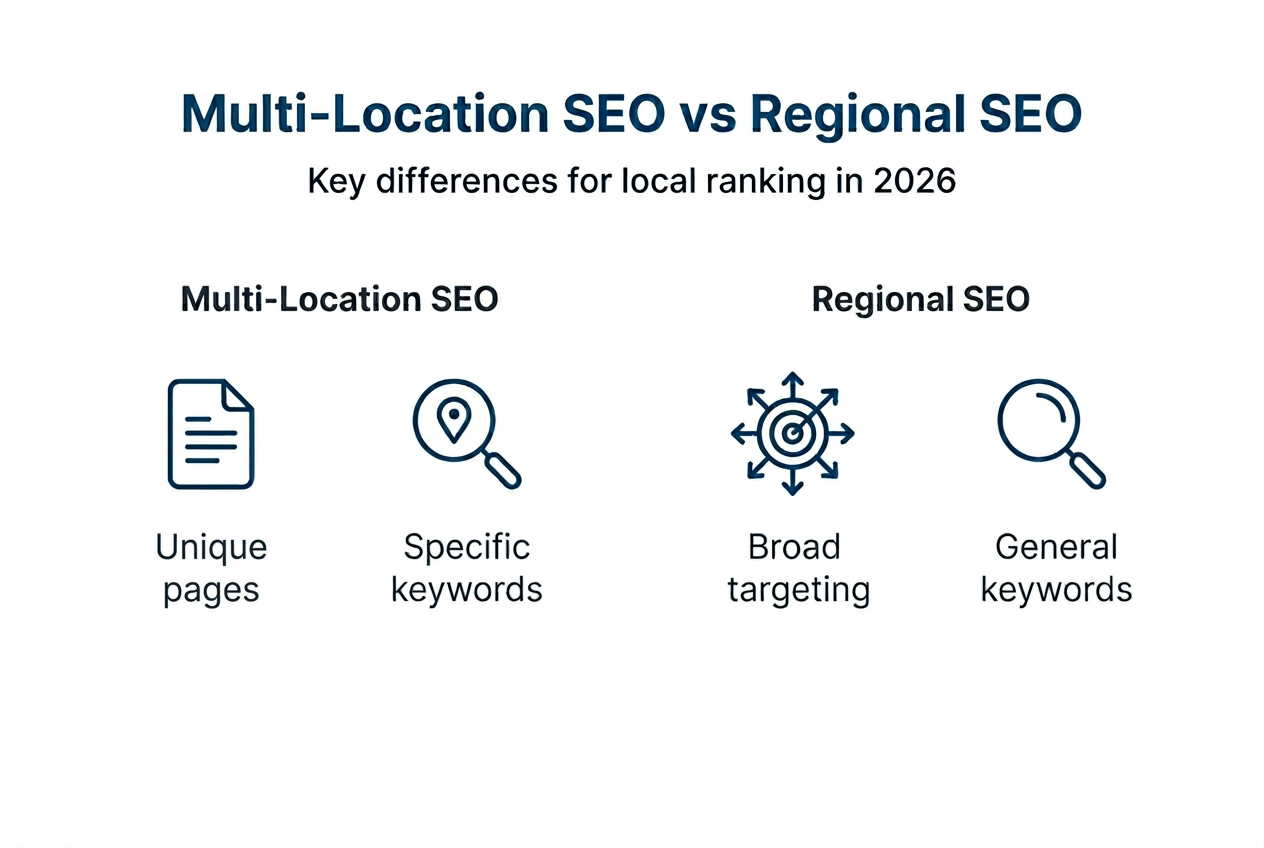
The difference between regional SEO and multi-location local SEO is precision. Regional SEO targets broad areas with general content. Multi-location SEO creates hyper-focused strategies for each address, speaking directly to neighborhood-level search intent. This granular approach drives significantly better conversion rates because you're answering the exact questions local searchers ask.
How AI is transforming multi-location SEO in 2026
AI revolutionizes multi-location SEO by automating time-consuming tasks and uncovering insights human analysis would miss. Here's how it works in practice.
AI-powered keyword research generates location-specific keyword sets automatically. Instead of manually researching keywords for each location, AI tools analyze local search patterns, competitor rankings, and regional language variations. You get comprehensive keyword lists tailored to each market in minutes, not weeks.
AI-driven content creation produces geo-specific landing pages at scale. These tools generate unique, relevant content for each location while maintaining brand voice and including local keywords naturally. The result? Pages that rank well without duplicate content penalties.
Competitor analysis becomes strategic with AI. Tools like competitor keyword analysis platforms monitor rival businesses' local strategies, backlink profiles, and content performance. AI can analyze competitor strategies to discover opportunities your rivals overlook.
Performance analytics powered by AI track rankings, traffic, and conversions across all locations simultaneously. The systems identify underperforming locations, suggest optimization priorities, and predict which changes will deliver the biggest impact.
Pro Tip: Use AI to identify gaps your competitors miss by analyzing their content for missing local keywords and topics. Creating content around these gaps establishes your locations as more comprehensive local resources, improving authority and rankings.
The role of AI in local SEO extends beyond automation. It provides predictive insights that help you allocate resources to high-impact activities, making multi-location management efficient even with limited marketing teams.
Creating geo-targeted content and landing pages for each location
Geo-targeted content addresses the specific needs, interests, and search behaviors of each location's audience. Generic pages saying "We serve multiple locations" fail to connect with local searchers who want proof you understand their community.
Creating optimized landing pages per location requires these steps:
- Research local keywords including neighborhood names, landmarks, and regional terminology
- Write unique content featuring local stories, community involvement, and location-specific services
- Include accurate NAP information matching your Google Business Profile exactly
- Add local schema markup to help search engines understand your location data
- Optimize for mobile since most local searches happen on smartphones
- Embed reviews and testimonials from customers at that specific location
- Create location-specific calls to action like "Visit our Downtown Seattle location" instead of generic CTAs
The impact is substantial. Businesses with geo-targeted landing pages see 30-40% higher conversion rates because the content resonates with local intent.

| Strategy | Conversion Rate | Organic Traffic Increase |
|---|---|---|
| Generic multi-location page | 2.1% | Baseline |
| Basic geo-targeted pages | 2.8% | +15% |
| AI-optimized geo-targeted pages | 3.5% | +35% |
Beyond conversion rates, geo-targeted pages improve your local SEO for AI search visibility. When AI assistants recommend local businesses, they prioritize those with clear, detailed location information and relevant local content.
Follow this local SEO checklist 2026 to ensure each landing page includes all critical optimization elements before publishing.
Best practices for managing SEO across multiple locations
Successful multi-location SEO requires systematic management to maintain consistency while allowing location-specific customization. These practices keep your strategy organized and effective.
Core management tasks include:
- Verify consistent NAP information across all platforms for every location
- Create and optimize Google Business Profiles for each address with unique descriptions, categories, and photos
- Build local citations on relevant directories, ensuring accuracy and completeness
- Monitor and respond to reviews individually for each location to build local reputation
- Track local rankings separately to identify which locations need optimization attention
- Update content regularly to reflect local events, seasonal offerings, and community involvement
Centralizing SEO management while empowering local input works best. Use a central team or agency to set standards, provide templates, and handle technical SEO. Allow location managers to contribute local knowledge, photos, and community updates that make content authentic.
Avoid these common pitfalls:
- Duplicate content across location pages triggers search engine penalties and dilutes rankings
- Inconsistent business information confuses search engines and customers, hurting all locations
- Neglecting underperforming locations creates visibility gaps competitors exploit
- Using single tracking for all locations hides individual performance issues
Pro Tip: Schedule quarterly audits using AI tools to verify NAP consistency, check for citation errors, and identify outdated content. Automation catches problems before they hurt rankings, and consistent local SEO practices significantly improve organic traffic and customer engagement.
Implement this local business search ranking guide as your management framework, adapting tactics to your specific business model and resources.
Enhance your multi-location SEO with expert digital marketing services
Mastering multi-location SEO demands time, expertise, and the right technology stack. Digital Marketing All specializes in AI-powered strategies that simplify complex multi-location challenges for businesses like yours.
Our platform combines advanced AI tools with proven local SEO tactics. We help you implement geo-fencing tactics that target local audiences with precision, ensuring your marketing reaches customers near each location.
Reputation management becomes effortless with our review generation and management services. Consistent positive reviews across all locations boost local rankings and build trust with potential customers. Our waiting room solutions even help convert website visitors into customers more effectively. Let our team handle the technical complexity while you focus on running your business.
Frequently asked questions
What is multi-location SEO and who needs it?
Multi-location SEO is the practice of optimizing search visibility for each physical business location separately, creating unique local authority for every address. Any business with two or more physical locations needs this strategy, including retail chains, restaurant franchises, medical practices with multiple offices, and service businesses operating in different cities. Without location-specific optimization, you lose local customers to competitors who appear more prominently in neighborhood searches.
How does AI improve local SEO for multiple locations?
AI automates time-intensive tasks like keyword research, content creation, and competitor analysis across all locations simultaneously. It generates location-specific keyword lists, creates unique geo-targeted content at scale, monitors competitor strategies, and provides predictive analytics to prioritize high-impact optimizations. This automation makes managing dozens or hundreds of locations feasible for small marketing teams while improving results through data-driven insights humans would miss.
Why are geo-targeted landing pages important?
Geo-targeted landing pages convert 30-40% better than generic pages because they address local search intent directly. When someone searches for services near them, they want confirmation you understand their community and can serve their specific needs. Pages featuring local keywords, neighborhood references, and location-specific content signal relevance to both search engines and potential customers, dramatically improving both rankings and conversion rates.
What are common mistakes in multi-location SEO to avoid?
The biggest mistakes include using duplicate content across location pages, maintaining inconsistent NAP information across platforms, neglecting underperforming locations, and tracking all locations as one entity instead of monitoring individual performance. These errors confuse search engines, trigger penalties, and hide problems until significant ranking damage occurs. Systematic management with regular audits prevents these issues before they impact visibility.
How often should I update my local SEO strategy for multiple locations?
Review and update your strategy quarterly to address algorithm changes, competitor movements, and seasonal opportunities. Perform monthly checks on critical elements like NAP consistency, Google Business Profile accuracy, and review response rates. Location-specific content should refresh whenever local offerings, events, or community involvement changes. AI monitoring tools can alert you to ranking drops or citation errors immediately, allowing real-time responses rather than waiting for scheduled reviews.