

What is keyword prominence and why does placement matter?
Keyword prominence is the practice of placing your target keyword in the most visible, high-impact areas of a webpage. It is not about how often a keyword appears. It is about where it appears first.
Search engines like Google scan a page from top to bottom during crawling. When they encounter your primary keyword early, in the right locations, they quickly confirm what the page is about. That early confirmation strengthens your relevance signal before any deeper semantic analysis begins.
The highest-impact positions for keyword prominence in 2026 are:
- Page URL: Including your keyword in the URL slug sends an immediate topical signal.
- Title tag: The single most prominent on-page SEO element. Keywords here carry the most weight.
- H1 heading: Your main page heading should reflect the same keyword as your title tag.
- Meta description: While not a direct ranking factor, it reinforces topical relevance and improves click-through rates.
- First 100 words: Keywords in the opening content correlate directly with first-page Google rankings.
Table of Contents
- How does keyword prominence differ from density, proximity, and consistency?
- Why keyword prominence is crucial for SEO success
- Effective strategies to optimize keyword prominence in web content
- How AI-driven search in 2026 amplifies the importance of keyword prominence
- Examples of keyword prominence across different content types
- Tools and methods to analyze keyword prominence on a webpage
- Key Takeaways
- FAQ
How does keyword prominence differ from density, proximity, and consistency?
These four concepts are related but measure completely different things. Confusing them leads to poor optimization decisions.

| Concept | What it measures | Primary focus |
|---|---|---|
| Keyword prominence | Where the keyword appears on the page | Placement priority |
| Keyword density | How often the keyword appears relative to total word count | Frequency |
| Keyword proximity | How close individual words within a phrase are to each other | Word spacing |
| Keyword consistency | Whether the same keyword is used uniformly across the page | Uniformity |
Prominence measures placement priority, not repetition. Density measures frequency. Proximity measures closeness between words in a phrase. Consistency measures whether you use the same term throughout rather than switching between synonyms.
Practical implications for your content:
- High prominence with low density can still produce strong rankings.
- Good proximity matters most for multi-word phrases like "local SEO services."
- Consistency prevents search engines from splitting your topical signals across multiple keyword variants.
Why keyword prominence is crucial for SEO success
Keyword prominence is a confirmed ranking factor, not a theory. Google has reinforced this guidance consistently, and it remains one of the clearest on-page signals you can control directly.
Google's John Mueller put it plainly: use your most important keyword in titles, headings, subheadings, and captions so that both users and Google immediately understand what the page covers. Burying a keyword at word 20,000 and calling it your primary focus is, in his words, "already doing things wrong."
Key insight: Keyword prominence acts as an intent anchor during the initial crawl, before AI and semantic models analyze content more deeply. Without it, even well-written content can be misclassified.
Pro Tip: Place your primary keyword within the first sentence of your opening paragraph, not just somewhere in the first section. That single adjustment often produces a measurable improvement in how quickly search engines classify your page.
Effective strategies to optimize keyword prominence in web content
The goal is natural, early placement across your most influential page elements. Mechanical stuffing does the opposite of what you want.
Best practices for strong keyword placement:
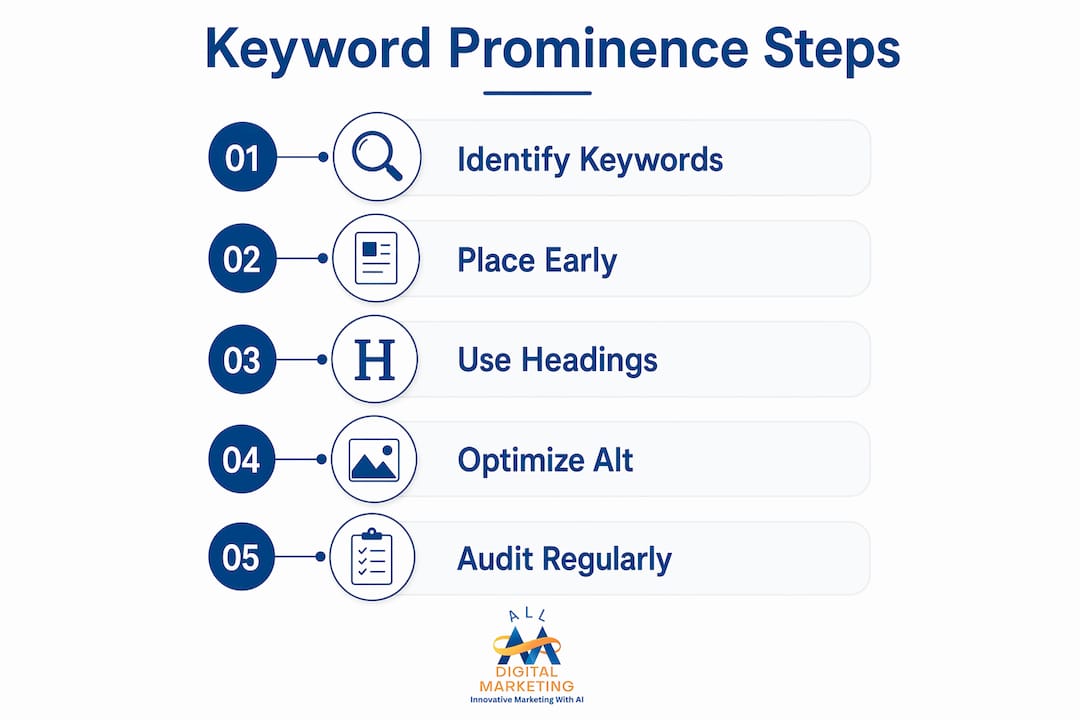
- Write your URL slug around the primary keyword before you publish.
- Open your title tag with the keyword rather than ending with it.
- Match your H1 to your title tag keyword, or use a close natural variant.
- Use the keyword early in your opening paragraph.
- Include it in at least one early H2 subheading where it fits naturally.
- Add it to image alt text when the image is directly relevant to the topic.
Common mistakes to avoid:
- Placing the keyword only in the conclusion or a mid-page section.
- Using a different keyword in the title tag than in the H1.
- Repeating the keyword so often in the opening paragraph that it reads unnaturally.
- Ignoring the URL slug entirely and leaving it as a string of numbers or stop words.
Pro Tip: Read your opening paragraph aloud after placing the keyword. If it sounds forced, rewrite the sentence until the keyword fits the way a person would actually say it. Readability and prominence are not in conflict.
How AI-driven search in 2026 amplifies the importance of keyword prominence

AI search models have not made keyword prominence obsolete. They have made it more important. Large language models and AI-driven ranking systems rely on early keyword signals to categorize content quickly before running deeper semantic evaluation.
Think of it this way: an AI model reading your page for the first time needs an immediate anchor to understand the topic. If your primary keyword appears clearly in the title, H1, and opening paragraph, the model gets a strong, consistent signal. Without that anchor, even high-quality content can be sorted into the wrong category.
AI systems are also highly effective at detecting keyword stuffing. Packing your keyword into the first paragraph five times does not improve prominence. It triggers a quality penalty. The standard in 2026 is early, natural placement, not aggressive repetition.
For a deeper look at how AI search ranking changes the visibility equation, the rules around prominence are central to staying competitive.
Examples of keyword prominence across different content types
Seeing keyword prominence applied across real content formats makes the concept concrete.
Title tags: A title like "Keyword Prominence: The On-Page SEO Signal That Drives Rankings" places the primary keyword at the very start. That is high prominence. A title like "On-Page SEO: Tips, Tricks, and Keyword Prominence" buries the keyword and weakens the signal.
H1 headings: Your H1 should mirror your title tag keyword closely. If your title targets "local SEO for restaurants," your H1 should open with that phrase or a direct variant, not a generic welcome statement.
Opening paragraphs: The initial part of your content is prime real estate. A blog post targeting "what is keyword density" should use that phrase very early, not after a long preamble about the history of SEO.
Subheadings: H2 and H3 tags that include the keyword or a close variant reinforce the topical signal throughout the page. This is especially useful for long-form content where the keyword might not appear frequently in the body text.
Image alt text: Alt text is a search-engine-visible location most writers overlook. When an image directly illustrates your topic, the alt text is a clean opportunity to add prominence without disrupting the reading experience.
For a full breakdown of how searcher intent optimization connects to keyword placement, the relationship between prominence and intent is direct.
Tools and methods to analyze keyword prominence on a webpage
You do not need expensive software to audit keyword prominence. Several practical methods work well.
Browser search (Ctrl+F / Cmd+F): The simplest audit. Search your primary keyword on your own page and note where it first appears. If the first result is below the fold or deep in the body, your prominence is low.
SEOptimer: This on-page SEO audit tool flags keyword placement issues, including whether your primary keyword appears in the title tag, H1, and meta description. It gives you a structured checklist rather than a manual scan.
Google Search Console: While it does not measure prominence directly, it shows which queries your page ranks for and at what position. A page with weak prominence often ranks for secondary terms instead of its primary keyword.
Manual content audit: Copy your page content into a plain text document. Scan the first 100 words and confirm your keyword appears there. Then check the title tag, H1, URL, and meta description one by one against a simple checklist.
Microsoft Clarity: This behavior analytics tool shows where users stop reading. If engagement drops before reaching your keyword, that is a signal your content structure needs adjustment, not just your keyword placement.
The most reliable method is a combination: run an automated audit with a tool like SEOptimer, then do a manual read to confirm the keyword placement sounds natural in context.
Key Takeaways
Keyword prominence is a confirmed ranking factor that works by placing your primary keyword in the most visible page elements, starting with the title tag, H1, URL, and first 100 words.
| Point | Details |
|---|---|
| Placement beats repetition | High prominence with low keyword density can still produce strong rankings. |
| First 100 words matter most | Keywords in opening content correlate directly with first-page Google rankings. |
| AI search amplifies prominence | AI models use early keyword signals as intent anchors before deeper semantic analysis. |
| Stuffing backfires | Modern AI algorithms detect and penalize unnatural keyword concentration at the top of a page. |
| Audit with real tools | Use SEOptimer or a manual checklist to confirm keyword placement across title, H1, URL, and meta description. |
FAQ
What does keyword prominence mean?
Keyword prominence refers to how early and visibly your target keyword appears in the most influential areas of a webpage, including the title tag, H1 heading, URL, and opening paragraph. It is about placement priority, not repetition.
Which best describes keyword prominence?
Keyword prominence is an on-page SEO signal that measures where a keyword appears, not how often. A keyword placed in the title tag and first 100 words has high prominence; one buried mid-page has low prominence even if it appears multiple times.
What is an example of keyword proximity?
Keyword proximity measures how close the individual words within a phrase are to each other. For example, "local SEO services" has tighter proximity than "local professional SEO consulting services," where extra words split the core phrase.
Is keyword prominence still relevant in 2026?
Yes. AI-driven search models rely on early keyword signals to categorize content quickly before running deeper semantic evaluation, making prominence more important, not less, in 2026.
How do you improve keyword prominence on an existing page?
Move your primary keyword into the title tag, H1, and the first sentence of your opening paragraph. Then confirm it appears in the URL slug and meta description. Those five changes cover the highest-impact locations.