

Digital marketing is no longer optional for small businesses competing in local markets. 80% of mobile local searches lead to store visits within a single day, yet many business owners still miss this massive opportunity. This guide breaks down how AI-powered strategies and local SEO combine to transform your online presence into a reliable lead generation engine. You'll discover proven tactics that drive measurable growth without overwhelming complexity or budgets.
Table of Contents
- Foundations of Digital Marketing
- Importance of Local SEO for Small Businesses
- Role of AI in Digital Marketing
- Common Misconceptions About Digital Marketing
- Practical Local SEO and AI-Driven Tactics
- Integrating Digital Marketing Channels for Maximum Lead Generation
- Summary and Action Plan for Implementation
- Discover Expert AI & Local SEO Marketing Solutions
- Frequently Asked Questions
Key Takeaways
| Point | Details |
|---|---|
| Multi-Channel Approach | Digital marketing encompasses SEO, PPC, content marketing, social media, and email to reach audiences effectively. |
| Local SEO Impact | Local SEO drives 80% store visits after local mobile searches within 24 hours. |
| AI Precision | AI improves lead targeting precision by 40% and boosts conversion rates 20-30% higher than static campaigns. |
| SEO + PPC Synergy | Combining SEO and PPC increases leads by up to 50% compared to single-channel efforts. |
| Google My Business | Optimizing Google My Business boosts local visibility by 50% for businesses targeting nearby customers. |
Foundations of Digital Marketing
Digital marketing uses online channels to connect businesses with potential customers where they already spend time. Unlike traditional advertising that broadcasts messages to broad audiences, digital strategies target specific groups with measurable precision. This shift matters because it delivers better ROI for limited marketing budgets.
Digital marketing encompasses SEO, PPC, content marketing, social media, and email to reach audiences effectively. Each channel serves different purposes in your customer journey. SEO builds long-term organic visibility. PPC delivers immediate traffic for time-sensitive campaigns. Content marketing establishes authority and nurtures prospects. Social media creates community engagement. Email maintains direct relationships with existing customers.
Multi-channel digital marketing increases engagement by up to 70% compared to single-channel approaches. Here's why integration matters:
- Search engines show your website to people actively looking for your services
- Social platforms build brand awareness among audiences who aren't yet searching
- Email converts warm leads who need additional touchpoints
- PPC captures high-intent buyers ready to act immediately
The digital marketing basics differ fundamentally from traditional methods. You track every dollar spent, measure specific actions taken, and adjust campaigns in real time. Small businesses gain the same sophisticated tools previously reserved for enterprise companies.
"Digital marketing democratizes business growth by making advanced targeting and analytics accessible to companies of all sizes, leveling the competitive playing field."
Your marketing stack should align with how customers discover and evaluate businesses in your industry. Service businesses often prioritize local SEO and reviews. E-commerce companies lean heavily on PPC and social ads. B2B firms invest in content marketing and email nurturing. The right mix depends on where your specific audience makes buying decisions.
Importance of Local SEO for Small Businesses
Local SEO targets customers in your geographic area when they search for products or services nearby. This precision matters because local SEO drives 80% store visits after local mobile searches within a day. People searching "plumber near me" or "best pizza in Seattle" have immediate buying intent.
Google My Business optimization boosts local visibility by 50% for businesses targeting nearby customers. Your Google Business Profile appears in map results, local pack rankings, and knowledge panels. These prime positions capture attention before users even click to your website.
Effective local SEO requires several coordinated tactics:
- Claim and verify your Google Business Profile with accurate NAP information
- Collect and respond to customer reviews consistently
- Build local citations on directories and industry sites
- Create location-specific content targeting neighborhood keywords
- Optimize your website with local schema markup
Here's how local SEO metrics compare across implementation stages:
| Stage | Search Visibility | Monthly Leads | Review Count | Map Ranking |
|---|---|---|---|---|
| Not Optimized | 10-20% | 5-10 | 0-5 | Not ranked |
| Basic Setup | 30-40% | 15-25 | 10-20 | Position 8-10 |
| Fully Optimized | 70-85% | 40-60 | 50+ | Position 1-3 |
Geotargeting lets you focus marketing spend on areas where you actually serve customers. A roofing company doesn't need visibility in cities 100 miles away. Reputation management strengthens your local presence by showcasing satisfied customers to prospects researching their options.
You can optimize local search visibility faster than national SEO because competition stays regional. Most small businesses still neglect basic optimization, creating immediate opportunities. The businesses that invest in Google My Business optimization consistently outrank competitors in map results and local pack positions.
Service area businesses benefit just as much as storefronts. HVAC contractors, electricians, and consultants all appear in local results when potential customers need help. Even B2B companies targeting regional accounts gain advantage through local SEO focused on business districts and commercial areas.
Role of AI in Digital Marketing
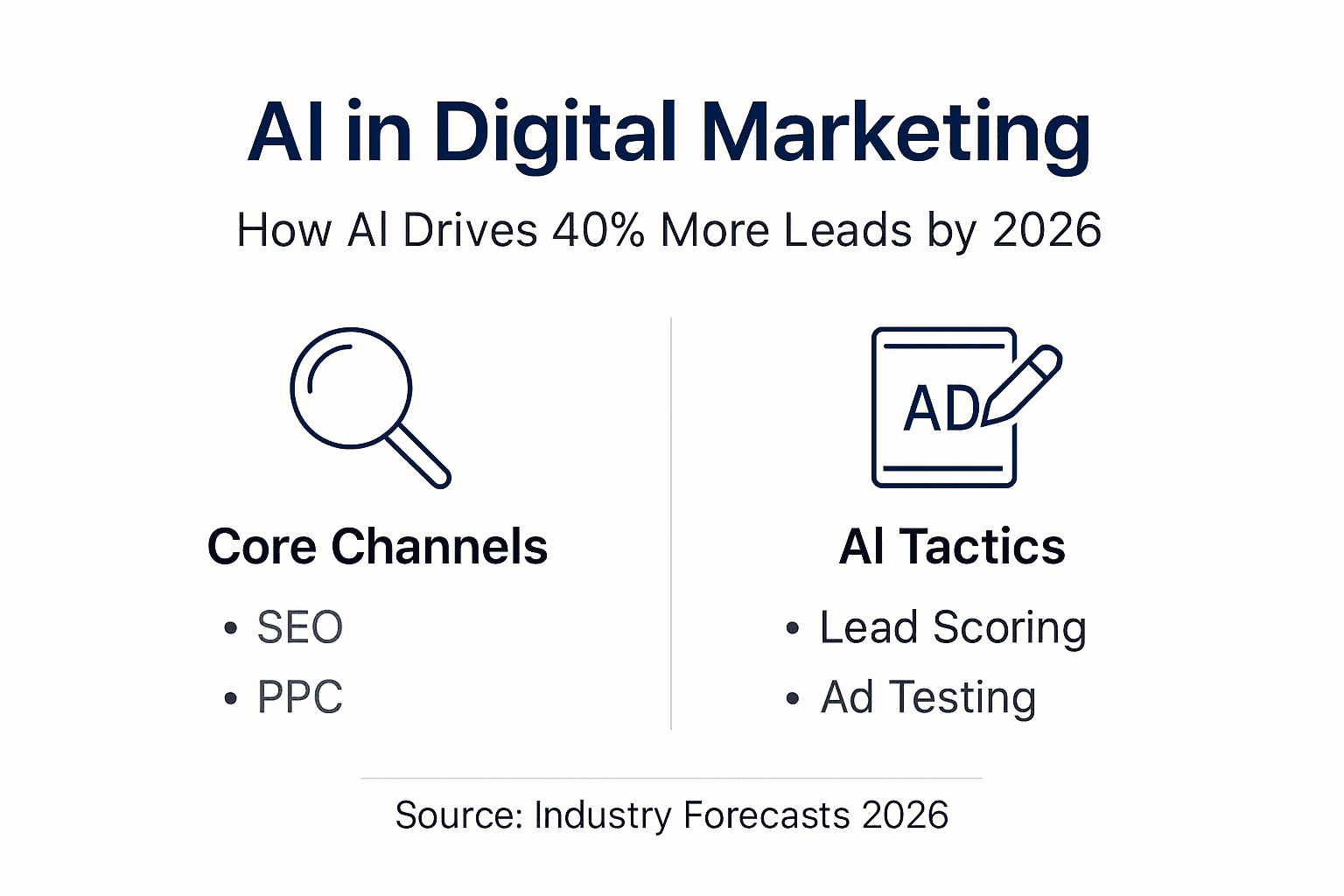
AI transforms digital marketing from reactive guesswork into predictive precision. Machine learning algorithms analyze customer behavior patterns, predict future actions, and automate optimization at speeds impossible for human marketers. This capability matters because AI improves lead targeting precision by 40% while reducing wasted ad spend.

AI-driven personalization delivers the right message to each prospect based on their browsing history, demographic data, and engagement patterns. Someone who visited your pricing page three times sees different content than a first-time visitor. This relevance increases conversion rates by making every interaction feel tailored to individual needs.
The measurable benefits extend across your entire marketing funnel:
- Predictive analytics forecast which leads will convert before you contact them
- Dynamic content adjusts website copy and offers based on visitor segments
- Chatbots qualify prospects and answer questions 24/7 without staffing costs
- Automated bid optimization adjusts PPC campaigns every hour for maximum ROI
- Sentiment analysis monitors brand mentions and identifies reputation issues early
AI optimizes ad conversion rates 20-30% higher than static campaigns by continuously testing variables humans miss. The technology identifies micro-patterns in time of day, device type, audience segment, and creative elements that influence buying decisions. These insights compound over time as algorithms learn what works for your specific business.
Pro Tip: Start with one AI tool focused on your biggest bottleneck. If lead quality is poor, use AI-powered audience targeting. If conversion rates lag, try AI chatbots or dynamic landing pages. Master one application before expanding to others.
Small businesses access enterprise-level AI through affordable SaaS platforms. You don't need data scientists or six-figure budgets. Tools like AI in local SEO solutions integrate with existing systems and show results within weeks. The AI benefits for small business extend beyond marketing into operations, customer service, and strategic planning.
Common AI applications for SMEs include email subject line optimization, social media post scheduling based on engagement patterns, and content recommendations that keep website visitors exploring longer. Each automation frees your time while improving performance metrics that directly impact revenue.
Common Misconceptions About Digital Marketing
Many small business owners hold beliefs about digital marketing that limit their success. Understanding reality versus perception helps you make smarter strategic decisions. Let's address the three most damaging misconceptions.
Misconception #1: Digital marketing equals only social media advertising. Reality shows 58% of SMB owners incorrectly associate digital marketing solely with social media. Social platforms represent just one channel in a comprehensive strategy. SEO, PPC, email, content, and website optimization often deliver better ROI depending on your industry and customer journey.
Misconception #2: AI marketing is too complex and costly for SMEs. Modern AI tools are built specifically for small businesses without technical teams. Cloud-based platforms handle the complexity while you focus on strategy and results. Monthly costs often run less than hiring one part-time marketing employee, and AI marketing misconceptions prevent businesses from accessing game-changing advantages already available.
Misconception #3: Local SEO only matters for retail stores. Service businesses, B2B companies, and professional services all benefit from local search optimization. Lawyers, accountants, consultants, and contractors win clients through local search. Anyone serving a specific geographic area needs local SEO regardless of whether customers visit a physical location.
These myths persist because digital marketing evolved rapidly over the past decade. What seemed true five years ago no longer applies. The tools became more accessible, AI democratized advanced tactics, and mobile search behavior shifted how people discover businesses.
Pro Tip: Audit your current marketing beliefs by tracking actual results rather than assumptions. If you think email doesn't work, test a campaign and measure open rates. If you believe AI is too expensive, compare monthly subscription costs to your current manual processes.
Breaking free from misconceptions opens strategic options you previously dismissed. Multi-channel approaches outperform single-tactic efforts. AI tools enhance rather than complicate your marketing. Local SEO drives qualified leads for virtually every business model. Start by questioning one assumption that's held you back, then test the alternative.
Practical Local SEO and AI-Driven Tactics
Implementing effective strategies requires specific steps you can start today. These tactics combine local SEO fundamentals with AI-powered optimization for maximum lead generation. Each action builds on the previous one to create compounding results.
Step 1: Optimize Your Google Business Profile Completely. Optimizing Google My Business boosts local visibility by 50%, making this your highest-priority task. Add accurate business hours, service descriptions, photos, and your website link. Select the most specific business categories. Post weekly updates about offers, events, or helpful tips.
Step 2: Build a Systematic Review Collection Process. Automate review requests after successful transactions using email or SMS. Respond to every review within 24 hours, addressing concerns and thanking supporters. Reviews signal trust to both search algorithms and potential customers researching your business.
Step 3: Integrate SEO and PPC for Synergistic Growth. Combining SEO and PPC increases leads by up to 50% compared to using either alone. Use PPC data to identify high-converting keywords, then target them with SEO content. Bid on branded terms to dominate search results pages completely. This integrated approach maximizes visibility while improving cost efficiency.
Step 4: Deploy AI Analytics for Lead Prediction. AI tools analyze which website visitors and ad clickers are most likely to convert based on behavior patterns. Focus sales outreach on these high-probability leads first. The technology scores prospects automatically, letting you prioritize efforts where they'll generate the most revenue.
Step 5: Create Location-Specific Landing Pages. Build dedicated pages for each service area or neighborhood you target. Include local landmarks, area-specific content, and customer testimonials from that location. These pages rank for geo-modified keywords and convert better because they feel relevant to local searchers.
Here's how SEO and PPC compare for different lead generation goals:
| Factor | SEO | PPC |
|---|---|---|
| Time to Results | 3-6 months | Immediate |
| Cost per Lead | Lower long-term | Higher short-term |
| Lead Volume | Grows over time | Consistent if funded |
| Best For | Sustained growth | Quick tests, promotions |
| Targeting Precision | Keyword-based | Highly granular |
Your budget allocation should match business stage and goals. New businesses need PPC for immediate leads while building SEO foundations. Established companies shift more budget to SEO as organic rankings improve. Most successful strategies maintain both channels at varying investment levels.
Explore local PPC tips for campaigns targeting nearby customers. Learn to optimize local search presence through comprehensive tactics. Master AI PPC lead generation techniques that improve campaign performance automatically.
Integrating Digital Marketing Channels for Maximum Lead Generation
Single-channel marketing leaves money on the table. Integration multiplies effectiveness by creating touchpoints throughout the customer journey. When channels work together, each amplifies the others rather than competing for budget.
SEO and PPC synergy drives 50% more leads than isolated efforts. Your SEO content educates prospects and builds trust. PPC retargets those engaged visitors with timely offers when they're ready to buy. This coordinated approach nurtures leads through awareness, consideration, and decision stages efficiently.
Your website serves as the conversion hub where all channels direct traffic. Conversion-focused web design lifts leads 15-20% by removing friction from the buying process. Fast loading speeds, clear calls to action, mobile optimization, and trust signals like reviews all influence whether visitors become customers.
Reputation management enhances every other channel's performance. Reputation management enhances customer acquisition by 25% because prospects research reviews before contacting businesses. Strong ratings improve PPC quality scores, boost SEO rankings through review signals, and increase social media credibility.
Choosing the right marketing tools requires evaluating several factors:
- Ease of use: Can your team operate it without extensive training?
- Integration capability: Does it connect with your existing CRM and analytics?
- Local market focus: Does it prioritize geographic targeting and local SEO?
- Proven results: Can the vendor show case studies from similar businesses?
- Cost structure: Does pricing scale reasonably as you grow?
Successful integration demands continuous performance measurement. Track leads by source channel to identify what's working. Monitor cost per lead across SEO, PPC, social, and email. Calculate customer lifetime value to determine which channels attract the most profitable customers. Use these insights to shift budget toward highest-performing tactics.
Implement AI marketing integration strategies that automate cross-channel optimization. Combine local SEO and PPC integration approaches for geographic market dominance. The businesses that master channel coordination consistently outperform competitors stuck in single-tactic thinking.
Summary and Action Plan for Implementation
You now understand how AI and local SEO combine to generate qualified leads for small businesses. The strategies covered deliver measurable results when implemented systematically. Your next step is moving from knowledge to action with a practical roadmap.
AI and local SEO provide SMEs with precision targeting previously available only to enterprise companies. These technologies level the competitive playing field while reducing wasted marketing spend. The measurable benefits include 40% improved lead targeting, 50% visibility increases through local optimization, and 20-30% higher conversion rates from AI-optimized campaigns.
Follow this five-step implementation plan:
-
Set clear goals with specific metrics. Define exactly what success looks like: number of leads, cost per lead, revenue from digital channels. Track these numbers weekly.
-
Audit your current digital presence. Assess your Google Business Profile, website performance, review ratings, and existing marketing channels. Identify the biggest gaps.
-
Prioritize quick wins first. Claim and optimize your Google Business Profile, set up review collection, and fix critical website issues. These deliver fast results that build momentum.
-
Implement one AI tool focused on your biggest bottleneck. Choose lead qualification, ad optimization, or personalization based on where you're losing the most opportunity. Master it before adding others.
-
Establish measurement and optimization routines. Review performance data every week. Test one variable at a time. Scale what works and cut what doesn't. Continuous improvement compounds over months.
Avoid these common pitfalls that derail digital marketing success:
- Overreliance on social media while neglecting search visibility where buying intent is higher
- Ignoring local SEO despite serving a specific geographic market
- Underestimating AI setup and learning curves without allocating time for mastery
- Expecting immediate results from SEO when it requires 3-6 months to gain traction
- Failing to track ROI by channel, making budget decisions based on assumptions
Start with manageable steps that fit your current resources. You don't need to implement everything simultaneously. Focus on foundations first, then layer in advanced tactics as you gain experience and see results. Scale AI usage gradually as you identify which applications deliver the strongest ROI for your specific business model.
Discover Expert AI & Local SEO Marketing Solutions
You've learned the strategies that drive digital marketing success for small businesses. Now it's time to accelerate your results with expert guidance and proven tools. Digital Marketing All specializes in AI-powered marketing and local SEO solutions designed specifically for businesses targeting nearby customers.
Our team helps you implement the exact tactics covered in this guide, from Google Business Profile optimization to AI-driven PPC campaigns that deliver qualified leads consistently. We've helped hundreds of small businesses increase local visibility and convert more website visitors into paying customers.
Explore our comprehensive resources to deepen your expertise. Our AI-driven PPC guide walks through campaign setup and optimization strategies that maximize ROI. The local SEO optimization guide provides step-by-step instructions for dominating local search results. Learn advanced search strategies through our SEO vs GEO vs SEM strategies comparison.
We combine AI precision with local market expertise to position your business where customers are searching. Whether you need comprehensive digital marketing management or focused support for specific channels, our solutions scale with your goals and budget. Start transforming your online presence into a reliable lead generation engine today.
Frequently Asked Questions
What is digital marketing and how does it differ from traditional advertising?
Digital marketing uses online channels like search engines, social media, email, and websites to reach targeted audiences where they already spend time. Unlike traditional advertising that broadcasts messages to broad audiences through TV, radio, or print, digital strategies deliver measurable precision. You track every interaction, adjust campaigns in real time, and target specific demographics or behaviors. This data-driven approach provides better ROI for limited budgets and lets small businesses compete effectively against larger competitors.
How long does it take to see results from local SEO efforts?
Basic local SEO improvements like claiming your Google Business Profile and collecting initial reviews can show results within 2-4 weeks as your listing appears in map results. More comprehensive local SEO including citation building, content creation, and review accumulation typically requires 3-6 months to achieve top rankings in competitive markets. The timeline depends on your current online presence, competition level, and implementation consistency. Quick wins come first, while sustained top rankings build gradually through ongoing optimization.
Can small businesses afford AI marketing tools?
Modern AI marketing platforms are specifically designed for small business budgets, with many tools costing less than $100-300 monthly. Cloud-based SaaS solutions handle technical complexity while you focus on strategy. Compare this cost to hiring marketing staff or wasting ad spend on poorly targeted campaigns. Most AI tools pay for themselves through improved conversion rates and reduced manual work within the first month. Start with one focused application addressing your biggest bottleneck, then expand as you see ROI.
Should I invest more in SEO or PPC for lead generation?
The optimal mix depends on your business stage and goals. New businesses need PPC for immediate leads while building SEO foundations over 3-6 months. Established companies with existing rankings can shift more budget to SEO for lower cost-per-lead long-term. Most successful strategies maintain both channels because they work synergistically, with PPC providing quick results and valuable keyword data while SEO builds sustainable organic visibility. Combining SEO and PPC increases total leads by up to 50% compared to using either alone.
How do I measure digital marketing ROI effectively?
Track leads and revenue by specific channel using UTM parameters, call tracking numbers, and form attribution. Calculate cost per lead by dividing total channel spend by leads generated. Measure customer lifetime value to determine which channels attract the most profitable customers. Set up conversion tracking in Google Analytics and your CRM to connect marketing activities to actual sales. Review these metrics weekly, test one variable at a time, and shift budget toward highest-performing tactics. Focus on revenue impact rather than vanity metrics like impressions or clicks.