

Citation building is the process of creating and managing online mentions of your business's name, address, and phone number across directories, maps, and websites so search engines can verify your business is real and rank it in local results. The single best first step you can take right now is to run a citation audit: search your business name across Google, Yelp, and the major data aggregators, then record every variation you find in a spreadsheet. That audit becomes your roadmap for everything that follows, from fixing inconsistencies to claiming new listings on the platforms that matter most.
Key Takeaways
Citation building is a data-accuracy discipline: businesses with consistent, cross-validated NAP records across authoritative directories rank higher in local search, appear in AI-generated answers, and avoid the customer-facing damage that incorrect listings cause.
| Point | Details |
|---|---|
| Audit before you build | Run a full citation audit and create a canonical NAP record before submitting to any new directories. |
| Fix aggregators first | Correcting records at the aggregator level propagates fixes broadly and produces faster ranking improvements than adding new listings. |
| Quality over volume | Accurate listings on authoritative platforms outperform large numbers of weak or inconsistent citations. |
| Monitor on a schedule | Re-audit your full citation set quarterly and trigger a manual check any time your address, phone, or hours change. |
| Digital Marketing All | Provides done-for-you citation audits, canonical NAP setup, profile claiming, and ongoing monitoring for local businesses. |
Table of Contents
- What is citation building, and what counts as a local citation?
- Why does citation building matter for local SEO and visibility?
- How do you build local citations step by step?
- Which platforms and tools should you use for citations?
- What are the best practices for keeping citations accurate?
- How do you monitor citations and confirm they are indexed?
- Should you build citations yourself or hire a provider?
- What does research say about citations, entity trust, and reputation risk?
- Do citation strategies differ by industry or business type?
- How do citations affect voice search and AI-driven local search?
- What are the legal and compliance considerations for virtual addresses?
- An editorial perspective on what citation building actually demands
- Digital Marketing All handles citation audits and listing management for you
- Sources
- FAQ
What is citation building, and what counts as a local citation?
A local citation is any online mention of your business that includes at least your name, address, and phone number—commonly called NAP. Most citations also carry your website URL, business hours, and categories, making them NAP+W records. The more complete and consistent those fields are, the more useful the citation is to both search engines and potential customers.
Citations come in two forms. Structured citations appear in directory-style listings where each field has its own slot: Google Business Profile, Yelp, Bing Places, and industry directories all follow this model. Unstructured citations are editorial mentions in blog posts, news articles, event pages, or local guides where your business details appear in running text rather than a form.
Both types count. A restaurant review on a local food blog that names your address is an unstructured citation. Your Yelp profile is a structured one. Search engines read both, but structured citations carry more predictable weight because the data is machine-readable.
| Citation type | Where it appears | Example |
|---|---|---|
| Structured | Directory or map listing | Google Business Profile, Yelp, Bing Places |
| Unstructured | Editorial content | "Visit Joe's Plumbing at [street address]" in a local blog post |
The formatting of your NAP matters as much as its presence. "Suite 200" and "Ste 200" look identical to a human but read as two different addresses to an algorithm. Pick one format and use it everywhere, copy-pasted from a master record, not retyped from memory.
Why does citation building matter for local SEO and visibility?
Google's local algorithm uses citation cross-validation as a trust signal. When your business name, address, and phone number appear consistently across authoritative sources, Google gains confidence that your entity is real and correctly located. Inconsistent listings fragment that signal, which can suppress your rankings in the local pack and on Google Maps. Moz explains that inconsistent citations can fragment an entity and harm local visibility directly.
The customer-facing risk is just as real. A wrong phone number on a directory listing means a potential customer calls a disconnected line and moves on to your competitor. A stale address sends someone to your old location. These are not hypothetical scenarios; they happen every day to businesses that built citations years ago and never revisited them.
Incorrect business listing information carries a direct reputation cost. Research cited by Moz indicates that over half of consumers would leave a negative review after finding incorrect business information online. A single outdated listing can trigger that reaction, and a negative review is far harder to remove than a corrected address field.
The connection to AI-driven discovery is newer but growing fast. Tools like Google's AI Overviews, ChatGPT's local search features, and voice assistants all pull from the same structured data ecosystem that powers traditional local SEO. Clean, consistent citations improve the chances of being surfaced by AI tools because those systems rely on verified, cross-referenced entity data to generate confident answers. If your NAP is fragmented, AI tools simply skip you or cite a competitor whose data is cleaner.
How do you build local citations step by step?
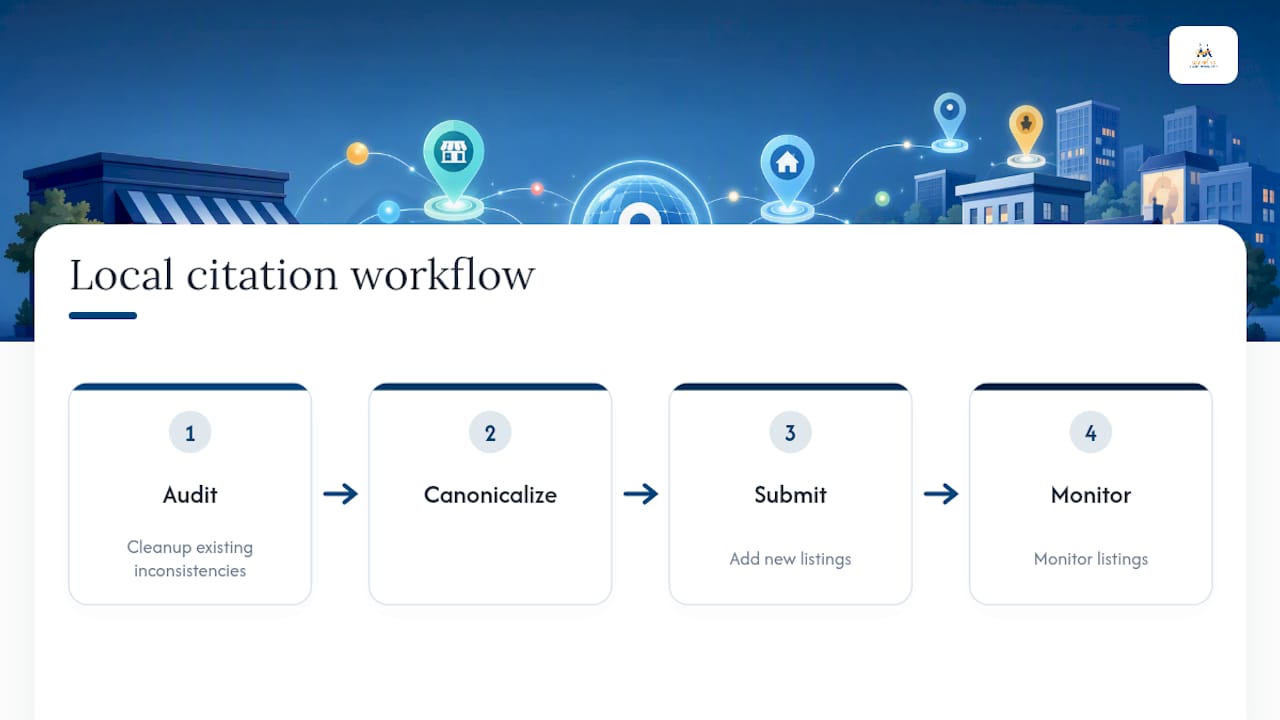
The recommended workflow moves in four stages: audit, canonicalize, submit, and monitor. Cleanup work on existing inconsistencies often produces faster local ranking improvements than adding new listings, so resist the urge to skip straight to submission.
Step 1: Run a citation audit
Search your business name, phone number, and address variations across Google, Yelp, Facebook, and the major data aggregators (Neustar Localeze, Data Axle, Foursquare). Tools like BrightLocal's Citation Tracker or Whitespark's Citation Finder automate much of this. Log every listing you find, including the URL, the NAP as it currently appears, and any discrepancies.
Step 2: Create a canonical NAP record
Before touching a single listing, build a master record in a spreadsheet. Decide on the exact spelling of your business name, the exact address format (including suite notation), the phone number format (with or without parentheses), and your primary website URL. This master record is your single source of truth. Every listing gets populated by copy-pasting from it, not by retyping.
Fields to include in your canonical record:
- Legal business name (exactly as registered)
- Street address, suite format, city, state, ZIP
- Primary phone number (choose one format and keep it)
- Website URL (with or without trailing slash, consistently)
- Business categories (primary and secondary)
- Business description (under 250 words, no keyword stuffing)
- Hours of operation
- Email address
- Notes on alternate or tracking numbers
Step 3: Fix aggregators first, then claim core profiles
Data aggregators like Neustar Localeze and Data Axle push your business information to hundreds of downstream directories. Fixing your record at the aggregator level propagates corrections broadly and efficiently. After aggregators, claim and optimize your Google Business Profile, Yelp, and Bing Places listings. Then move to industry-specific and locality-specific directories.

Step 4: Submit to additional directories
Submission options include manual entry (you fill out each form yourself), aggregator submission services, or listing management platforms like Semrush Listing Management, BrightLocal, or Whitespark. Manual works fine for a handful of listings. At scale, a platform or agency saves significant time.
Pro Tip: Never submit to a directory you cannot verify or log into later. If you lose access to a listing, correcting it in the future becomes a support ticket nightmare. Always use a business email address you control, and store login credentials in a password manager.
A realistic timeline: expect two to four weeks for aggregator updates to propagate, and four to eight weeks for new directory listings to be indexed by Google. Prioritize quality over speed.
Which platforms and tools should you use for citations?
Every U.S. local business should claim these core platforms first, as Search Engine Journal recommends:
Google Business Profile is non-negotiable. It feeds Google Maps, the local pack, and Google's AI Overviews. Claim it, verify it by postcard or phone, and fill every field completely including photos, hours, and service areas.
Yelp carries strong domain authority and is a primary source for voice assistants like Siri and Amazon Alexa. Even if you do not actively solicit Yelp reviews, an unclaimed profile is a liability because anyone can suggest edits to it.
Bing Places is often overlooked, but Bing powers search results on Microsoft Edge, Cortana, and a significant share of desktop searches. Claiming it takes under 30 minutes and can import directly from your Google Business Profile.
Beyond the core three, the right additional directories depend on your industry and location. A law firm should be on Avvo and FindLaw. A restaurant should be on TripAdvisor and OpenTable. A home services contractor should be on Angi and HomeAdvisor. Local chambers of commerce and city business directories are valuable for any business type.
For managing citations at scale, three tools stand out:
BrightLocal offers a Citation Tracker, a Citation Builder service, and audit reports that show you exactly which listings exist, which are inconsistent, and which are missing. It is well-suited for agencies managing multiple clients.
Whitespark specializes in citation finding and building, with a strong focus on local search. Its Citation Finder tool identifies where competitors have citations that you do not, which is a practical way to find gaps.
Semrush Listing Management lets you push your business data to dozens of directories from a single dashboard and monitors for changes. It integrates with the broader Semrush SEO suite, making it a natural fit if you already use Semrush for keyword research or rank tracking.
What are the best practices for keeping citations accurate?
Consistency is the foundation. Every listing must match your canonical NAP record exactly, including punctuation, abbreviations, and suite formatting. Small businesses often fragment their entity unintentionally through minor formatting differences: "Suite 4" versus "Ste. 4," or "(555) 123-4567" versus "555-123-4567." To Google's entity-matching system, those are different businesses.
Follow these practices to keep your citation footprint healthy:
- Use one canonical phone number. If you use call tracking numbers for advertising, keep your primary NAP phone number consistent across all organic listings. Use tracking numbers only in paid ad campaigns.
- Avoid keyword stuffing in your business name. Listing your business as "Joe's Plumbing Best Plumber Chicago" violates Google's guidelines and can get your profile suspended.
- Use consistent categories. Choose the most accurate primary category and limit secondary categories to those that genuinely describe your services.
- Audit for duplicates quarterly. Duplicate listings split your citation signals and confuse customers. When you find one, claim it and request a merge or deletion through the platform's support process.
- Assign citation ownership internally. One person on your team should own the master NAP record and be responsible for updating all listings when your address, phone, or hours change.
Pro Tip: When you move locations or change your phone number, update your aggregator records first. Aggregators push data downstream, so fixing the source prevents the wrong information from re-appearing on directories you already corrected manually.
Virtual addresses and shared office suites carry additional risk. Google's guidelines prohibit listing a virtual office address unless a staff member is physically present there during stated hours. Using a virtual address that does not meet this standard can result in a suspended Google Business Profile.
How do you monitor citations and confirm they are indexed?
Building citations is not a one-time task. Listings change, get edited by third parties, or simply fall out of sync when you update your website or phone number. A monitoring routine keeps your citation footprint accurate over time.
To confirm a citation is indexed, search Google for the exact URL of the listing (use site:yelp.com/biz/your-business-name) or search your business name plus city and check whether the listing appears. Most directory listings index within two to six weeks of submission.
A practical monitoring spreadsheet should track these fields:
| Field | What to record |
|---|---|
| Platform name | Google Business Profile, Yelp, Bing Places, etc. |
| Listing URL | Direct link to the live listing |
| NAP as listed | Exact name, address, phone as it appears |
| Last verified date | Date you last confirmed the listing is live and accurate |
| Discrepancy notes | Any field that does not match your canonical record |
| Status | Live, pending, inconsistent, duplicate, or suppressed |
Re-audit your full citation set at least once per quarter. Trigger an immediate manual check any time you change your address, phone number, business name, or hours. BrightLocal and Semrush Listing Management both offer automated alerts when a listing changes, which is worth the subscription cost for businesses with more than a handful of locations.
Should you build citations yourself or hire a provider?
The right answer depends on four factors: how competitive your local market is, how many locations you operate, how much internal bandwidth you have, and how often your business details change.
DIY works well when you operate a single location in a low-to-moderate competition market, your NAP has been stable for years, and you have two to four hours per month to maintain listings. The manual process is straightforward: claim your core profiles, submit to a handful of industry directories, and check in quarterly.
Hiring a provider makes sense when you operate multiple locations, you are in a highly competitive vertical like legal, medical, or home services, or your business recently moved or rebranded. Agencies and listing management platforms handle the volume and have established relationships with directories that can speed up corrections.
When evaluating a vendor, ask these questions:
- Do you provide a full citation audit before starting work?
- Will I have login access to every profile you create on my behalf?
- How do you handle duplicates and suppression requests?
- Do you check for indexation after submission, or just confirm submission?
- What is your process when a listing reverts to incorrect information?
Red flags to watch for: a vendor who cannot show you an audit before quoting, one who submits to hundreds of directories without reviewing each for quality, or one who retains ownership of your listings rather than handing credentials to you. Understanding what to expect when outsourcing this work helps you ask the right questions and avoid vendors who treat citation building as a bulk-submission exercise rather than a data-accuracy process.
What does research say about citations, entity trust, and reputation risk?
Google's approach to local ranking treats citation consistency as an entity confidence signal. When your business name, address, and phone number appear the same way across authoritative sources, Google's systems can confidently match those mentions to a single entity and reward it with stronger local visibility. When the data is fragmented, that confidence drops.
The practical implication is direct: cleanup work on high-authority sources produces faster local ranking improvements than adding new low-quality listings. Fix your Google Business Profile, your aggregator records, and your top-tier directory listings before you spend time submitting to smaller directories. Accuracy on the sources Google trusts most is worth more than volume across sources it barely indexes.
The reputation dimension compounds the SEO risk. A customer who finds your wrong address on Apple Maps does not call to ask for the right one. They show up at the wrong location, leave frustrated, and write a review about the experience. That review then becomes a negative signal in your local reputation profile, which feeds back into local ranking. Fixing citations is not just an SEO task; it is a customer experience task.
For businesses that want to tie their citation work into a broader authority strategy, building E-E-A-T content alongside clean citations creates a reinforcing loop: structured data on your site aligns with your directory listings, and both signal the same verified entity to search engines and AI tools.
Do citation strategies differ by industry or business type?
Yes, and the differences are meaningful. The core NAP-consistency principles apply universally, but the directory mix, the category choices, and the volume of citations you need vary significantly by vertical.
Healthcare and legal businesses face the highest scrutiny. Patients and clients verify credentials before calling, so listings on Healthgrades, Zocdoc, Avvo, and FindLaw carry more weight than a generic business directory. Accuracy is also a compliance issue: a wrong address on a medical directory can affect insurance verification and patient routing.
Home services contractors (plumbers, electricians, HVAC) benefit most from Angi, HomeAdvisor, and Houzz, where consumers actively search for vetted providers. Reviews on these platforms feed directly into purchase decisions, so citation completeness and review volume work together.
Restaurants and hospitality need TripAdvisor, OpenTable, and Grubhub alongside the core three. Hours and menu accuracy matter more here than in almost any other vertical because a customer who shows up during hours listed as "open" and finds the door locked will not return.
Multi-location businesses face a different challenge: maintaining NAP consistency across dozens or hundreds of location pages while keeping each listing locally relevant. A listing management platform is almost always the right call at this scale, and each location needs its own Google Business Profile with location-specific categories and descriptions.
Service-area businesses (those that serve customers at the customer's location rather than a fixed address) should hide their physical address on Google Business Profile and define a service area instead. Listing a home address or a virtual office as a storefront violates Google's guidelines and risks suspension.
How do citations affect voice search and AI-driven local search?
Voice search queries are almost always local and intent-driven: "find a plumber near me," "what time does the hardware store close," "best Italian restaurant in downtown Austin." The answers come from the same structured data ecosystem that powers the local pack. If your Google Business Profile is complete and your citations are consistent, voice assistants can confidently surface your business. If your data is fragmented, they default to a competitor whose data is cleaner.

AI-driven local search adds another layer. Google's AI Overviews, ChatGPT's browsing features, and Perplexity's local answers all synthesize information from multiple sources. A business with consistent NAP across Google Business Profile, Yelp, Bing Places, and authoritative industry directories gives AI systems multiple corroborating data points to draw from. That cross-validation is what builds the entity confidence score these systems use to decide which businesses to recommend.
Schema markup on your website reinforces this. Adding LocalBusiness schema with your canonical NAP fields ties your site's structured data to your directory listings, giving AI crawlers a direct, machine-readable confirmation of your business details. Local SEO strategies that integrate AI signals treat citations and schema as two parts of the same entity-verification system, not separate tasks.
The practical takeaway: keep your Google Business Profile updated in real time (hours changes, holiday closures, new services), because voice assistants pull from it directly and often without the delay that affects directory propagation.
What are the legal and compliance considerations for virtual addresses?
Virtual offices and shared workspaces are common among service-area businesses, home-based businesses, and startups that want a professional address without a commercial lease. The compliance picture is more complicated than most business owners realize.
Google's guidelines require that any address listed on Google Business Profile be a location where a staff member is physically present during the hours stated on the listing. A virtual office where you receive mail but never actually work does not meet this standard. Listings that violate this policy are subject to suspension, which removes your business from Google Maps and the local pack entirely.
Yelp and Bing Places have similar policies, though enforcement is less aggressive than Google's. Both platforms reserve the right to remove listings that use addresses where the business is not genuinely operating.
Legal and licensing considerations vary by state and industry. Some professional licenses (contractor licenses, healthcare provider licenses, law firm registrations) require a physical address on file with the licensing board. Using a virtual address for your Google Business Profile while your license lists a different address creates a discrepancy that can surface in citation audits and raise questions with regulators.
If you operate from a co-working space like WeWork or Regus, check whether your membership agreement permits you to use the address as a business address for directory listings. Some agreements do; others do not. Using an address without that permission can result in the co-working operator requesting removal of your listing.
The safest approach for home-based businesses is to use a service-area configuration on Google Business Profile, hide the physical address, and define your coverage area by city or ZIP code. This keeps your home address private, complies with Google's guidelines, and accurately represents how your business actually operates.
An editorial perspective on what citation building actually demands
What most businesses get wrong about citation work
Citation building gets treated as a one-time setup task, and that misunderstanding is where most local SEO problems begin. Businesses claim their Google Business Profile, submit to a handful of directories, and consider the job done. Then they move offices, change their phone number, or rebrand, and the old data sits on dozens of directories for years, quietly undermining every new SEO effort.
The more useful mental model is to treat your citation footprint the way you treat your accounting records: something that requires a designated owner, a regular review cycle, and a single source of truth that everything else derives from. The businesses that rank consistently well in local search are not the ones with the most citations. They are the ones whose data is the most accurate across the sources that matter.
There is also a tendency to overweight volume. Submitting to 300 directories sounds impressive, but if 250 of them have low domain authority and inconsistent data standards, the net effect on your local rankings is negligible at best and actively harmful at worst. Quality and consistency matter more than raw citation volume, and the evidence for this is consistent across every credible local SEO study.
The AI dimension changes the stakes further. As more consumers use voice search and AI-generated answers to find local businesses, the businesses with clean, cross-validated entity data will be surfaced more often. That is not a prediction; it is already happening. The businesses that invested in citation accuracy two years ago are the ones appearing in AI Overviews today. The window to build that foundation before AI-driven local search becomes the dominant channel is narrowing.
Digital Marketing All handles citation audits and listing management for you
For local businesses that want accurate, well-managed citations without spending hours in spreadsheets, Digital Marketing All delivers a done-for-you citation service that covers the full workflow: audit, canonical NAP creation, aggregator fixes, core profile claiming, and ongoing monitoring. You receive a complete audit spreadsheet, login credentials for every profile created on your behalf, and indexation confirmation so you know the work is actually live.
Most citation cleanup campaigns run four to eight weeks from audit to indexed listings. Ongoing monitoring is available as a retainer, which makes sense for businesses in competitive markets or those with frequent data changes. If you are starting from scratch or recovering from a rebrand, a project-based engagement gets your foundation right before you invest in broader local SEO.
The next step is straightforward: request a citation audit through Digital Marketing All's AI and local search roadmap, or contact the team directly for a scope estimate. Whether you need a one-time cleanup or ongoing management, the process starts with knowing exactly what your citation footprint looks like today.
Sources
- What is NAP in Local SEO? - Moz
- How to Build Local Citations & Boost Your Visibility Online | Semrush
- NAP Consistency Checker 2026: Local Citation Audit | Backlynk
- Citation Building Tips for Local SEO Success (Complete 2026 Guide) | DirJournal
- A Guide to Local Citation Building - Search Engine Journal
FAQ
What is the meaning of citation building in local SEO?
Citation building is the process of creating and managing online mentions of your business's name, address, and phone number across directories, maps, and websites. Consistent citations help search engines verify your business as a real, trustworthy entity and improve your rankings in local search results.
How do you do local citation building?
Start with a citation audit to find all existing listings and record any NAP discrepancies. Create a canonical NAP record, fix aggregator data first, then claim and optimize your Google Business Profile, Yelp, and Bing Places listings before adding industry-specific directories.
What is a citation in the context of construction or home services?
For a construction or home services business, a citation is any online listing that includes your business name, address, and phone number on platforms like Angi, HomeAdvisor, Houzz, or the Better Business Bureau. These listings help local customers find and verify your business and contribute to your local search rankings.
How many citations does a local business need?
There is no universal target number. What matters is having accurate, consistent listings on the platforms your customers and search engines actually use. Prioritize Google Business Profile, Yelp, Bing Places, and the top industry-specific directories for your vertical before pursuing volume on lower-authority sites.
Can incorrect citations hurt your local SEO rankings?
Yes. Inconsistent NAP data across directories fragments your entity signal in Google's local algorithm, which can suppress your local pack rankings. Beyond SEO, incorrect listings send customers to wrong locations or disconnected phone numbers, which drives negative reviews and lost revenue.