

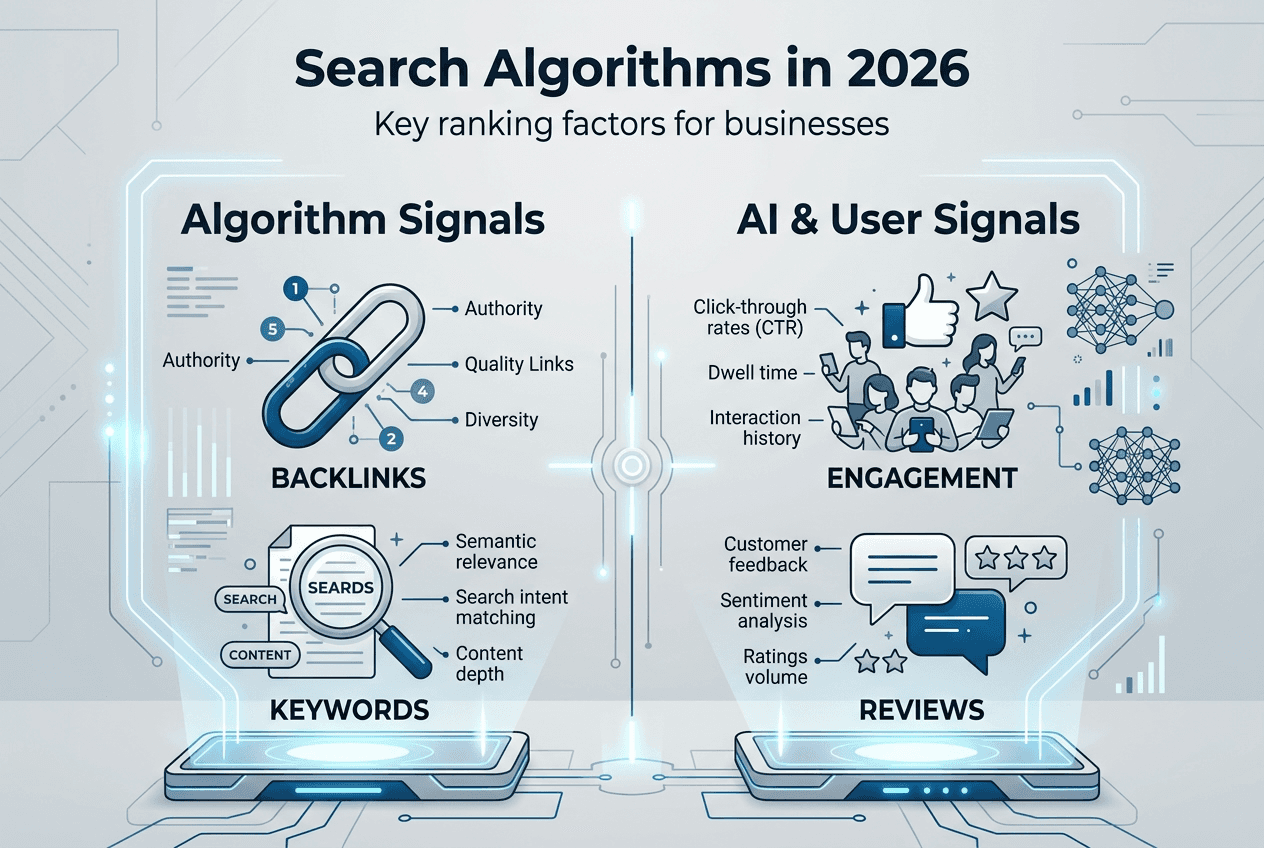
Most businesses spend thousands optimizing for keywords, yet user interaction signals now outweigh traditional factors in determining your actual rank position. The evolution from simple keyword matching to AI-powered semantic understanding has fundamentally changed how search engines evaluate and rank your content. This guide breaks down exactly how modern algorithms work, why AI technologies like Gemini 2.5 matter for your visibility, and what you can do right now to leverage these systems for better rankings and more customers.
Table of Contents
- What Are Search Engine Algorithms And Why They Matter For Your Business
- How AI Has Transformed Search Algorithms In 2026
- The Role Of User Signals And NavBoost In Search Rankings
- Practical Steps For Businesses To Leverage Search Algorithms And AI In 2026
- Discover Expert Digital Marketing Services For 2026 Success
Key takeaways
| Point | Details |
|---|---|
| AI drives modern search | Search algorithms now use advanced AI like Gemini 2.5 and BERT to understand user intent beyond simple keyword matching. |
| User signals dominate rankings | NavBoost and similar systems prioritize click data, dwell time, and engagement over traditional SEO factors. |
| Intent beats keywords | Modern algorithms focus on semantic meaning and context rather than exact keyword repetition. |
| Adaptation is essential | Businesses must align strategies with AI-driven ranking factors and user experience metrics to maintain visibility. |
What are search engine algorithms and why they matter for your business
Search engines use algorithms to evaluate and rank web pages based on hundreds of factors beyond just keywords. These complex formulas analyze everything from content quality and relevance to technical performance and user experience signals. Understanding how these systems work gives you a massive advantage in attracting customers who are actively searching for your products or services.
Think of algorithms as sophisticated sorting machines. When someone searches for "best accounting software for small business," the algorithm doesn't just match those exact words. It evaluates:
- Content relevance and depth of information
- Page loading speed and mobile responsiveness
- Author expertise and site authority (E-E-A-T: Experience, Expertise, Authoritativeness, Trustworthiness)
- User engagement metrics like time on page and bounce rate
- Backlink quality and quantity
- Freshness and regular content updates
The E-E-A-T principle has become central to how algorithms assess quality. Google wants to surface content created by people who actually know what they're talking about and have real experience in their field. This means your about page, author bios, and demonstrated expertise matter more than ever.
For your business, this matters because visibility drives revenue. If you understand what algorithms prioritize, you can structure your website and content to align with those priorities. Companies that grasp these mechanics consistently outrank competitors who rely on outdated tactics like keyword stuffing or link schemes.
Pro Tip: Set up Google Search Console alerts to monitor algorithm updates monthly, allowing you to adjust your strategy before ranking drops occur rather than reacting after the damage is done.
The shift toward user-centric ranking means your focus should be on creating genuinely helpful content that answers real questions. Algorithms have become remarkably good at detecting when content is created purely for search engines versus when it serves actual human needs. Learning how to rank on Google requires understanding this fundamental principle.
How AI has transformed search algorithms in 2026
Search technology has undergone a radical transformation from simple keyword matching to sophisticated semantic understanding. Modern search engines utilize AI technologies such as Gemini 2.5 and BERT to go beyond keywords and understand user intent. This evolution means your content strategy must shift from targeting specific phrases to addressing the underlying questions and needs driving those searches.
The AI revolution in search happened through several key technologies:
- BERT (Bidirectional Encoder Representations from Transformers): Analyzes the context of words in relation to all other words in a sentence, understanding nuance and conversational queries.
- Gemini 2.5: Google's latest multimodal AI that processes text, images, video, and audio to deliver comprehensive understanding of search intent.
- Knowledge Graph: Connects entities, facts, and relationships to provide direct answers and rich results beyond traditional blue links.
- Neural Matching: Bridges the gap between what users type and what they actually mean, even when the exact words don't appear on the page.
Google's AI-driven semantic search interprets meaning, context, and user goal, enhancing result relevance far beyond what keyword-based systems could achieve. When someone searches "how do I fix a leaky faucet," the algorithm understands they need step-by-step instructions, possibly video content, and likely product recommendations for replacement parts.
This fundamental shift changes everything about SEO strategy. You can no longer game the system with exact-match keywords repeated at specific densities. Instead, you need to think like your customers and create content that genuinely addresses their questions, concerns, and needs at different stages of their journey.
"AI integration in search algorithms represents the biggest shift in how businesses must approach online visibility since the invention of search engines themselves. The focus has moved from optimizing for machines to optimizing for human intent, with AI serving as the interpreter."
The practical impact for businesses is clear. Your content must demonstrate topical authority by covering subjects comprehensively rather than superficially. AI can detect when you've genuinely explored a topic versus when you've created thin content targeting a keyword. The AI search impact on rankings extends beyond traditional search results to how your brand appears in AI-generated recommendations and summaries.

Businesses leveraging AI for branding in 2026 gain competitive advantages by aligning their content strategy with how these systems actually work. The technology rewards depth, expertise, and genuine value over manipulation and shortcuts.
The role of user signals and NavBoost in search rankings
While most businesses obsess over backlinks and keywords, NavBoost is one of Google's strongest ranking signals based on user click data and interaction. This system fundamentally changed how rankings work by incorporating real user behavior into the algorithm. When people consistently click your result and stay on your page, NavBoost interprets this as a quality signal and can boost your rankings accordingly.
User signals are behavioral data points that search engines collect from actual searcher interactions:
- Click-through rate from search results
- Time spent on page (dwell time)
- Bounce rate and pogo-sticking (returning to search results quickly)
- Scroll depth and engagement with content
- Return visits and brand searches
NavBoost leverages large-scale user feedback loops to refine search results prioritizing user engagement. This creates a powerful feedback mechanism where good user experiences lead to better rankings, which drive more traffic, creating a virtuous cycle for quality content.
| Traditional Ranking Factors | NavBoost User Signals |
|---|---|
| Backlink quantity and quality | Actual click-through rates from search results |
| Keyword optimization and placement | Time users spend engaging with content |
| Technical SEO elements | Return visits and brand loyalty signals |
| Domain authority metrics | Pogo-sticking and bounce patterns |
| Content length and structure | Scroll depth and interaction data |
What makes NavBoost particularly interesting is its history. The framework dates back to a 2004 patent, meaning Google has been refining user interaction data for over two decades. This isn't a new experiment but a mature, battle-tested system that has become increasingly sophisticated.
The practical implications are huge. You can have perfect technical SEO, stellar backlinks, and optimized content, but if users don't engage with your pages, NavBoost will gradually push you down. Conversely, pages that consistently satisfy users can outrank technically superior competitors.
Pro Tip: Use Google Analytics 4 to track engagement metrics like average engagement time and scroll depth, then systematically improve pages with high impressions but low engagement to capitalize on NavBoost's influence.
This user-centric approach means your content must deliver immediate value. The headline must match the searcher's intent. The opening paragraph must confirm they're in the right place. The information must be easy to scan and digest. Everything should guide them toward their goal without friction or distraction.
Businesses that boost their site with NavBoost focus relentlessly on user experience. They test different headlines, improve page speed, add helpful visuals, and structure content for easy consumption. These efforts compound over time as positive user signals reinforce higher rankings.
Practical steps for businesses to leverage search algorithms and AI in 2026
Understanding and leveraging AI-driven algorithms can dramatically improve online rankings and customer engagement. The key is moving from theoretical knowledge to concrete action. Start by auditing your current approach against what you now know about modern ranking factors.
Begin with a comprehensive assessment of your existing SEO efforts:
- Analyze your content for topical depth versus keyword targeting
- Review user engagement metrics in Google Analytics 4
- Identify pages with high impressions but low click-through rates
- Assess mobile experience and Core Web Vitals scores
- Evaluate whether your content demonstrates genuine expertise and experience
Once you understand your current position, implement AI-optimized content strategies:
- Focus on search intent: Research what users actually want when they search your target keywords, not just the keywords themselves.
- Create comprehensive topic clusters: Build pillar content covering subjects thoroughly, with supporting articles addressing specific questions.
- Optimize for featured snippets: Structure answers concisely with clear definitions, lists, and tables that AI can easily extract.
- Enhance E-E-A-T signals: Add author bios, credentials, case studies, and original research that demonstrate expertise.
- Improve user experience metrics: Reduce page load times, improve mobile responsiveness, and make content scannable with clear headings and visuals.
- Generate quality reviews: Encourage satisfied customers to leave detailed reviews that boost trust signals and local rankings.
User experience optimization directly impacts NavBoost rankings. Simple changes like adding a table of contents, breaking up long paragraphs, or including relevant images can significantly improve engagement metrics. Test different formats to see what keeps users on your pages longer.
Use specialized tools to identify opportunities your competitors are missing. Analyze keyword gaps where you could rank but currently don't. Study top-ranking pages to understand what type of content and format the algorithm currently favors for specific queries.
Create a systematic checklist for ongoing algorithm adaptation:
- Monthly review of Search Console data for ranking changes
- Quarterly content audits to refresh and expand top pages
- Regular competitor analysis to spot emerging trends
- Continuous testing of headlines, formats, and content structures
- Active monitoring of algorithm update announcements
Reviews and engagement signals have become crucial ranking factors. Implement a consistent process for requesting reviews from satisfied customers. Respond to all reviews, positive and negative, to show you value customer feedback. This builds both algorithm trust signals and genuine customer confidence.
The businesses winning in 2026 treat SEO as an ongoing process of improvement rather than a one-time project. They understand that building brand authority with AI requires consistent effort aligned with how modern algorithms actually evaluate and rank content.
Discover expert digital marketing services for 2026 success
Applying these algorithm insights effectively requires both expertise and consistent execution. Our agency specializes in AI-powered strategies that align perfectly with how modern search algorithms evaluate and rank content.
We create tailored campaigns leveraging the latest AI insights and user behavior data to maximize your visibility where it matters most. Our Facebook advertising services combine precise audience targeting with compelling creative that drives engagement and conversions.
For businesses targeting local customers, our geo-fencing advertising solutions deliver your message to potential customers exactly when they're near your location or visiting competitors. This hyper-local approach capitalizes on high-intent moments.
Our review generation services systematically build the trust signals and user engagement metrics that modern algorithms prioritize. More quality reviews mean better rankings, higher click-through rates, and increased customer confidence. We handle the entire process, making it effortless for your satisfied customers to share their experiences while you focus on running your business.
Frequently asked questions
What are search engine algorithms in simple terms?
Search engine algorithms are complex computer programs that evaluate and rank web pages based on hundreds of factors including content quality, user experience, and relevance to search queries. They act as automated judges deciding which pages best answer what people are searching for.
How does NavBoost differ from traditional ranking factors?
Traditional ranking factors like backlinks and keywords are static page attributes, while NavBoost uses real-time user behavior data including clicks, time on page, and return visits. NavBoost can override other signals when user engagement consistently indicates a page satisfies searcher intent better than higher-ranked competitors.
What role does AI play in understanding search intent?
AI technologies like BERT and Gemini 2.5 analyze the context and relationships between words to understand what users actually mean, not just what they type. This allows search engines to match queries with relevant content even when the exact keywords don't appear, focusing on semantic meaning and user goals.
How can small businesses stay updated with algorithm changes?
Subscribe to Google Search Central blog, set up Google Search Console to monitor performance changes, and follow reputable SEO news sources. Focus on fundamental principles like creating helpful content and improving user experience rather than chasing every minor update.
What are the benefits of combining SEO with user experience improvements?
Improved user experience directly enhances the engagement metrics that NavBoost and similar systems use for ranking. Faster load times, better mobile design, and clearer content structure simultaneously improve rankings and conversion rates, creating compounding returns on your optimization efforts.