

Local SEO lead generation is the practice of combining search visibility, Google Business Profile management, and localized content to attract nearby customers who are actively ready to buy. The goal is not raw traffic. It is qualified leads that convert into calls, bookings, and revenue.
Here is what works right now:
- Optimize your Google Business Profile (GBP) completely. Select the most specific primary category available, since GBP completeness and category accuracy heavily influence local pack ranking weight.
- Keep NAP consistent everywhere. Your business name, address, and phone number must match exactly across your website, GBP, and every directory listing.
- Embed LocalBusiness schema on every page. Relatively few small businesses use this structured data, making it one of the easiest ways to pull ahead of competitors.
- Build a review acquisition system. Request reviews soon after job completion, and respond to every review promptly, ideally within a couple of days.
- Publish localized content and service area pages with genuine, location-specific information and structured data markup.
- Make your site fast on mobile. The vast majority of "near me" searches happen on mobile devices, and a slow-loading site risks losing leads before they see your contact information.
- Earn local backlinks from chambers of commerce, community sponsorships, and local press.
- Feed AI-powered local search by keeping your GBP active with fresh photos, posts, and Q&A responses.
Pro Tip: Treat your GBP and review pipeline as living assets, not setup tasks. Businesses that post weekly, upload photos regularly, and respond to every review compound their visibility gains over time, in both traditional local pack results and AI-generated answers.
Table of Contents
- What is local lead generation and why does it matter for small businesses?
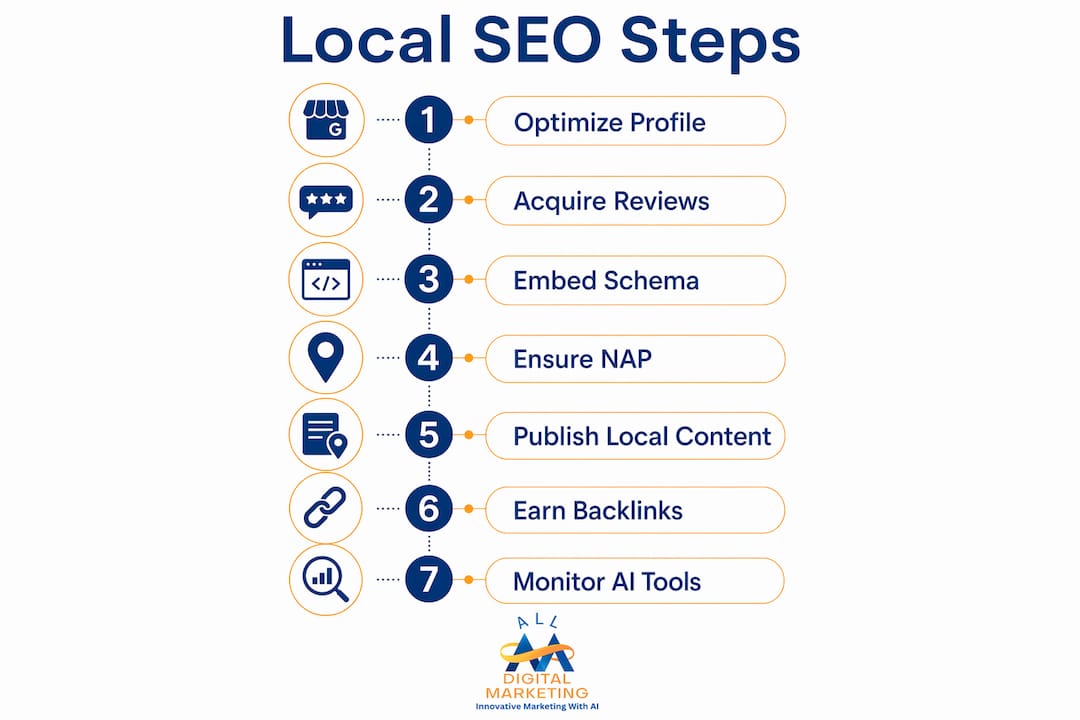
- Seven proven strategies to generate local business leads with SEO
- A step-by-step guide to generating leads through local search
- How AI-powered strategies are reshaping local SEO lead generation
- How Digital Marketing All helps you turn local search into real leads
- Key Takeaways
- FAQ
What is local lead generation and why does it matter for small businesses?
Local lead generation means converting nearby searchers into paying customers. It differs from generic SEO in one critical way: success is measured by qualified leads, not page views. A plumber ranking for "emergency plumber near me" who gets zero calls has not generated a single lead. Visibility without conversion is just vanity.
"Local SEO lead generation is judged not by traffic volume but by qualified local leads that convert into paying customers. A bakery ranking for 'best bakery near me' that gets 10,000 impressions and zero phone calls has not generated a single lead. It has generated vanity metrics." — Local SEO Lead Generation Guide, 2026
Consumer behavior has shifted fast. Prospects now judge a business directly on the search results page, reading star ratings, review counts, and posted hours before ever clicking through to a website. That means your GBP, your reviews, and your local content are doing sales work before your website even loads.
AI search surfaces are accelerating this shift. Google AI Overviews, Gemini, and ChatGPT with maps context all synthesize GBP data, review text, and third-party mentions to generate local recommendations. The distinction between traditional local search and AI search visibility is rapidly vanishing, which makes continuous profile freshness more critical than ever.
Seven proven strategies to generate local business leads with SEO
These seven tactics represent the highest-leverage moves for local search optimization in 2026. Each one is within your direct control.
1. Complete and optimize your Google Business Profile
GBP is the single highest-leverage local SEO asset you own. Category selection, profile completeness, photos, and ongoing activity drive most local pack movement. Select the most specific primary category available. Fill every attribute field. Add fresh photos at least twice a month, and post updates at least once a week tied to real events, promotions, or completed projects.

Being open when users search is now the No. 5 local pack ranking factor. Audit your hours quarterly and set special hours for holidays before they arrive.
2. Build a review acquisition and response system
Reviews influence ranking, conversion, and AI answer quality simultaneously. Three dimensions matter: quantity, velocity, and content. A steady flow of recent reviews beats a large stale pile. Keywords in review text ("they fixed our furnace same-day in Denver") feed relevance for those exact phrases, and AI answers quote review language nearly verbatim when explaining recommendations.
Request a review within two hours of job completion via text or email. Respond to every review, positive and negative, within 24–48 hours. Never offer incentives, which violates both Google and FTC guidelines.
3. Embed LocalBusiness schema on every page
Only 18.5% of small business websites use LocalBusiness schema, which makes this one of the fastest ways to outrank competitors. Embedding JSON-LD schema with your exact NAP, geo-coordinates, service areas, and hours directly feeds Google and AI engines the structured data they need to recommend your business confidently. Consistent use of this schema correlates with local pack ranking improvements within 14–30 days.
You can validate your implementation free at Schema.org's validator, and WordPress users can deploy it quickly with the Schema and Structured Data plugin.
4. Ensure NAP consistency across all platforms
Many small business websites do not display consistent NAP, meaning a significant share of businesses may be undermining their own local rankings. Your business name, address, and phone number must match exactly across your website, GBP, and every directory listing. Even minor variations, like "St." versus "Street," create conflicting signals that confuse both Google and AI engines.
Add your NAP to the footer of every page. Link to your GBP profile from your footer as well. Few small business sites do this, yet it consolidates ownership signals quickly.
5. Publish localized content and service area pages
Each location or genuine service area needs one indexable page with content that could only be written about that specific place: the local team, services and pricing specifics, location-specific photos, and nearby areas served. LocalBusiness structured data belongs on each page. Generic "Plumber in [City]" pages created by swapping a city name into a template get filtered by Google's helpful-content systems and can suppress the pages you actually care about.
Answer the local questions your customers actually ask. "How much does X cost in [city]?" and "Do you serve [suburb]?" are the kinds of answer-first content that win featured snippets and AI answer citations.
6. Earn local backlinks from authentic community sources
Five genuine local links typically outweigh fifty generic directory citations for prominence in local pack rankings. The chamber of commerce, local business associations, community event sponsorships, local press coverage, and supplier or partner pages each carry relevance-laden authority that most small business competitors never pursue. Run a quarterly local link push: one sponsorship, one association, one press-worthy story.

Pro Tip: Sponsor a local youth sports team or community event. The link from the organization's website is authentic, locally relevant, and often permanent, which is exactly what Google and AI engines weight most heavily.
7. Use AI-powered tools to monitor and adapt your local visibility
AI local search results pull from the same signals as the traditional local pack: GBP data, review content, and third-party mentions, synthesized differently. Businesses with stale profiles are not just losing map pack spots. They are becoming invisible to AI-driven discovery entirely. Use AI-powered local SEO strategies to monitor your visibility across both traditional and AI search surfaces, and adapt your GBP activity based on what the data shows.
A step-by-step guide to generating leads through local search
Follow this sequence to build a local lead generation system that compounds over time.
-
Audit your current local visibility. Run your business name through Google Maps from a non-logged-in browser. Use a grid-based rank tracker to check your actual map pack position, since Google personalizes results and will often show your own business ranked artificially high when you search for yourself.
-
Fix conversion leaks first. Test your site's mobile load speed. Confirm a click-to-call button sits above the fold. Verify that your hours and service area display sitewide, not buried on a contact page. Slow mobile experiences cause rapid visitor drop-off, wasting every ranking gain you earn.
-
Optimize your GBP completely. Select the most specific primary category. Fill every attribute. Add fresh photos weekly. Post updates consistently. Seed your Q&A section with the three to five questions customers ask most, and answer them yourself.
-
Set up a review request cadence. Text or email every customer within two hours of job completion. Respond to every review within a short timeframe, ideally within one to two days. Review velocity compounds over 6–12 months and is the single most reliable local ranking lever for service businesses.
-
Publish location-specific pages with schema. Write one page per service per city with original content, a local case study, team mention, LocalBusiness schema, and a clear call to action. These pages rank in blue-link results and feed AI Overviews.
-
Pursue local backlinks quarterly. One sponsorship, one association membership, one piece of local press coverage per quarter builds the prominence layer that separates top performers in competitive markets.
-
Measure what moves. Track GBP impressions, listing actions (calls, direction requests, website clicks), website conversions from local channels using UTM parameters and call tracking, and closed deals by location.
Pro Tip: Use a grid-based rank tracker and manually inspect your GBP from a private browser window in different zip codes. Your personalized search results are not what your customers see, and acting on them leads to false confidence.
How AI-powered strategies are reshaping local SEO lead generation
AI local search is not a separate discipline. AI Local Pack results synthesize GBP data, review content, and third-party mentions to generate business recommendations using the same inputs that drive traditional local rankings. There is no separate AI checklist. The businesses winning AI-generated answers are the ones who already do local SEO properly.
What AI engines specifically reward:
- Fresh, complete GBP data. Accurate hours, recent photos, active posts, and complete service descriptions are the inputs AI needs to confidently recommend your business.
- Review velocity and content quality. AI answers quote review language nearly verbatim. Steady, keyword-rich reviews are your AI sales copy.
- LocalBusiness schema and NAP consistency. Structured, machine-readable data across GBP, your website, and citation directories feeds both traditional search and AI search simultaneously.
- Third-party mentions. Local press coverage, community recommendations, and vertical directory listings cross-referenced by AI engines influence who gets named in answers.
- Specific, answerable website content. Pricing transparency, availability details, and service specifics get surfaced. Vague brochure pages do not.
The compounding effect here is real. Conversion optimization at each funnel stage produces a 33% total increase in leads when 10% lifts are achieved at each step: local pack appearance, website UX, and booking conversion. Consistent posting builds freshness. Steady review velocity builds trust signals. Updated photos drive higher engagement. Higher engagement improves rankings, which brings more profile views and more reviews, which further improve rankings. And all of those signals now feed AI systems that are reshaping how local businesses get discovered.
Businesses ignoring AI signals risk invisibility on next-generation local search surfaces. The role of AI in local SEO is no longer theoretical. It is the front door to local search for a growing share of your potential customers.
How Digital Marketing All helps you turn local search into real leads
Most small businesses have some local visibility. What they are missing is a system that turns that visibility into a steady flow of qualified leads. Digital Marketing All builds that system for you, combining GBP optimization, review operations, location-page architecture with schema, citation cleanup, and local link campaigns into one managed program.
The concrete difference: you get done-for-you execution across every layer of the local conversion funnel, from profile freshness and review generation to AI-search readiness, without hiring a full in-house team or managing a dozen separate vendors. Every campaign includes pack-position and call tracking so you see exactly what moved and why.
If you are ready to close the gap between your current rankings and the leads your business should be generating, get started with Digital Marketing All today.
Key Takeaways
Local SEO generates leads only when visibility, profile management, review velocity, and mobile conversion work together as one system, not as separate projects.
| Point | Details |
|---|---|
| GBP drives ranking weight | Google Business Profile completeness and category accuracy heavily influence local pack ranking weight. |
| Schema adoption is low | Only 18.5% of small business websites use LocalBusiness schema, making it a fast competitive advantage. |
| Mobile speed is a conversion gate | 84% of "near me" searches happen on mobile; sites that load in over three seconds lose the lead. |
| Local links beat generic citations | Five genuine local links typically outweigh fifty generic directory citations for local pack prominence. |
| Digital Marketing All | Offers done-for-you GBP optimization, review operations, schema setup, and local link campaigns with call tracking. |
FAQ
What is local SEO lead generation?
Local SEO lead generation is the practice of using Google Business Profile optimization, localized content, and review management to attract nearby customers actively searching for your services and convert them into qualified leads.
How do I use local SEO to generate leads faster?
Start by completing your GBP with accurate categories and fresh photos, then build a review request system and embed LocalBusiness schema on your website. These three moves produce the fastest visible movement, often within 14–30 days.
Does AI search change how local SEO works?
AI local search pulls from the same signals as the traditional local pack: GBP data, review content, and third-party mentions. Businesses with complete, active profiles and strong review velocity are already positioned for both surfaces.
How many local backlinks do I actually need?
Quality matters far more than volume. Five genuine local links from sources like a chamber of commerce, a community sponsorship, or local press typically outweigh fifty generic directory citations for local pack prominence.
How should I track local SEO lead generation performance?
Track GBP impressions, listing actions (calls, direction requests, website clicks), website conversions from local channels using UTM parameters and call tracking, and closed deals by location to measure true ROI.