

The main types of conversational AI are rule-based systems, retrieval-based assistants, generative LLM chatbots, hybrid systems, voice and IVR agents, virtual assistants, and agentic/autonomous agents. Each type represents a step up in flexibility, grounding, and the ability to take real action on behalf of a user.
Here is a quick map to guide your choice before we go deeper:
- Rule-based chatbots: Best for predictable, high-volume FAQ deflection where every answer is known in advance.
- Retrieval-based assistants: Best for knowledge-grounded Q&A where accuracy and traceability matter more than creative language.
- Generative/LLM chatbots: Best when queries vary widely, synthesis is needed, or personalization is a priority.
- Hybrid systems: Best for production deployments that need both guardrails and flexibility.
- Voice and IVR agents: Best for phone-channel automation, call deflection, and hands-free interactions.
- Virtual assistants: Best for multi-turn, goal-oriented customer conversations across web and messaging channels.
- Agentic/autonomous agents: Best for end-to-end task completion that spans multiple systems and requires real decisions.
| Type | Best for | Complexity | Channels supported |
|---|---|---|---|
| Rule-based | FAQ deflection, scripted flows | Low | Web chat, SMS |
| Retrieval-based | Knowledge Q&A, support search | Medium | Web chat, messaging |
| Generative/LLM | Open-ended dialog, synthesis | Medium–High | Web, messaging, API |
| Hybrid | Production CX with guardrails | High | Web, SMS, voice |
| Voice/IVR | Phone automation, call routing | Medium | Voice/IVR |
| Virtual assistant | Multi-turn customer service | High | Web, messaging, voice |
| Agentic | Cross-system task completion | Very High | Web, API, backend |
Key Takeaways
Choosing the right conversational AI type requires matching interaction complexity, channel requirements, and data sensitivity to the architecture that handles them with the least operational risk.
| Point | Details |
|---|---|
| Match type to complexity | Rule-based for scripted flows; hybrid or virtual assistant for variable, multi-turn interactions. |
| Ground generative systems with RAG | RAG reduces hallucination by injecting retrieved, verified facts into the LLM prompt before generation. |
| Instrument before scaling | Set deflection rate, containment, CSAT, and cost-per-interaction baselines during the pilot phase. |
| Start agentic pilots narrow | Restrict agentic agents to read-only, non-critical tasks first; expand permissions only after verified reliability. |
| Compliance is architecture | HIPAA, CCPA, and data residency requirements must be resolved at the infrastructure level, not patched in afterward. |
Table of Contents
- What are the types of conversational AI, and how do they differ?
- Core technical components every conversational AI system uses
- What are the main types of conversational AI in practice?
- How does conversational AI run in production?
- Why do LLMs and RAG change what conversational AI can do?
- Where does each conversational AI type actually perform best?
- How do you choose the right type and measure success?
- What are the real risks of conversational AI, and how do you mitigate them?
- What does recent research say about agentic conversational AI?
- A practitioner's perspective on adopting conversational AI
- Sources
- FAQ
What are the types of conversational AI, and how do they differ?
Conversational AI refers to any software system that can understand natural language input, track context across a conversation, and produce a relevant response or take an action. That definition covers a wide range of architectures, from a simple decision-tree bot that matches keywords to a fully autonomous agent that books a flight, updates a CRM record, and sends a confirmation email without human involvement.
The practical difference between a basic chatbot and a full conversational AI assistant comes down to three capabilities: memory (does the system remember what was said earlier?), grounding (does it pull from verified facts or generate freely?), and tool access (can it actually do something, or only talk?). A rule-based chatbot typically has none of these. A modern virtual assistant has all three.
A concrete example makes this tangible. A customer messages a retail support bot asking about a delayed order. A rule-based bot returns a canned "check your email for tracking info" response. A full conversational AI assistant authenticates the customer, queries the order management system, identifies the delay reason, offers a reschedule or refund, and logs the interaction in the CRM, all within the same conversation thread. Same channel, very different capability.
Core technical components every conversational AI system uses
Every AI-driven conversational agent, regardless of type, is built from the same functional building blocks. Understanding these components helps you map each conversational AI type to the architecture it actually requires.
- Automatic Speech Recognition (ASR): Converts spoken audio to text. Critical for voice channels; not needed for text-only deployments.
- Natural Language Understanding (NLU): Extracts intent (what the user wants) and entities (key data like dates, names, product IDs) from text.
- Dialogue Manager / Policy: Decides what the system should do next based on intent, current state, and business rules.
- Context and Memory Layers: Working memory holds the current turn's data; episodic memory stores conversation history; semantic memory holds long-term facts about the user or domain.
- Retrieval / RAG Module: Fetches relevant documents or records from a knowledge base to ground the response in verified facts.
- Natural Language Generation (NLG): Produces the text response, either from templates (rule-based) or a language model (generative).
- Text-to-Speech (TTS): Converts the text response back to audio for voice channels.
- Integration and Action Layer: Connects to external APIs, databases, CRM systems, and tools so the system can take real actions, not just talk.
A simplified production flow looks like this: the user sends a query → ASR converts speech to text (voice only) → NLU extracts intent and entities → the dialogue manager updates conversation state → the retrieval module fetches relevant context → NLG generates a response → TTS delivers it (voice only) → the action layer executes any required backend call → telemetry logs the full interaction.
Infrastructure choices follow directly from this stack. Retrieval-based and agentic systems need a vector store (such as Pinecone, Weaviate, or pgvector) to hold document embeddings. Generative systems incur token costs that scale with conversation length. Voice stacks face strict latency constraints, typically under 300ms for ASR-to-response to feel natural. Every production deployment needs monitoring and observability tooling to catch failures before users do.
| Component | Required for rule-based | Required for generative | Required for agentic |
|---|---|---|---|
| ASR | Voice only | Voice only | Voice only |
| NLU / Intent | Yes | Partial (LLM handles) | Yes |
| Dialogue manager | Yes | Yes | Yes |
| Memory / context | Minimal | Session-level | Persistent, multi-session |
| RAG / retrieval | No | Recommended | Yes |
| NLG (LLM) | No | Yes | Yes |
| Action / tool layer | No | Optional | Yes |
What are the main types of conversational AI in practice?
The enterprise taxonomy of conversational AI covers five to seven distinct types depending on how granularly you split voice and text channels. Here is an implementation-friendly breakdown of each.
Rule-based chatbots
Rule-based chatbots follow decision trees or keyword-matching logic written by a human. Every possible path is defined in advance. They are fast to build, easy to audit, and completely predictable, which makes them the right choice for high-volume FAQ deflection, appointment booking with fixed options, or any scenario where every valid answer is already known.
The trade-off is brittleness. A user who phrases a question outside the expected patterns gets a dead end or a generic fallback. Maintenance burden grows with every new product, policy, or FAQ added to the tree. Rule-based and AI-powered chatbots have fundamentally different failure modes: rule-based systems fail silently on out-of-scope queries, while AI systems can fail loudly with confident wrong answers.
Channels: Web chat, SMS, Facebook Messenger. Platform examples: Simple flows built on Google Dialogflow's intent-matching layer or Amazon Lex with scripted slot-filling.
Retrieval-based assistants
Retrieval-based assistants search a curated knowledge base to find the best matching answer rather than generating one from scratch. Modern implementations use dense vector retrieval (embedding similarity search) rather than keyword matching, which dramatically improves recall on paraphrased or ambiguous queries.
These systems are well-suited for internal knowledge search, technical support, and compliance-sensitive environments where every answer must trace back to an approved source document. They do not hallucinate because they are not generating text freely. The limitation is coverage: if the answer is not in the knowledge base, the system cannot help.
Channels: Web chat, enterprise messaging (Slack, Teams). Platform examples: Rasa with a retrieval pipeline, or custom builds on Azure Bot Services backed by Azure AI Search.
Generative/LLM chatbots
Generative chatbots use large language models (LLMs) such as OpenAI's GPT APIs to produce responses token by token. They handle open-ended questions, synthesize information from multiple sources, and adapt tone and style to the conversation. Generative AI chatbots expand the scope of questions answered and personalization, but they require grounding to avoid factual errors.
Without retrieval grounding, a pure generative system can confidently state incorrect information, a failure mode called hallucination. For customer-facing deployments, this is a serious risk. Generative systems also carry ongoing token costs that scale with conversation length and user volume.
Channels: Web, API integrations, developer tools. Platform examples: OpenAI's ChatGPT and GPT APIs, Microsoft Azure OpenAI Service.
Hybrid systems
Hybrid systems combine rule-based guardrails, retrieval grounding, and a generative LLM. A typical architecture routes structured transactions (account lookup, order status) through deterministic logic, uses RAG for knowledge Q&A, and falls back to the LLM for open-ended conversation. This is the architecture most production deployments actually use, because it balances control with flexibility.
The build complexity is higher, but the operational risk is lower than that of a pure generative deployment. Microsoft Bot Framework and Azure Bot Services are commonly used to orchestrate these multi-component stacks.
Channels: Web, SMS, voice, messaging apps.
Virtual assistants
Virtual assistants are multi-turn, goal-oriented agents designed for extended customer conversations. They maintain session context, handle topic switches, and can complete transactions. Conversational AI deployments commonly split into customer-facing virtual agents and agent-assist copilots for human agents, and virtual assistants occupy the customer-facing role.
The agent-assist variant works alongside a human agent, surfacing relevant knowledge articles, suggested responses, and CRM data in real time. Both patterns require robust dialogue management and integration with backend systems.
Channels: Web chat, mobile apps, voice, messaging. Platform examples: Google Dialogflow CX for complex multi-turn flows.
Voice agents and conversational IVR
Voice agents replace traditional touch-tone IVR menus with natural language phone interactions. A caller says "I want to check my balance" instead of pressing 2. The system uses ASR to transcribe speech, NLU to extract intent, and TTS to deliver a spoken response.
Voice introduces constraints that text channels do not face: ASR accuracy degrades under background noise and with non-standard accents, latency must stay under roughly 300ms to feel natural, and TTS voice quality directly affects user trust. Global deployments need to account for language and accent diversity. Statista data on the most-spoken languages worldwide is a practical starting point for planning which language models and accent test sets to prioritize.
Channels: Phone/IVR, smart speakers. Platform examples: Amazon Lex with Amazon Connect, Google Dialogflow CX telephony integration.
Agentic/autonomous agents
Agentic agents go beyond conversation. They decompose a goal into sub-tasks, call external tools and APIs, make decisions at each step, and complete end-to-end workflows without human intervention at every turn. A user says "renew my subscription and send me a receipt," and the agent handles authentication, payment processing, CRM update, and email delivery as a single orchestrated workflow.
This is the fastest-moving category in conversational AI. MIT Sloan describes agentic AI as a shift from "talking to users" to "working for the business", with multi-step workflow completion as the defining characteristic. The governance and observability requirements are proportionally higher.
Channels: Web, API, backend systems. Platform examples: OpenAI Assistants API with function-calling, Microsoft Copilot Studio with Power Automate connectors.
Comparison of conversational AI types
How does conversational AI run in production?
Getting from a working prototype to a production deployment requires more than a good model. The operational mechanics matter as much as the architecture.
End-to-end data flow: User input arrives via web, mobile, or phone → preprocessing cleans and normalizes the text or audio → NLU extracts intent and entities → the dialogue manager updates conversation state → the retrieval module fetches relevant context (if RAG is enabled) → the response generator produces a reply → the action layer executes any backend call (API, database write, CRM update) → telemetry logs the full interaction for monitoring and audit.
Deployment options break into three patterns. Cloud-hosted LLM APIs (OpenAI, Azure OpenAI, Google Vertex AI) offer the fastest time to prototype but put data in a third-party environment. On-premises or private-hosted models (Rasa, open-source LLMs in containerized environments) give full data control at higher infrastructure cost. Hybrid stacks run deterministic logic and sensitive data processing on-prem while calling cloud LLMs only for non-sensitive generation tasks.
Low-latency voice stacks require dedicated infrastructure: streaming ASR, a fast dialogue manager, and a TTS service with sub-300ms response time. Containerization with Kubernetes is common for scaling voice workloads during peak call volumes.
Deployment checklist (prototype to scale):
- Prototype: Define scope, build intent taxonomy, connect one data source, test with synthetic conversations.
- Pilot: Deploy to a limited user group, instrument telemetry, establish baseline KPIs (deflection rate, containment, CSAT).
- Harden: Add fallback routing to human agents, implement confidence thresholds, run adversarial test suites.
- Compliance review: Confirm data residency, logging policies, PII redaction, and any HIPAA or CCPA obligations.
- Scale: Expand channels, add retrieval sources, tune model update cadence, and set up A/B testing for conversational flows.
- Operate: Monitor for model drift, run post-deployment audits quarterly, and maintain a documented escalation path.
Pro Tip: Set your human escalation threshold before launch, not after. Define the confidence score below which the system hands off to a live agent, and test that handoff path as thoroughly as you test the main conversation flow.
Why do LLMs and RAG change what conversational AI can do?
Large language models shifted conversational AI from pattern-matching to genuine language understanding. But raw LLM capability without grounding creates a specific problem: the model generates fluent, confident text that can be factually wrong. RAG reduces hallucination by grounding the model in external, domain-specific documents retrieved at inference time, injecting verified facts directly into the prompt before the LLM generates a response.
The RAG workflow in simple steps:
- Embed: Convert your knowledge base documents into vector embeddings and store them in a vector database.
- Retrieve: When a user query arrives, embed the query and run a similarity search to pull the top-k most relevant document chunks.
- Inject: Insert the retrieved chunks into the LLM prompt as context.
- Generate: The LLM produces a response grounded in the retrieved facts, not just its training data.
- Cite: Return source references alongside the answer so users can verify.
When to use pure generative vs. RAG-augmented: Pure generative works when the task is creative, conversational, or does not require factual precision (drafting emails, brainstorming). RAG is the right choice whenever accuracy, traceability, or knowledge freshness matters, which covers most enterprise customer service, HR, and healthcare deployments.
Practical mitigation tactics beyond basic RAG include query rewriting (reformulating the user's question to improve retrieval recall), confidence scoring (flagging low-confidence answers for human review), runtime guardrails (blocking responses that violate content policies), and factuality scoring (comparing the generated answer against retrieved sources). Multi-turn retrieval and history-conditional query generation are active research areas that improve RAG performance in long conversations where earlier turns change the meaning of a later query.
Operational trade-offs to plan for: token costs grow with context window size; retrieval latency adds delay per turn depending on index size; knowledge indices need versioning and regular refresh; and embedding models must be updated when the underlying LLM changes to avoid retrieval quality degradation. Pairing a strong AI search strategy with your RAG pipeline significantly improves retrieval precision.
Where does each conversational AI type actually perform best?
The value of understanding the different types of chatbots and virtual agents becomes clearest when you map them to real outcomes.
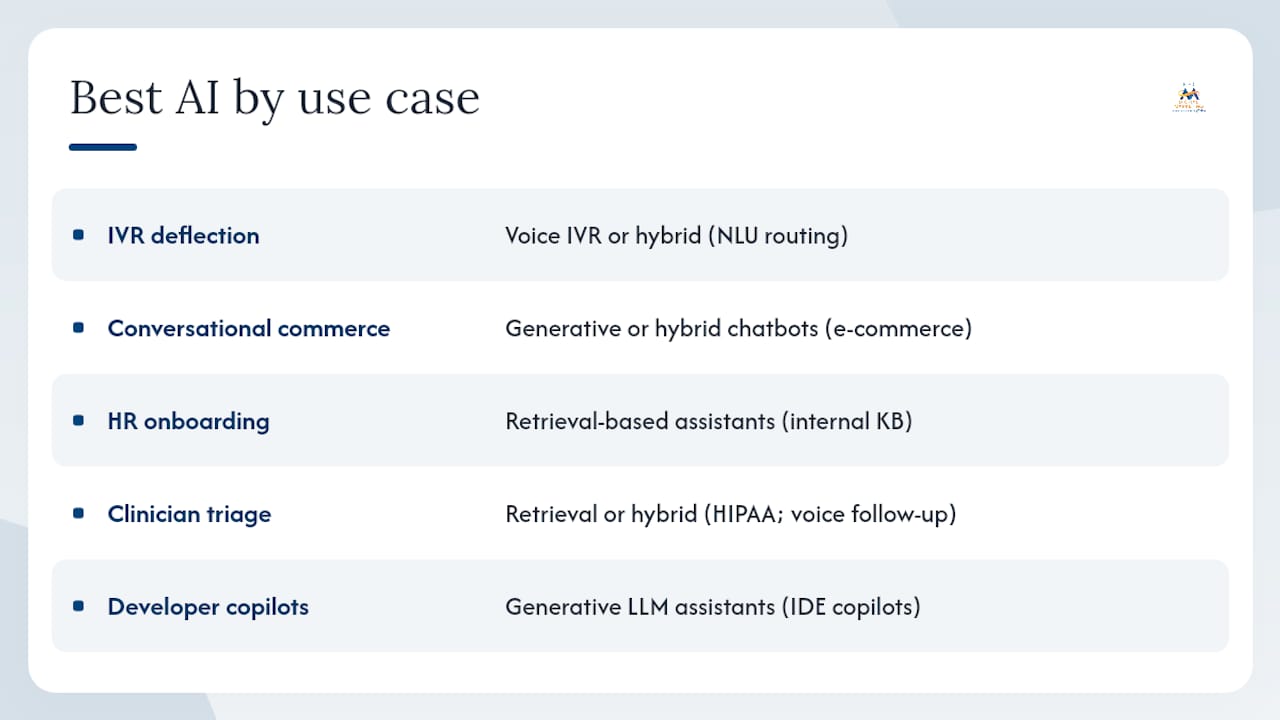
Customer self-service and IVR deflection: Voice IVR agents handle routine call center inquiries (balance checks, appointment scheduling, status updates) without a live agent. A hybrid voice agent with NLU-based intent routing can deflect a significant share of inbound calls, reducing cost per interaction and wait times.
Conversational commerce and lead qualification: Generative or hybrid chatbots on e-commerce sites guide shoppers through product selection, answer specification questions, and qualify leads before routing to sales. AI-driven personalization embedded in these flows increases conversion by surfacing the right product at the right moment.
HR onboarding bots: Retrieval-based assistants answer new-hire questions about benefits, policies, and IT setup by searching an internal knowledge base. They reduce HR ticket volume without requiring a generative model, keeping sensitive employee data within a controlled index.
Clinician triage and patient follow-up: In healthcare, conversational AI must comply with HIPAA. Retrieval-based or hybrid systems with strict data residency controls are the standard choice. Voice agents handle post-discharge follow-up calls, collecting symptom data and flagging high-risk patients for clinical review.
Developer copilots for code review: Generative LLM assistants integrated into IDEs (such as GitHub Copilot, built on OpenAI's APIs) suggest code completions, explain error messages, and surface relevant documentation. This is one of the highest-adoption use cases for generative conversational AI in enterprise settings.
Knowledge-base search assistants: Internal retrieval-based assistants help employees find policies, contracts, and technical documentation. Gartner research indicates conversational assistants are increasingly serving modern workers and operational use cases, not only external customers.
Industry-specific compliance notes: Healthcare deployments require HIPAA Business Associate Agreements with any cloud vendor processing PHI. Payment flows must meet PCI DSS requirements, typically by routing card data through a tokenization layer outside the conversational AI stack. Global call center voice deployments need accent-tuned ASR models and multilingual TTS, given the breadth of languages spoken by customers worldwide.
How do you choose the right type and measure success?
Choosing a conversational AI type is a decision about interaction complexity, data sensitivity, and operational capacity, not just technology preference.
Decision checklist:
- What channels must you support? (Web, SMS, voice, or all three?)
- How variable are user queries? (Predictable → rule-based; highly variable → generative or hybrid)
- Does the system need to take actions, or only provide information?
- What is the expected conversation volume? (High volume with low complexity favors rule-based; moderate volume with high complexity favors hybrid or virtual assistant)
- How sensitive is the data? (PII, PHI, or payment data requires on-prem or private-hosted options with strict logging controls)
Privacy and compliance for U.S. deployments:
- CCPA: Requires disclosure of data collection, opt-out rights, and data deletion on request. Conversational logs that contain personal information are covered.
- HIPAA: Any bot handling protected health information (PHI) must run on a HIPAA-compliant infrastructure with a signed BAA.
- Data residency: Enterprise buyers increasingly require that conversation data stay within U.S. data centers. Confirm this with your cloud provider before deployment.
- Authentication: Voice agents handling account data should use voice biometrics or knowledge-based authentication, not just caller ID.
- Logging policies: Log enough to debug and audit, but redact PII from logs by default. Define retention periods before launch.
Evaluation metrics:
Integration considerations: Most production deployments connect to a CRM (Salesforce, HubSpot), a ticketing system (Zendesk, ServiceNow), and at least one database. Use webhooks and event hooks to keep conversation context synchronized with backend records. For AI-powered marketing strategies, connecting your conversational AI to your CRM unlocks lead scoring and follow-up automation in the same workflow.
What are the real risks of conversational AI, and how do you mitigate them?
Every conversational AI type carries failure modes. Knowing them in advance is what separates a successful deployment from a costly one.
Common failure modes:
- Hallucination: Generative models produce confident, fluent, but factually incorrect responses. Mitigation: implement RAG grounding, factuality scoring, and answer citation.
- Context loss in long dialogs: Systems that lack persistent memory drop earlier context after a few turns, causing confusing or contradictory responses. Mitigation: implement episodic memory or conversation summarization at regular intervals.
- Poor ASR under accents: Speech recognition accuracy drops significantly for non-standard accents or noisy environments. Mitigation: test ASR models against accent-diverse test sets before launch; offer a text fallback.
- Misrouted intents: NLU classifiers assign the wrong intent when queries are ambiguous or out-of-distribution. Mitigation: set confidence thresholds; route low-confidence queries to a clarification prompt or human agent.
- Data leakage via logs: Conversation logs can inadvertently capture PII, payment data, or health information. Mitigation: implement real-time PII redaction in the logging pipeline before data is written to storage.
- Bias in training data: Models trained on unrepresentative data produce responses that perform poorly for certain user groups. Mitigation: audit training data for demographic and linguistic diversity; run bias evaluation suites before launch.
Operational mitigations:
- Use runtime guardrails (content filters, topic blockers) to prevent the system from responding to out-of-scope or harmful queries.
- Run adversarial prompt test suites before every major model update to catch jailbreaks and prompt injection attempts.
- Monitor for model drift monthly: track intent classification accuracy and CSAT trends; retrain when either degrades.
- Design human escalation as a first-class feature, not an afterthought. Users who reach a dead end and cannot escalate leave with a negative impression.
- Conduct post-deployment audits quarterly, reviewing a random sample of conversations for accuracy, tone, and compliance.
What does recent research say about agentic conversational AI?
Agentic conversational AI is the most active research frontier in the field, and the gap between research and production deployment is narrowing faster than most practitioners expect.
ACL 2026 research on the ConvAgent framework describes a single-agent architecture that interleaves contextualized search and reasoning across conversation turns. The system uses history-conditional query generation (reformulating each search query based on the full conversation history, not just the latest message), a search-result utilization reward (reinforcing the model when it correctly uses retrieved information), and mixed-initiative action rewards (reinforcing the model when it proactively takes useful actions rather than waiting for explicit instructions). These three components together produce an agent that gets better at multi-step tasks the longer the conversation runs, rather than degrading as context accumulates.
The practical implication is significant. An agentic system does not just answer a question about an invoice; it finds the invoice, flags the discrepancy, initiates a correction workflow, and notifies the relevant team, all within a single conversational session. MIT Sloan frames this as a business-paradigm shift: the system moves from a communication interface to an operational worker.
For practitioners considering agentic pilots, the governance requirements are proportionally higher than for standard chatbots. Data quality must be high because the agent acts on what it finds. Observability tooling must capture every tool call and decision point, not just the final response. Rollback strategies need to be defined before deployment: if an agent takes a wrong action, how do you detect it, stop it, and reverse it?
Recommended practitioner approach for agentic pilots:
- Start with non-critical backend tasks (internal knowledge search, draft generation, data lookup) before deploying agents that write to production systems.
- Define a strict tool scope: list exactly which APIs and databases the agent can call, and block everything else by default.
- Require human approval for any action above a defined risk threshold (financial transactions, data deletion, external communications).
- Log every tool call with input, output, and timestamp for full audit traceability.
- Review the agentic AI vs. automation comparison to clarify where agentic systems add value over simpler automation for your specific use case.
Pro Tip: Before your first agentic pilot, map every system the agent will touch and assign a risk tier (read-only, write, financial, external). Only allow read-only access in the first pilot phase. Expand permissions only after the agent demonstrates reliable behavior on lower-risk tasks.
A practitioner's perspective on adopting conversational AI
The single biggest mistake teams make when adopting conversational AI is starting with the technology and working backward to a use case. The right sequence is the opposite: start with a specific, measurable business problem, then choose the type of conversational AI that solves it with the least complexity.
My top three recommendations for teams getting started:
- Prioritize data and knowledge indexing first. A generative or retrieval-based system is only as good as the knowledge it can access. Before you build a single conversation flow, audit your knowledge base, clean your documentation, and decide what the system is and is not allowed to answer.
- Design clear fallback and hand-off paths before launch. Every conversational AI system will encounter a query it cannot handle. The quality of that failure experience determines whether users trust the system or abandon it. A graceful escalation to a human agent is not a fallback; it is a feature.
- Start with a hybrid architecture. Pure rule-based systems are too brittle for most real-world query variation. Pure generative systems carry too much hallucination risk for most enterprise deployments. A hybrid that routes structured transactions through deterministic logic and uses RAG-grounded generation for open-ended queries gives you the best of both.
Gartner's analysis of modern worker adoption reinforces a point that often gets overlooked: conversational AI is not only a customer-facing tool. Internal deployments for HR, IT helpdesk, and operations often deliver faster ROI because the user base is smaller, the queries are more predictable, and the data governance is simpler.
On governance: every team deploying conversational AI needs a named owner for the system's behavior, not just its infrastructure. That person reviews conversation logs, approves model updates, and owns the escalation design. Without that accountability, model drift and compliance gaps accumulate quietly until they become visible problems.
Sources
The sources below are organized by the next step you are most likely to take.
Taxonomy and how-to guides:
- ACL Anthology 2026 proceedings (ConvAgent paper)
- Agentic AI explained (MIT Sloan)
- Conversational AI Assistant: The Complete Agentic Architecture Guide (Agentive AI Agents)
- Most spoken languages worldwide (Statista)
- Chatbots will appeal to modern workers (Gartner)
RAG, grounding, and architecture:
Agentic research:
Implementation and marketing use cases:
If you are ready to put conversational AI to work for your business, Digital Marketing All's reputation management and AI-powered customer outreach services are a practical starting point for teams that want measurable results without building from scratch.
FAQ
What is the simplest type of conversational AI to deploy?
Rule-based chatbots are the simplest to deploy because every response path is defined in advance, requiring no machine learning training or model management.
How does RAG reduce hallucination in generative chatbots?
RAG retrieves verified documents from a knowledge base and injects them into the LLM prompt before generation, so the model produces answers grounded in real source material rather than relying solely on its training data.
What is the difference between a virtual assistant and an agentic AI?
A virtual assistant handles multi-turn conversations and can complete transactions within a single system. An agentic AI decomposes goals into sub-tasks, calls multiple external tools and APIs, and completes end-to-end workflows autonomously across systems.
Which conversational AI types work best for voice channels?
Voice agents and conversational IVR systems are purpose-built for phone channels, using ASR for speech-to-text and TTS for text-to-speech. Hybrid systems can also support voice when paired with a low-latency ASR/TTS stack.
What compliance requirements apply to conversational AI in the U.S.?
U.S. deployments must address CCPA for consumer data rights, HIPAA for any system handling protected health information, and PCI DSS for payment data. Data residency, PII redaction in logs, and authentication methods must be confirmed at the infrastructure level before launch.