

TL;DR:
- Schema markup is embedded code that helps search engines understand website content and display rich results. It improves user click-through rates but does not directly affect search rankings or AI citations. Proper implementation, validation, and matching schema types to content are essential for maximizing its benefits.
Schema markup is machine-readable code embedded in your website that explicitly tells search engines what your content represents, enabling enhanced search listings and better comprehension by AI systems. The role of schema markup goes well beyond decoration. It is a technical layer built on Schema.org vocabulary, recognized by Google, Bing, and Yahoo, that converts your page content into structured signals these systems can act on. Pages with rich results attract 58% of clicks compared to 41% for standard listings. That 17 percentage point gap is the clearest argument for implementing structured data correctly. Schema markup is not a direct ranking factor, but it makes your existing positions work significantly harder.
What is the role of schema markup in search visibility?
Schema markup is structured data code that represents content entities and their relationships in a format search engines read directly. Without it, a search engine must infer what your page is about from text alone. With it, you explicitly state: "This is a product. Its price is $49. Its rating is 4.8 out of 5." That clarity changes how your listing appears in search results.
The Schema.org vocabulary, maintained collaboratively by Google, Microsoft, Yahoo, and Yandex, provides the shared language for this communication. When you apply Schema.org types correctly, you give every major search engine the same unambiguous signal. That consistency matters because search engines process billions of pages daily and reward content they can categorize quickly.
The importance of schema markup becomes most visible in rich results. Rich results are enhanced search listings that display star ratings, prices, images, FAQs, or event dates directly in the search engine results page (SERP). These visual enhancements increase the space your listing occupies and give searchers more reason to click before they even visit your site.
Schema markup also feeds into AI-powered features like Google AI Overviews. Pages with well-implemented structured data appear more frequently in AI Overviews than those without. The mechanism is semantic clarity. When your content is unambiguous to a machine, AI systems can reference it with greater confidence.
How does schema markup improve click-through rates?
The evidence for schema's impact on click-through rates is direct and measurable. JobPosting schema yields a 1,194% CTR lift compared to standard job listings. Product and Article schema types also deliver measurable gains. These numbers reflect what happens when a listing stands out visually against a page of plain blue links.
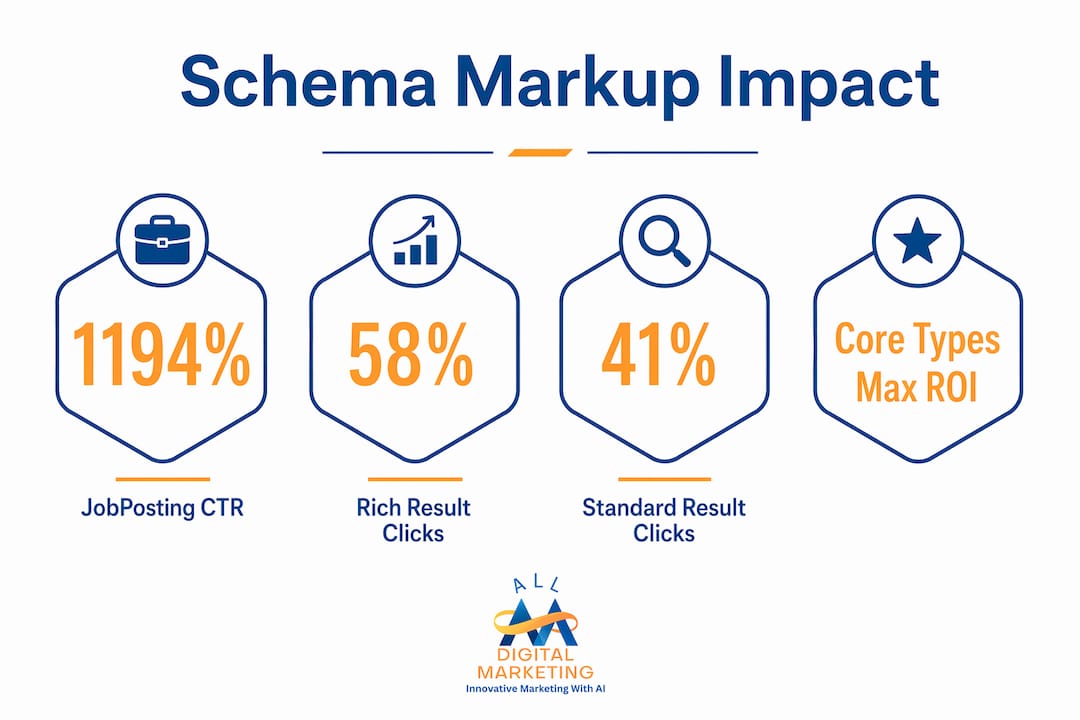
The mechanism works like this: schema makes your page eligible for rich results, but Google decides algorithmically whether to display them. Eligibility is not a guarantee. Google weighs content quality, page authority, and markup accuracy before rendering a rich result. Your job is to implement schema correctly and let Google's systems make the call.
The schema types most likely to generate rich results in 2026 include:
- Product: Displays price, availability, and review stars for e-commerce pages
- Article: Enables news carousels and article-specific SERP features
- Review / AggregateRating: Shows star ratings directly in search listings
- JobPosting: Generates job listing cards with salary and location data
- Recipe: Displays cook time, calories, and ratings in recipe cards
- Event: Shows event dates, locations, and ticket availability
- BreadcrumbList: Displays site hierarchy below the listing title
- FAQPage: No longer generates expandable rich results but retains semantic value for AI comprehension
Most websites chase obsolete rich snippet types instead of focusing on the core types that generate returns. Focus on Product, Article, Organization, and BreadcrumbList for measurable benefits. Deprecated schema types waste implementation effort and can introduce conflicting signals.
Pro Tip: Audit your site's content categories before choosing schema types. An e-commerce site gains the most from Product and AggregateRating schema. A news publisher should prioritize Article and BreadcrumbList. Matching schema type to content type is the single fastest way to improve rich result eligibility.
Does schema markup directly affect SEO rankings or AI citations?
Schema markup is not a direct ranking factor. Google has stated this explicitly. Structured data does not move your page from position 8 to position 3. What it does is make your position 3 listing far more compelling than a competitor's position 2 listing that lacks rich results.
Two independent studies found no significant AI citation boost from schema markup alone. This finding surprises many marketers who assume that feeding structured data to AI systems automatically increases how often those systems cite their content. The distinction matters: schema improves machine comprehension, not machine citation. AI models cite content based on authority, relevance, and content quality, not markup presence.
Google's 2026 generative AI search documentation confirms this directly. Google does not recommend any "AI-specific" schema for inclusion in AI Overviews. Core ranking systems determine AI Overview eligibility. Schema supports those systems by reducing semantic ambiguity, but it does not replace the need for authoritative, well-written content.
The removal of FAQPage rich results from SERPs illustrates this distinction well. Google eliminated the expandable FAQ feature from search listings, which alarmed many SEOs who had invested in FAQ schema. The reality is more nuanced:
- FAQPage rich results no longer appear in standard SERPs
- FAQPage schema still communicates structured question-and-answer content to AI systems
- AI engines consume valid FAQ markup for semantic understanding despite the disappearance of the visual SERP feature
- The removal signals Google's shift toward content robustness over visual SEO features
Schema markup is foundational technology, not a shortcut. Invest in it for clarity and comprehension, not for ranking jumps that the data does not support.
Pro Tip: Pair schema implementation with a content quality audit. Schema tells search engines what your content is. Strong, authoritative content tells them why it deserves to rank. Both signals work together, and neither replaces the other.
How to implement and validate schema markup correctly
JSON-LD is Google's recommended format for schema markup. It sits in a <script> tag in your page's <head> section, separate from your HTML content. This separation makes it easier to update, audit, and validate without touching your visible page structure. Microdata and RDFa are alternative formats, but JSON-LD is the standard for new implementations.
Correct implementation follows four steps:
- Select the right schema type for each page. Use Schema.org's type hierarchy to find the most specific applicable type. A product page uses
Product, notThing. A local business usesLocalBusinessor a subtype likeRestaurantorMedicalClinic. - Match markup to visible content. Google penalizes mismatched or invisible markup. If your schema states a price of $29 but your page shows $49, Google will suppress the rich result and may flag the page.
- Validate before publishing. Run every new schema implementation through Google's Rich Results Test and the Schema Markup Validator. Use linters and validation tools to catch syntax errors like trailing commas and mismatched brackets in JSON-LD. These invisible errors prevent rich result eligibility entirely.
- Use
@idto connect related entities. Linking entities like Organization, Website, and Person with@idcreates a consistent knowledge graph across your site. This avoids "duplicate truths," where two schema blocks on the same site contradict each other about your business name, address, or founding date.
Common errors that reduce schema effectiveness include:
- Syntax mistakes in JSON-LD (trailing commas, unclosed brackets)
- Duplicate schema blocks with conflicting property values
- Using deprecated schema types that no longer generate rich results
- Applying schema to content that does not appear on the page
- Missing required properties for the chosen schema type
The Schema.org and Google guidelines define required and recommended properties for each type. Missing a required property, such as name on an Organization or price on a Product, prevents rich result display even if the rest of the markup is correct.
Pro Tip: Audit your existing schema before adding new types. Many sites accumulate broken or outdated markup from previous developers or plugins. A clean audit often reveals conflicting blocks that suppress rich results you should already be earning.

What are the future opportunities for schema in AI-driven search?
Schema markup's most underused opportunity sits in "Action" schema types. Types like BuyAction, OrderAction, and ReserveAction describe transactions a user can complete directly from a search result or AI interface. Adoption of these types remains low across most industries. That low adoption creates an asymmetric opportunity for sites that implement them correctly now, before AI agents begin routing transactions at scale.
The strategic priority for schema investment varies by business type:
| Business type | Priority schema types | Key benefit |
|---|---|---|
| E-commerce | Product, AggregateRating, BuyAction | Rich product listings, star ratings, purchase eligibility |
| Publishers and blogs | Article, BreadcrumbList, FAQPage | News carousels, site hierarchy, AI comprehension |
| SaaS and software | SoftwareApplication, FAQPage, Organization | App store-style listings, credibility signals |
| Job boards | JobPosting, Organization | Job listing cards with salary and location data |
| Local businesses | LocalBusiness, Review, Event | Map pack signals, review stars, event visibility |
The Google FAQ rich results change is a useful case study in how to think about schema investments. Marketers who treated FAQPage schema purely as a visual SERP feature abandoned it when the feature disappeared. Marketers who understood its semantic value kept it and gained an advantage in AI comprehension. The lesson: anchor schema decisions in what the data shows, not in what looks impressive in a screenshot.
Schema markup enhances visibility in AI-powered search by reducing the ambiguity that forces AI systems to make assumptions about your content. Every assumption an AI system makes is a point where it might get your content wrong. Schema eliminates those assumptions one entity at a time.
Pro Tip: If you run an e-commerce site, implement BuyAction schema now even if AI agents are not yet routing purchases at scale. Early adopters will have validated, indexed markup when AI transaction routing becomes standard. Late adopters will be playing catch-up.
Key Takeaways
Schema markup is the most direct technical signal you can send to search engines and AI systems to improve how your content is understood and displayed.
| Point | Details |
|---|---|
| Schema boosts CTR, not rankings | Pages with rich results earn 58% of clicks vs. 41% for standard listings, but schema does not move rank positions. |
| JSON-LD is the required format | Google recommends JSON-LD exclusively; missing required properties prevent rich result display entirely. |
| Validate every implementation | Use Google's Rich Results Test and a JSON-LD linter to catch syntax errors before they suppress your rich results. |
| AI citation requires content quality | Schema improves machine comprehension but does not significantly increase AI citation rates on its own. |
| Action schema is the next frontier | BuyAction and OrderAction types have low adoption now, creating early-mover opportunity for e-commerce and service sites. |
Schema markup: what the data actually tells us
I have reviewed a lot of schema implementations over the years, and the most common mistake I see is treating structured data as a checklist item rather than a communication layer. Teams add schema, check the box, and move on. Then they wonder why their rich results are inconsistent or why their AI Overview appearances are sporadic.
The data is clear on one point that most articles gloss over: schema does not compensate for weak content. Two independent studies confirmed no significant AI citation uplift from schema alone. That finding should redirect effort, not discourage it. Schema works best when it describes content that already deserves to rank. It makes strong content work harder. It does not rescue content that lacks depth or authority.
The FAQPage situation is the clearest example of why you should understand schema's purpose before implementing it. When Google removed the expandable FAQ feature from SERPs, many marketers declared FAQ schema dead. The ones who kept it understood that AI systems still consume that structured question-and-answer data for semantic understanding. They were right. The visual feature disappeared; the semantic value did not.
My practical advice: start with a schema audit, not a schema build. Most sites I review have broken or conflicting markup from old plugins or previous developers. Fixing what exists almost always delivers faster results than adding new types. Once your foundation is clean, prioritize the schema types that match your actual business model, and validate every change before it goes live.
Schema is foundational technology for the AI search era. It will not replace content quality or domain authority, but sites that skip it are leaving comprehension signals on the table that their competitors are already using.
— Diane
How Digitalmarketingall supports your schema-powered SEO strategy
Schema markup makes your search listings more credible and informative. Online reviews make them more persuasive. These two signals work together: Review and AggregateRating schema display your star ratings directly in search results, but only if you have a consistent stream of genuine reviews to draw from. Digitalmarketingall's review generation and management services help you build that review foundation systematically. More verified reviews mean richer schema data, stronger click-through rates, and greater trust signals for both search engines and potential customers. If your schema is ready but your review profile is thin, that is the next gap to close.
FAQ
What is schema markup in simple terms?
Schema markup is code added to your website that tells search engines exactly what your content represents, such as a product, article, or local business. It uses the Schema.org vocabulary recognized by Google, Bing, and Yahoo.
Does schema markup improve Google rankings?
Schema markup is not a direct ranking factor according to Google. It improves click-through rates by enabling rich results, which makes your existing ranking position more effective.
What schema types generate rich results in 2026?
Product, Article, Recipe, Review, JobPosting, Event, and BreadcrumbList are among the supported types that generate rich results. FAQPage no longer produces expandable SERP features but retains value for AI comprehension.
How do I validate my schema markup?
Use Google's Rich Results Test and the Schema Markup Validator to check for errors. Run a JSON-LD linter to catch syntax mistakes like trailing commas that prevent rich result eligibility.
Does schema markup help with AI Overviews?
Schema reduces semantic ambiguity, which helps AI systems understand your content more accurately. Google's own documentation confirms that no special AI-specific schema is needed; core content quality and ranking signals determine AI Overview inclusion.