

TL;DR:
- AI enhances customer engagement by personalizing interactions and orchestrating real-time, multi-channel experiences.
- Effective AI requires unified data, transparency, and agentic systems that learn and adapt continuously.
The role of AI in customer engagement is to automate, personalize, and optimize customer interactions in real time so businesses build stronger, more loyal relationships at scale. 92% of global enterprises have already implemented or piloted AI in customer service as of 2026. That number signals a fundamental shift, not a trend. Yet adoption alone does not guarantee results. The real differentiator is how well businesses unify data, orchestrate AI systems, and earn consumer trust through transparency. This guide breaks down what actually works, where most organizations fall short, and how to build an AI-driven engagement strategy that delivers measurable returns.
How does AI transform customer engagement through personalization?
AI transforms customer engagement by replacing segment-based targeting with individual-level, real-time decision-making. Traditional marketing treats customers as members of a group. AI treats each customer as a unique profile with a history, a context, and a predicted next action.
The unified customer profile problem
The primary cause of AI personalization failures is fragmented data layers, not poor AI models. When your AI pulls from disconnected systems, it optimizes against incomplete information and delivers irrelevant experiences. A customer who just called your support line should not receive a promotional email about the product they complained about. That kind of disconnect happens when online behavior, offline transactions, and service history live in separate silos.
Effective AI personalization requires a unified customer profile that combines:
- Real-time behavioral signals (pages visited, time on site, clicks)
- Transactional history (purchases, returns, subscription status)
- Service interactions (support tickets, chat logs, call records)
- Predictive attributes (churn probability, lifetime value score, next-best-action)
Pro Tip: Before investing in any new AI personalization tool, audit your data infrastructure first. A sophisticated AI model fed fragmented data will consistently underperform a simpler model fed clean, unified data.
AI orchestration versus scheduled campaigns
AI-driven journey orchestration treats every customer touchpoint as a node in a continuous decision graph. The system evaluates channel, timing, and message based on live customer behavior rather than a pre-built calendar. A scheduled campaign sends an email on Tuesday because someone set it up that way. An orchestrated AI system sends a push notification on Thursday at 7:42 PM because that is when this specific customer is most likely to convert.
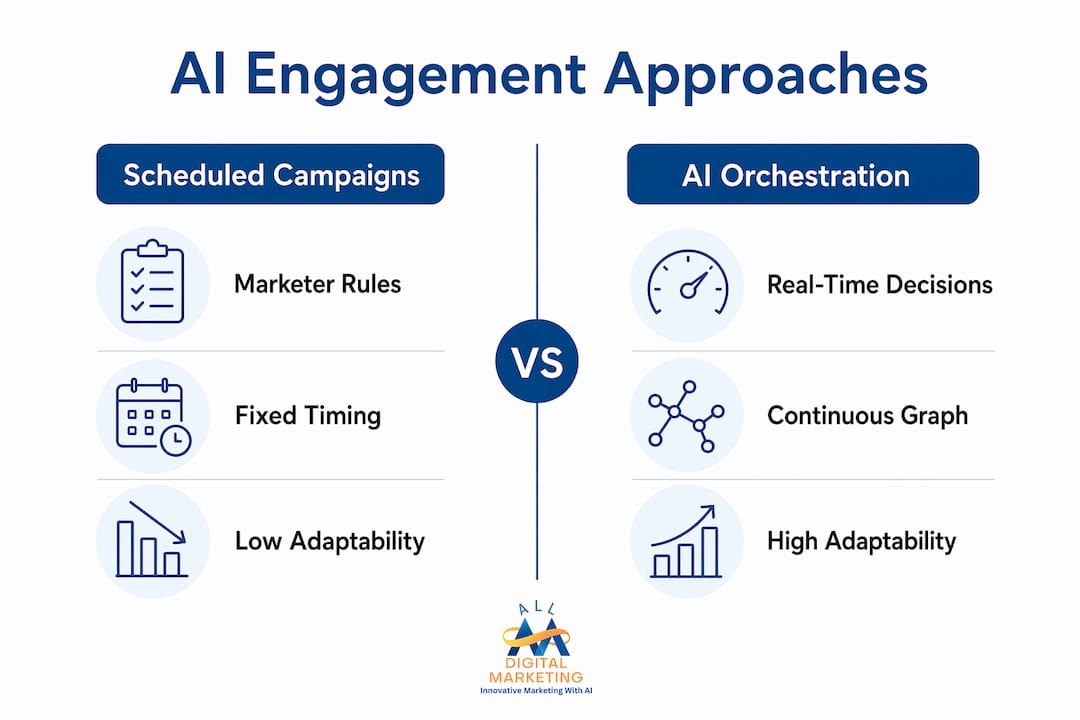
The difference in outcomes is significant. Orchestration creates coherent experiences across channels and produces measurable retention gains. Scheduled campaigns create noise.
| Approach | Decision basis | Timing | Adaptability |
|---|---|---|---|
| Scheduled campaigns | Marketer-defined rules | Fixed calendar | Static |
| AI journey orchestration | Real-time behavior signals | Dynamic, per customer | Continuous learning |
What AI tools are most effective for customer interaction?
The most effective AI tools for customer interaction fall into three categories: self-service agents, real-time agent support, and automated quality assurance. Each addresses a different layer of the customer experience.

Chatbots and virtual assistants
AI chatbots handle 24/7 self-service for routine inquiries, freeing human agents for complex cases. They answer FAQs, process returns, check order status, and route escalations. The business case is clear: consistent availability at a fraction of the cost of human staffing. The customer experience case is more nuanced. 76% of consumers believe AI will improve service quality, but 84% give virtual agents only three attempts before abandoning the interaction entirely. That tolerance threshold is narrow. Chatbots that fail to resolve issues quickly do not just frustrate customers. They push 47% of them toward a competing brand.
AI copilots for human agents
AI copilots assist human agents in real time by surfacing relevant knowledge, suggesting responses, and flagging compliance risks during live conversations. They do not replace agents. They make agents faster and more accurate. The investment gap here is notable: 56% of enterprises plan to invest in AI copilots, but only 38% currently use them. That 18-point gap represents a significant competitive opportunity for organizations that move first.
Automated quality assurance and coaching
Traditional quality assurance reviews a small sample of calls, often less than 5%, because human reviewers cannot scale. AI-powered quality assurance monitors every interaction, scores agent performance, and triggers coaching recommendations automatically. Only 32% of enterprises currently use AI quality assurance tools, despite 46% planning to deploy them. The organizations already using these tools gain a compounding advantage: better agents, faster improvement cycles, and higher customer satisfaction scores.
What are the biggest challenges in scaling AI for customer engagement?
Scaling AI for customer engagement is harder than deploying it. Most organizations discover that the technology works. The organization does not.
The top barriers to scaling
- Legal, compliance, and privacy concerns top the list at 66% of marketing organizations. Data residency rules, consent requirements, and sector-specific regulations create real constraints on what AI can do with customer data.
- Brand governance blocks 50% of organizations from moving at AI speed. When AI generates content or makes decisions autonomously, brand consistency becomes a serious risk without proper guardrails.
- Tool integration complexity affects 46% of teams. Most enterprises run dozens of marketing and service platforms. Getting them to share data and coordinate actions requires significant technical investment.
- Organizational bottlenecks slow everything down. Over 92% of marketing campaigns require 10 or more stakeholders, and C-suite approval cycles create delays that negate AI's speed advantage.
- Operational readiness gaps are widespread. Only 16% of organizations say they are fully prepared to operate AI at speed, and just 20% have standardized workflows for scaling AI campaigns.
Consumer trust as a scaling constraint
Trust is not a soft metric. It is a hard operational requirement. 71% of consumers say knowing they are interacting with AI is very or extremely important to them. Hiding AI involvement does not protect the brand. It destroys trust when customers find out.
"The ability to reverse mistakes ranks as the top trust-building factor for AI interactions. Consumers do not expect AI to be perfect. They expect it to be correctable. Organizations that build clear escalation paths and error-recovery mechanisms into their AI systems earn significantly higher trust scores than those that do not."
The practical implication is direct: disclose AI involvement upfront, build easy human handoff options, and give customers the ability to undo or override AI-driven decisions. These are not just ethical choices. They are retention strategies.
How does agentic AI maximize ROI in customer engagement?
Agentic AI is the next level beyond basic automation. A standard chatbot follows a script. An agentic AI system autonomously completes multi-step tasks across functions without requiring human approval at each step. It can identify a churn risk, pull the customer's history, calculate the best retention offer, send a personalized message, and log the outcome, all without a human in the loop.
Agentic AI versus basic automation
The distinction matters because the market is full of what practitioners call "agent washing." Vendors relabel simple rule-based chatbots as agentic AI to capitalize on the trend. True agentic systems have three defining characteristics: they learn from outcomes, they adapt their approach based on new information, and they coordinate across multiple systems autonomously.
| Capability | Basic automation | Agentic AI |
|---|---|---|
| Task scope | Single-step, rule-based | Multi-step, cross-functional |
| Learning | None | Continuous from outcomes |
| Human approval | Required at each step | Only for defined exceptions |
| Personalization depth | Segment-level | Individual, real-time |
High-impact use cases
Three use cases show the clearest ROI for agentic AI in customer engagement:
- Proactive churn intervention: The system detects early warning signals, such as declining login frequency or reduced purchase volume, and triggers a personalized retention sequence before the customer cancels.
- Cart abandonment recovery: Rather than sending a generic "you left something behind" email, an agentic system evaluates the customer's price sensitivity, preferred channel, and optimal send time before acting.
- Real-time price-drop alerts: The system monitors inventory and pricing, then notifies customers who previously viewed a product at the exact moment a price drops to their likely threshold.
Pro Tip: Do not expect agentic AI to deliver full ROI in the first 90 days. Performance improves as the system accumulates behavioral data. Organizations with clean, unified data foundations see meaningful results in 3–6 months. Those starting with fragmented data should plan for 9–12 months before the system reaches its potential.
The integration of marketing and service AI is what makes agentic orchestration work. When the marketing system knows what the service system knows, the AI can make decisions that reflect the full customer relationship rather than just the last transaction. This is where the biggest revenue impact lives, and where most organizations are still behind. For a broader view of how these strategies apply to smaller organizations, the AI marketing trends for 2026 offer practical context for teams at every scale.
Key Takeaways
AI-driven customer engagement delivers its strongest results when unified data, transparent AI disclosure, and agentic orchestration work together rather than in isolation.
| Point | Details |
|---|---|
| Data unification comes first | Fragmented data causes AI personalization failures more than weak AI models do. |
| Consumer trust requires disclosure | 71% of consumers want to know when they are interacting with AI. |
| Agentic AI outperforms basic bots | True agentic systems learn, adapt, and act across functions without step-by-step human approval. |
| Operational complexity is the real barrier | Only 16% of organizations are fully prepared to operate AI at speed. |
| Investment gaps signal opportunity | The 18-point gap between AI copilot plans and deployment is a competitive opening for early movers. |
Why most AI engagement strategies stall before they scale
I have watched organizations pour significant budget into AI tools and then wonder why their customer satisfaction scores barely moved. The pattern is almost always the same. The technology works. The organization around it does not.
The most common mistake is treating AI deployment as the finish line. A business installs a chatbot, calls it agentic AI, and declares the project complete. What they actually deployed is a glorified FAQ page with a chat interface. Real agentic AI requires a clean data foundation, integrated systems, and defined escalation protocols. Without those three elements, the label is just marketing.
The second mistake is underestimating how much consumer trust shapes outcomes. I have seen brands lose loyal customers not because their AI gave a wrong answer, but because the customer felt deceived about who they were talking to. Transparency is not optional. It is the foundation of every successful AI engagement program I have seen work at scale.
What actually works is the combination of AI efficiency and human empathy. AI handles volume, speed, and consistency. Humans handle complexity, emotion, and relationship repair. The AI-human synergy model is not a compromise. It is the architecture that produces the best outcomes for both customers and the business. The brands winning in 2026 are not the ones with the most AI. They are the ones who figured out where AI ends and where a human needs to take over.
— Diane
How Digitalmarketingall supports AI-driven customer engagement
Building a strong AI-driven engagement strategy depends on more than technology. Customer reviews are one of the most direct signals AI systems use to assess brand trust and local relevance. Digitalmarketingall's review generation and management service helps businesses collect, manage, and respond to customer feedback in a way that strengthens both their reputation and their visibility in AI-powered search results. When your review profile is active and credible, AI recommendation engines take notice. Businesses that treat review management as part of their engagement strategy see stronger retention signals and better placement in AI-driven discovery. Explore how Digitalmarketingall connects AI-powered marketing strategies with real customer feedback outcomes.
FAQ
What is the role of AI in customer engagement?
AI automates routine interactions, personalizes messaging at the individual level, and orchestrates multi-channel experiences in real time. Its core function is to make every customer interaction faster, more relevant, and more consistent.
How does AI personalization differ from traditional segmentation?
Traditional segmentation groups customers by shared attributes and sends the same message to all of them. AI personalization builds an individual model for each customer and adapts messaging based on real-time behavior and predicted intent.
Why do AI customer engagement programs fail?
The most common cause of failure is fragmented data, not weak AI models. When customer data lives in disconnected systems, AI optimizes against incomplete information and delivers irrelevant experiences that erode trust.
What is agentic AI and how does it apply to customer engagement?
Agentic AI autonomously completes multi-step tasks across systems without requiring human approval at each step. In customer engagement, it handles use cases like proactive churn intervention, cart abandonment recovery, and real-time price alerts.
How important is transparency when using AI in customer service?
Transparency is critical. 71% of consumers say knowing they are interacting with AI is very or extremely important. Disclosing AI involvement and offering easy human handoff options are the two most effective trust-building practices available.