

Most small to medium businesses struggle with local SEO because their approach is fragmented and overlooks AI-driven opportunities. Over 60% of local ranking losses are caused by simple mistakes like inconsistent business information and neglecting Google My Business updates. This guide provides a clear, step-by-step process that integrates AI with proven tactics to improve your local visibility, drive more qualified traffic, and convert searches into leads.
Table of Contents
- Prerequisites And Essential Tools For Local SEO
- Step 1: Claim And Optimize Your Google My Business Listing
- Step 2: Build And Manage Consistent Local Citations
- Step 3: Leverage AI-Driven Keyword Research And Content Optimization
- Step 4: Manage Reputation And Encourage Customer Reviews
- Step 5: Optimize Website And Mobile User Experience
- Common Mistakes And Troubleshooting In Local SEO
- Expected Results, Timelines, And Measuring Success
- Boost Your Local SEO With Expert Help
- FAQ
Key Takeaways
| Point | Details |
|---|---|
| Consistent citations improve rankings by 15% | Accurate business listings across 5-7 directories build trust signals and boost local search positions. |
| AI-driven keyword research increases click-through rates by up to 40% | AI tools identify high-intent local keywords traditional methods miss. |
| Optimizing Google My Business drives 35% more local traffic | Complete GMB profiles with photos, posts, and accurate data maximize visibility. |
| Mobile optimization prevents losing 50% of potential customers | Responsive design and fast load speeds keep mobile searchers engaged. |
| Regular audits fix common errors causing ranking drops | Monthly check-ins correct NAP inconsistencies and maintain performance. |
Prerequisites and Essential Tools for Local SEO
Before diving into local SEO tactics, you need a clear understanding of your target local market and specific business goals. Are you targeting customers within a 5-mile radius or serving multiple neighborhoods? Knowing this shapes every decision.
You must have access to your Google My Business account and your website backend. Without these, you cannot implement the optimizations that drive results. Additionally, basic familiarity with local SEO concepts such as NAP consistency, citations, and schema markup will help you follow along and execute effectively.
Essential local SEO tools typically cost between $50 and $200 monthly. These include citation management platforms, rank tracking software, and AI-powered keyword research tools. The investment pays off quickly when you see improved rankings and increased leads. Using AI-powered tools balances cost and efficiency, letting you compete with larger competitors without hiring a full team.
Pro Tip: Start with free tools like Google Search Console and Google Analytics to establish baselines before investing in premium platforms. This helps you understand what metrics matter most for your business.
Here is a breakdown of essential tools and their typical costs:
| Tool Category | Purpose | Estimated Monthly Cost |
|---|---|---|
| Citation Management | Maintain consistent NAP across directories | $50-$100 |
| Rank Tracking | Monitor local search positions | $30-$80 |
| AI Keyword Research | Identify high-intent local keywords | $40-$120 |
| Review Management | Automate review requests and responses | $30-$100 |
Understanding the role of AI in local SEO helps you leverage these tools effectively and stay ahead of competitors still relying solely on manual methods.
Step 1: Claim and Optimize Your Google My Business Listing
Your Google My Business listing is the single most powerful local SEO asset you control. Optimizing your Google My Business listing can boost local search traffic by up to 35%, making it the essential first step in any local SEO strategy.

Start by claiming your listing if you have not already done so. Google will verify your business through a postcard, phone call, or email depending on your business type. Once verified, complete every section of your profile with accurate information.
Complete these critical steps:
- Add your exact business name, address, and phone number (NAP) matching what appears on your website.
- Select the most specific primary category for your business and add relevant secondary categories.
- Upload at least 10 high-quality photos including your storefront, interior, products, and team members.
- Write a compelling business description using natural local keywords without keyword stuffing.
- Set accurate business hours including holiday schedules and special hours.
- Add attributes like wheelchair accessibility, parking availability, and payment options.
- Enable messaging to let customers contact you directly through your listing.
Regular updates keep your listing fresh and signal to Google that your business is active. Post weekly updates about promotions, events, or helpful tips related to your industry. Answer questions in the Q&A section promptly and accurately.
Pro Tip: Add products or services directly to your GMB profile with descriptions and prices. This creates additional opportunities to appear in relevant searches and gives potential customers clear information before they contact you.
For deeper strategies on maximizing your profile, review how to optimize your Google Business Profile for top map pack positions.
Step 2: Build and Manage Consistent Local Citations
Local citations are online mentions of your business name, address, and phone number on directories, websites, and platforms. Consistent local citations across 5-7 relevant directories improve local rankings by approximately 15%, making them a critical trust signal for search engines.
Start by identifying the top directories relevant to your industry and location. General directories like Yelp, Yellow Pages, and Bing Places matter for every business. Industry-specific directories carry even more weight for niche businesses.
Follow this citation-building process:
- Create a master document with your exact NAP information formatted consistently.
- Submit your business to 5-7 high-authority directories first.
- Use the exact same NAP format across every listing (same abbreviations, punctuation, suite numbers).
- Add your website URL, business description, and category selections where available.
- Upload photos and logos to make listings more engaging.
Monitor your citations quarterly using citation tracking tools or manual searches. Inconsistencies confuse search engines and dilute your ranking potential. When you find incorrect information, claim the listing and update it immediately or contact the directory to request corrections.
Here are priority citation sources by business type:
| Business Type | Essential Citations | Industry-Specific Citations |
|---|---|---|
| Retail | Google, Yelp, Bing Places | Chamber of Commerce, Shopping directories |
| Restaurants | Google, Yelp, TripAdvisor | OpenTable, Zomato, local food blogs |
| Professional Services | Google, Bing, Yelp | Avvo, Healthgrades, industry associations |
| Home Services | Google, Yelp, Angi | HomeAdvisor, Thumbtack, Houzz |
Building and maintaining strong local SEO citations creates a foundation of trust that supports all your other local SEO efforts.
Step 3: Leverage AI-Driven Keyword Research and Content Optimization
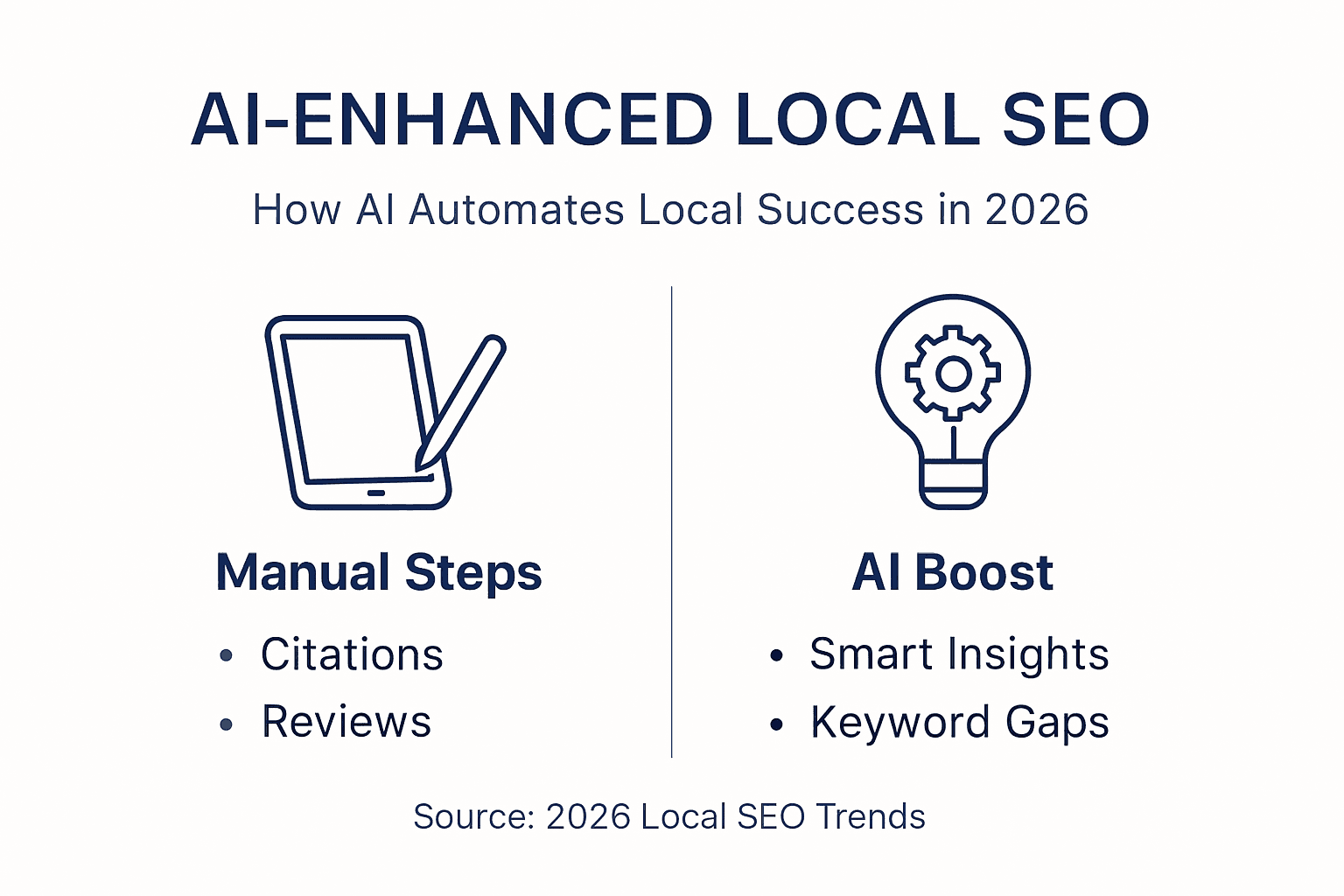
Traditional keyword research tools miss the nuanced, conversational queries people actually use when searching for local businesses. AI-driven keyword research tools identify high-intent local search terms that result in a 25-40% higher click-through rate compared to conventional methods.
AI analyzes search patterns, user intent, and semantic relationships to surface keywords your competitors overlook. These tools reveal the exact phrases potential customers type when they are ready to buy or book services.
Implement AI-powered keyword optimization:
- Use AI keyword tools to find location-specific, high-intent search terms.
- Analyze Google autosuggest data to understand real-time search behavior.
- Optimize your homepage, service pages, and blog content with these keywords naturally.
- Create FAQ content answering the specific questions AI tools identify.
- Update meta titles and descriptions to include local modifiers and primary keywords.
Apply local schema markup to your website to give search engines structured data about your business. This increases your chances of appearing in rich snippets by 30%, making your listing more prominent and clickable in search results.
Focus on keywords that include your city, neighborhood, or region combined with your service. For example, "emergency plumber in downtown Seattle" performs better than generic "plumber" searches because it captures ready-to-hire customers.
Pro Tip: Use AI to analyze competitor content and identify keyword gaps where you can rank more easily. Target these opportunities first for quick wins.
Understanding AI in local SEO visibility and conducting thorough keyword gap analysis gives you sustainable competitive advantages. Explore more about AI-driven keyword research to refine your approach.
Step 4: Manage Reputation and Encourage Customer Reviews
Customer reviews directly influence both your search rankings and conversion rates. Strong customer reviews can increase leads by up to 20% and serve as critical ranking signals that Google uses to determine local search positions.
Building a consistent review generation process separates successful local businesses from those that struggle to compete. You need both quantity and quality of reviews across multiple platforms.
Execute this review management strategy:
- Set up automated email or SMS review requests sent 2-3 days after purchase or service completion.
- Make the review process simple with direct links to your Google My Business and industry-specific review platforms.
- Respond to every review within 24-48 hours, thanking positive reviewers and addressing concerns professionally in negative reviews.
- Display review counts and star ratings prominently on your website and marketing materials.
- Never incentivize reviews with discounts or payments as this violates platform guidelines and risks penalties.
- Monitor review platforms weekly to catch and respond to new feedback quickly.
Negative reviews are not disasters when handled correctly. A professional, helpful response shows potential customers that you care about service quality and resolve issues promptly. This often converts skeptical prospects better than perfect five-star ratings that seem fake.
Highlight specific positive reviews in your marketing content and social media to maximize their impact. Real customer testimonials build trust faster than any marketing copy you write yourself.
Implementing comprehensive review generation and management systems ensures you continuously build social proof that drives both rankings and conversions.
Step 5: Optimize Website and Mobile User Experience
Your website must deliver an exceptional experience on mobile devices where most local searches happen. Neglecting mobile optimization can cause businesses to lose up to 50% of potential local customers who abandon slow or difficult-to-navigate sites.
Google prioritizes mobile-first indexing, meaning your mobile site performance directly impacts your rankings. A fast, intuitive mobile experience keeps visitors engaged and converts them into leads or customers.
Optimize these critical website elements:
- Implement responsive design that adapts seamlessly to all screen sizes.
- Achieve page load speeds under 3 seconds by compressing images, minimizing code, and using a content delivery network.
- Display click-to-call buttons prominently so mobile users can contact you instantly.
- Make your NAP information visible on every page, especially in the header or footer.
- Create clear navigation menus with minimal clicks to reach service pages or contact forms.
- Use legible font sizes and adequate spacing for easy mobile reading.
Using local schema markup increases chances of appearing in rich snippets by 30%, giving you enhanced visibility in search results. Implement LocalBusiness schema with your NAP, hours, service area, and review ratings to help search engines understand and display your information accurately.
Test your site regularly on actual mobile devices, not just desktop browser emulators. User behavior on phones differs significantly, and real-world testing reveals friction points that analytics might miss.
Mastering mobile search optimization for local business ensures you capture and convert the majority of local searchers who find you on smartphones. Learn more through current mobile SEO statistics that underscore why mobile matters.
Common Mistakes and Troubleshooting in Local SEO
Over 60% of local ranking losses stem from inconsistent NAP, neglecting GMB upkeep, and ignoring customer reviews. These mistakes are completely avoidable with proper systems and regular maintenance.
The most damaging error is inconsistent business information across your website, GMB, and citation sources. Search engines lose confidence when they find conflicting addresses or phone numbers. This confusion directly translates to lower rankings.
Avoid these critical mistakes:
- Failing to update GMB posts and photos regularly, which reduces engagement by up to 25%.
- Ignoring negative reviews or responding defensively instead of professionally.
- Using different phone numbers or address formats across platforms.
- Neglecting to monitor and remove duplicate GMB listings that split your ranking power.
- Skipping mobile optimization and losing half your potential traffic.
- Building low-quality citations on spammy directories that harm more than help.
Schedule monthly local SEO audits to catch and fix issues before they cause significant damage. Use a checklist to verify NAP consistency, check for new reviews, update GMB content, and monitor your local rankings.
"The businesses that dominate local search are not necessarily doing anything revolutionary. They are simply consistent with the fundamentals and quick to fix problems when they arise."
Pro Tip: Set calendar reminders for the first Monday of each month to review your GMB insights, respond to pending reviews, and verify your top citations remain accurate. This 30-minute investment prevents costly ranking drops.
Maintaining strong local SEO citation management practices and staying current on local SEO mistakes to avoid keeps your business visible and competitive.
Expected Results, Timelines, and Measuring Success
Realistic expectations prevent frustration and help you stay committed to local SEO long enough to see meaningful results. Most businesses notice visible ranking improvements within 3 to 6 months after implementing comprehensive local SEO strategies consistently.
Your timeline depends on several factors including current visibility, competition intensity, and implementation consistency. Businesses starting from scratch take longer than those optimizing existing foundations.
Typical monthly costs for tools and services range from $50 to $200 for small businesses handling most work internally. Hiring agencies or consultants increases costs but accelerates results and ensures expert execution.
Track these key performance metrics:
- Local search impressions and clicks in Google Search Console.
- GMB insights including profile views, website clicks, direction requests, and phone calls.
- Organic traffic from local keywords in Google Analytics.
- Lead volume and source tracking to measure conversion rates.
- Local ranking positions for your target keywords.
- Review quantity, ratings, and response rates.
Combining AI tools with manual oversight yields approximately 50% efficiency gains compared to purely manual approaches. AI handles data analysis, keyword research, and pattern identification while you focus on strategy and creative optimization.
Here is how different approaches compare:
| Approach | Time Investment | Monthly Cost | Results Timeline | Best For |
|---|---|---|---|---|
| Manual SEO | 15-20 hours | $50-$100 | 6-9 months | Very small businesses, tight budgets |
| AI-Driven | 8-12 hours | $100-$200 | 3-6 months | SMBs wanting efficiency |
| Hybrid (AI + Expert) | 5-8 hours | $150-$500 | 2-4 months | Competitive markets, growth-focused |
The hybrid approach delivers the fastest, most sustainable results by leveraging AI for scale and efficiency while applying human expertise for strategy and creativity.
Boost Your Local SEO with Expert Help
Implementing these local SEO strategies takes time and expertise, but you do not have to do it alone. Our AI-powered tools and step-by-step guides simplify the entire process, helping you compete effectively without dedicating countless hours to technical details.

We provide comprehensive resources for every aspect of local SEO, from optimizing your Google Business Profile to building high-quality citations and managing your online reputation. Our analytics tools track your progress and identify opportunities you might miss on your own.
Whether you need guidance on strategic planning or hands-on help with implementation, our solutions adapt to your budget and goals. Get started with our local business search ranking guide that breaks down complex concepts into actionable steps, or dive into our detailed Google Business Profile optimization guide to maximize your most valuable local SEO asset.
FAQ
What is the typical timeframe to see results from local SEO?
Most small to medium businesses see noticeable improvements within 3 to 6 months after implementing comprehensive local SEO strategies. Results depend on your current visibility, competition intensity, and how consistently you execute optimizations.
How does AI improve local SEO keyword research?
AI analyzes massive data sets to identify high-intent local keywords that traditional methods miss, including conversational queries and semantic variations. This results in 25-40% higher click-through rates by targeting searches from customers ready to buy.
What are the most common local SEO mistakes to avoid?
Inconsistent NAP data across platforms, ignoring Google My Business updates, and neglecting customer reviews cause over 60% of local ranking losses. Regular monthly audits and prompt corrections are essential for maintaining strong local search positions.