

Every American small business owner knows the challenge of standing out when social media feels crowded and noisy. It matters because connecting with customers online is no longer optional, especially with over 5.2 billion social media users worldwide offering new opportunities for growth. Discover practical ways to use AI-powered strategies and platform-specific tactics to increase your brand’s visibility and generate quality leads.
Table of Contents
- What Social Media Marketing Means Today
- AI-Powered Strategies For Local Businesses
- Major Types Of Social Media Campaigns
- How Social Media Drives Leads And Sales
- Risks, Reputation, And Compliance Issues
- Key Mistakes And Best Practices To Avoid
Key Takeaways
| Point | Details |
|---|---|
| Evolving Social Media Marketing | Social media marketing has transitioned to a data-driven strategy focused on authentic connections and targeted engagement with audiences. |
| AI Integration for Local Businesses | AI tools enhance operational efficiency and provide local businesses with advanced marketing capabilities that were previously exclusive to larger firms. |
| Diverse Campaign Types | Different social media campaigns, including awareness, engagement, and conversion, require tailored strategies based on specific business objectives and target audiences. |
| Risk Management Importance | Businesses must develop comprehensive social media policies to mitigate reputational risks and ensure compliance with data privacy regulations. |
What Social Media Marketing Means Today
Social media marketing has transformed from simple platform posting to a sophisticated, data-driven strategy for connecting with audiences worldwide. Over 5.2 billion social media users now represent an enormous potential marketplace for businesses seeking targeted engagement.
Today's social media marketing goes far beyond traditional advertising. It's a dynamic ecosystem where brands can:
- Build authentic audience relationships
- Generate real-time customer feedback
- Create targeted advertising campaigns
- Develop interactive brand storytelling
- Leverage user-generated content
The landscape of social media platforms offers unique opportunities for businesses. Usage patterns vary significantly across different demographic groups, making strategic platform selection crucial. YouTube, Facebook, Instagram, and TikTok each provide distinct channels for reaching specific audience segments.
Here is a comparison of popular social media platforms and their key business advantages:
| Platform | Primary Audience | Content Strength | Business Advantage |
|---|---|---|---|
| YouTube | Broad, all ages | Video tutorials, demos | High engagement, SEO boost |
| Adults, families | Community content | Large audiences, targeting | |
| Millennials, Gen Z | Visual storytelling | Brand awareness, influencers | |
| TikTok | Gen Z, young adults | Short-form video | Viral potential, trend focus |
Successful social media marketing now requires understanding complex algorithmic behaviors, audience psychographics, and content optimization techniques. Businesses must craft compelling narratives that resonate authentically with their target demographics while navigating platform-specific engagement strategies.

Pro tip: Develop a consistent brand voice that remains genuine across different social media platforms, focusing on creating value for your audience rather than just promoting products.
AI-Powered Strategies for Local Businesses
Local businesses are experiencing a technological revolution through AI-powered marketing strategies that transform traditional approaches. Small businesses are increasingly adopting AI tools to improve operational efficiency and gain competitive advantages in an increasingly digital marketplace.
The most powerful AI strategies for local businesses focus on several key areas:
- Automated customer communication
- Personalized marketing campaigns
- Predictive data analytics
- Intelligent content generation
- Targeted social media engagement
Competitive Intelligence emerges as a critical advantage for local businesses leveraging AI technologies. Recent Census Bureau research reveals that generative AI is democratizing advanced marketing capabilities previously accessible only to large corporations.
AI enables local businesses to craft sophisticated, data-driven marketing approaches that were once impossible. Machine learning algorithms can now analyze customer behaviors, predict purchasing patterns, and generate hyper-personalized content that resonates with specific audience segments. This technological leap allows small businesses to compete more effectively against larger competitors by delivering precisely targeted messaging and experiences.
Pro tip: Start with one or two AI marketing tools that directly address your most pressing business challenges, and gradually expand your technological capabilities.
Major Types of Social Media Campaigns
Social media marketing has evolved into a sophisticated landscape with multiple campaign approaches designed to achieve specific business objectives. Various social media campaign strategies enable businesses to connect with audiences through targeted, data-driven communication methods.
The primary types of social media campaigns include:
-
Awareness Campaigns
- Build brand recognition
- Introduce new products or services
- Expand audience reach
-
Engagement Campaigns
- Encourage audience interaction
- Generate comments and shares
- Create community connections
-
Conversion Campaigns
- Drive specific actions
- Generate leads
- Increase sales and revenue
Performance-Driven Strategies represent the next frontier of social media marketing. Public health communication research demonstrates how targeted messaging can effectively influence audience behaviors through carefully crafted content and strategic distribution.
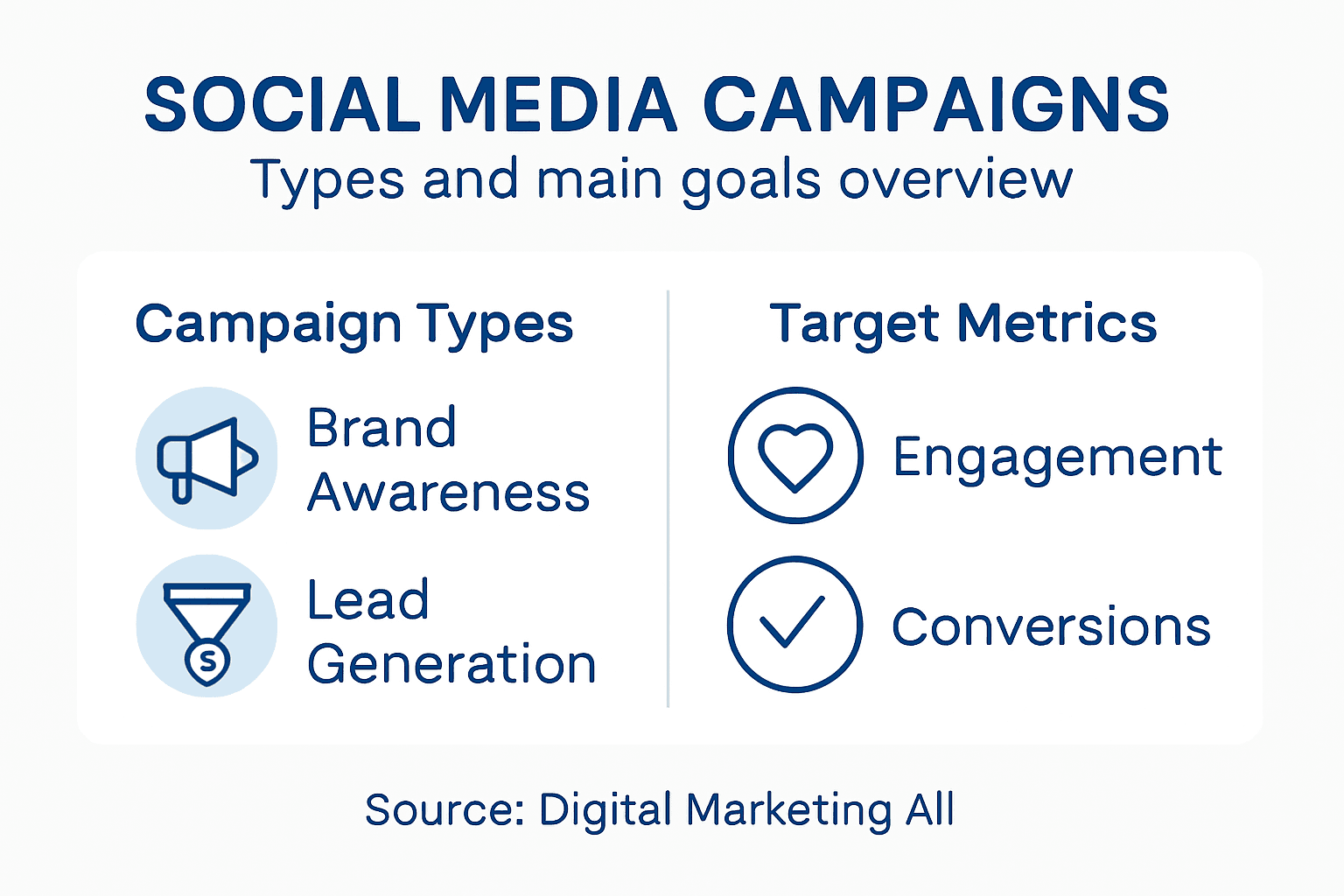
Each campaign type requires a unique approach tailored to specific audience segments and marketing objectives. Successful social media campaigns leverage data analytics, audience insights, and creative storytelling to cut through digital noise and deliver meaningful experiences that resonate with target demographics.
Below is a summary of major types of social media campaigns and their strategic business goals:
| Campaign Type | Main Goal | Ideal Metric | Typical Content Format |
|---|---|---|---|
| Awareness | Boost recognition | Reach, impressions | Announcements, visuals |
| Engagement | Foster interaction | Comments, shares | Polls, interactive posts |
| Conversion | Drive action/sales | Clicks, purchases | Promos, calls-to-action |
Pro tip: Develop a comprehensive audience persona before launching any social media campaign to ensure your messaging precisely targets the right people with the right content.
How Social Media Drives Leads and Sales
Social media has revolutionized how businesses generate and convert leads in the digital marketplace. Direct interaction with consumers enables companies to create targeted strategies that transform casual followers into potential customers.
Key mechanisms for driving leads and sales through social media include:
-
Targeted Advertising
- Precise audience segmentation
- Customized messaging
- Retargeting capabilities
-
Conversion Optimization
- Trackable engagement metrics
- Seamless purchase pathways
- Interactive content formats
-
Trust Building
- Social proof through reviews
- Authentic brand storytelling
- Community engagement
Algorithmic Precision transforms social platforms into powerful sales engines. Economic research demonstrates how strategic content distribution can significantly influence consumer purchasing behaviors through sophisticated targeting techniques.
Successful social media lead generation requires a nuanced approach that combines data analytics, creative content, and strategic engagement. Businesses must craft compelling narratives that not only attract attention but also guide potential customers through a seamless journey from initial interest to final purchase.
Pro tip: Create platform-specific content strategies that align with each social media channel's unique audience behaviors and engagement patterns.
Risks, Reputation, and Compliance Issues
Social media platforms present complex challenges for businesses navigating digital communication landscapes. Social media risk management requires understanding systemic risks that can potentially damage brand reputation and trigger legal consequences.
Key compliance and reputation risks include:
-
Content Risks
- Misinformation spread
- Inappropriate content
- Potential platform policy violations
-
Data Privacy Challenges
- User information protection
- Regulatory compliance
- Consent and transparency requirements
-
Reputational Vulnerabilities
- Public perception management
- Crisis communication strategies
- Brand authenticity maintenance
Systemic Risk Mitigation demands proactive strategies. Reputation management research highlights the critical importance of fact-checking, maintaining transparency, and developing robust content moderation protocols.
Businesses must develop comprehensive social media governance frameworks that balance engagement with responsible communication. This involves creating clear guidelines, training employees, and implementing sophisticated monitoring systems to detect and address potential reputational threats before they escalate.
Pro tip: Develop a comprehensive social media policy that includes clear content guidelines, employee training protocols, and real-time monitoring mechanisms.
Key Mistakes and Best Practices to Avoid
Social media marketing requires strategic navigation to avoid common pitfalls that can undermine brand credibility and engagement. Social media marketing strategies demand careful attention to content authenticity and audience connection.
Critical mistakes businesses frequently encounter include:
-
Content Authenticity Failures
- Spreading unverified information
- Producing superficial content
- Ignoring audience feedback
-
Engagement Strategy Errors
- Over-promoting products
- Inconsistent brand messaging
- Neglecting platform-specific nuances
-
Algorithmic Misunderstandings
- Failing to adapt to platform changes
- Misinterpreting engagement metrics
- Using outdated content strategies
Targeted Content Approaches are essential. Successful social media strategies prioritize understanding platform dynamics, respecting user privacy, and creating genuinely valuable content that resonates with specific audience segments.
Companies must develop adaptive, transparent marketing approaches that prioritize authentic communication and demonstrate genuine value to their audience. This requires continuous learning, metric analysis, and a willingness to evolve marketing strategies based on real-world performance and audience feedback.
Pro tip: Implement a monthly content audit to systematically review and refine your social media strategy, ensuring alignment with audience expectations and platform trends.
Unlock the Power of AI-Driven Social Media Marketing for Your Business
The article highlights the transformative role of AI in elevating social media marketing strategies. If you struggle to harness complex algorithms, personalize content, and boost your local visibility with authentic engagement, you are not alone. Many businesses face the challenge of standing out in an overcrowded digital space where trust, targeted campaigns, and data-driven decisions are essential. Advanced AI-powered solutions can help you overcome these obstacles by enabling predictive analytics, targeted advertising, and optimized social media presence that matches your unique audience.
At Digital Marketing All, we specialize in elevating your online visibility using AI-driven marketing strategies for local and national businesses. From enhancing your presence on platforms like Facebook, Instagram, and TikTok to mastering search engine autosuggest and Google My Business optimization, our services focus on delivering real results through innovative tools and proven tactics.
- Dominate AI recommendations with tailored content
- Improve local search rankings with expert SEO
- Drive quality leads and measurable conversions
Elevate your brand by embracing AI-powered social media marketing today. Visit Digital Marketing All to discover how our comprehensive services can transform your digital presence and help your business thrive. Don’t wait to capture the attention your brand deserves.
Explore targeted solutions at Digital Marketing All and start winning your market now.
Frequently Asked Questions
How has social media marketing changed in recent years?
Social media marketing has evolved into a sophisticated, data-driven strategy that focuses on building relationships, generating real-time feedback, and creating interactive brand storytelling beyond traditional advertising methods.
What advantages do different social media platforms offer for businesses?
Each platform, such as YouTube, Facebook, Instagram, and TikTok, has unique audience demographics and content strengths, allowing businesses to target specific audience segments effectively based on their marketing goals.
How can local businesses leverage AI in social media marketing?
Local businesses can use AI for automated customer communication, personalized marketing, predictive analytics, and targeted engagement strategies that enhance operational efficiency and competitiveness.
What are the main types of social media campaigns?
The primary types include awareness campaigns (to build brand recognition), engagement campaigns (to encourage audience interaction), and conversion campaigns (to drive specific actions), each requiring tailored strategies to achieve distinct business objectives.