

TL;DR:
- Understanding search intent helps align content with user goals, improving rankings and conversions.
- Google prioritizes "Needs Met" over authority signals, making intent matching critical.
- Regularly audit and update content to adapt to evolving user search behaviors and intent shifts.
Most business owners focus hard on choosing the right keywords, optimizing their pages, and building backlinks. Yet their rankings still disappoint them. The missing piece is rarely technical. It is search intent. Understanding why someone types a query into Google, and aligning your content to that reason, is what separates businesses that attract the right traffic from those that simply attract traffic. This guide walks you through what search intent is, how search engines use it to rank pages, and how you can apply it to your digital strategy starting today.
Table of Contents
- What is search intent and why does it matter?
- Understanding the main types of search intent
- How search engines evaluate search intent (and why it impacts your ranking)
- Identifying and matching search intent in your digital strategy
- What most business owners miss about search intent
- Ready to take the next step?
- Frequently asked questions
Key Takeaways
| Point | Details |
|---|---|
| Search intent defined | Search intent is the reason behind a user's online query and must be matched for better SEO. |
| Intent types matter | Knowing the main intent types helps you create content that aligns with what customers seek. |
| Manual checks are essential | Tools are reliable but always verify intent by reviewing live search results, especially for mixed queries. |
| Ranking depends on intent | Google now prioritizes matching search intent over content credentials like E-E-A-T. |
| Strategy requires updates | Audit and adjust your strategy regularly to keep up with shifting search intents and user needs. |
What is search intent and why does it matter?
Search intent is the underlying reason or goal behind a user's search query. When someone types something into Google, they are not just looking for words on a page. They are trying to accomplish something specific. Maybe they want to learn, find a particular website, make a purchase, or compare options before buying. Your job as a business owner is to figure out which of those goals your target audience has, and then build content that directly satisfies it.
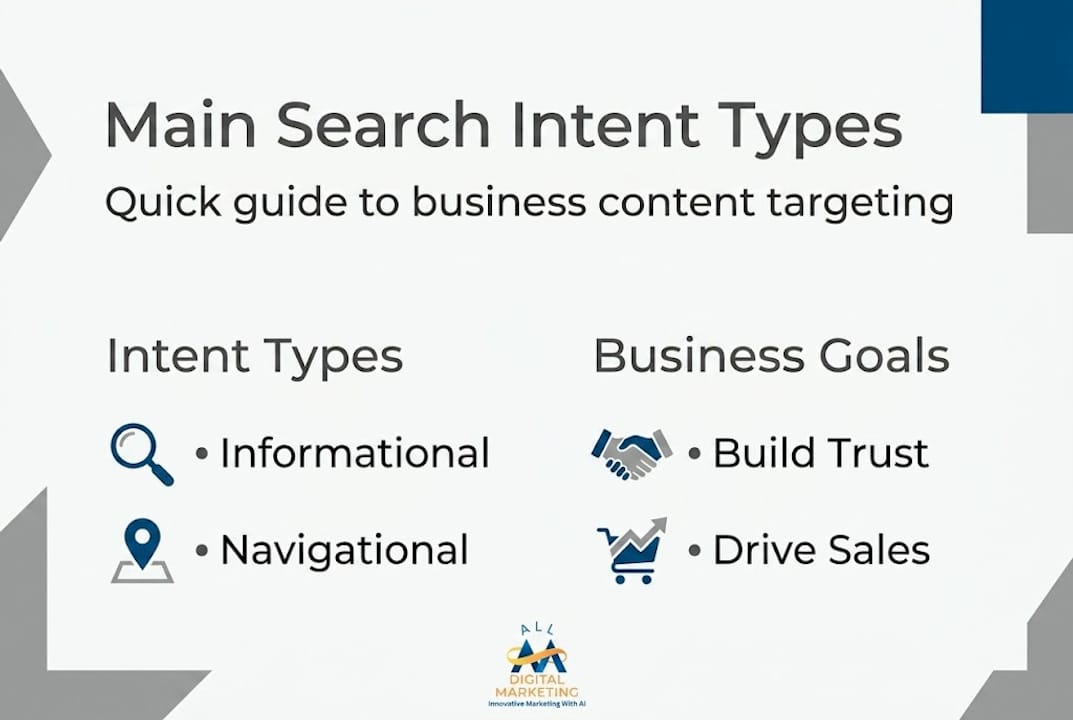
Search intent is generally grouped into four categories:
- Informational intent: The user wants to learn something. Example: "how does SEO work"
- Navigational intent: The user is trying to reach a specific website or page. Example: "Digital Marketing All blog"
- Transactional intent: The user is ready to take an action, typically a purchase. Example: "buy local SEO services"
- Commercial investigation intent: The user is researching before making a decision. Example: "best SEO agencies for small businesses"
Understanding which category applies to a given keyword is critical because Google actively matches its search results to the dominant intent behind each query.
Here is a quick look at the four intent types and what they signal:
| Intent type | User goal | Typical signal words |
|---|---|---|
| Informational | Learn or understand | how, what, why, guide, tips |
| Navigational | Find a specific site | brand name, login, homepage |
| Transactional | Buy or sign up | buy, order, pricing, hire |
| Commercial investigation | Compare before buying | best, vs, review, top |
Getting this right has a direct impact on your conversion rates and your search rankings. If someone searches for "how to improve local SEO" and lands on a page that immediately tries to sell them a service package, they will leave quickly. That early exit tells Google your page did not satisfy the user's intent, and your rankings suffer as a result.
"Intent alignment is not just about keyword matching. It is about anticipating what users genuinely need at each stage of their decision journey."
Automated keyword research tools have made intent classification much faster. Tools like Ahrefs and Semrush classify keywords by intent using SERP analysis and machine learning, achieving between 85 and 92 percent accuracy. That is impressive, but it also means that up to 15 percent of their classifications may be off, particularly for mixed intent queries where users have multiple possible goals. Always pair tool data with a manual look at actual search results.
Investing time in searcher intent optimization early in your strategy will save you from building content libraries that attract the wrong visitors and fail to convert.
Understanding the main types of search intent
Now that you know what search intent is, let's explore each type so you can match your content effectively.
Informational intent covers a huge volume of searches. Users at this stage are curious or need guidance. They are not ready to buy yet. Content that performs well here includes blog posts, how-to guides, explainer videos, and FAQs. If your business is a local plumbing service, a post like "why is my water pressure low" directly targets this intent and positions you as a trusted expert before the user ever needs to call anyone.

Navigational intent is more straightforward. The user already knows where they want to go. Your priority here is to make sure your brand appears when someone searches your business name or your most well-known services. This is also where a well-optimized Google Business Profile matters significantly.
Transactional intent is where revenue happens. Users searching "hire an SEO agency near me" or "buy content marketing package" have moved past research. They want to act. Your landing pages, service pages, and product listings need to be crystal clear, fast loading, and friction-free. Remove anything that slows down the decision or creates doubt.
Commercial investigation intent sits between informational and transactional. Users are comparing options, reading reviews, and weighing value. This is your opportunity to stand out through comparison guides, case studies, testimonials, and transparent pricing information. Businesses that skip this stage often lose customers who were genuinely ready to spend.
Here is how intent maps to content strategy:
| Intent type | Best content format | Business goal |
|---|---|---|
| Informational | Blog posts, videos, guides | Build trust and awareness |
| Navigational | Brand pages, GMB listing | Be found, reinforce identity |
| Transactional | Landing pages, service pages | Drive conversions |
| Commercial investigation | Comparisons, reviews, case studies | Influence the final decision |
A common mistake is creating content that mixes intents without prioritizing one. A blog post that tries to educate and sell at the same time often does neither effectively. Simplified SEO strategies teach us that focused, intent-specific content consistently outperforms content that tries to serve every goal at once.
One critical note: Google's quality evaluators flag pages where intent mismatches occur, and tools can miss these situations between 8 and 15 percent of the time, particularly when intent is shifting or overlapping. Manual SERP review is always more accurate for edge cases.
Pro Tip: Open Google Analytics or Search Console and look at which queries bring users to your highest-traffic pages. Then check whether those pages actually match the intent behind those queries. You may find that some of your best-ranking pages are attracting the wrong audience entirely.
How search engines evaluate search intent (and why it impacts your ranking)
With a strong grasp of intent types, it is crucial to understand how search engines assess whether you have met a user's intent.
Google uses human quality raters and AI systems to evaluate the quality of search results. One of the most important measures they use is called "Needs Met." This rating reflects how well a page satisfies the actual need behind a search query. Here is what many businesses do not know: Google prioritizes Needs Met over expertise and authority signals if the intent does not match the content. In other words, even a well-written, expert-level page can rank poorly if it answers the wrong question.
E-E-A-T, which stands for Experience, Expertise, Authoritativeness, and Trustworthiness, is still important. But it functions as a quality amplifier, not a substitute for relevance to user intent. Think of it this way: a page must first pass the Needs Met test before E-E-A-T even comes into play.
"A perfectly authoritative page that answers the wrong question will consistently underperform a less polished page that nails the user's actual need."
Here is what happens in practice when intent is misaligned. A business publishes a detailed service overview for a keyword that users are searching with informational intent. Visitors arrive, find a sales pitch instead of an answer, and leave within seconds. Those user engagement signals such as high bounce rates and low dwell time tell Google the page did not satisfy the query. Rankings drop. Traffic falls. And no amount of link building fixes the underlying problem.
To make sure your content consistently meets user intent, follow these three steps:
- Search your target keyword yourself. Look at the top five results. Are they blog posts, product pages, or comparison articles? The format of the top results reveals the dominant intent Google has identified for that query.
- Audit your page's opening message. Within the first two paragraphs, does your content directly address what the user is looking for? If not, restructure your introduction to immediately satisfy the query.
- Track engagement and iterate. Monitor your time on page, scroll depth, and conversion rates. If users are leaving quickly, the page is likely not matching intent. Test content adjustments and measure the results.
When your pages genuinely satisfy search intent optimization goals, Google rewards you with better visibility, higher click-through rates, and stronger rankings over time.
Identifying and matching search intent in your digital strategy
Knowing how engines judge intent, let's put this knowledge into action for your digital strategy.
The process starts with the right tools. Ahrefs and Semrush both offer intent classification as part of their keyword research features. When you pull up a keyword, these tools label it with an intent category based on SERP analysis and machine learning models. This speeds up your research significantly and helps you prioritize keywords that match your current content goals. However, keyword intent classification accuracy sits between 85 and 92 percent, meaning you should treat tool classifications as a starting point, not a final answer.
Here is a practical process for identifying true intent and building content around it:
- Start with the keyword in Google. Before building any content, type the keyword into Google and study the top 10 results. What format dominates? What questions do the top pages answer?
- Look at featured snippets and People Also Ask boxes. These reveal what Google believes users want most. Use them to shape your content structure.
- Identify the primary and secondary intent. Some queries have a clear dominant intent and a secondary one. For example, "best local SEO tools" is primarily commercial investigation but has an informational secondary layer. Build content that satisfies both.
- Map each keyword to a specific page type. Informational keywords belong on blog posts. Transactional keywords belong on service or product pages. Do not mix them without a clear structure.
- Audit your existing content for mismatches. Go through your top landing pages and compare the primary keyword each page targets against its content. If a service page ranks for an informational query, consider adding an educational section or creating a companion blog post.
A common pitfall is over-relying on tool classifications and skipping the manual check entirely. Tools work well for clear-cut queries but struggle with nuanced or emerging terms. Staying ahead of shifts in intent is one reason businesses should also pay attention to search optimization strategies that account for AI-generated results and zero-click searches, both of which have changed how intent is expressed online.
As AI search continues to evolve, content that clearly signals its intent and structure performs better across both traditional and AI-powered platforms. Explore AI search content strategies to ensure your content is built for the next generation of search, not just today's results pages.
Pro Tip: Build a simple intent audit spreadsheet. List your top 20 keywords, the current page targeting each one, the tool-generated intent label, and your manual verification result. Reviewing this once a quarter keeps your strategy sharp and responsive.
What most business owners miss about search intent
Most business owners treat search intent as a one-time checklist item. They classify their keywords once, align their pages, and move on. That approach works in the short term, but it misses something important: intent shifts over time.
A keyword that was primarily informational two years ago might now carry strong transactional signals because the market has matured. "AI marketing tools," for example, used to attract curious learners. Today it attracts buyers ready to subscribe. If your content has not kept pace with that shift, you are losing ground to competitors who noticed first.
The brands that lead in search consistently do two things well. They treat their intent analysis as a living process, not a project. And they bring genuine empathy to their keyword research, asking not just "what is the user searching for" but "why are they searching for it right now, and what would genuinely help them." Tools can surface data. They cannot replicate that kind of thinking.
We also see businesses ignore the lessons hidden in competitor content. When a competitor's page outranks yours for a shared keyword, studying that page tells you exactly what Google believes better satisfies user intent. That insight is more actionable than any tool report. Staying curious and learning from those wins and losses, including through resources on emotional triggers in SEO, keeps your strategy grounded in what actually moves users to engage and convert.
Ready to take the next step?
Understanding search intent is one of the most valuable shifts you can make in your digital marketing approach. It helps you attract the right visitors, keep them engaged, and convert them into customers.

At Digital Marketing All, we help small and medium-sized businesses turn search intent insights into real online visibility. From content strategy and SEO to AI-powered search optimization and local market domination, our team is ready to help you build a strategy that matches what your customers are actually searching for. Explore our resources and services today and start ranking for the right reasons.
Frequently asked questions
How do I check the search intent behind a keyword?
The most reliable method is to type the keyword directly into Google and analyze the top results. Manual SERP review consistently outperforms automated tools, especially for mixed or shifting intents where tools miss classifications 8 to 15 percent of the time.
Can I just trust tools like Ahrefs or Semrush to determine intent?
These tools are accurate for the majority of keywords, but they should not be your only source. Ahrefs and Semrush intent tools achieve 85 to 92 percent accuracy, so manual verification is always advised for your most important keywords.
Why does matching search intent matter more than E-E-A-T?
Google's quality rating system scores relevance to user need above authority signals when there is a conflict. Google prioritizes Needs Met over E-E-A-T when a page does not match the user's actual intent, which means relevance is your first priority.
How often should I audit my content for intent alignment?
Review your content for intent alignment every three to four months at minimum. Major Google algorithm updates often shift how intent is interpreted, and regular audits help you catch and correct misalignments before they hurt your rankings.
Can search intent change over time for the same keyword?
Absolutely. The dominant intent behind a keyword can evolve as markets mature, trends shift, and user expectations change. Intent can shift significantly over time, which is why automated tools error on 8 to 15 percent of mixed or shifting intent queries and manual checks remain essential.