

Every American small business owner knows how tough it feels to compete for attention online. PPC advertising offers a clear path to connect with real customers right when they are searching for your services, and it delivers results instantly compared to slower SEO methods. This guide explains PPC’s transparent, performance-driven approach and shows how AI-powered tools and smart strategies can help you reach local audiences, increase leads, and make every marketing dollar count.
Table of Contents
- Defining PPC Advertising and Core Concepts
- Main PPC Ad Formats and Placement Options
- How PPC Drives Local and National Visibility
- AI-Powered PPC Strategies for Lead Generation
- Costs, ROI, and Common Pitfalls to Avoid
Key Takeaways
| Point | Details |
|---|---|
| Effective Keyword Research | Identifying specific search terms is crucial for targeting the right audience and improving ad visibility. |
| Diverse Ad Formats | Utilizing various ad formats, such as search and display ads, enhances strategic engagement with potential customers. |
| AI Optimization | Implementing AI tools allows businesses to optimize audience targeting and bid management effectively, leading to higher-quality leads. |
| Strategic Budget Management | Regularly reviewing budgets and tracking conversions helps maximize ROI and reduce unnecessary spending in PPC campaigns. |
Defining PPC Advertising and Core Concepts
Pay-Per-Click (PPC) advertising represents a dynamic digital marketing strategy where advertisers pay a fee each time their online advertisement gets clicked. Unlike traditional advertising models, PPC offers a precise, measurable approach to driving targeted website traffic. Digital marketing professionals leverage PPC as a strategic method to immediately connect with potential customers searching for specific products or services.
The core mechanism of PPC advertising involves bidding on specific keywords relevant to a business's target audience. Advertisers select keywords potential customers might use when searching online, then create tailored ads that appear in search engine results or on partner websites. When users click these strategically placed advertisements, the advertiser is charged a predetermined amount, making the model highly transparent and performance-driven.
Key components of an effective PPC campaign include:
- Keyword Research: Identifying precise search terms potential customers use
- Ad Copywriting: Crafting compelling, targeted messages
- Landing Page Optimization: Designing conversion-focused web pages
- Performance Tracking: Monitoring metrics like click-through rates and conversion percentages
Pro tip: Start with a small budget and experiment with different keyword combinations to understand which ads generate the most cost-effective results.
Main PPC Ad Formats and Placement Options
PPC advertising offers diverse ad formats designed to help businesses reach their target audiences across multiple digital platforms. Search engine and display ad formats provide advertisers with strategic options to maximize visibility and engagement. These formats range from text-based search ads to visually compelling display advertisements that appear on websites, social media platforms, and mobile applications.
The primary PPC ad formats include:
- Search Network Ads: Text-based advertisements appearing alongside search engine results
- Display Network Ads: Visual banner and graphic advertisements shown on partner websites
- Remarketing Ads: Targeted ads displayed to users who previously visited a website
- Shopping Ads: Product-specific advertisements with images and pricing information
- Video Ads: Promotional video content displayed on platforms like YouTube
Effective ad placement requires understanding platform-specific targeting capabilities. Google Ads, for instance, allows advertisers to refine audience targeting based on demographics, interests, browsing behavior, and geographic location. Social media platforms like Facebook and Instagram offer similar sophisticated targeting mechanisms that enable precise audience segmentation.
Here's a quick comparison of PPC ad formats and ideal use cases:
| Ad Format | Best For | Key Advantage |
|---|---|---|
| Search Network Ads | High-intent searches | Immediate visibility |
| Display Network Ads | Brand awareness campaigns | Wide audience reach |
| Remarketing Ads | Re-engagement strategies | Increase conversion rates |
| Shopping Ads | E-commerce and retail | Showcase products visually |
| Video Ads | Storytelling and engagement | High audience interaction |
Pro tip: Rotate and test multiple ad formats simultaneously to determine which combinations generate the most cost-effective engagement for your specific business goals.
How PPC Drives Local and National Visibility
PPC advertising provides businesses with a powerful mechanism to simultaneously target local and national audiences through strategic digital marketing approaches. Digital advertising strategies enhance brand visibility across multiple geographic scales, enabling companies to precisely reach potential customers in specific neighborhoods or across entire regions.
Key strategies for maximizing local and national visibility include:
- Geo-Targeted Advertising: Configuring ads to appear in specific cities, states, or regions
- Location-Based Keyword Optimization: Using region-specific search terms
- Demographic Targeting: Refining audience selection based on local and national characteristics
- Local Extension Strategies: Adding location information to search ads
- National Broad-Match Campaigns: Creating wider-reaching advertisement approaches
Small businesses can leverage PPC to compete with larger national brands by implementing hyper-local targeting techniques. Google Ads and social media platforms offer sophisticated tools that allow advertisers to narrow their audience by zip code, city, or metropolitan area, while simultaneously providing options for broader national reach. These platforms enable precise budget allocation, ensuring that marketing dollars are spent efficiently on the most promising customer segments.

Pro tip: Create separate ad campaigns for local and national audiences, using distinct keywords and messaging to maximize relevance and engagement.
AI-Powered PPC Strategies for Lead Generation
AI is revolutionizing pay-per-click advertising by enabling unprecedented precision in targeting and lead generation strategies. AI-powered marketing optimization tools are transforming how businesses approach digital advertising, creating more intelligent and responsive campaign management systems that dramatically improve conversion rates.
Key AI-driven PPC lead generation strategies include:
- Predictive Audience Modeling: Using machine learning to identify potential high-value customers
- Dynamic Ad Content Generation: Creating personalized ad variations automatically
- Real-Time Bid Optimization: Adjusting campaign spending based on immediate performance data
- Intelligent Audience Segmentation: Breaking down target markets with unprecedented granularity
- Automated Performance Analytics: Continuously monitoring and improving campaign effectiveness
Small businesses can leverage AI technologies to compete with larger competitors by implementing sophisticated targeting techniques that were previously accessible only to companies with extensive marketing resources. Machine learning algorithms can now analyze complex user behavior patterns, predict potential customer interactions, and automatically adjust advertising strategies in real-time. These technologies enable precise budget allocation, ensuring marketing dollars are spent on the most promising lead generation opportunities.
The following table summarizes how AI enhances core PPC functions:
| PPC Function | How AI Improves It | Business Benefit |
|---|---|---|
| Audience Targeting | Predicts high-value segments | Higher quality leads |
| Bid Management | Optimizes bids in real time | More efficient ad spending |
| Ad Creation | Generates personalized ads | Boosts engagement and relevance |
| Analytics | Automates performance tracking | Faster, data-driven decisions |
Pro tip: Implement AI-powered tools that provide continuous learning and optimization, allowing your PPC campaigns to become more effective with each iteration.
Costs, ROI, and Common Pitfalls to Avoid
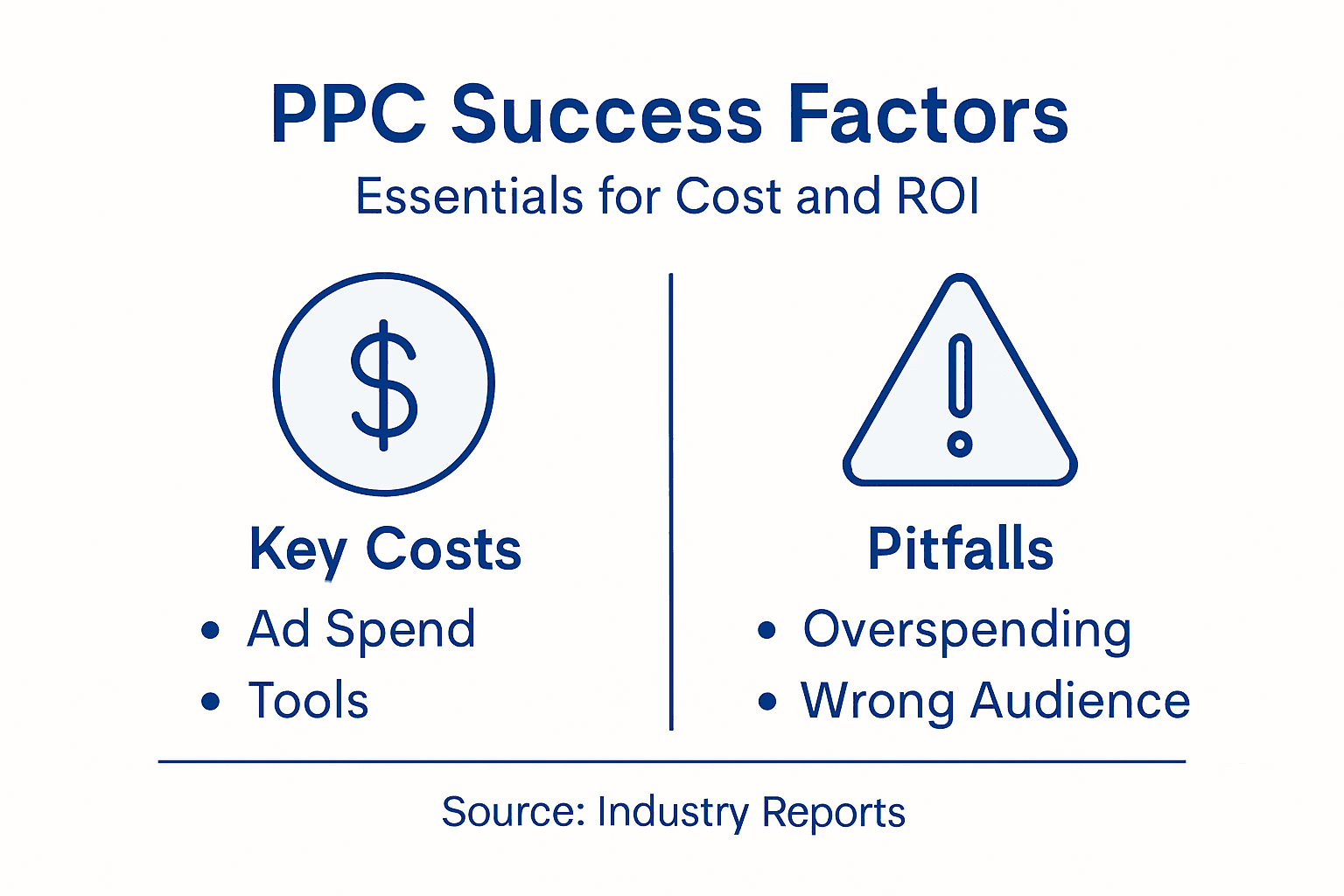
PPC advertising requires strategic financial management to ensure maximum return on investment and minimize unnecessary spending. Marketing performance measurement systems are critical for understanding and optimizing the financial effectiveness of digital advertising campaigns.
Common PPC pitfalls that can drain marketing budgets include:
- Poorly Defined Target Audiences: Wasting money on irrelevant clicks
- Inadequate Keyword Research: Targeting overly broad or incorrect search terms
- Neglecting Conversion Tracking: Failing to measure actual campaign performance
- Inconsistent Ad Messaging: Creating disconnected landing page and ad experiences
- Overlooking Negative Keywords: Not filtering out non-converting search queries
Successful PPC campaigns demand continuous monitoring and strategic budget allocation. Businesses must develop a granular understanding of their cost per click, conversion rates, and customer acquisition costs. This requires implementing robust analytics frameworks that provide real-time insights into campaign performance, allowing marketers to quickly adjust strategies, redistribute spending, and maximize their return on investment.
Pro tip: Establish a strict weekly budget review process and set clear performance thresholds that automatically trigger campaign adjustments or pauses.
Unlock Your PPC Potential with AI-Driven Digital Marketing Solutions
Pay-Per-Click advertising offers a powerful way to boost local and national online visibility while driving targeted traffic and high-quality leads. However managing PPC campaigns effectively demands precise keyword research, smart bid optimization, and continuous performance tracking to avoid wasted budget and maximize ROI. The transformative role of AI in PPC strategies unlocks smarter audience targeting and real-time bid adjustments but navigating these complex tools and tactics can feel overwhelming for small to medium-sized businesses.
At Digital Marketing All, we specialize in empowering businesses to overcome these challenges with a blend of advanced AI-powered PPC solutions, conversion-focused web design, and targeted local SEO strategies. Our approach ensures your ads reach the right customers at the right moment while amplifying your online presence through Google My Business optimization and search engine autosuggest domination. See how integrating AI-led PPC services with expert content marketing can dramatically raise your conversion rates and lower your customer acquisition costs.
Ready to dominate search results and convert clicks into loyal customers?
Explore our tailored pay-per-click advertising services to start generating consistent leads today. Visit Digital Marketing All to take your digital marketing success to the next level with innovative strategies designed for local and national impact.
Frequently Asked Questions
What is PPC advertising?
Pay-Per-Click (PPC) advertising is a digital marketing strategy where advertisers pay a fee each time their advertisement is clicked. It allows businesses to connect instantly with potential customers searching for specific products or services.
How does keyword research impact a PPC campaign?
Keyword research is crucial for a successful PPC campaign as it identifies the precise search terms that potential customers use. Selecting the right keywords helps ensure that ads reach a relevant audience, maximizing engagement and conversions.
What are the different ad formats available in PPC advertising?
PPC advertising includes various ad formats such as search network ads, display network ads, remarketing ads, shopping ads, and video ads. Each format serves different purposes and is effective for specific marketing strategies.
How can AI improve PPC advertising strategies?
AI enhances PPC advertising by offering predictive audience modeling, dynamic ad content generation, real-time bid optimization, intelligent audience segmentation, and automated performance analytics, leading to improved targeting and higher conversion rates.
Recommended
- Master AI-Driven PPC: 6 Steps to High-Quality Leads & ROI
- Master Google Adwords PPC Campaigns for Quick ROI!
- Crack the Code of B2B PPC: Turn Clicks into Customers 🚀
- Unlock the Magic of digital marketing—Boost Sales Fast
- Boosting Your Brand Awareness Through Targeted PPC Campaigns - City Web Company | Digital Marketing Agency