

Advanced AI strategies are no longer a supporting function in business planning. They are the engine of strategy itself. The most competitive organizations in 2026 treat AI not as a tool for cutting costs but as the mechanism through which they sense markets, allocate resources, and make decisions continuously, not quarterly. BCG analysis confirms this shift: AI agents now reallocate resources and enable real-time strategy adjustments that replace the old model of periodic planning cycles.
The origin of competitive advantage has changed. Where scale and cost efficiency once defined who won, Bain & Company research shows the new edge comes from the velocity of organizational learning. Early AI adopters who build faster feedback loops compound their intelligence advantage over time, making it progressively harder for slower-moving competitors to close the gap.
The core elements driving this transformation include:
- Autonomous agents that execute multistep decisions without human approval at every stage
- Continuous data feedback loops that feed real-time market signals back into strategy
- Proprietary intelligence systems that grow smarter with each deployment
- Governance redesign that defines where AI acts independently and where humans must intervene
- CEO-led transformation that frames AI as workforce empowerment, not replacement
McKinsey, The Strategy Institute, and Harvard Business School all point to the same conclusion: organizations that embed AI into their core strategy, rather than running it as a parallel technology initiative, build durable competitive positions that widen over time.
How advanced AI strategies are reshaping key business domains
AI's impact on business strategy is not uniform across an organization. It concentrates in specific domains where the combination of data volume, decision frequency, and speed of change makes human-only processes inadequate.
Strategy formulation and scenario planning have changed fundamentally. AI systems now process competitive signals, macroeconomic data, and internal performance metrics simultaneously, generating scenario models that would take human analysts weeks to build. This gives strategy teams the ability to test assumptions in near real time rather than waiting for quarterly reviews.

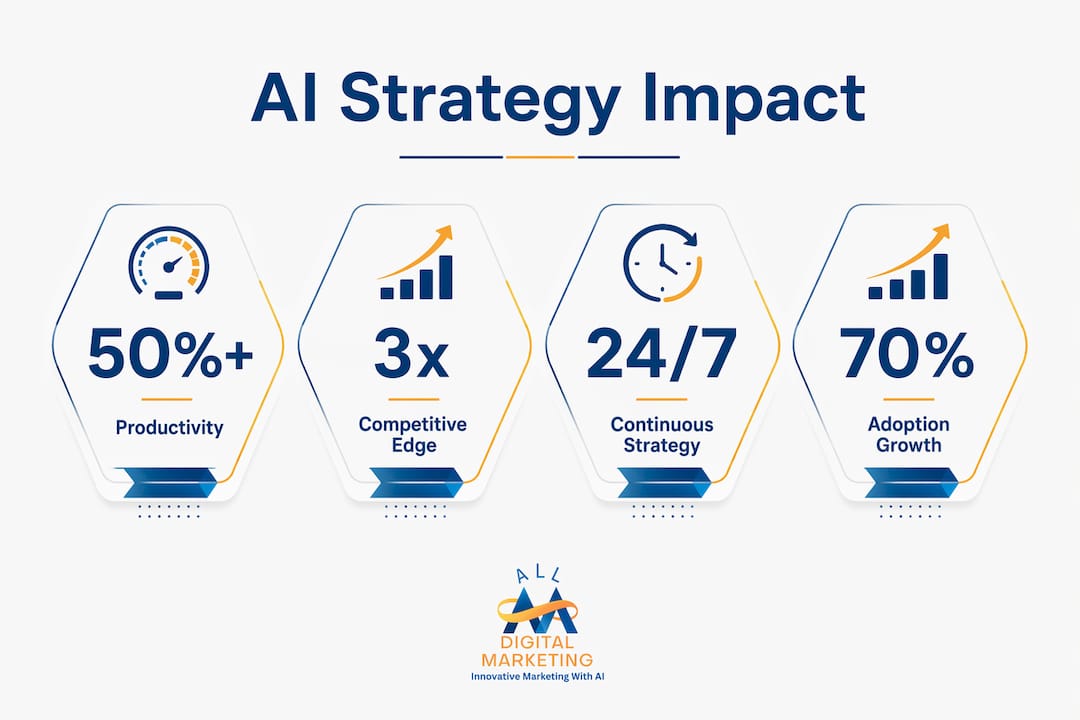
Workflow redesign and workforce transformation represent the most visible operational shift. BCG forecasts productivity gains in knowledge work through AI-powered agentic workflows, a shift comparable in scale to what globalization delivered for manufacturing. Agent-led processes handle research, drafting, analysis, and routing, freeing human teams to focus on judgment-intensive decisions.
Governance and ethical frameworks are adapting alongside the technology. As AI agents take on more autonomous execution, the question of accountability becomes urgent. BCG notes that redefining escalation criteria and decision ownership is not optional for organizations running multistep AI processes. Governance that weakens after deployment creates model drift, where AI systems gradually deviate from their intended behavior without anyone noticing until the damage is done.
Key domains where AI is actively reshaping strategy right now:
- Dynamic resource allocation: AI continuously shifts budget and capacity toward highest-return opportunities
- Real-time market sensing: AI monitors competitor moves, customer sentiment, and supply chain signals simultaneously
- Customer experience personalization: Predictive models anticipate needs before customers articulate them
- Risk identification: AI flags emerging compliance, financial, and operational risks earlier than traditional monitoring
Pro Tip: Don't spread AI investments across every department at once. Identify the two or three domains where AI can most directly accelerate your core business objectives, and build depth there first. Concentrated bets outperform distributed experiments every time.
How to build and implement an AI-driven business strategy
The organizations that succeed with AI in 2026 follow a deliberate sequence. They do not start with technology selection. They start with strategy.
-
Anchor AI to your North Star objectives. Deloitte and PwC are explicit on this point: AI strategy must begin with the core business objectives it is meant to serve. AI that runs parallel to strategy generates activity. AI embedded in strategy generates competitive momentum.
-
Secure CEO commitment as the transformation's champion. Adecco's CEO Denis Machuel demonstrated this by co-designing AI workflows directly with employees, framing the change as role elevation rather than job elimination. That approach built the internal trust needed for adoption at scale.
-
Identify focused domains for maximum impact. Bain's research on successful AI leaders consistently shows ruthless concentration on a small number of high-impact bets, not broad experimentation across the organization.
-
Redesign workflows before deploying agents. Agentic AI performs best when the underlying process has been rebuilt for it, not when it is layered onto legacy workflows. Map the decision points, data flows, and handoffs before selecting any technology.
-
Build an agent factory. Bain describes this as a repeatable, industrial-grade process for building, testing, governing, and scaling AI agents. Without this infrastructure, organizations stay trapped in perpetual pilots that never reach enterprise scale.
-
Establish escalation-based governance. The transition from human-in-the-loop oversight to defined autonomy boundaries is a leadership decision, not a technical one. Set clear criteria for when AI acts independently and when it escalates to a human.
-
Construct a learning architecture from day one. Bain's research shows that organizations embedding evaluation systems, shared memory, and feedback loops into their AI deployments from the start build a compounding intelligence advantage. Each deployment becomes smarter and cheaper than the last.
What the future of AI in business strategy looks like
The trajectory of AI in business strategy points toward greater autonomy, faster adaptation, and deeper integration into core operations. Several trends are already visible in 2026 and will accelerate through the rest of the decade.
Agentic AI adoption is scaling exponentially. What began as isolated pilots in 2023 and 2024 is now moving into core business processes. Organizations that built their agent factories early are deploying at a pace that late movers cannot match with incremental investment.

Governance models are evolving from oversight to escalation. The human-in-the-loop model, where a person approves every AI action, is giving way to defined autonomy boundaries with escalation triggers. This shift is necessary for AI to operate at the speed and volume that creates real competitive advantage.
AI-native process design is replacing retrofitted automation. The next generation of competitive organizations will not adapt existing processes for AI. They will design processes from scratch with AI as the primary actor, treating human judgment as the exception rather than the rule.
Multi-vendor ecosystem orchestration is becoming a core competency. No single AI platform handles every strategic need. Organizations are building the capability to coordinate multiple AI systems, models, and vendors within a unified governance framework.
Key challenges and opportunities on the horizon:
- Greenfield vs. brownfield decisions: New ventures can build AI-native from the start; established organizations must decide how aggressively to replace legacy infrastructure
- Workforce role redefinition: The most valuable human roles will shift toward AI oversight, exception handling, and strategic judgment
- Data network effects: Organizations accumulating proprietary data today are building AI advantages that compound over years
- Readiness gaps: A global executive survey found only 24–27% of organizations report having the talent, IT readiness, or regulatory compliance capability to implement AI successfully at scale
What the research says about AI leadership and strategic value
The performance gap between AI leaders and laggards is not theoretical. It is measurable, and it is widening.
Research by the Belfer Center published in 2026 finds that innovation-focused AI strategies deliver superior value to both firms and workers compared to approaches centered on labor-intensity reduction. Organizations that use AI to build new capabilities and accelerate growth consistently outperform those using AI primarily to cut headcount or reduce operating costs.
The global executive survey data reinforces this. Among organizations where AI is extensively impacting their business model, 73% report that AI is providing strategic advantage, compared to just 27% in the full sample. That gap reflects the difference between organizations that have embedded AI into strategy and those still treating it as an experimental technology.
Key finding: AI-transformed organizations report operational readiness levels roughly double those of the broader sample, with 50% reporting adequate talent, 48% sufficient IT readiness, and 51% readiness for regulatory compliance.
Deloitte and PwC both emphasize that AI embedded in strategy creates virtuous cycles: better data improves AI performance, which improves business outcomes, which generates more data. BCG adds that governance redesign is the prerequisite for this cycle to function at scale. Without clear escalation frameworks and defined autonomy boundaries, multistep AI execution creates accountability gaps that undermine the entire system.
The leadership behaviors that separate successful AI adopters are consistent across Bain, BCG, and Deloitte research: CEO-level commitment, concentrated investment in a small number of high-impact domains, and a deliberate architecture for organizational learning. These are not technology decisions. They are strategic choices that determine whether AI becomes a durable advantage or an expensive experiment.
For organizations looking to put these principles into practice at the marketing level, AI-powered marketing strategies offer a concrete starting point for building AI-driven competitive advantage in customer acquisition and retention.
Digitalmarketingall works with businesses ready to move from AI awareness to AI execution. If building your online presence and reputation is part of your AI-driven growth strategy, explore how reputation management can become a measurable competitive asset.
Key Takeaways
Advanced AI strategies deliver the strongest competitive advantage when they are embedded in core business objectives, governed by clear escalation frameworks, and built on a learning architecture that compounds intelligence over time.
| Point | Details |
|---|---|
| AI shifts strategy from periodic to continuous | BCG shows AI agents enable real-time resource reallocation, replacing quarterly planning cycles. |
| Innovation focus outperforms cost reduction | Belfer Center research confirms innovation-led AI strategies deliver superior long-term value to firms and workers. |
| Readiness gaps are widespread | Only 24–27% of organizations report adequate talent, IT readiness, or compliance capability for enterprise AI, according to the global executive survey. |
| Agent factories prevent perpetual pilots | Bain identifies repeatable build-test-govern-scale processes as the prerequisite for enterprise-level AI deployment. |
| Learning architecture compounds advantage | Organizations that embed feedback loops and shared memory from day one build AI systems that grow smarter with each deployment. |
FAQ
What is the role of AI in business strategy?
AI's role in business strategy has expanded from task automation to continuous, autonomous decision-making. It enables real-time scenario planning, dynamic resource allocation, and organizational learning that compounds competitive advantage over time.
What are the benefits of advanced AI for organizations?
BCG research points to productivity gains of 30–50% in knowledge work through agentic AI workflows, while Belfer Center findings show innovation-focused AI strategies deliver superior long-term returns compared to cost-reduction approaches.
How do you implement an AI-driven strategy effectively?
Start by anchoring AI initiatives to your core business objectives, secure CEO-level commitment, concentrate investment in two or three high-impact domains, and build a repeatable agent factory infrastructure before scaling. Governance frameworks defining AI autonomy boundaries must be established before deployment, not after.
What makes AI strategies succeed or fail?
The primary differentiator is whether AI is embedded in core strategy or run as a standalone technology initiative. Organizations where AI is extensively integrated report strategic advantage at nearly three times the rate of those with limited integration, according to the global executive survey: 73% versus 27%.