

Most small business owners think PPC is just a way to buy traffic, but that's a costly misconception. When integrated strategically with SEO and AI tools, PPC transforms into a visibility engine that reduces customer acquisition costs while boosting local search rankings. This guide walks you through practical, data-backed strategies to optimize your PPC campaigns, manage budgets effectively, and leverage AI insights to dominate your local market without wasting ad spend.
Table of Contents
- Key Takeaways
- Why PPC is crucial for online visibility in small and medium businesses
- Overcoming challenges: managing costs and competition with AI and human oversight
- Benchmarking PPC budgets and measuring true impact beyond clicks
- Integrating PPC with SEO and AI for optimized local search visibility
- Boost your local visibility with expert PPC and geo-fencing services
- Frequently asked questions
Key Takeaways
| Point | Details |
|---|---|
| AI with human oversight | In SMBs, human oversight complements AI to adapt campaigns for seasonal shifts and nuanced customer behavior that automation may misread. |
| Hybrid PPC and SEO | Integrating PPC with SEO lets paid data inform content strategy, reduce acquisition costs, and increase overall visibility. |
| Local targeting advantages | PPC enables precise local targeting by geography, demographics, devices, and time of day to reach customers when they are ready to buy. |
| Test small keyword sets | Run 10 to 15 keyword tests and scale the three that generate actual phone calls or form fills to guide content and SEO priorities. |
| Negative keyword discipline | Build and maintain a negative keyword list and review search term reports weekly to prevent wasted ad spend. |
Why PPC is crucial for online visibility in small and medium businesses
PPC advertising places your business at the top of search results instantly, giving you immediate visibility that organic SEO takes months to achieve. For small and medium businesses competing against established brands, this speed matters. Paid ads don't just drive traffic; they generate valuable data about which keywords convert, what messaging resonates, and where your ideal customers search.
The real power emerges when you use PPC insights to fuel your organic strategy. Hybrid PPC-SEO approaches reduce customer acquisition costs by testing keywords in paid campaigns before committing SEO resources. You discover high-converting search terms quickly, then optimize content to rank organically for those same phrases. This feedback loop creates compounding visibility gains that pure SEO or standalone PPC can't match.
Local and niche markets benefit especially from PPC's targeting precision. You can specify geographic radius, demographics, device types, and even time of day to reach customers when they're ready to buy. A plumber in Austin can target homeowners within 10 miles searching "emergency pipe repair" on mobile between 6 AM and 10 PM, maximizing relevance while minimizing wasted impressions.
Pro Tip: Run small PPC tests on 10-15 keywords you think matter, then double down on the three that generate actual phone calls or form fills. Use those winners to guide your content calendar and SEO priorities.
Consider these visibility advantages PPC delivers:
- Instant top-of-page placement for competitive keywords where organic ranking takes 6-12 months
- Real-time data on search volume, click-through rates, and conversion patterns by keyword
- Brand exposure even when users don't click, building recognition through repeated ad impressions
- Ability to promote time-sensitive offers, seasonal services, or new product launches immediately
- Control over messaging and landing page experience, optimizing the entire customer journey
The SEO vs PPC debate misses the point entirely. Smart businesses use both, letting each channel strengthen the other. Your PPC campaigns reveal what customers actually want; your SEO efforts capture that demand cost-effectively over time.
Overcoming challenges: managing costs and competition with AI and human oversight
Cost per click continues climbing across most industries, with local service businesses seeing average CPCs between $3 and $15 depending on competition. Rising costs don't mean PPC stops working; they mean you need smarter keyword selection and tighter campaign management. The businesses that thrive focus on long-tail keywords with clear purchase intent rather than chasing expensive head terms.

In low-data environments typical of SMBs, human oversight outperforms fully automated AI systems. Algorithms excel at processing volume and identifying patterns, but they struggle with context. An experienced PPC manager recognizes when a keyword's conversion rate drops because of seasonal shifts, competitor promotions, or changes in customer behavior that AI misinterprets as random noise.
Building comprehensive negative keyword lists is your first defense against wasted spend. If you sell premium landscaping services, exclude terms like "cheap," "DIY," "free," and "jobs" to avoid clicks from bargain hunters and job seekers. Review search term reports weekly, adding 5-10 new negatives each time. This ongoing refinement typically reduces cost per conversion by 20-30% within 60 days.
The hybrid approach combines AI's speed with human strategic thinking. Let automated bidding handle real-time auction decisions across thousands of searches daily. You focus on campaign structure, audience segmentation, ad copy testing, and landing page optimization. This division of labor maximizes efficiency while preserving the judgment calls that separate winning campaigns from mediocre ones.
Pro Tip: Set up conversion tracking for phone calls, form submissions, and chat initiations separately. Many SMBs discover phone calls convert 3-5 times better than forms, completely changing their bidding strategy and budget allocation.
Key strategies to control costs and improve competitiveness:
- Target 4-6 word long-tail keywords with specific intent like "emergency AC repair north Dallas" instead of "AC repair"
- Use location bid adjustments to increase spend in your highest-converting ZIP codes by 20-40%
- Schedule ads during business hours when you can answer calls, pausing overnight unless you have 24/7 service
- Test responsive search ads with 10-15 headline and description variations to find winning combinations
- Monitor competitor ad copy and landing pages monthly, adapting your messaging to highlight differentiators
"The businesses winning at PPC aren't necessarily spending more. They're spending smarter, using data to eliminate waste and double down on what works. That requires both AI tools and human expertise working together."
Explore proven PPC campaign tactics and AI-powered optimization strategies to refine your approach and stay ahead of rising costs.
Benchmarking PPC budgets and measuring true impact beyond clicks
Successful local SMBs typically invest $1,000-$3,000 monthly in PPC, with exact amounts varying by industry competition and average transaction value. A boutique law firm might spend $5,000 because one client generates $15,000 in revenue, while a coffee shop might cap spending at $800 since customer lifetime value is lower. The key is matching ad spend to realistic revenue potential.
Return on Ad Spend (ROAS) reveals profitability far better than click-through rates or cost per click. Calculate ROAS by dividing revenue generated by ad spend. A 4:1 ROAS means every dollar spent returns four dollars in revenue. Most service businesses target 3:1 to 5:1 ROAS, while e-commerce often aims for 6:1 or higher due to repeat purchase potential.
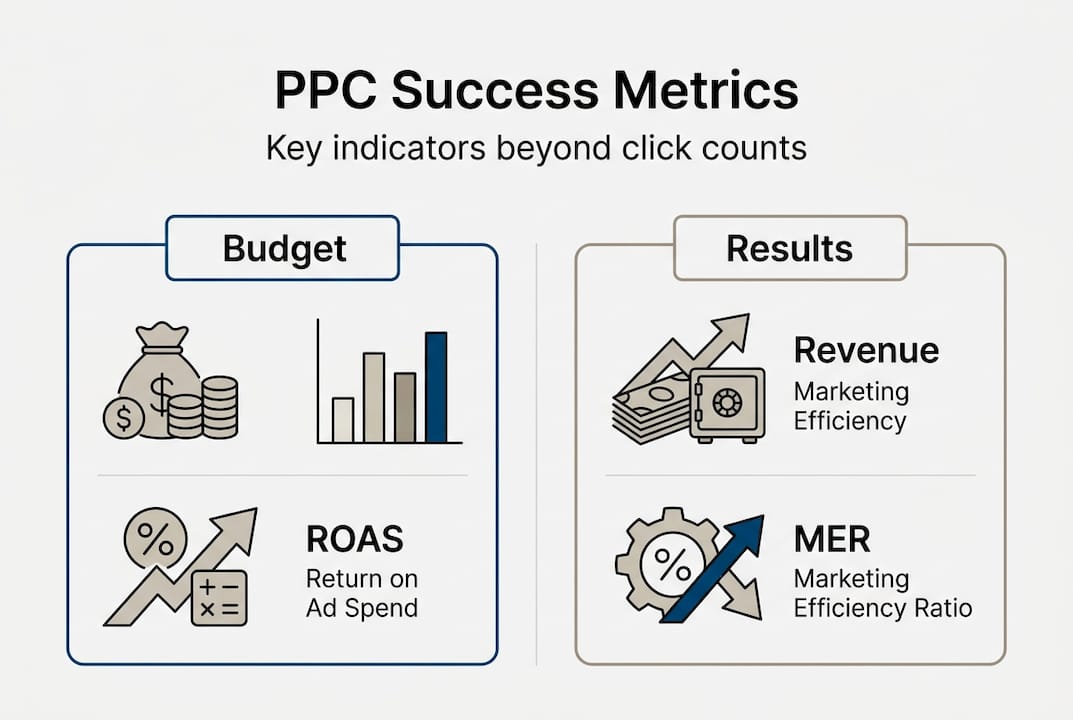
Marketing Efficiency Ratio (MER) provides a broader view by comparing total revenue to total marketing spend across all channels. If you spend $2,000 on PPC, $1,000 on SEO, and $500 on social media while generating $21,000 in revenue, your MER is 6:1. This metric prevents the mistake of optimizing PPC in isolation while ignoring how channels work together.
| Budget level | Monthly spend | Expected outcomes | Best for |
|---|---|---|---|
| Starter | $500-$1,000 | 30-60 qualified clicks, 3-8 conversions | Testing viability, very local focus |
| Growth | $1,000-$3,000 | 100-250 clicks, 10-25 conversions | Established local businesses scaling up |
| Competitive | $3,000-$7,000 | 300-600 clicks, 30-60 conversions | Multi-location or high-value services |
| Dominant | $7,000+ | 700+ clicks, 70+ conversions | Market leaders, premium services |
Tracking multiple metrics guides smarter budget decisions:
- Conversion rate by campaign and ad group to identify top performers worth increased investment
- Cost per acquisition (CPA) compared to customer lifetime value to ensure profitability
- Impression share to understand how often you're missing opportunities due to budget constraints
- Quality Score by keyword to find underperformers dragging down account efficiency
- Attribution across touchpoints to see how PPC assists conversions credited to other channels
Set realistic expectations based on your market position. New businesses competing against established players need 90-120 days of consistent spending to gather enough data for meaningful optimization. Expect initial ROAS around 2:1, improving to 4:1 or better as you refine targeting, messaging, and landing pages.
Learn advanced techniques in our AI PPC lead generation guide to maximize returns from every dollar invested.
Integrating PPC with SEO and AI for optimized local search visibility
The synergy between PPC and SEO creates a visibility multiplier effect that neither channel achieves alone. When you run PPC campaigns, you get immediate data on which keywords drive conversions, what ad copy resonates, and which landing pages perform best. Feed these insights into your SEO strategy to prioritize content creation and on-page optimization around proven winners.
AI tools analyze search patterns across both paid and organic channels, identifying opportunities human analysts might miss. Machine learning algorithms spot correlations between keyword combinations, user demographics, and conversion likelihood, then recommend bid adjustments and content topics. The hybrid approach reduces overall customer acquisition costs by 15-35% compared to running channels independently.
Local search requires specific coordination between PPC and SEO efforts. Your Google Business Profile optimization, local citation building, and review generation all improve organic local pack rankings. Simultaneously, location extensions and local inventory ads in PPC campaigns drive immediate visibility. Together, they dominate the local search results page with both paid and organic listings.
| Strategy element | PPC approach | SEO approach | Combined benefit |
|---|---|---|---|
| Keyword research | Test 50-100 keywords quickly with small budgets | Focus on 10-20 high-priority terms for content | Paid data reveals which organic targets matter most |
| Conversion optimization | A/B test headlines, CTAs, page layouts weekly | Implement winning variations sitewide | Faster improvement cycles, higher overall conversion rates |
| Competitive intelligence | Monitor competitor ad copy and bidding patterns | Analyze their backlink profiles and content gaps | Complete picture of competitor strategy and weaknesses |
| Seasonal planning | Adjust bids and budgets for peak demand periods | Publish seasonal content 60-90 days early | Capture demand through both immediate ads and organic rankings |
Follow this stepwise approach to coordinate PPC and SEO for maximum local visibility:
- Launch PPC campaigns targeting your top 20-30 keywords to generate immediate data on performance and conversion rates.
- Analyze which keywords and ad copy variations produce the lowest cost per conversion after 30 days of testing.
- Create SEO-optimized content targeting your three best-performing PPC keywords, using winning ad copy insights for headlines and meta descriptions.
- Build location-specific landing pages for each service area, supporting both organic rankings and PPC Quality Scores.
- Monitor organic ranking improvements for targeted keywords, gradually reducing PPC spend on terms where you achieve top-three organic positions.
- Reinvest PPC budget savings into new keyword expansion or competitive terms where organic ranking remains difficult.
Optimize your local search presence and explore AI-powered PPC tactics to implement these integrated strategies effectively.
Boost your local visibility with expert PPC and geo-fencing services
Implementing the strategies outlined above requires expertise, time, and ongoing optimization that most SMB owners struggle to maintain while running their businesses. Digital Marketing All specializes in PPC management tailored specifically for small and medium businesses looking to maximize local visibility without wasting budget on unqualified clicks.
Our geo-fencing services take local targeting to the next level, allowing you to reach customers within specific geographic boundaries around your business, competitor locations, or relevant events. Combined with AI-powered bid management and conversion tracking, we help you achieve ROAS targets while building long-term organic visibility through integrated SEO strategies.
Partner with us to develop a customized PPC and SEO plan aligned with your budget and growth goals. Our geo-fencing solutions deliver precisely targeted local advertising that turns nearby searchers into customers.
Frequently asked questions
How does PPC improve online visibility for small businesses?
PPC places your ads at the top of search results instantly, giving you visibility that organic SEO takes months to build. It also generates data on high-converting keywords you can use to optimize your organic strategy, creating a compounding visibility effect across both paid and organic channels.
What should SMBs budget for effective PPC campaigns?
Most successful local SMBs invest $1,000-$3,000 monthly in PPC, though exact amounts depend on industry competition and customer value. Start with a modest budget to test keyword performance, then scale spending on campaigns delivering 3:1 or better ROAS.
Can PPC and SEO work together to reduce costs?
Absolutely. Use PPC to quickly identify which keywords convert, then create SEO content targeting those same terms. This hybrid approach reduces overall customer acquisition costs by 15-35% compared to running channels separately, since you optimize organic efforts based on proven paid performance data.
What metrics matter most for measuring PPC success?
Track ROAS (revenue divided by ad spend) and MER (total revenue divided by total marketing spend) rather than just clicks or impressions. Also monitor conversion rate, cost per acquisition, and Quality Score to identify optimization opportunities that improve profitability over time.
How much management do PPC campaigns require?
Effective PPC demands weekly attention for search term review, negative keyword additions, bid adjustments, and ad copy testing. Most SMBs either dedicate 5-8 hours weekly to campaign management or partner with specialists who provide ongoing optimization and strategic guidance.
Recommended
- 7 Local PPC Tips: Maximize ROI for Small Business Ads
- Local Business Growth: PPC, AI Strategies & Search Price Optimization
- PPC Advertising Guide: AI Strategies & Local Lead Generation | Digital Marketing All
- Master AI-Driven PPC: 6 Steps to High-Quality Leads & ROI
- Τι Είναι το CPC – Κόστος και Απόδοση στις Διαφημίσεις - maverix.gr