

Perplexity retrieves live sources before it writes a single word, then returns answers annotated with numbered, clickable citations tied to those retrieved results. That transparency is real and useful, but the citations themselves aren't a verification stamp. Independent audits have flagged meaningful error rates, so treat every numbered marker as a starting point for your own check, not a finished fact.
TL;DR:
- Perplexity prioritizes recency and clear answer structure, so pages updated recently and with snapshot answers are more likely to be cited.
- Citations link to individual snippets, but around 27% of them do not actually support the claimed information, requiring independent verification.
- Source labels such as Government or Academic improve initial confidence but do not guarantee correctness, making cross-checking essential for critical use cases.
- Cited URLs should always be validated directly through the source page, as snippets can be misleading and citations are sometimes misattributed or fabricated.
- Developers should manage citation streams carefully, validate URLs with HEAD requests, and avoid trusting model-generated links to ensure sources are accurate and reliable.
Table of Contents
- How Does Perplexity Generate Citations?
- What Do Perplexity's Numbered Citations and Source Labels Mean?
- What Makes a Page More Likely to Get Cited?
- Where Do Perplexity Citations Go Wrong?
- How Should Developers Map Citation Markers to URLs?
- Transparency Shifts the Work, It Doesn't Remove It
- Where to Read More on Perplexity's Citation Mechanics
- Sources
- FAQ
How Does Perplexity Generate Citations?
Perplexity works differently from a standard chatbot because it searches before it writes. This is a retrieval-first architecture: the system runs a live web search across its index and partner sources, pulls back a batch of candidate documents, and only then asks the language model to draft an answer. The model doesn't answer from memory. It answers from what it just read.
That process happens in stages:
- Retrieval: Perplexity queries the web in real time and collects a pool of candidate pages relevant to your question.
- Ranking: A multi-stage filter narrows that pool by relevance, freshness, content structure, and the domain's topical authority.
- Synthesis: The model drafts a response using only the retrieved excerpts, inserting numbered markers like
[1]that map directly to specific search result entries. - Preset variation: Faster modes tend to cite fewer sources with simple
[1]style markers, while deep research or Pro Search presets can run multiple retrieval rounds and return larger citation sets, sometimes using different marker formats.
The practical takeaway for anyone publishing content: you can't be cited if you were never retrieved. Discoverability, not just accuracy, is the entry ticket. If your page never surfaces in Perplexity's initial candidate pool, it never gets a chance to earn a citation slot, no matter how well it answers the question.
What Do Perplexity's Numbered Citations and Source Labels Mean?
Each numbered marker in a Perplexity answer isn't decorative. It links to a specific search_result entry that includes a title, a short snippet, a URL, and often a publication date. Click the number, and you jump straight to a source card carrying that metadata, so you can size up a claim before you ever leave the page.
Perplexity also applies something separate from those per-answer citations: site-wide source labels such as Government, Academic, or Trusted. These labels attach to entire domains, not individual pages, and they're assigned through a centralized review process rather than generated on the fly for each query.
Quick rule of thumb: a citation with a recent date, a clear excerpt, and a recognized source label deserves more initial confidence than one lacking all three. But "more confidence" isn't the same as "verified." Even a Government-labeled domain can be cited for a sentence it doesn't actually support, which is exactly the kind of error covered in the verification section below.
A few things worth remembering about what you're looking at:
- Numbered markers map to individual search results, not to the domain's overall reputation.
- Source labels are domain-level signals, so a labeled site's older or lower-quality page still carries the same badge.
- Snippets shown in source cards are excerpts, not full context, so a snippet can look supportive while the underlying page argues something different.
What Makes a Page More Likely to Get Cited?
Perplexity doesn't cite pages at random, and the pattern is fairly observable if you pay attention to what tends to show up in Perplexity's answers. Recency matters heavily for anything time-sensitive. A page updated last month usually beats a page last touched three years ago, even if the older page is more thorough.
Structure matters just as much as freshness. Sources that state the direct answer in the first 100 words get extracted and cited more often than sources that bury the point under three paragraphs of scene setting. Clean headings, lists, tables, and schema markup all make it easier for Perplexity's ranking stage to pull a clean, quotable excerpt.
Other signals that shape whether your page makes the cut:
- BLUF structure: answering the core question early, before background or caveats.
- Schema markup: structured data that helps automated systems parse what a page is actually claiming.
- Topical corroboration: being backed up by other independent domains saying something similar, which often outweighs a single high domain rating on its own.
- Domain diversity enforcement: Perplexity tends to spread citations across multiple domains rather than stacking several from one site.
Pro Tip: Don't try to own an entire broad topic. Perplexity's domain diversity behavior means a narrow, well-structured page on one specific angle often wins a citation slot over a sprawling page trying to cover everything.
Where Do Perplexity Citations Go Wrong?
Two failure modes show up repeatedly, and they're not the same problem. Misattribution happens when the underlying claim is correct but the citation attached to it doesn't actually contain that information. Fabrication is more serious: the claim isn't supported by any of the cited sources at all, meaning it slipped through from the model's own synthesis rather than the retrieved text.
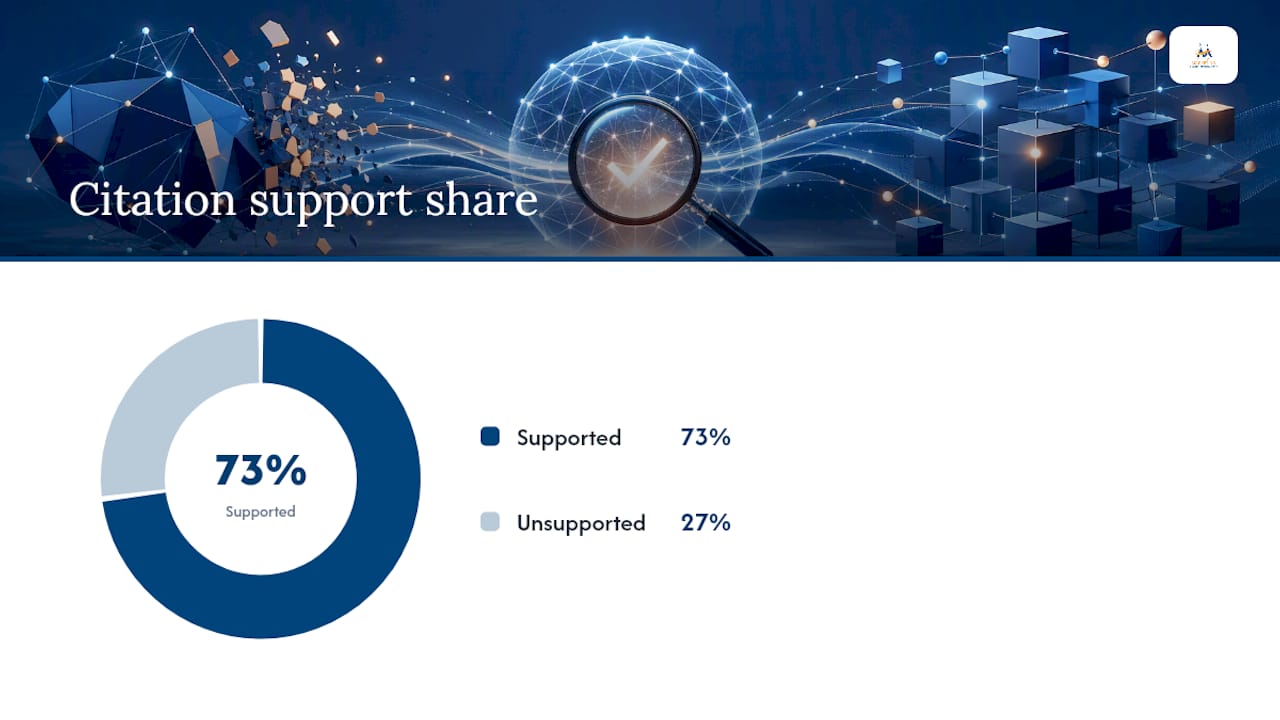
These aren't rare edge cases. An audit of 1,450 queries found that roughly 27% of citations didn't actually support the sentence they were attached to, a meaningful gap between what looks sourced and what's actually verified.
A practical verification checklist:
- Open the cited URL directly rather than trusting the snippet shown in the source card.
- Locate the exact sentence or data point the citation is supposed to support.
- Check the publication date and trace back to the primary source if the cited page is itself summarizing another report.
- Note the original citation's own sourcing, in case the page you're checking is several steps removed from the actual data.
Watch for warning signs: the same domain cited repeatedly across unrelated claims, snippets that read like a loose paraphrase rather than a direct match, or streamed responses where a numbered marker never resolves to an id. If you're using Perplexity for academic or legal work, always trace claims back to primary sources and disclose AI assistance according to your publisher's or institution's own rules.
How Should Developers Map Citation Markers to URLs?
Building on Perplexity's API means handling a stream, not a single finished response. Search_results events arrive first, carrying ids, titles, snippets, and URLs. Content chunks with inline markers like [1] follow, and each marker corresponds to one of those ids.
A few implementation practices matter more than they might seem:
- Collect and append every search_results batch as it arrives instead of overwriting the previous one, since multi-round retrieval can send several batches before the response finishes.
- Validate every citation URL with a HEAD request and a reasonable timeout before rendering it as a live link.
- Show a graceful fallback, not a broken link, when a marker's id has no matching search_result.
- Never construct or trust a model-generated URL. Pull every link straight from the search_results payload.
Pro Tip: If your app shows a citation number with no working link behind it, that's almost always a batch that got overwritten rather than appended. Check your collection logic before assuming the API dropped data.
Transparency Shifts the Work, It Doesn't Remove It
Perplexity's biggest contribution to AI search isn't accuracy. It's visibility. Showing its sources rebalances responsibility: the platform does the retrieval and shows its work, but the reading and judgment still fall on you.
I treat Perplexity as a triage tool for fast research, a way to surface candidate sources quickly, not as a finished answer. For anything consequential, a decision that affects money, health, or a published claim, I read the primary source myself before repeating it.
For publishers and brands, this cuts the other way. If Perplexity rewards recency, clear structure, and answer-first framing, then earning citations is a discoverability problem as much as a content-quality one. A page written to be understood by both people and retrieval systems, as covered in guidance on zero-click optimization, has a real shot at that visibility. A page that buries its answer under throat-clearing doesn't.
— Diane O'Brien
Where to Read More on Perplexity's Citation Mechanics
Start with Perplexity's own explanations of how retrieval and citation work and the streaming citation documentation for developers building on the API. For a look at where the system falls short, the CiteOwl audit of 1,450 queries breaks down measured citation-precision issues in detail. If you want to preview how your own page's title and description might appear in retrieval results, SERP Snippet Preview is a useful free check.
If you'd rather have someone structure your content specifically to earn AI citations and stronger local visibility, Digital Marketing All's local SEO and AI visibility services build pages around exactly the signals covered above, freshness, clear answer structure, and topical authority.
Sources
- Streaming citation parsing — Perplexity docs (Cookbook)
- How does Perplexity work — Perplexity Help Center
- Does Perplexity make up citations? 1,450 queries audited — CiteOwl blog
FAQ
Why Is Perplexity Controversial?
Perplexity has faced criticism over how it retrieves and summarizes content from publishers, including legal disputes about whether its scraping and summarization practices respect publisher rights and licensing terms, an issue distinct from its citation accuracy.
Why Do People Say Perplexity Is Failing on Accuracy?
Critics point to documented citation errors, including audits showing roughly 27% of citations failed to support the sentence they were attached to, which undercuts trust even when the retrieval-first design is sound in principle.
Is Perplexity a Good Source of Information?
Perplexity is a strong starting point for research because it shows numbered, clickable citations tied to retrieved sources, but it isn't a finished source on its own. Verify important claims against the primary source before relying on them.
Does Perplexity AI Track You?
Perplexity, like most search and AI platforms, collects usage data to operate and improve its product; specific tracking practices and opt-out options are detailed in its own privacy policy rather than in its citation mechanics.
How Are Perplexity's Source Labels Different From Citations?
Citations are numbered, per-answer links to specific retrieved pages, while source labels like Government or Academic are site-wide badges applied to entire domains through a separate review process.