

TL;DR:
- Local search dominance relies on relevance, distance, and prominence signals evaluated by Google.
- Building a strong foundation with consistent NAP data and citation audits is essential.
- Ongoing optimization of GBP, reviews, and content, supplemented by AI strategies, enhances visibility.
Picture this: a potential customer searches for your exact service, right in your neighborhood. Your competitor shows up first, gets the call, and wins the job. You never even knew the opportunity existed. This scenario plays out thousands of times daily for local businesses without a clear local search dominance process in place. The good news is that Google's local ranking system follows predictable rules, and businesses that learn to work those rules consistently win more visibility, more clicks, and more customers. This guide breaks down every step, from building your foundation to using AI, so you can stop guessing and start growing.
Table of Contents
- Understand the local search dominance framework
- Prepare your foundation: Audit and optimize essentials
- Execute winning actions: GBP, local content, and reviews
- Amplify results with AI and advanced strategies
- Track, troubleshoot, and verify progress
- A real-world perspective: What most guides miss about local search dominance
- Ready to dominate your local market? Next steps
- Frequently asked questions
Key Takeaways
| Point | Details |
|---|---|
| Three pillars matter most | Relevance, distance, and prominence form the foundation of local search rankings. |
| GBP & reviews drive quick wins | Optimizing your Google Business Profile and building reviews yield the fastest visibility boosts. |
| AI and advanced tactics amplify growth | Leveraging AI, local content, and structured data sets your business apart and boosts long-term results. |
| Consistent tracking avoids pitfalls | Regular monitoring helps catch errors and capitalize on what's working for continuous dominance. |
Understand the local search dominance framework
Now that you understand the business risk, let's define exactly what drives dominance in local search. Google evaluates local businesses using three core pillars, and every tactic you apply ties back to at least one of them.
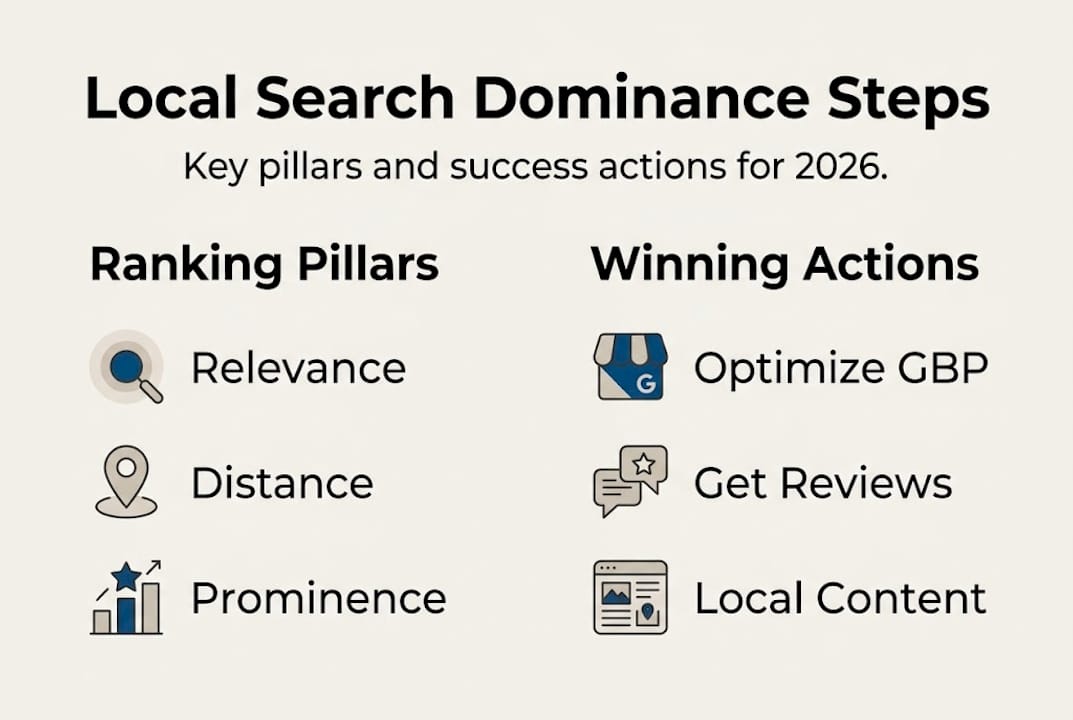
According to Google's ranking pillars, the local search dominance process centers on Relevance, Distance, and Prominence. Here's what each one means for your business:
- Relevance: How well your profile and content match what the searcher needs. This includes your business category, the keywords in your Google Business Profile (GBP), and the services you list.
- Distance: How close your business is to the searcher. You can't control your address, but you can expand your service area reach through smart content and citations.
- Prominence: How well-known and trusted your business appears online. Reviews, backlinks, and consistent mentions across the web all feed this signal.
These pillars work together. A business strong in all three consistently appears in the local Map Pack, the top three results shown on Google Maps. That placement matters because Map Pack results capture 45 to 50% of all local clicks. Missing that box means missing nearly half your potential traffic.
| Ranking Pillar | Key Signals | Your Control Level |
|---|---|---|
| Relevance | Categories, keywords, services listed | High |
| Distance | Physical location, service area | Low to Medium |
| Prominence | Reviews, citations, backlinks, GBP activity | High |
AI and behavioral data are also shaping results fast. Google now factors in how users interact with your listing, whether they click, call, or request directions. Building a profile people actually engage with is no longer optional.
Prepare your foundation: Audit and optimize essentials
To build real-world dominance, start by solidifying the details that Google and customers trust most. Weak foundations mean wasted effort on advanced tactics.

Your Name, Address, and Phone number (NAP) must be identical everywhere your business appears online. Even small variations, like "St." versus "Street," confuse Google and erode trust. A solid comprehensive local SEO foundation requires you to audit citations and NAP first, then build reviews and content, and monitor results consistently while avoiding shortcuts.
Here is how to prepare your foundation step by step:
- Run a citation audit. Search your business name across Google, Yelp, Facebook, Bing Places, and at least ten industry directories. Note every inconsistency.
- Correct all NAP errors. Update listings one by one or use a citation management platform. Consistency is the goal.
- Review your GBP completeness. Check that you have selected the right primary category, added all relevant secondary categories, listed your hours accurately, and uploaded recent photos.
- Fill in your services and description. Use natural language that includes the keywords your customers actually search for.
- Remove duplicate listings. Duplicate GBP entries split your authority and confuse searchers. Merge or remove them.
For deeper guidance on getting this right, review these GBP optimization steps and pair them with strong citation management tips to keep your data clean over time.
Pro Tip: Use a citation tracking tool like BrightLocal or Whitespark to automate updates across directories. Manual correction works, but automation saves hours and catches listings you would otherwise miss.
Execute winning actions: GBP, local content, and reviews
With your foundational data solid, it's time to take action with the three essential engines of local ranking. These are not one-time fixes. They require consistent effort, and that consistency is exactly what separates businesses that dominate from those that drift.
Optimizing your GBP on an ongoing basis is the highest-impact single action you can take. Key mechanics include GBP optimization covering categories, photos, posts, hours, and consistent NAP citations, along with review management, local content clusters, schema markup, and behavioral signals. Post weekly updates, add new photos monthly, and respond to every question in the Q&A section.
Follow these steps for your content and review engines:
- Build geo-focused content. Create service pages and blog posts that target your city or neighborhood combined with your core service. "Roof repair in Austin" beats generic "roof repair" every time.
- Automate review requests. Send a follow-up message or email within 24 hours of completing a job. Make it easy by including a direct link to your Google review page.
- Respond to every review. Thank positive reviewers by name when possible. Address negative reviews calmly and professionally. This signals active management to Google.
- Add photos consistently. Businesses with regular photo uploads see stronger engagement, which feeds behavioral signals.
Pro Tip: Use a short review request script: "Hi [Name], thank you for choosing us. If you have a moment, we would love your feedback on Google. Here is the link: [your review link]. It really helps our local neighbors find us."
Businesses ranking in the local Map Pack average 250-plus reviews, and regular reply activity directly boosts trust signals in Google's algorithm.
For a detailed breakdown, follow this GBP optimization guide and explore additional GBP and reputation steps to strengthen your approach. Use this GBP optimization checklist to make sure nothing gets skipped.
Amplify results with AI and advanced strategies
Execution produces fast wins, but ongoing dominance means leveling up with AI and strategic refinements. Local search is evolving rapidly, and AI is now at the center of how Google interprets and ranks local content.
AI-driven strategies include semantic content for Generative Engine Optimization (GEO), entity authority built through structured data, review sentiment analysis, and hyperlocal personalization. These are not distant future concepts. They apply to your business right now.
Here's how to put AI and advanced tactics to work:
- Use AI writing tools to generate neighborhood-specific content, FAQs, and service descriptions that match how local customers phrase their searches.
- Add schema markup to your website. LocalBusiness schema tells Google exactly what you do, where you operate, and how to categorize you. This boosts entity authority.
- Analyze review sentiment with AI tools to spot recurring complaints or praise patterns. Fix what customers dislike and amplify what they love in your marketing.
- Manage multi-location complexity. If you serve multiple areas, create dedicated geo-layered pages for each location to avoid keyword cannibalization.
- Address spam competition. If fake competitors appear above you in results, use Google's Business Redressal form to report them.
For edge case handling like service area businesses, hide your physical address in GBP if you work from home. Set your service area by city or zip code instead.
Pro Tip: AI-driven personalization tools monitor behavioral signals like click patterns and dwell time. Use these insights to refine your landing pages and profile content regularly. Also explore these proven search optimization tactics for a broader strategy view. For deeper context, check these AI-driven local SEO tactics from industry experts.
Track, troubleshoot, and verify progress
The final piece is knowing your hard work is actually boosting visibility and business growth, and learning how to fine-tune when something is not working.
Results take time. Empirical benchmarks show most businesses see meaningful improvements within 3 to 6 months, with Map Pack clicks accounting for 45 to 50% of local traffic and successful campaigns delivering 150 to 347% lead growth and ranking expansions of 247 to 1,700%.
Follow this tracking process:
- Set up rank tracking. Use tools like BrightLocal, Local Falcon, or Whitespark to track where you appear in the Map Pack across different neighborhoods.
- Monitor GBP Insights. Track calls, direction requests, website clicks, and photo views monthly. Drops in any metric signal a problem to investigate.
- Audit citations quarterly. New incorrect listings appear over time. Make citation audits a recurring habit.
- Watch review velocity. A sudden drop in new reviews can hurt prominence. Reactivate your review request process if the pace slows.
- Check for algorithm updates. Google updates its local algorithm multiple times per year. Subscribe to industry news sources to stay ahead.
| Metric | Healthy Benchmark | Warning Sign |
|---|---|---|
| Map Pack ranking | Top 3 in primary city | Dropping below position 5 |
| Monthly reviews | 4 to 8 new reviews | Zero new reviews for 30+ days |
| GBP photo views | Growing month over month | Flat or declining |
| Citation accuracy | 95%+ consistent | Multiple NAP mismatches found |
For context on recent changes that affect your tracking, review the latest GBP update tips and study local SEO growth results from real businesses that followed this process.
A real-world perspective: What most guides miss about local search dominance
With tools and checklists in hand, here is the harder truth: following frameworks alone is not enough. We see this repeatedly with businesses that complete every technical step but still stall in rankings.
The reason? Behavioral signals cannot be faked, and hyperlocal content architecture matters as much as the content itself. When real customers engage with your profile, click, call, and leave reviews, Google recognizes that as genuine authority. A perfectly filled-out GBP with no activity will always lose to a slightly imperfect profile with real, consistent community signals.
Google's control over local results raises real concerns about manipulation risk, but authentic prominence consistently wins over time. Brand searches, meaning people specifically searching your business name, amplify every other ranking signal you build.
The businesses that sustain top positions are not just optimized. They are trusted. Build real relationships with customers, earn reviews through genuine service, and post content that actually helps your community. These are the signals that no algorithm update can take away. Explore more real-world local search strategies to put this perspective into practice.
Ready to dominate your local market? Next steps
No matter where you are on your local search journey, specialized help can amplify your results. Applying this entire process takes time, expertise, and the right tools. That's exactly where Digital Marketing All comes in.

Our team helps local businesses get more reviews through automated, proven systems that keep your reputation growing month after month. If you want search visibility you can count on, our SEO results guarantee means you only pay for real, measurable outcomes. And if pricing strategy is your next step, explore how we optimize search pricing to maximize your return from every search click. Let's build the local presence your business deserves.
Frequently asked questions
How long does local search dominance take to achieve?
Most businesses see measurable improvements within 3 to 6 months after following the full local search dominance process consistently.
Which local search ranking factor matters most for fast wins?
Optimizing your Google Business Profile and actively generating reviews deliver the quickest ranking boosts according to local SEO best practices.
What is the impact of reviews on local search results?
Businesses in the top Map Pack positions average over 250 reviews, with both volume and recency contributing directly to local visibility.
How does AI improve local search rankings?
AI enhances rankings through hyperlocal content creation, review sentiment analysis, and entity authority optimization that aligns your business with how modern search engines interpret relevance.
Recommended
- Rank #1 on Google Maps 2026: The Step-by-Step Local SEO Guide
- Unlock Google Domination: 15 Action-Fueled SEO Content Writing Tips for 2025
- SEO Small Business | Dominate Local Search Results
- Local Search Ranking Factors 2026: Boost Your Visibility | Digital Marketing All
- How to Run a 2026 SEO Audit: Step-by-step to Uncover Growth for UK Businesses - Gregg King SEO