

Most local business owners assume that simply having their business listed on Google, Yelp, and a few directories guarantees better visibility. The reality is far more nuanced. Inconsistent or duplicate local listings can actually confuse search engines, split your ranking signals, and reduce your local search prominence. Understanding what local listings are, why accuracy matters, and how to optimize them for AI-driven search results can transform your local visibility and drive more customers through your door. This guide breaks down everything you need to know about local listings and how to leverage them effectively.
Table of Contents
- Key takeaways
- What are local listings and why do they matter?
- Common challenges with local listings and how to fix them
- How to optimize local listings for maximum local search impact
- Advanced tips for sustaining powerful local listing presence
- Elevate your local business with expert listing services
- FAQ
Key Takeaways
| Point | Details |
|---|---|
| NAP consistency boosts rankings | Having the same name, address, and phone number everywhere strengthens search signals and improves local rankings. |
| Duplicate listings hurt visibility | Duplicate listings split reviews and ranking signals, reducing visibility and trust. |
| NAP audits and master document | Regular audits and a master NAP document help maintain listing accuracy across all platforms. |
| Optimized listings boost traffic | Optimizing local listings improves visibility and drives more walk in customers and online traffic. |
What are local listings and why do they matter?
Local listings are business entries that appear across online directories, search engines, maps, and mobile apps. They display your business name, address, phone number, hours, and other essential information that help customers find and contact you. These entries form the backbone of your local online presence, serving as digital signposts that guide potential customers to your physical location or website.
Local listings directly impact your search rankings through three core factors: relevance, proximity, and prominence. Search engines evaluate how well your business matches a user's query, how close you are to the searcher, and how well-known your business appears based on listing consistency and reviews. When your NAP information is consistent across platforms, search algorithms can confidently associate all your business data together, strengthening your ranking signals. Inconsistent NAP details confuse AI algorithms and split ranking signals, making it harder for search engines to determine which information is correct.
AI-driven local search increasingly relies on structured data from your listings to deliver accurate results. Voice assistants and AI recommendation engines pull information directly from local listings to answer queries like "best pizza near me" or "plumber open now." Your listing accuracy determines whether AI systems recommend your business or skip over you entirely. This makes maintaining precise, consistent listings more critical than ever for local SEO strategies and AI tips.
Your listing presence also influences Google's Local Pack visibility, the prominent three-business display that appears at the top of local search results. Businesses with complete, accurate listings have substantially higher chances of appearing in this coveted position. Voice search outcomes depend heavily on listing data quality, as virtual assistants prioritize businesses with verified, consistent information across platforms.
Key benefits of local listings include:
- Improved visibility in local search results and map displays
- Increased foot traffic from customers finding accurate business information
- Better review aggregation across platforms, building social proof
- Enhanced credibility through consistent, professional business information
- Higher conversion rates from customers who can easily contact or visit you
Building a strong foundation with local SEO citations ensures search engines view your business as legitimate and trustworthy, directly impacting how often you appear in local search results.
Common challenges with local listings and how to fix them
Duplicate listings represent one of the most damaging issues for local businesses. When multiple entries exist for the same business, customer reviews get split across different listings, diluting your social proof and confusing potential customers about which profile is legitimate. Your ranking signals also fragment, as search engines struggle to determine which listing contains the authoritative information. This fragmentation reduces trust signals and can push you out of the Local Pack entirely.

Inconsistent formatting creates similar problems. Using "St" on one platform and "Street" on another, or listing different phone numbers across directories, sends conflicting signals to search algorithms. These inconsistencies erode your entity signals, the data points that help search engines understand your business as a single, unified entity. Outdated information, such as old addresses or disconnected phone numbers, further damages trust and sends customers to the wrong location or dead ends.
Google's systems automatically attempt to merge or suppress duplicate listings, but this process is imperfect and often produces unexpected results. The algorithm might choose the wrong listing as the primary one, or suppress a listing you've carefully optimized. Relying solely on automatic merging leaves too much to chance and can result in lost visibility during critical business periods.
Manual fixes provide the most reliable solution. Start by conducting a complete audit of all your listings across major platforms like Google Business Profile, Bing Places, Apple Maps, Yelp, Facebook, and industry-specific directories. Document every variation you find, noting differences in formatting, phone numbers, or addresses. Create a master NAP document that serves as your single source of truth, specifying exactly how your business name, address, and phone number should appear everywhere.
Once you've identified duplicates, submit merge requests through each platform's support system. For Google Business Profile, use the "Report a problem" feature to flag duplicates and request consolidation. Most platforms have similar processes, though response times vary. While waiting for merges, update all controllable listings to match your master NAP document exactly.
Common pitfalls with local listings include:
- Using abbreviations inconsistently (Ave vs Avenue, LLC vs L.L.C.)
- Listing old phone numbers that forward to current numbers
- Including multiple addresses for businesses with several locations without proper differentiation
- Forgetting to update listings after relocations or rebranding
- Allowing unauthorized users to create or edit listings
Pro Tip: Use tools like BrightLocal or Whitespark to routinely audit your listings and identify duplicates before they damage your rankings. Suppressing duplicates before building new citations prevents future conflicts and maintains clean ranking signals. Regular quarterly audits catch problems early, before they significantly impact your business voice listings and local visibility.
Addressing local SEO citation management proactively saves time and protects your hard-earned local search rankings from unnecessary erosion.
How to optimize local listings for maximum local search impact
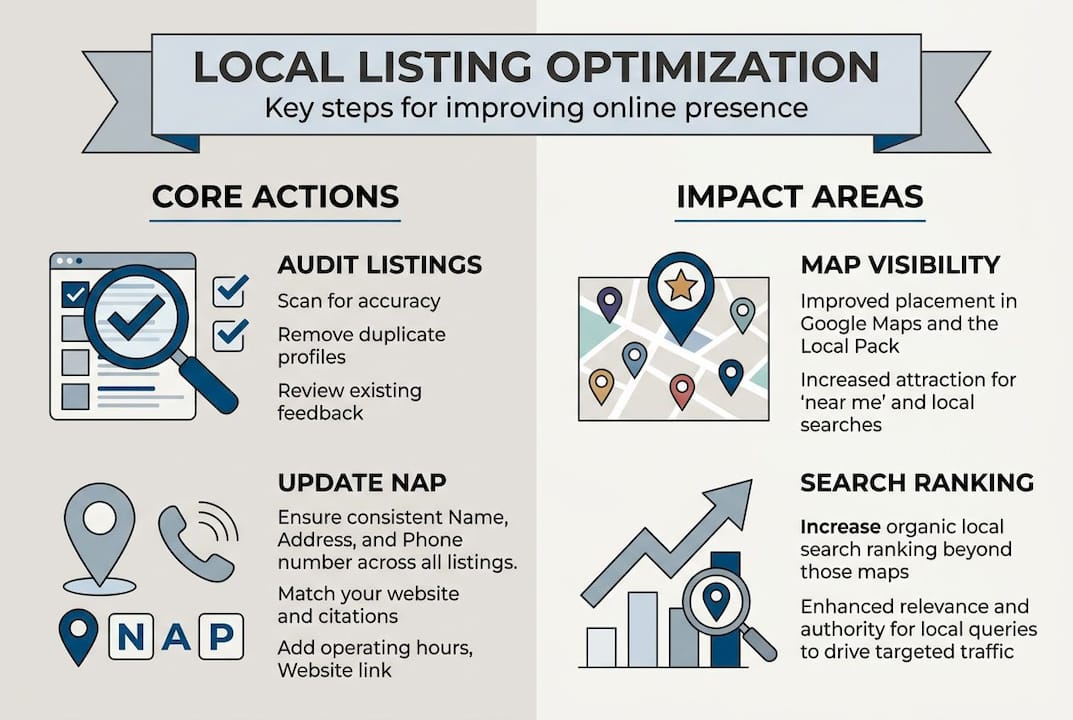
Optimizing your local listings requires a systematic approach that addresses accuracy, completeness, and ongoing maintenance. Follow this step-by-step process to maximize your local search impact:
- Audit all existing listings across major platforms and directories to identify inconsistencies, duplicates, and incomplete information
- Create and maintain a master NAP document specifying exact formatting for your business name, full address, and primary phone number
- Correct duplicate listings by submitting merge requests and updating controllable entries to match your master document
- Consistently use your exact business information across all platforms, avoiding any variations in spelling, punctuation, or formatting
- Add rich content including high-quality photos of your location, products, and team, complete business hours with holiday schedules, and detailed service descriptions
- Encourage satisfied customers to leave reviews on your primary listings and respond professionally to all reviews, both positive and negative
- Implement schema markup on your website to help AI and search engines understand your business information and connect it to your listings
Businesses that maintain accurate NAP information see higher Map Pack visibility, with meta-analysis showing significant effect sizes on both traffic and rankings. Case studies demonstrate that comprehensive listing optimization can produce a 40% increase in walk-ins and up to 300% boost in website traffic within three to six months.
| Metric | Before Optimization | After Optimization | Improvement |
|---|---|---|---|
| Map Pack Appearances | 12/month | 47/month | +292% |
| Website Clicks from Listings | 89/month | 267/month | +200% |
| Phone Calls from Listings | 34/month | 58/month | +71% |
| Walk-in Customers (attributed) | 23/month | 32/month | +39% |
Pro Tip: Prioritize optimization on top directories and aggregators first to maximize impact before expanding to niche platforms. Focus on Google Business Profile, Bing Places, Apple Maps, and major data aggregators like Neustar Localeze and Factual. These platforms feed information to hundreds of smaller directories, multiplying your optimization efforts.
Optimized listings contribute significantly to AI-driven search algorithms understanding and featuring your business. Structured data from consistent listings helps AI systems build confidence in your business information, making them more likely to recommend you in voice search results and AI-powered recommendations. Complete listings with photos, hours, and descriptions provide the rich context AI needs to match your business with relevant user queries.
Implementing comprehensive local SEO strategies alongside listing optimization creates a powerful foundation for local search dominance. Understanding local search ranking factors 2026 helps you prioritize efforts that deliver the highest return on investment.
Maintaining excellence in local SEO citations optimization ensures your business remains competitive as search algorithms evolve and new platforms emerge.
Advanced tips for sustaining powerful local listing presence
Sustaining strong local listing performance requires ongoing maintenance and strategic use of technology. Establish a routine maintenance schedule with quarterly comprehensive audits and monthly spot checks of your top five listings. This cadence catches problems before they accumulate and impact rankings, while remaining manageable for small business owners or lean marketing teams.
| Approach | Effectiveness | Cost | Ease of Use | Best For |
|---|---|---|---|---|
| Manual Auditing | Moderate | Free | Low | Single-location businesses with limited budgets |
| Automated Tools | High | $50-300/month | High | Multi-location businesses or those prioritizing efficiency |
| Hybrid Approach | High | $20-100/month | Moderate | Most small to medium businesses seeking balance |
AI-powered tools streamline listing monitoring and optimization:
- Automated alerts notify you immediately when NAP information changes on major platforms
- Review management systems aggregate feedback across platforms and prompt timely responses
- Duplicate detection software continuously scans for new duplicate listings before they damage rankings
- Citation building platforms identify high-value directories and automate submission processes
- Competitive analysis tools show how your listing presence compares to local competitors
Pro Tip: Invest in creating a comprehensive master NAP document as your single source of truth and integrate it across all marketing materials, from business cards to email signatures. Train every team member who might communicate business information to reference this document, preventing well-intentioned staff from inadvertently creating inconsistencies.
Proactive strategies help you respond swiftly to new duplicates or inaccuracies. Set up Google Alerts for your business name combined with terms like "address" or "phone number" to catch unauthorized listings. Monitor your Google Business Profile insights weekly for unusual activity that might indicate duplicate listings drawing traffic away from your primary profile. Join local business forums and Facebook groups where members often share warnings about problematic directories or citation sources.
Leveraging AI voice search optimization through structured local data positions your business for the growing voice search market. Ensure your listings include natural language descriptions that match how people speak queries aloud. Add FAQ sections to your Google Business Profile that address common voice search patterns like "What time does [business] open?" or "Does [business] offer [service]?" This structured approach helps voice assistants pull accurate information directly from your listings.
Creating a 'Single Source of Truth' NAP document and auditing regularly via tools like BrightLocal or Whitespark, while suppressing duplicates before building new citations, represents industry best practice for 2026.
Strategically boosting business views with local listings requires both technical precision and ongoing commitment. Businesses that dominate AI and voice listings consistently invest in listing quality and leverage automation to maintain their competitive advantage.
Elevate your local business with expert listing services
Managing local listings effectively requires expertise, time, and the right tools. While this guide equips you with the knowledge to optimize your listings, partnering with specialists can accelerate results and free you to focus on running your business. Digital Marketing All offers comprehensive services designed specifically for local businesses seeking to dominate their markets.

Our review generation and management services help you build the social proof that amplifies your listing performance, turning satisfied customers into powerful advocates. We provide specialized Yelp help services to resolve profile issues, manage reviews, and optimize your presence on this critical platform. Our full-service website solutions complement your listings with conversion-focused designs that turn listing clicks into customers. We combine AI-powered strategies with proven local SEO tactics to position your business prominently in search results, AI recommendations, and voice search outcomes.
FAQ
What are local listings?
Local listings are online business entries that display your name, address, phone number, and other key information across directories, search engines, and apps. They serve as digital signposts helping customers discover and contact your business. Accurate listings improve your visibility in local search results and map displays.
Why is NAP consistency important for local SEO?
Consistent NAP information ensures search engines correctly associate your business across all platforms, strengthening your ranking signals. Inconsistent NAP confuses search engines, splitting signals and reducing your Local Pack visibility. Maintaining exact formatting across all listings builds the trust signals that improve rankings.
How do duplicate listings affect my business?
Duplicate listings split reviews and rankings, significantly lowering your SEO performance by fragmenting your ranking signals. Google may automatically merge or suppress duplicates, but these automated processes often produce unpredictable results. Conducting manual audits, creating a master NAP document, and submitting merge requests deliver more reliable outcomes.
Can AI-powered tools help manage local listings?
AI tools automate audits and provide alerts when listings become inconsistent or duplicates appear, saving substantial time while improving accuracy. Using a master NAP document with automated tools helps maintain listing accuracy across hundreds of platforms effortlessly. These tools enhance efficiency in local search optimization, allowing you to focus on serving customers rather than manually checking directories.
Recommended
- Get 2X to 5X More Views for Your Business with Local Listings
- The Ultimate Guide to Getting Found Online in Your Local Area
- 7 Local SEO Strategies & AI Tips to Boost Rankings | Digital Marketing All
- Local Search Ranking Factors 2026: Boost Your Visibility | Digital Marketing All
- Local Listings Optimisation for Boosting SME Visibility